What is the basic stainless steel plate weight formula?
Plate weight equals length times width times thickness times density: W = L x W x T x rho. Keep every dimension in the same unit system and the result is the mass of the plate.

The formula is just density applied to a rectangular solid. Volume is the product of the three dimensions, and multiplying by density converts that volume into mass. The only place people go wrong is mixing unit systems, so the rest of this guide is mostly about keeping the units consistent.
In words: a bigger plate is heavier, a thicker plate is heavier, and a denser alloy is heavier for the same size. A 316L plate and a 316L stainless plate of identical size weigh more than a duplex 2205 plate of the same size because 316L is denser (7.98 g/cm3) than duplex (7.80 g/cm3). The equation does not care what the metal is called; it only cares about its density.
Why does plate weight depend on material density rather than size alone?
Two plates with identical length, width and thickness can have very different weights because stainless, duplex and nickel alloys pack different amounts of mass into the same volume.
Density is mass per unit volume. Carbon steel is about 7.85 g/cm3, but the alloys JN Alloy supplies range from roughly 7.80 g/cm3 for duplex to 8.89 g/cm3 for Hastelloy C276 and nickel 200. That spread of about 14 percent means a C276 plate weighs around 14 percent more than a carbon steel plate of exactly the same size, even though both are 'steel'.
This matters for logistics and cost. Freight, crane rating, and even the number of plates per export crate are driven by mass, not by the millimetre dimensions on the drawing. Sizing a lift plan from a carbon-steel weight while the job actually uses Inconel 625 (8.44 g/cm3) understates the load by nearly 8 percent, which is a real safety margin.
What density value should you use for 304, 316L and other stainless grades?
Use the typical density published on the producer data sheet or the ASTM specification: about 7.93 g/cm3 for 304, 7.98 g/cm3 for 316L, 7.80 g/cm3 for duplex, and 8.44 to 8.89 g/cm3 for the nickel alloys.
Density is a physical constant of the alloy chemistry, so the right number is the one tied to the UNS grade, not a generic 'stainless' figure. The table below lists the values JN Alloy uses for quotation and is consistent with the major producer data sheets (Special Metals, Haynes, Carpenter, Outokumpu, Sandmeyer, Rolled Alloys). Individual heats vary by about plus or minus 1 percent, which is within the normal scatter of any weight estimate.
Typical density of stainless and nickel alloys (producer data-sheet values)
|
Grade (UNS) |
Family |
g/cm3 |
lb/in3 |
lb/ft3 |
|
304 / 304L (S30400) |
Austenitic |
7.93 |
0.2865 |
495.0 |
|
316 / 316L (S31603) |
Austenitic |
7.98 |
0.2883 |
498.2 |
|
310S (S31008) |
Austenitic |
7.90 |
0.2854 |
493.2 |
|
321 (S32100) |
Austenitic |
7.92 |
0.2862 |
494.4 |
|
347 (S34700) |
Austenitic |
7.98 |
0.2883 |
498.2 |
|
253MA (S30815) |
Austenitic |
7.80 |
0.2818 |
486.9 |
|
Duplex 2205 (S32205) |
Duplex |
7.80 |
0.2818 |
486.9 |
|
Super Duplex 2507 (S32750) |
Super duplex |
7.80 |
0.2818 |
486.9 |
|
904L (N08904) |
Super-austenitic |
7.95 |
0.2872 |
496.3 |
|
254 SMO (S31254) |
Super-austenitic |
8.00 |
0.2890 |
499.4 |
|
Alloy 20 (N08020) |
Fe-Ni-Cr |
8.08 |
0.2919 |
504.4 |
|
Alloy 31 (N08031) |
Fe-Ni-Cr-Mo |
8.10 |
0.2926 |
505.7 |
|
Incoloy 800H/HT (N08810/11) |
Fe-Ni-Cr |
7.94 |
0.2869 |
495.7 |
|
Incoloy 825 (N08825) |
Fe-Ni-Cr-Mo |
8.14 |
0.2941 |
508.2 |
|
Inconel 600 (N06600) |
Ni-Cr |
8.47 |
0.3061 |
528.8 |
|
Inconel 625 (N06625) |
Ni-Cr-Mo |
8.44 |
0.3050 |
526.9 |
|
Inconel 718 (N07718) |
Ni-Cr-Nb |
8.19 |
0.2958 |
511.3 |
|
Hastelloy C276 (N10276) |
Ni-Cr-Mo-W |
8.89 |
0.3212 |
555.0 |
|
Hastelloy C22 (N06022) |
Ni-Cr-Mo-W |
8.69 |
0.3140 |
542.5 |
|
Monel 400 (N04400) |
Ni-Cu |
8.83 |
0.3190 |
551.3 |
|
Nickel 200/201 (N02200/201) |
Nickel |
8.89 |
0.3212 |
555.0 |
These densities are the single most important input to the weight formula. When a buyer asks 'how much does a 904L stainless plate weigh', the answer starts with 7.95 g/cm3; the dimensions only come second.
How do you calculate plate weight in kilograms when your dimensions are in millimetres?
With millimetre dimensions the formula is W(kg) = L(mm) x W(mm) x T(mm) x rho(g/cm3) divided by 1,000,000.
A cubic millimetre holds 0.001 gram per gram-per-cubic-centimetre of density, because 1 cm3 is 1000 mm3 and 1 g/cm3 equals 1000 kg/m3. Carrying that through gives the very practical rule: divide the product of the three millimetre dimensions by one million, then multiply by the density in g/cm3.
Worked example: a 2000 mm x 1000 mm x 10 mm plate in 316L. Volume = 2000 x 1000 x 10 = 20,000,000 mm3. Weight = 20,000,000 / 1,000,000 x 7.98 = 20 x 7.98 = 159.6 kg. Check it the other way: 2.0 m x 1.0 m x 0.010 m = 0.020 m3, x 7980 kg/m3 = 159.6 kg. Both routes agree, which is the whole point of keeping units consistent.
Quick rule: in millimetres the 1,000,000 divisor is the only thing to remember. Forget it and your answer is off by a factor of a million.
What is the quick weight-per-square-metre rule for stainless plate?
For a plate one metre square, the weight in kg per square metre is simply the thickness in millimetres times the density in g/cm3: kg/m2 = T(mm) x rho.
This falls straight out of the millimetre formula: a 1 m x 1 m plate has L x W = 1,000,000 mm2, so the 1,000,000 divisor cancels and you are left with T(mm) x rho. It is the fastest way to sanity-check a quote or a crane load.
Weight per square metre of stainless plate by thickness and grade (kg/m2)
|
Thickness (mm) |
304 (7.93) |
316L (7.98) |
Duplex 2205 (7.80) |
Super Duplex 2507 (7.80) |
|
3 |
23.8 |
23.9 |
23.4 |
23.4 |
|
5 |
39.7 |
39.9 |
39.0 |
39.0 |
|
6 |
47.6 |
47.9 |
46.8 |
46.8 |
|
8 |
63.4 |
63.8 |
62.4 |
62.4 |
|
10 |
79.3 |
79.8 |
78.0 |
78.0 |
|
12 |
95.2 |
95.8 |
93.6 |
93.6 |
So 10 mm 316L plate is about 79.8 kg for every square metre. A 1.2 m x 2.4 m sheet is 2.88 m2, which at 79.8 kg/m2 is 229.8 kg - a number you can now compute in your head on the shop floor.
How do you convert the length x width x thickness x density formula to imperial units?
In imperial units use W(lb) = L(ft) x W(ft) x T(in) x rho(lb/ft3) / 12, or equivalently W(lb) = L(in) x W(in) x T(in) x rho(lb/in3).
The cleanest imperial form keeps length and width in feet and thickness in inches: the area in square feet times the thickness in inches divided by 12 gives volume in cubic feet, and multiplying by density in lb/ft3 gives pounds. Because 1 ft3 of 316L-class steel is about 498 lb, the per-inch thickness factor is roughly 41.5 lb/ft2 for 316L.
Example: a 4 ft x 8 ft x 0.375 in (3/8 in) 316L plate. W = 4 x 8 x 0.375 x 498.2 / 12 = 12 x 0.375 x 41.52 = 498.2 / 12 x 12 x 0.375 = 41.52 x 12 x 0.375 = 187.3 lb. The same plate in metric (1219 x 2438 x 9.53 mm, 7.98 g/cm3) is 85.1 kg, and 85.1 kg x 2.2046 = 187.6 lb - the small difference is rounding of the inch fraction.
Imperial weight factor (lb per square foot per inch of thickness)
|
Material |
lb/ft3 |
lb/ft2 per inch |
|
Carbon steel (reference) |
490.0 |
40.83 |
|
304 / 316L |
495-498 |
41.3-41.5 |
|
Duplex 2205 |
486.9 |
40.58 |
|
Incoloy 825 |
508.2 |
42.35 |
|
Inconel 625 |
526.9 |
43.91 |
|
Hastelloy C276 |
555.0 |
46.25 |
|
Monel 400 |
551.3 |
45.94 |
How do you calculate the weight of a plate when you measure in metres and millimetres?
When length and width are in metres but thickness is in millimetres, the weight is W(kg) = L(m) x W(m) x T(mm) x rho(g/cm3) - no extra divisor needed.
This is the most common mixed-unit case in fabrication: drawings give metres for the sheet and millimetres for the gauge. Because 1 m3 of a rho g/cm3 alloy is rho x 1000 kg, and T(mm) is T/1000 of a metre, the 1000s cancel and you simply multiply L(m) x W(m) x T(mm) x rho. There is no 1,000,000 divisor to forget.
For a 1.5 m x 3.0 m x 12 mm 310S stainless plate (7.90 g/cm3): W = 1.5 x 3.0 x 12 x 7.90 = 4.5 x 12 x 7.90 = 54 x 7.90 = 426.6 kg. The 310S high-temperature grade is slightly lighter than 316L, which is why a furnace builder choosing 310S saves a little mass on every panel.
Does plate weight change with actual versus nominal thickness?
Yes - the weight you pay for and lift should be based on the actual measured thickness, while the nominal (ordered) thickness is only the target the mill rolls to within ASTM tolerance.

A '10 mm' plate is not exactly 10.000 mm. ASTM A480 allows the as-rolled thickness to sit within a tolerance band around the nominal value, and the minus side of that band is what reduces real weight. Quotations are usually struck on nominal thickness, but a scale weight or a lift plan should use the mill ticketted thickness stamped on the material certificate.
For most corrosion-resistant plate the under-tolerance is a few tenths of a millimetre on thin stock and a slightly larger absolute amount on thick stock. The effect on weight is exactly proportional to the thickness ratio, so a plate that rolls 3 percent thin is 3 percent light - small, but worth tracking on a 5 tonne order.
How do ASTM thickness tolerances affect the calculated plate weight?
ASTM A480 sets the plus/minus thickness tolerance for stainless plate; using the nominal thickness overstates weight by the under-tolerance fraction and the practical correction is a few percent at most.
The tolerance is a band, not a hard limit, so the expected weight sits somewhere between the nominal-thickness figure and the nominal-minus-under-tolerance figure. The table shows the typical under-tolerance band for austenitic plate and the resulting weight ratio, using A480-style values as illustration.
Illustrative under-tolerance effect on plate weight (A480-style band)
|
Nominal T (mm) |
Typical under-tol (mm) |
Min actual T (mm) |
Weight ratio |
|
6 |
0.30 |
5.70 |
0.950 |
|
8 |
0.30 |
7.70 |
0.963 |
|
10 |
0.30 |
9.70 |
0.970 |
|
12 |
0.30 |
11.70 |
0.975 |
|
16 |
0.35 |
15.65 |
0.978 |
|
20 |
0.40 |
19.60 |
0.980 |
Rule of thumb: for a provisional lift or freight number, shave 2 to 5 percent off the nominal-thickness weight on thick stainless plate to approximate the actual scale weight. Confirm against the mill certificate before finalising.
How do you calculate the weight of a plate that has cut-outs or holes?
Subtract the volume of each cut-out from the full rectangle before applying density: W = (L x W x T - sum of cut-out areas x T) x rho.
A hole or nozzle opening removes material, so its weight must come off. Because every cut-out has the same thickness as the plate, you can work in area: total area = full rectangle minus the sum of the cut-out areas, then multiply by thickness and density as usual.
Example: a 1500 mm x 1500 mm x 8 mm 316L plate (7.98) with one 300 mm diameter hole. Full area = 2.25 m2. Hole area = pi x 0.15^2 = 0.0707 m2. Net area = 2.179 m2. Weight = 2.179 x 8 x 7.98 = 139.1 kg. The uncut plate would have been 143.6 kg, so the hole saves about 4.5 kg. On a pressure-vessel skirt with dozens of lightening holes the saving is significant.
How much does a standard 1.2 m x 2.4 m (4 ft x 8 ft) stainless sheet weigh?
A 1.2 m x 2.4 m sheet at 6 mm ranges from about 135 kg (duplex) to about 154 kg (Hastelloy C276 or nickel); 316L sits at roughly 138 kg.
The 4 ft x 8 ft / 1.22 m x 2.44 m sheet is the universal merchant size, so it is worth memorising the weight band. Using W = L(m) x W(m) x T(mm) x rho with area 2.88 m2 and T = 6 mm gives the values below.
Weight of a 1.2 m x 2.4 m (approx 4 ft x 8 ft) sheet at 6 mm (kg)
|
Grade |
Density g/cm3 |
Weight (kg) |
Weight (lb) |
|
304 / 316L |
7.93 / 7.98 |
137.0 / 137.9 |
302 / 304 |
|
321 |
7.92 |
136.9 |
302 |
|
Duplex 2205 |
7.80 |
134.8 |
297 |
|
904L |
7.95 |
137.4 |
303 |
|
Incoloy 825 |
8.14 |
140.7 |
310 |
|
Inconel 625 |
8.44 |
145.9 |
322 |
|
Hastelloy C276 |
8.89 |
153.6 |
339 |
|
Monel 400 |
8.83 |
152.6 |
336 |
The spread between the lightest (duplex) and heaviest (C276/Monel) grade at the same size is about 14 percent, which is exactly the density spread from the table in section three.
What is the weight of common stainless plate grades per unit area?
Per square metre at 10 mm, 304 is 79.3 kg, 316L is 79.8 kg, duplex is 78.0 kg, and the nickel alloys run from about 81 kg (825) to 89 kg (C276/Monel).
Because kg/m2 = T(mm) x rho, the per-area weight is fixed once you know the grade density and the thickness. The table extends the rule to the high-performance alloys so a process engineer can compare a 625-versus-316L change in mass directly.
Plate weight per m2 at 10 mm thickness (kg/m2)
|
Grade |
Density g/cm3 |
10 mm kg/m2 |
Relative to 7.85 |
|
304 / 316L |
7.93 / 7.98 |
79.3 / 79.8 |
1.010 / 1.017 |
|
310S |
7.90 |
79.0 |
1.006 |
|
Duplex 2205 / 2507 |
7.80 |
78.0 |
0.994 |
|
904L |
7.95 |
79.5 |
1.013 |
|
Incoloy 825 |
8.14 |
81.4 |
1.037 |
|
Inconel 625 |
8.44 |
84.4 |
1.075 |
|
Hastelloy C276 |
8.89 |
88.9 |
1.133 |
|
Monel 400 |
8.83 |
88.3 |
1.125 |
The 'relative to 7.85' column is the factor often printed on flange and fitting weight charts, and it is simply the grade density divided by carbon-steel density. It lets you scale any carbon-steel weight table to the alloy you actually ordered.
How do nickel alloys such as Inconel, Hastelloy and Monel compare in plate weight?
Nickel alloys are 4 to 14 percent heavier than 316L plate of the same size, with Monel 400 and Hastelloy C276 at the top of the range near 8.83 to 8.89 g/cm3.
The density climbs as the nickel and heavy-element content rises: Inconel 625 at 8.44, Inconel 718 at 8.19, Hastelloy C22 at 8.69, and C276 at 8.89. That is why a Inconel 625 plate and a Hastelloy C276 plate of identical dimensions feel noticeably heavier than the 316L they often replace in the same vessel.
For selection, the extra mass is usually a small price for the corrosion or strength gain, but it changes the support structure. When a designer switches a tray from 316L to C276, the support steel must carry about 11 percent more dead load, and the foundation must too. Our C22-versus-C276 and C276-versus-904L guides cover when the upgrade is worth it.
How do you estimate the weight of stainless pipe or round bar from the same formula?
Pipe and bar are just plate bent or rolled into another shape, so the same volume-times-density idea applies: pipe weight uses the annular area (OD2 - ID2), and bar weight uses the cross-sectional area of the profile.
For a hollow pipe the cross-section is a ring, so mass per length = (pi/4) x (OD2 - ID2) x rho. For solid round bar it is (pi/4) x d2 x rho, and for flat bar it collapses back to width x thickness x rho - literally the plate formula on its side. The principle never changes: volume times density.
Per-metre weights for pipe are published in the ASME B36.19 dimension and weight tables and per-piece weights for flanges in the weld-neck flange weight chart; both are derived from exactly this calculation, only with the appropriate profile geometry substituted for the rectangle.
Weight constants for related shapes (per metre, metric)
|
Shape |
Formula per metre |
Example (316L, rho 7.98) |
|
Flat bar w x t |
w(mm) x t(mm) x 7.98 / 1e6 kg |
50x10 -> 3.99 kg/m |
|
Round bar d |
(pi/4) x d2 x 7.98 / 1e6 kg |
25 mm -> 3.91 kg/m |
|
Pipe OD/ID |
(pi/4)(OD2-ID2) x 7.98 / 1e6 kg |
60.3x2.77 -> 4.0 kg/m |
How accurate is the length x width x thickness x density calculation in practice?
A careful calculation is typically within 2 to 4 percent of the scale weight; the gap comes from density scatter, thickness tolerance, and surface finish, not from the formula itself.
The formula is exact for a perfect rectangular prism. Real plate deviates because: (1) density varies about plus or minus 1 percent between heats; (2) the actual thickness sits inside the ASTM tolerance band; and (3) a ground or machined surface removes a few microns more than a pickled one. Added in quadrature these give a 2 to 4 percent envelope, which is more than enough for quotation, freight, and lift planning.
If you need better than that - for example weighing a shipped order for a customs declaration - use the actual thickness from the certificate and the density printed on it, and accept the mill scale weight as the authority. The theoretical number is a planning tool, not a legal weight.
How do you estimate shipping and handling weight from plate weight?
Add the individual plate masses, apply a 2 to 5 percent packing allowance for crate, spacers and pallet, and add the tare of any reusable frame to get the gross shipment mass for freight and the crane.
Total net mass is the sum of every plate weight from the formula above. Export packing - steel framing, wood, edge protection - typically adds 2 to 5 percent, and a reusable stillage or sea frame has its own tare (often 50 to 200 kg) that the crane must lift even though it is not product. For a mixed order of duplex plate, Incoloy 825 sheet, and Monel 400 plate, sum each grade separately because their densities differ.
Step 1 - compute each plate weight with its own grade density (sections 4-7).
Step 2 - sum net mass by grade so the lift plan reflects the real mix.
Step 3 - add 2-5 percent packing allowance for crate, foam and spacers.
Step 4 - add the tare of any reusable frame or sea pallet.
Step 5 - round up to the next 10 kg for the carrier's chargeable weight.
Which ASTM standards govern stainless and nickel alloy plate thickness and tolerance?
ASTM A240/A240M covers stainless plate, sheet and strip; ASTM A480/A480M sets the thickness tolerances; and the nickel alloys have their own plate specifications such as B575 (C276), B424 (825), B168 (600) and B443 (625).
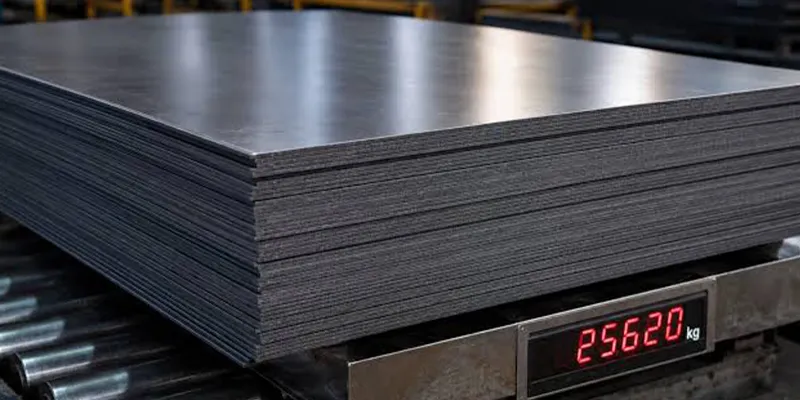
The product specification (A240 for stainless, B-series for nickel alloys) defines chemistry, mechanical properties and the dimensional envelope, while A480 is the general requirements standard that carries the actual thickness and flatness tolerances quoted in section nine. Always cite the pair together when you need a defensible weight basis.
Material specification map for the grades in this article
|
Grade family |
Plate specification |
General requirements |
|
304 / 316L / 310S / 321 / duplex |
ASTM A240 / A240M |
ASTM A480 / A480M |
|
904L / Alloy 31 (super-austenitic) |
ASTM B625 |
ASTM A480 / A480M |
|
Alloy 20 |
ASTM B463 |
ASTM A480 / A480M |
|
Incoloy 800H/HT / 825 |
ASTM B409 / B424 |
ASTM A480 / A480M |
|
Inconel 600 / 625 / 718 |
ASTM B168 / B443 / B670 |
ASTM A480 / A480M |
|
Hastelloy C276 / C22 |
ASTM B575 |
ASTM A480 / A480M |
|
Monel 400 |
ASTM B127 |
ASTM A480 / A480M |
|
Nickel 200 / 201 |
ASTM B162 |
ASTM A480 / A480M |
When a purchaser asks for the weight basis, the correct answer is 'nominal thickness per ASTM A240 with A480 tolerance, density per the material certificate'. That phrasing is auditable and matches how mills quote.
What are the most common mistakes when calculating stainless plate weight?
The usual errors are mixing metric and imperial units, using a generic steel density instead of the grade density, forgetting the minus thickness tolerance, and confusing nominal with actual thickness.
- Mixing units - multiplying mm by inches, or metres by mm without the right divisor, is the number-one cause of answers that are 25x or 1000x off.
- Wrong density - using 7.85 for everything ignores the 7.80 to 8.89 g/cm3 range and understates nickel-alloy mass by up to 13 percent.
- Nominal instead of actual thickness - forgetting the A480 under-tolerance overstates weight by a few percent on every thick plate.
- Counting cut-outs twice or not at all - a plate with holes is lighter; subtract the hole area before applying density.
- Quoting kg/m2 at the wrong thickness - the kg/m2 rule scales with thickness, so 6 mm and 10 mm are not interchangeable.
- Treating theoretical weight as a scale weight - for freight and lift plans add packing and tare, and for customs use the mill scale weight.
If your calculated weight looks wrong by a factor of 1000, you divided by the wrong power of ten in the millimetre formula. Re-derive from volume x density and the error will show itself immediately.
How can you build a stainless plate weight calculator in a spreadsheet?
Build a small table with length, width, thickness, density and a weight formula, then copy it down for every plate so a whole bill of material totals automatically.
A spreadsheet turns the formula into a reusable tool your sales and planning teams can use on every enquiry. The steps below work in Excel, Google Sheets or any compatible tool, and the same layout feeds a bill-of-material weight total for freight and lift planning.
Step 1. Set up the input columns: Create columns for Grade, Length, Width, Thickness and Density. Enter length and width in metres (or mm consistently) and thickness in mm, and pull the density from the grade table in section three.
Step 2. Write the weight formula: In the weight column enter =Length*Width*Thickness*Density for the metre/mm version, or =Length*Width*Thickness*Density/1000000 if all three dimensions are in mm. Copy the formula down for every row.
Step 3. Add a kg-to-lb column: Add a column =Weight*2.20462 so imperial readers and freight forwarders get pounds directly from the same inputs.
Step 4. Add a per-area check: Add a column =Thickness*Density to show kg/m2; this is the fast sanity check that catches a wrong thickness or density before you total the sheet.
Step 5. Total the bill of material: Use SUM on the weight column to get net mass, then multiply by 1.03 for a packing allowance and add any frame tare to get the gross shipment mass.
Step 6. Validate against a known case: Test the sheet on the 1.2 m x 2.4 m x 6 mm 316L case from section eleven; it must return about 137.9 kg. If it does not, the unit divisor is wrong.
Step 7. Lock the density table: Keep the density values on a separate reference tab and reference them by grade so no one edits a number by hand and breaks every row at once.
Frequently Asked Questions
Plate weight equals length times width times thickness times density: W = L x W x T x rho. In metric millimetres the practical form is W(kg) = L(mm) x W(mm) x T(mm) x density(g/cm3) / 1,000,000. Keep all dimensions in one unit system so the result is mass, not a meaningless number.
What units must I use in the plate weight formula?
Use one consistent system. Millimetres with g/cm3 needs a divide by 1,000,000 for kilograms; metres with millimetres and g/cm3 needs no divisor; imperial uses feet, inches and lb/ft3 with a divide by 12. Mixing units is the most common cause of a wrong answer.
What density should I use for 316L stainless steel?
Use 7.98 g/cm3 (about 498 lb/ft3). 304/304L is 7.93 g/cm3 and 310S is 7.90 g/cm3. Duplex 2205 is lighter at 7.80 g/cm3, while the nickel alloys run from 8.14 g/cm3 (Incoloy 825) up to 8.89 g/cm3 (Hastelloy C276, nickel 200).
How do I convert plate weight from kilograms to pounds?
Multiply kilograms by 2.20462 to get pounds. A 1.2 m x 2.4 m x 6 mm 316L sheet is about 137.9 kg, which is 304 lb. The same conversion applies to any alloy once you have the metric mass.
What does one square metre of 6 mm stainless plate weigh?
kg/m2 equals thickness in mm times density, so 6 mm 316L (7.98) is 47.9 kg/m2, 304 (7.93) is 47.6 kg/m2, and duplex 2205 (7.80) is 46.8 kg/m2. At 10 mm those become 79.8, 79.3 and 78.0 kg/m2 respectively.
Is plate weight the same as plate price per kg?
No. Weight is a physical mass from dimensions and density; price per kg is a commercial number that also includes alloy surcharge, finish and processing. Weight tells you the mass, price per kg tells you the cost of that mass.
Does duplex stainless weigh less than 316L?
Yes, for the same size. Duplex 2205 is 7.80 g/cm3 versus 7.98 for 316L, so a duplex plate is about 2.3 percent lighter. Super duplex 2507 is the same density as 2205. The saving is modest but real on large orders.
How much does a 4 ft x 8 ft stainless steel sheet weigh?
A 4 ft x 8 ft (1.2 m x 2.4 m) sheet at 6 mm is about 138 kg for 316L, 135 kg for duplex 2205, 146 kg for Inconel 625, and 154 kg for Hastelloy C276 or Monel 400. The spread tracks the density difference between grades.
Why is my calculated weight different from the mill scale weight?
Three effects: density varies about 1 percent between heats, the actual thickness sits inside the ASTM A480 tolerance band (usually a little thin), and surface finish removes a few microns. Together they put the real weight within 2 to 4 percent of the calculation.
What is the difference between theoretical weight and actual weight?
Theoretical weight is the volume-times-density number from this formula; actual weight is what the calibrated scale reads at the mill. Use theoretical weight for planning and quotation, and the scale weight as the authority for shipment and customs.
How do I account for the minus thickness tolerance?
ASTM A480 lets the rolled thickness run a few tenths of a millimetre under nominal on thin plate and a little more on thick plate. Subtract that under-tolerance from the nominal thickness, or simply shave 2 to 5 percent off the nominal weight as a provisional correction.
Can I use the same formula for stainless pipe?
Yes. Pipe is a rolled plate, so use the annular cross-section: mass per metre = (pi/4) x (OD2 - ID2) x density. Round bar uses (pi/4) x d2 x density and flat bar uses width x thickness x density. ASME B36.19 lists the published per-metre pipe weights from this same calculation.
How do I calculate the weight of a plate with holes?
Subtract each cut-out area from the full rectangle, then multiply the net area by thickness and density. For a 300 mm hole in a 1500 mm square 8 mm 316L plate the hole removes about 4.5 kg.
What density do Inconel 625 and Hastelloy C276 have?
Inconel 625 is 8.44 g/cm3 (about 527 lb/ft3) and Hastelloy C276 is 8.89 g/cm3 (about 555 lb/ft3). Both are well above 316L, so parts made from them are roughly 6 to 11 percent heavier for the same dimensions.
Which ASTM standard covers stainless plate thickness tolerance?
ASTM A480/A480M sets the thickness and flatness tolerances; ASTM A240/A240M is the product specification for the stainless plate itself. Nickel alloys use B-series plate specs (B575, B424, B168, B443) with the same A480 tolerance reference.
How do I calculate weight per foot for imperial plates?
Weight per square foot per inch of thickness equals density in lb/ft3 divided by 12. For 316L that is about 41.5 lb/ft2 per inch; multiply by the actual thickness in inches and by the area in square feet.
Does surface finish change the weight?
Only slightly. A ground or machined surface removes a few microns more metal than a pickled finish, so a ground plate is marginally lighter. The effect is well under 1 percent and is usually ignored in weight estimates.
How can I make a quick plate weight calculator?
Put length, width, thickness and density in a spreadsheet, enter =Length*Width*Thickness*Density (metre/mm version) in the weight column, copy it down for every plate, and total the column for the order mass. Add a kg-to-lb column and a 3 percent packing allowance for shipment weight.
Glossary
|
Term |
Definition |
|
Density |
Mass per unit volume of the alloy, g/cm3 or lb/ft3. The key input to the weight formula. |
|
Specific gravity |
Density relative to water (1.00 g/cm3 at 4 C). Stainless is about 7.8 to 8.9. |
|
Specific weight |
Weight per unit volume, often lb/ft3 in imperial usage; equals density x gravity. |
|
Nominal thickness |
The ordered or named thickness (for example 10 mm) that the mill rolls to. |
|
Actual thickness |
The measured as-rolled thickness, which sits inside the ASTM tolerance band. |
|
Mill tolerance |
The allowed plus/minus deviation from nominal dimensions set by the ASTM spec. |
|
Thickness tolerance |
The ASTM A480 band for plate thickness; the minus side reduces real weight. |
|
kg/m2 |
Kilograms per square metre; equals thickness in mm times density in g/cm3. |
|
lb/ft3 |
Pounds per cubic foot; 1 g/cm3 equals 62.43 lb/ft3. |
|
lb/in3 |
Pounds per cubic inch; 1 g/cm3 equals 0.03613 lb/in3. |
|
kg/m3 |
Kilograms per cubic metre; 1 g/cm3 equals 1000 kg/m3. |
|
ASTM A240 |
Specification for chromium and chromium-nickel stainless steel plate, sheet and strip. |
|
ASTM A480 |
General requirements for stainless plate, sheet and strip, including thickness tolerances. |
|
Austenitic stainless steel |
Face-centred cubic stainless (304, 316, 310S) with high toughness and weldability. |
|
Duplex stainless steel |
Mixed austenite-ferrite stainless (2205) with high strength and pitting resistance. |
|
Super duplex |
Higher-alloy duplex (2507) for aggressive chloride service such as seawater. |
|
Ferritic stainless steel |
Body-centred cubic stainless (430 family) with lower nickel and density near 7.7. |
|
Precipitation-hardening |
Age-hardened alloys (17-4PH, 718) strengthened by a second-phase precipitate. |
|
UNS number |
Unified Numbering System code (for example N06625) that uniquely identifies an alloy. |
|
W.Nr |
German material number (Werkstoffnummer) used alongside UNS in Europe. |
|
Theoretical weight |
The volume-times-density mass from the formula, used for planning and quotation. |
|
Actual weight |
The calibrated scale weight at the mill; the authority for shipment and customs. |
|
Tare weight |
The mass of packing, crate or reusable frame that is lifted but is not product. |
|
Plate |
A flat rolled product thicker than about 3 mm, supplied as plate, sheet or coil. |