|
QUICK ANSWER
Explosion bonding and roll bonding both produce a true metallurgical bond between a nickel alloy layer (such as Alloy 625 or 825) and a carbon or low-alloy steel base. Roll bonding suits large, flat, thinner-clad plates in volume, and its producers describe it as the lower-cost route.
Explosion bonding suits very thick base plates, thick cladding, and combinations that cannot be hot rolled. Neither process is inherently "stronger": ASTM A265 is process-neutral and sets the same bond shear minimum of 140 MPa (20,000 psi) for both. Bond quality is verified by shear or bend tests plus ultrasonic testing (ASTM A578), and these tests apply only if the purchase order calls for them. |
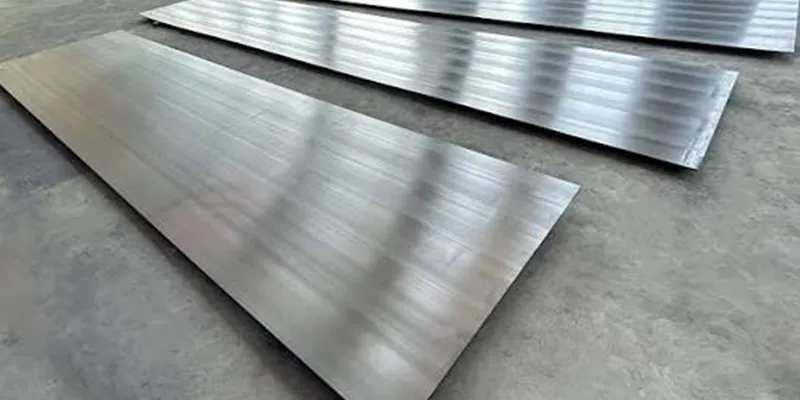
A pressure vessel for hot, corrosive service needs the corrosion resistance of a nickel alloy but the strength and low price of steel. Clad plate delivers both: a thin nickel alloy skin permanently bonded to a thick steel backing. The bond is what makes the plate work, so the way it is made and the way it is tested matter more than almost any other specification detail. This article compares the two main manufacturing routes, explosion bonding and roll bonding, and explains the tests that prove a bond is sound.
Each section opens with a direct answer, followed by the evidence. Much of the published data comes from clad plate producers, who have an interest in their own process. We flag vendor claims and say where independent data was not found.
What is nickel alloy clad plate, and why is it used?
Nickel alloy clad plate is a carbon or low-alloy steel plate with a thin layer of nickel or nickel-base alloy permanently bonded to one or both faces. It is used because the steel carries the pressure load while the nickel alloy resists corrosion, which can cost far less than a plate made entirely of the nickel alloy.
Think of a steel plate wearing a corrosion-proof coat that cannot peel off. ASTM A265 defines this product as steel plate to which a layer of nickel or nickel-base alloy is "integrally and continuously bonded", mainly for pressure vessels and other uses where the alloy's corrosion resistance is the priority [5]. The cladding layer is thin, typically 1.5 to 10 mm, on a base that can be many times thicker [2].
The savings can be large. Industeel calculated an ASME Section VIII Division 1 vessel in SA516 Grade 65 steel with 3 mm of Alloy 825 cladding and found material cost savings of 19% at 10 bar, 34% at 20 bar, and 37% at 30 bar compared with a solid Alloy 825 plate [1]. This is a producer calculation for one design case, so treat it as an illustration. The saving grows with pressure because higher pressure needs a thicker wall, and that extra thickness is cheap steel rather than expensive alloy.
How does explosion bonding work?
In explosion bonding, an explosive charge drives the nickel alloy plate into the steel plate at high speed, and the impact welds the two together in the solid state without melting either metal.
The cladding plate is placed parallel to the base plate with a small gap called the standoff distance, and explosive is spread over the cladding plate. The detonation sweeps across the plate and drives it onto the base at a carefully chosen collision velocity. The impact expels air and surface impurities ahead of the collision point, leaving clean metal pressed against clean metal [15]. One secondary source gives typical impact speeds of 250 to 500 m/s and standoff gaps of 0.5 to 4 times the cladding thickness [14].
The bond line has a characteristic wavy shape. VDM Metals, a nickel alloy producer, notes that the blast waves leave ripples with wavelengths of a few millimeters in the bonding plane, and that this locally reduces the thickness of the cladding layer [3]. Researchers studying explosion-welded Incoloy 800 on 304 stainless steel found the same wavy morphology and recorded the highest hardness in a small zone at the wave ridge [13]. In plain terms, the interface is strong but not flat, and it is slightly harder than the metal on either side.
Explosion bonding is practical for very large and very thick plates. A reference summary reports cladding thicknesses from 0.025 to 100 mm, base plates over 1 m thick, and clad plates up to 5 by 12 m [11]. A NobelClad technical bulletin, as reproduced by Wermac, gives typical maximums of 500 mm for the base and 25 mm for the cladding [12]. The two sources describe different limits: one gives outer limits of the technology and the other typical commercial maximums. Always confirm size limits with the producer.
How does roll bonding work?
In roll bonding, a nickel alloy slab and a steel slab are assembled, heated to about 900 to 1,200 °C, and hot rolled together so that heat and rolling pressure fuse them into one plate of the final thickness.
VDM Metals describes the sequence: slabs or thick plates are assembled, heated to a temperature typical for the materials, and rolled to size. The rolling reduces the thickness and creates the metallic bond at the same time [3]. Industeel says the high temperature and high rolling force guarantee an integral metallurgical bond, and the plate is then heat treated (normalized, or quenched and tempered) to give the steel backing its mechanical properties [1].
Because the plate is rolled, the bond line is flat and uniform, with neither the wave pattern of explosion bonding nor a heat-affected zone, according to Industeel [1]. The limits are mill limits. VDM states that the available sizes are limited by the maximum piece weights a mill can handle and the size of its roll stands, and that very thick plates are usually made by other processes for technical and economic reasons [3]. For nickel alloys 625 and 825, voestalpine lists roll-bonded plates of 6 to 120 mm total thickness, 1.5 to 10 mm cladding, up to 3,800 mm wide and up to 15,000 mm long, with further sizes on request [2].
How do explosion bonding and roll bonding compare on size, thickness, and bond line?
Roll bonding offers a flat bond line, good flatness, and lower cost on large plates up to about 120 mm total thickness, while explosion bonding reaches much thicker base plates and thicker cladding but leaves a wavy bond line.

The table below sets the two processes side by side using producer and technical sources.
|
Dimension |
Roll bonding |
Explosion bonding |
|
Bonding mechanism |
Hot rolling of an assembled slab pack; heat plus pressure [3] |
Impact from detonation; solid-state weld without melting [12] |
|
Process temperature |
About 900 to 1,200 °C during rolling [3] |
Bond forms from impact energy rather than furnace heating [3][12] |
|
Bond line |
Flat, homogeneous; no wave and no heat-affected zone per Industeel [1] |
Wavy, with wavelengths of a few mm; cladding locally thinned [3] |
|
Size range (nickel alloys 625/825, roll) |
Total 6 to 120 mm; cladding 1.5 to 10 mm; up to 3,800 mm wide, 15,000 mm long [2] |
Cladding 0.025 to 100 mm; base over 1 m; plates to 5 × 12 m (outer limits) [11]; typical maximums 500 mm base and 25 mm cladding [12] |
|
Size limits set by |
Mill piece weight and roll stand size [3] |
Availability of flat starting plate, transport, and detonation limits such as noise [3][12] |
|
Residual stress and flatness |
Industeel claims lower residual stresses and better flatness [1] |
Producers state the plates are supplied at final dimensions with insignificant deformation [3] |
|
Cost position |
Industeel claims cost competitiveness versus explosion cladding [1] |
NobelClad argues direct attachment of internals lowers fabrication cost [4] |
|
Typical strengths |
Large flat plates in volume; thin to medium cladding; clad pipe feedstock [1] |
Very thick plates, thick cladding, hard-to-roll combinations, tubesheets [3][11] |
Sources: [1] Industeel (roll-bond producer); [2] voestalpine (roll-bond producer); [3] VDM Metals (alloy producer); [4] NobelClad (explosion-bond producer); [11] Design World summary; [12] Wermac reproduction of NobelClad bulletin NT 200. No independent price comparison was found; cost positions are producer claims.
Which process produces the stronger bond?
Neither. Both processes are routinely qualified to the same minimum bond strength, 140 MPa (20,000 psi) in shear, and the standard that governs nickel alloy clad plate does not favor either process. Producers of each process claim the other's product is more vulnerable, and we found no independent head-to-head dataset to settle it.
The older text of ASTM A265 says the cladding may be metallurgically bonded to the base by any method that produces plate meeting the specification [6]. Bond strength is then measured, not assumed. The ASTM A263, A264, and A265 family sets a minimum shear strength of 20,000 psi (140 MPa) for the cladding and base interface when the purchaser requires the test [6][7].
Explosion-bond evidence. In a test program by NobelClad and the Colorado School of Mines, the clad tensile strength exceeded the shear strength in every material tested. For stainless and nickel alloy clad, the through-thickness tensile strength of the explosion weld exceeded that of the steel base. In welded coupons with cladding from 0.8 to 4.8 mm, tensile specimens failed in the base metal at 589 to 610 MPa rather than at the bond [4]. This is a vendor program, and the welded-coupon phase used stainless steel cladding rather than nickel alloy.
Roll-bond evidence. Industeel states that its integral bond is guaranteed by 100% ultrasonic testing and mechanical shear tests, and that clad pipes and fittings keep their bond after cold forming. It cites a project that used more than 6,500 tons of Alloy 825 roll-bonded clad plate for pipes and fittings [1].
The conflict. A NobelClad slide shows disbonding in roll-bonded Alloy 625 clad plates after forming and welding, in a 53 in. caisson and a 39 in. induction bend [4]. Industeel reports the opposite experience for its plate [1]. Both are marketing-adjacent claims from competitors. For a critical vessel, the practical answer is to qualify the specific producer's plate by test, not to rely on the process label.
How is the bond quality of nickel alloy clad plate tested?
Bond quality is verified by mechanical tests, a shear test or bend tests, and by ultrasonic testing of the whole plate under ASTM A578. Metallography and corrosion tests after heat treatment can be added. These tests apply to both processes, and the purchase order must call for them.
No single test proves a bond. Destructive tests measure strength on samples. Ultrasonic testing scans the entire plate for areas where the layers have not joined. Together they cover both questions: is the bond strong, and is it present everywhere?
|
Test |
What it shows |
Requirement or practice |
|
Shear strength test |
Force needed to shear the cladding off the base, which measures bond strength |
Minimum 140 MPa (20,000 psi) under the A263/A264/A265 family when required by the purchaser [6][7] |
|
Bend test (bond) |
Whether the bond survives bending; three bend tests with the cladding in compression |
Alternative to the shear test when specified [6][7]; vendor may be allowed either in a purchaser specification [9] |
|
Tension test |
Strength of the composite plate against the base steel specification |
Part of the A265 mechanical tests [5] |
|
Ultrasonic test (UT) |
Locations where the bond is missing (non-bond or disbond) |
ASTM A578 straight-beam UT, which has three acceptance levels (A, B, C), with B applying unless otherwise agreed [8]; one public purchaser specification calls for Level C [9] |
|
Phased array UT |
Same purpose, with faster scanning and recorded images; used on explosion-bonded plate |
Reported for explosion clad inspection [10] |
|
Metallography |
Bond line microstructure, wave shape, any cracks or brittle zones |
Used by producers; for explosion bonds, micro shear cracks are a known defect type [10] |
|
Corrosion test after heat treatment |
Whether the cladding keeps its corrosion resistance after forming and post-weld heat treatment |
For Alloy 825, ASTM G28 Method A on coupons after simulated heat treatments [3] |
Sources: [3] VDM Metals; [5] ASTM A265 scope; [6][7] A265 and A264 text as reproduced; [8] ASTM A578/A578M; [9] public tender specification; [10] Evident Scientific. Acceptance criteria vary by edition and purchaser; confirm the edition cited in your order.
An important detail for buyers. The shear and bend tests are required "when required by the purchaser" in the standard text [6][7]. If the purchase order is silent, a producer is not obliged to run them. Likewise, A578 applies Acceptance Level B by default unless the purchaser and manufacturer agree otherwise [8]. Specify the tests and the level on the order.
What bond defects do these tests look for?
The main defect is non-bond (also called disbond), an area where the cladding never joined the steel. Explosion-bonded plate can also show micro shear cracks along the bond line.

Evident Scientific, an inspection equipment maker, lists micro shear cracks and disbonded areas as fabrication defects of explosion-bonded plate, and notes that destructive tests tend to reveal the cracks while ultrasonic testing efficiently finds disbonds [10]. Ultrasonic testing works because sound crosses a bonded interface but is partly reflected by a gap. ASTM A578 uses that effect: it records any discontinuity that causes complete loss of the back-wall echo, and its acceptance levels limit the size of such an area [8].
Size matters because a small non-bond may be tolerable while a large one is not. The A578 Level A and Level B criteria both refer to a continuous area that cannot be enclosed in a 3 in. (75 mm) circle, with further detail that differs by level [8]. Because the exact limits depend on the edition and level, we recommend confirming them against the current standard rather than relying on a summary.
NobelClad also tested a plate with a deliberately drilled 25 mm flat-bottom hole at the interface to simulate a non-bond. The tensile specimen failed at 525 kN with no disbond spreading from the simulated defect [4]. This is one vendor test on one plate, but it shows the principle: a small local non-bond does not automatically cause the bond to unzip.
How do heat treatment and fabrication affect clad plate?
Heat treatment and forming can change both the steel backing and the cladding, so the plate should be qualified in the condition it will actually be used, including simulated post-weld heat treatment. Heat treatment is described by VDM Metals as a critical issue for clad plate.
The steel backing and the nickel alloy respond differently to heat. For roll-bonded plate, producers supply the steel backing normalized or quenched and tempered to set its strength [1]. Explosion-bonded plate also goes through the heat treatments of vessel manufacturing, as the test described next shows.
A joint test by NobelClad and VDM Metals shows how this is checked. Coupons of explosion-clad Alloy 825 were put through delivery condition, a simulated head-forming heat treatment (forming at 1,035 °C, normalizing at 900 °C with accelerated cooling, tempering at 650 °C), and simulated post-weld heat treatment of 3.5 hours at 610 °C repeated three times. ASTM G28 Method A corrosion tests then showed that simulated post-weld heat treatment slightly increased corrosion rates, but the rates stayed far below 0.9 mm per year [3]. The lesson is general: ask for corrosion results on heat-treated coupons, not only on the as-delivered plate.
One caution on suitability. A secondary source lists usual limits for the metals that can be explosion welded, a minimum of 15% elongation and 30 J notch toughness at process temperature [14]. If your alloy and steel combination is unusual, confirm with the producer that it can be bonded and qualified.
How should I choose between explosion bonding and roll bonding?
Choose roll bonding for large plates up to about 120 mm total thickness with cladding up to about 10 mm, and choose explosion bonding when the base or cladding is thicker than roll mills offer, when the combination cannot be hot rolled, or when a producer's qualified explosion-bond plate fits the job. In many cases the purchase specification can allow either.
|
Situation |
Suggested process |
Why |
|
Large plates, total thickness up to about 120 mm, cladding up to about 10 mm |
Roll bonding |
Within published roll-bond size range for Alloys 625 and 825; flat bond line; cost position claimed by producers [1][2] |
|
Base plate thicker than roll mills offer, or cladding thicker than about 10 mm |
Explosion bonding |
Roll sizes are limited by piece weight and roll stands, and thick plate is generally made by other processes [3] |
|
Heat exchanger tubesheets and thick clad plate |
Explosion bonding |
Cited application of explosion clad plate [11] |
|
Material pair that is hard or impossible to hot roll |
Explosion bonding |
VDM cites combinations that are difficult or impossible by hot-rolled cladding [3] |
|
Direct welding of internals onto the cladding |
Either, with qualification |
NobelClad supplies tensile data for explosion clad [4]; whichever process is used, qualify the attachment weld on production-type plate |
|
Cladding must be fully corrosion-tested after heat treatment |
Either |
Request ASTM G28 Method A (Alloy 825) or the applicable test on heat-treated coupons [3] |
What should a purchase order for nickel alloy clad plate include?
State the clad plate specification, the cladding alloy and base steel grades, the thicknesses, the bond tests, the ultrasonic acceptance level, and the heat treatment and documentation required. Items left out of the order may not be tested.
Because the standards make several tests conditional, completeness at the order stage is the best quality control. A complete order should state:
- Specification: ASTM A265 or ASME SA-265, with the edition.
- Cladding alloy: UNS number and product specification, for example Alloy 625 (N06625, ASTM B443) or Alloy 825 (N08825, ASTM B424) [2].
- Base steel: grade and specification, for example SA516 Grade 65 or 70, and delivery condition (normalized or quenched and tempered) [1].
- Thicknesses: base thickness, minimum cladding thickness, and whether cladding is on one or both sides.
- Process: roll bonding, explosion bonding, or either. Public purchaser specifications often allow either route [9].
- Bond tests: shear test or bend tests, with the number and location of samples [6][7].
- Ultrasonic testing: ASTM A578 with the acceptance level stated [8].
- Corrosion and heat treatment: simulated post-weld heat treatment cycle and any required corrosion test on treated coupons [3].
- Documentation: material certificates (EN 10204 3.1 is common), test reports, and the UT report.
Frequently asked questions
Q: What is the minimum bond strength for nickel alloy clad plate?
A: The ASTM A263, A264, and A265 family sets a minimum shear strength of 20,000 psi (140 MPa) for the cladding and base interface when the purchaser requires the shear test [6][7].
Q: Is explosion-bonded plate stronger than roll-bonded plate?
A: Not as a general rule. ASTM A265 does not prefer a process [6]. Explosion-clad producers publish tensile data showing failure in the base metal [4], and roll-bond producers report 100% ultrasonic and shear testing [1]. Qualify the specific producer's plate.
Q: Does explosion bonding melt the metals?
A: No. It is a solid-state process: impact energy forms the bond without melting either plate [12]. The interface shows a wavy pattern and can show micro shear cracks if the process is poorly controlled [10].
Q: Why is there a wavy line in explosion clad plate?
A: The wave pattern is a normal feature of explosion welding. It forms as the plates collide, has wavelengths of a few millimeters, and locally reduces cladding thickness [3].
Q: Which ultrasonic test is used for clad plate bond?
A: ASTM A578/A578M, a straight-beam pulse-echo method with three acceptance levels. Level B applies by default unless the purchaser and manufacturer agree otherwise [8].
Q: How thick can roll-bonded nickel alloy clad plate be?
A: voestalpine lists roll-bonded Alloy 625 and 825 plates from 6 to 120 mm total thickness with 1.5 to 10 mm cladding, with other sizes on request [2]. Industeel lists nickel-base cladding of 2 to 6 mm [1].
Which standards apply to nickel alloy clad plate?
ASTM A265 (ASME SA-265) governs nickel and nickel-base alloy clad steel plate, and ASTM A578 governs its ultrasonic examination.
|
Standard |
What it covers |
|
ASTM A265 / ASME SA-265 |
Plate of carbon or low-alloy steel with nickel or nickel-base alloy integrally bonded on one or both sides; tension, shear, and bond tests [5] |
|
ASTM A264 / ASME SA-264 |
Stainless chromium-nickel steel-clad plate; the sister specification with the same 140 MPa shear minimum [7] |
|
ASTM A263 |
Corrosion-resisting chromium steel-clad plate; part of the same specification family [8] |
|
ASTM A578 / ASME SA-578 |
Straight-beam ultrasonic examination of rolled plain and clad steel plates; acceptance levels A, B, and C [8] |
|
ASTM B443 and B424 |
Cladding alloy product specifications for Alloy 625 (N06625) and Alloy 825 (N08825) [2] |
|
ASTM G28 Method A |
Intergranular corrosion test used by VDM to check Alloy 825 after heat treatment simulation [3] |
Sources and references
[1] Industeel (ArcelorMittal). "Clad plates" brochure. https://industeel.arcelormittal.com/fichier/clad-plates-brochure (roll-bond producer)
[2] voestalpine Grobblech. "hrbclad data sheet," 01/2026. https://www.voestalpine.com/stahl/content/download/70715/file/Data-sheet-hrbclad-voestalpine-EN-270126.pdf (roll-bond producer)
[3] VDM Metals via Cedinox. "Combining material advantages." https://www.cedinox.es/en/publicaciones/Combining-material-advantages/ (alloy producer)
[4] Prothe, C., Hurley, C., Banker, J. (DMC NobelClad) and Liu, S. (Colorado School of Mines). "Comparative Tensile and Shear Strength of Explosion Clad Materials," 2016. https://ism.ac.ru/events/EPNM2016/presentations/08.pdf (explosion-bond producer)
[5] ASTM A265-12(2026), Standard Specification for Nickel and Nickel-Base Alloy-Clad Steel Plate (scope as published). https://standards.nimonik.com/products/astm/a265/
[6] ASTM A265 text (1990s edition) as reproduced. https://www.academia.edu/39348564/A (older edition; confirm against current edition)
[7] ASTM A264 / ASME SA-264 text as reproduced. https://es.scribd.com/document/192648112/II-A01SA264 (sister specification)
[8] ASTM A578/A578M, Straight-Beam Ultrasonic Examination of Rolled Steel Plates for Special Applications (text as reproduced). https://pdfcoffee.com/a578a578m-17-104-pdf-free.html
[9] BHEL tender technical specification for Alloy C276 clad plate to ASTM A265. https://tenders.bhel.com/sites/default/files/tdc-rts-005-rev-001-1576148928.pdf (example of purchaser requirements)
[10] Evident Scientific. "Inspecting Explosion-Bonded Cladded Plates." https://ims.evidentscientific.com/en/insights/inspecting-explosion-bonded-cladded-plates (inspection equipment maker)
[11] Design World. "What is explosion welding?" https://www.designworldonline.com/?p=610956 (summary of published size ranges)
[12] Wermac. "Explosion cladding" (reproducing NobelClad Technical Bulletin NT 200). https://wermac.org/equipment/explosion_cladding.html (secondary reproduction)
[13] Zhao, H. et al. "An investigation on Incoloy800-SS304 clad plate by explosive welding." International Journal of Materials Research. https://www.degruyterbrill.com/document/doi/10.3139/146.110430/pdf
[14] Welding Advisers. "Explosion welding." https://www.welding-advisers.com/Explosion-welding.html (secondary source)
[15] MachineMFG. "Comprehensive Guide to Explosion Welding." https://shop.machinemfg.com/comprehensive-guide-to-explosion-welding-step-by-step-process-and-applications/ (equipment vendor blog, secondary source)