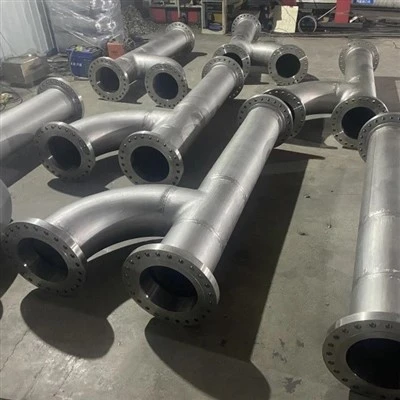
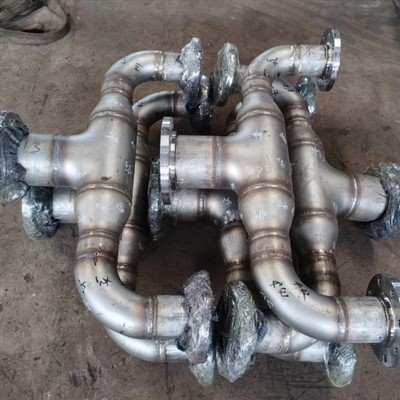
A "high-temperature forging" is a part shaped by squeezing hot metal between dies, usually made from a nickel-based superalloy so it keeps its strength and resists oxidation in the 650-1200 °C zone where jet engines and gas turbines operate.
AMS specifications (published by SAE International) are the contract that defines chemistry, melting method, heat treatment, strength, and testing for these alloys.

The four workhorse forging alloys are Inconel 718 (strength plus weldability), Inconel 625 (corrosion plus oxidation), Hastelloy X (oxidation to ~1200 °C), and Waspaloy (creep strength to ~760 °C).
NDT is mandatory: ultrasonic testing (UT) proves internal soundness, penetrant testing (PT) finds surface cracks, magnetic particle inspection (MPI) checks ferromagnetic steels, and radiography (RT) inspects complex or welded sections.
Always specify the AMS number, the revision letter, the condition, and the NDT class on a purchase order. "Alloy 718" alone is not a specification.
What Are Aerospace High-Temperature Forgings?
Aerospace high-temperature forgings are metal parts shaped by compressing hot metal between dies, made from nickel-based superalloys so they keep their strength and resist oxidation in the 650-1200 °C zone where jet engines and gas turbines operate. They matter because a single forging failure in a turbine disk or mounting bracket can disable an aircraft.
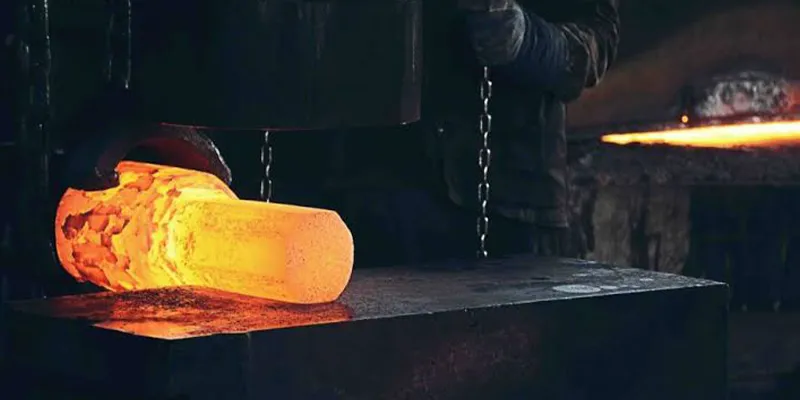
Forging differs from casting and machining. In casting, molten metal is poured into a mold; in machining, metal is cut away. In forging, a solid billet is compressed while hot (typically 950-1200 °C for nickel alloys), which aligns the grain flow along the part's outline and closes up internal voids. That grain flow is why a forged turbine disk resists crack growth far better than a machined block of the same alloy. The "high-temperature" qualifier means the alloy is designed to retain useful strength and resist scaling above roughly 650 °C, far beyond what ordinary stainless steel can tolerate. In plain terms: these are the toughest, heat-proof metal shapes that hold an engine together.
Which AMS Material Specifications Govern Aerospace High-Temperature Forgings?
The governing AMS specifications are product-form and condition standards published by SAE International; for the four main forging alloys the key numbers are AMS 5662 / 5663 / 5664 (Inconel 718), AMS 5666 (Inconel 625), AMS 5754 (Hastelloy X), and AMS 5708 / 5709 (Waspaloy). Each controls chemistry, melting practice, heat treatment, mechanical properties, and certification.
AMS (Aerospace Material Specification) documents are the lingua franca of aerospace procurement. They pin down the exact chemistry window and the melting route (almost always VIM plus VAR - vacuum induction melting plus vacuum arc remelting - for rotating parts), and they state the heat-treatment condition in which the material is delivered. A single alloy therefore appears under several AMS numbers depending on product form and condition, so naming the wrong number on a drawing is a real engineering error, not a clerical one.
|
Alloy (UNS) |
Typical role |
AMS material spec |
Product form covered |
Useful service ceiling |
|
Inconel 718 (N07718) |
Disks, shafts, fasteners |
AMS 5662 / 5663 / 5664 |
Bars, forgings, rings |
~650 °C (creep); oxidation to 980 °C |
|
Inconel 625 (N06625) |
Exhaust, ducts, springs |
AMS 5666 |
Bars, forgings, rings (annealed) |
~650 °C; oxidation to 980 °C |
|
Hastelloy X (N06002) |
Combustion chambers, afterburners |
AMS 5754 |
Bars, forgings, rings |
up to ~1200 °C |
|
Waspaloy (N07001) |
Turbine disks, high-temp fasteners |
AMS 5708 / 5709 |
Bars, forgings, rings |
~760 °C |
Service ceilings are nominal "useful strength / oxidation" guidance; the controlling limit is always the design drawing and the specific AMS revision.
Inconel 718 vs Inconel 625 vs Hastelloy X vs Waspaloy: Which Forging Alloy Should You Specify?
Pick the alloy by the dominant failure mode you must survive: choose Inconel 718 when you need the best strength-plus-weldability combination, Inconel 625 when corrosion and oxidation dominate, Hastelloy X when you must run hotter than ~900 °C, and Waspaloy when creep strength above ~650 °C is the priority.
These four alloys are not interchangeable; each is optimized for a different constraint. Inconel 718 is the default because its gamma-double-prime (γ″) strengthening lets it reach high strength while remaining weldable. Inconel 625 gains its strength from molybdenum and niobium and is chosen where seawater, exhaust, or oxidation attack matters more than peak strength.
Hastelloy X is a solid-solution alloy built for oxidation resistance up to ~1200 °C, ideal for static hot structures. Waspaloy, strengthened by gamma-prime (γ′), wins on creep strength in the 650-760 °C range for rotating engine hardware.
|
Property |
Inconel 718 |
Inconel 625 |
Hastelloy X |
Waspaloy |
|
Strengthening type |
γ″ (precipitation) |
Solid solution |
Solid solution |
γ′ (precipitation) |
|
Min. tensile (typical, aged) |
~1275 MPa (185 ksi) |
~830 MPa |
~690-755 MPa |
~1170 MPa |
|
Useful max temp |
~650 °C |
~650 °C |
~1200 °C |
~760 °C |
|
Weldability |
Excellent |
Excellent |
Good |
Difficult |
|
Magnetic? |
Non-magnetic |
Non-magnetic |
Non-magnetic |
Non-magnetic |
|
Best for |
Disks, shafts, fasteners |
Ducts, exhaust, springs |
Combustors, afterburners |
Turbine disks, hot fasteners |
What NDT Methods Are Required for Aerospace Forgings, and What Does Each Detect?
Aerospace forgings are routinely subjected to ultrasonic testing (UT) for internal soundness, liquid penetrant testing (PT) for surface cracks, magnetic particle inspection (MPI) for ferromagnetic steels, and radiography (RT) for complex or welded geometries. Surface and internal checks are complementary, never optional substitutes for one another.
A forging can look perfect on the outside yet hide a subsurface flaw, or be internally clean yet carry a hairline surface crack from handling. Each NDT method sees a different class of defect, which is why airframe and engine quality systems stack them.
UT uses sound waves to reveal internal voids, inclusions, and laps; PT uses a dye that seeps into open surface cracks and flares bright under UV light; MPI only works on magnetic steels and reveals surface and near-surface discontinuities; RT uses X-rays to image volumetric defects in thick or welded sections.
|
NDT method |
What it finds |
Typical aerospace standard |
Applies to |
|
Ultrasonic (UT) |
Internal voids, inclusions, laps, cracks |
AMS 2630 (>12.7 mm), AMS 2632 (≤12.7 mm) |
Nickel, steel, titanium |
|
Liquid penetrant (PT) |
Open surface cracks, porosity, seams |
AMS 2644, ASTM E1417 |
All alloys (non-porous) |
|
Magnetic particle (MPI) |
Surface / near-surface cracks in steel |
AMS 2300 / 2301 / 2303 / 2304, ASTM E1444 |
Ferromagnetic steels only |
|
Radiography (RT) |
Volumetric defects, weld flaws |
ASTM E1742, MIL-STD-453 |
Complex / welded sections |
How Do NDT Acceptance Criteria Map to AMS and ASTM Standards?
Acceptance criteria are defined by the ordered standard and class, not by a universal "pass," so a buyer must cite both the method standard (for example AMS 2630 Class A for UT) and the allowable indication size; for ferromagnetic steels the AMS 2300-series cleanliness classes convert inclusion counts into accept/reject limits.
NDT is meaningless without an acceptance rule. For UT of wrought nickel and steel product, AMS 2630 (thick) and AMS 2632 (thin) set reference-block-based quality levels - an FBH-equivalent (flat-bottom-hole) reflector limit and dense-indication rules. For penetrants, AMS 2644 defines the penetrant type, method, and sensitivity level (½ to 4) that govern how fine a crack can be found.
For steel cleanliness, the AMS 2300 family grades material by frequency (F) and severity (S) ratings from magnetic-particle indication lengths: AMS 2300 is the premium, VAR/ESR-required tier for critical rotating parts, and AMS 2301 / 2304 are the more common aircraft-quality tiers. These MPI cleanliness specs apply to ferromagnetic steels; nickel superalloys are instead qualified by UT and PT because they are non-magnetic.
|
Ordered test |
Governing standard |
What the class / level controls |
|
UT, thick product |
AMS 2630 |
Reflector size limit, scan coverage, Class A/B acceptance |
|
UT, thin product |
AMS 2632 |
Same framework for ≤12.7 mm sections |
|
PT |
AMS 2644 |
Penetrant type / method, sensitivity level ½-4 |
|
Steel cleanliness |
AMS 2300 / 2301 / 2304 |
F/S ratings to accept / reject (MPI) |
|
RT |
ASTM E1742 / MIL-STD-453 |
Image quality, discontinuity acceptance |
Why Does Melting Practice (VIM + VAR) Decide Forging Reliability?
Double melting - vacuum induction melting (VIM) followed by vacuum arc remelting (VAR), or electroslag remelting (ESR) - is what removes the non-metallic inclusions and gas pockets that would otherwise become crack starters in a rotating forging, which is why AMS specifications for critical parts mandate it.
A forging's life is set long before heat treatment, by how clean the starting billet is. Air-melted steel can contain oxide and sulfide inclusions that act as internal stress risers; under the cyclic loads of a turbine disk these grow into fatigue cracks. VIM melts the alloy under vacuum to strip dissolved gases and light elements, and VAR / ESR re-melts the ingot as a controlled drop, producing a uniform, inclusion-free electrode.
AMS 5662 and the premium 2300-series cleanliness specs explicitly require VIM + VAR / VAR-class melting for the most demanding rotating hardware, and a certificate that reports only "718" without the melt route does not demonstrate compliance.
What Documentation and Traceability Does AMS Require for Aerospace Forgings?
AMS compliance is proven on paper as much as on the part: every forging ships with a Certified Mill Test Report (CMTR) tied to a heat / lot number, recording chemistry, mechanical properties, heat treatment, melt practice, grain size, and NDT results, all traceable to the originating melt.
Aerospace supply chains are built on traceability. A forging without a matching CMTR is, functionally, not airworthy even if the metal is perfect, because no one can prove which melt it came from or which tests it passed. The AMS system expects testing in the delivered condition with documented sampling, and the certificate must identify the specification and revision (for example "AMS 5662M," not just "AMS 5662") plus the heat number. Third-party inspection by bodies such as Lloyds, Bureau Veritas, or DNV is frequently required for critical procurements, and records are retained for years so a part can be audited decades later.
How Should You Specify AMS and NDT in a Purchase Order?
Write the purchase order so a supplier cannot deliver the "wrong right alloy": name the exact AMS number with revision letter, the product form and condition, the melt practice, the NDT method and class, the certification level, and the marking / heat-traceability requirements.

The most common procurement failure is an order that says only "Alloy 718." Two suppliers can quote the same price for the same nominal alloy and deliver material with different melt routes, different testing, and different permissible chemistry. The specification, revision, and condition are what convert an alloy name into a purchase. A defensible order line reads something like: "Inconel 718 forgings to AMS 5663 Rev M, VIM + VAR, solution treated and precipitation hardened, 100% UT to AMS 2630 Class A, PT to AMS 2644 Level 3, with EN 10204 3.1 / 3.2 CMTR and heat-number traceability."
Frequently Asked Questions
Q: Is Inconel 718 stronger than Hastelloy X?
A: In terms of tensile and yield strength at room and moderate temperature, yes - aged Inconel 718 reaches roughly 1275 MPa tensile versus about 690-755 MPa for Hastelloy X. But Hastelloy X wins on oxidation resistance and useful service temperature, staying viable up to ~1200 °C where 718 would lose strength. Choose by duty, not by a single number.
Q: Can you substitute AMS 5663 for AMS 5662?
A: Not blindly. AMS 5662 is the solution-treated (soft, machinable) condition used when you machine then age; AMS 5663 is already precipitation-hardened (full strength, delivered ready). They are the same alloy and form but different conditions, so the substitution depends entirely on your drawing's heat-treatment intent.
Q: Do nickel superalloys need magnetic particle inspection?
A: Generally no. Inconel 718 / 625 and Hastelloy X are non-magnetic, so MPI (AMS 2300-series) does not apply; their cleanliness and surface integrity are proven by UT (AMS 2630 / 2632) and PT (AMS 2644). MPI is reserved for ferromagnetic steels.
Q: What does "AMS 2630 Class A" mean on a forging order?
A: It means 100% ultrasonic inspection of the forging per AMS 2630 at the most stringent (Class A) acceptance level, with rejectable indications defined by flat-bottom-hole-equivalent reflectors and dense-indication rules - the level typically required for critical rotating or flight-safety parts.