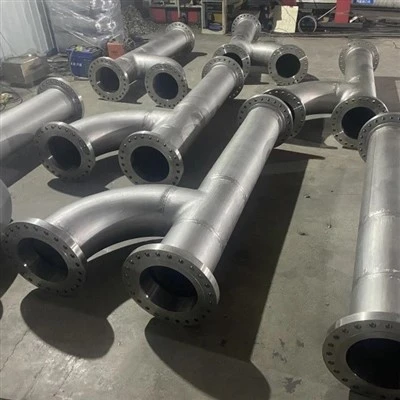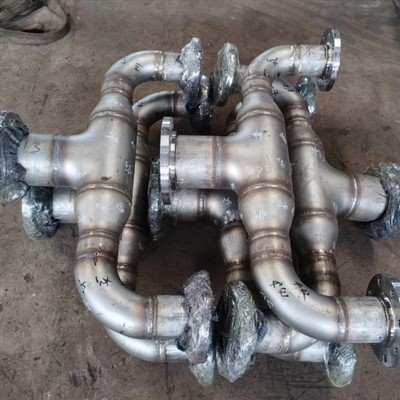
|
No single cutting method is best for every stainless steel plate. Laser gives the tightest tolerances on plate up to about 25 mm (1 in). Plasma is the fastest and most economical choice for thicker plate, roughly 16 to 50 mm (5/8 to 2 in), when edges will be machined or ground. Waterjet is the only one of the four with no heat-affected zone and has the greatest thickness range. Shearing is the cheapest way to make straight cuts in thinner plate, but stainless steel needs about 40% more shearing capacity than carbon steel. |
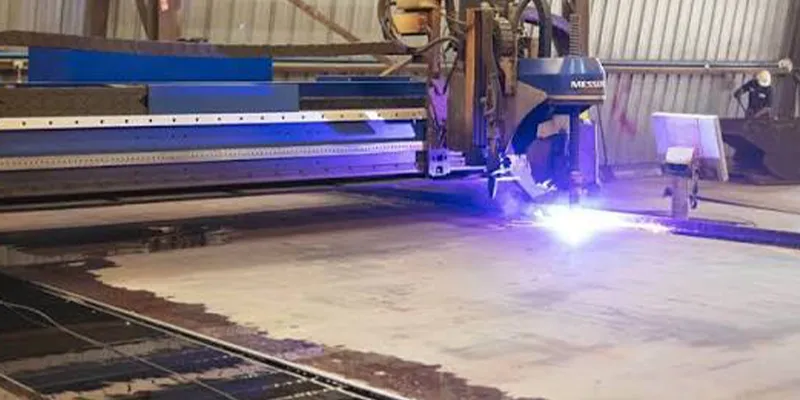
A stainless steel plate leaves the mill as a large, flat rectangle. Almost nobody needs it in that form. Cutting is therefore the first fabrication step, and it quietly decides three things that matter later: how accurate the part is, how the cut edge behaves in corrosive service, and how much the finished part costs. This article compares the four cutting methods used by plate processors, plasma, laser, waterjet, and shearing, across accuracy, thickness, speed, cost, edge quality, and corrosion resistance.
Each section opens with a direct answer, followed by the evidence behind it. Where the evidence is limited, for example where test data come from carbon steel rather than stainless steel, we say so.
What are the four main ways to cut stainless steel plate?
Plasma and laser cutting melt the metal with intense heat, waterjet cutting wears the metal away with a high-pressure stream of water and abrasive grit, and shearing slices the plate mechanically between two blades. Plasma and laser are thermal processes, waterjet is a "cold" process, and shearing is purely mechanical.
Think of each method as a different tool. Plasma is an electrically heated gas jet that melts a narrow channel through the plate. Laser is a focused beam of light that melts the metal while a gas stream blows the molten material out of the cut. Waterjet is a pressurized water stream carrying garnet grit that erodes the plate, much like sandblasting aimed at a single line. Shearing works like giant scissors: the blades push the metal until it fractures. The way each tool removes metal explains almost every difference in the tables that follow.
|
Method |
How it removes metal |
Heat-affected zone (HAZ) |
Secondary work usually needed |
|
Plasma |
Melting with a high-temperature ionized gas arc |
Yes; typically under 0.25 mm on steel with correct gas selection |
Typically yes: slag grinding and flattening to remove the HAZ and heat distortion |
|
Laser |
Melting with a focused light beam plus assist gas |
Yes, narrow; depth depends on the gas used |
Sometimes: removal of oxidized edge and HAZ (mainly with oxygen or air assist) |
|
Waterjet |
Erosion by water and abrasive |
None |
Usually none; satin-smooth edge |
|
Shearing |
Mechanical fracture between blades |
None (no heat), but a work-hardened edge band |
Burr removal when required |
Sources: Flow International comparison table [2]; Hypertherm plasma attributes [1]; shearing edge description from The Fabricator [10].
How accurate is each cutting method on stainless steel plate?
Laser and waterjet are the most accurate, with best-case tolerances near ±0.025 mm (±0.001 in). Plasma is the least precise of the three CNC methods, at roughly ±0.4 to ±0.5 mm (±0.015 to ±0.020 in) on a good table. Shearing accuracy depends mostly on the machine and blade condition, and it is not rated by ISO 9013.
Published tolerance numbers come in two flavors. Equipment makers quote best-case values measured under ideal conditions. Service providers list what they routinely hold on production work. The gap between the two is large, so a drawing tolerance should be confirmed with the processor rather than read off a brochure.
|
Method |
Best case (equipment maker) |
Typical, stated by processors or makers |
What changes the result |
|
Plasma |
±0.010 in (±0.25 mm) [2] |
±0.015 to ±0.020 in (±0.38 to ±0.5 mm) [1]; one supplier lists ±0.125 in (±3.2 mm) for general plate work [16] |
Table and motion quality, consumable wear, plate thickness. Edge angle about 2 to 3° under 10 mm, about 1° at 12 to 38 mm, under 1° at 50 mm (steel) [1] |
|
Laser |
±0.001 in (±0.025 mm) [2] |
±0.005 in (±0.13 mm) with air assist and ±0.002 in (±0.05 mm) with nitrogen at one fiber-laser shop [8]; ±0.015 in (±0.38 mm) listed by a stainless supplier up to 0.188 in plate [16] |
Assist gas, thickness, focus. Slight edge taper appears as plate gets thicker [8] |
|
Waterjet |
±0.001 in (±0.025 mm) [2] |
±0.030 in (±0.76 mm) listed for stainless plate up to 2 in thick [16] |
Plate thickness (the jet spreads and lags as it cuts deeper, causing taper), travel speed, abrasive quality |
|
Shearing |
Not published in the sources reviewed |
Not published in the sources reviewed |
Blade clearance and sharpness, hold-down force, plate length and flatness |
A useful specification tool. ISO 9013:2017 classifies thermal cuts by quality range, covering plasma cuts from 0.5 to 150 mm and laser cuts from 0.5 to 32 mm [3]. Writing the required ISO 9013 range on a drawing turns "good edge quality" into something measurable. Because the standard applies only to thermal cutting, waterjet and shearing tolerances must be agreed separately.
How thick can each method cut stainless steel plate?
Laser is practical up to about 25 mm (1 in) of stainless plate, plasma is ideal up to 50 mm (2 in) and can cut much thicker with extra finishing, and waterjet has the widest range, with makers quoting up to 24 in. Shearing is limited to thinner plate because stainless steel resists cutting far more than carbon steel.
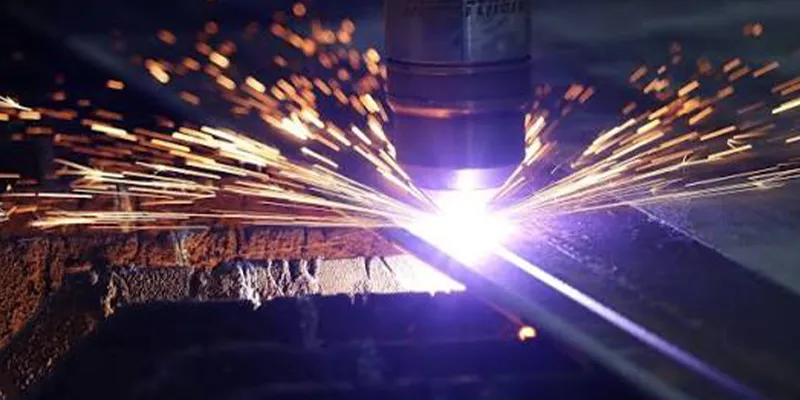
Thickness is the first filter in choosing a method because each process hits a physical wall. A laser must melt the full thickness with a very narrow beam and clear the molten metal with gas. That gets harder as plate thickens. Plasma carries more energy per cut and keeps working on thick plate. Waterjet is limited mainly by how tall the machine head can travel. For shearing, the limit is the force the machine can deliver.
|
Method |
Ideal or typical range |
Upper limit stated |
Notes |
|
Plasma |
Up to 50 mm (2 in) [1] |
Stainless up to 182 mm (6¼ in) with secondary work [1]; ISO 9013 plasma scope to 150 mm [3] |
Fast and low cost per cut through 50 mm [1] |
|
Laser |
Generally 1 in or less [2]; up to about 12.7 mm (0.5 in) on one 3 kW shop [8] |
ISO 9013 laser scope to 32 mm [3] |
In nitrogen cutting the beam supplies all the energy, so speed falls as thickness rises [7] |
|
Waterjet |
Not thickness-limited in the same way |
Up to 24 in; the machine's vertical travel is the only limit [2] |
Same machine setup for all materials [2]; slower as thickness rises |
|
Shearing |
Thin to moderate plate |
Guillotines handle carbon steel plate up to about 25 mm [13]; about 15 mm for stainless if derated 40% (EETA calculation) |
One rated machine: 3/8 in mild steel but 1/4 in stainless [12]; another: 6 mm mild steel but 4 mm stainless [14] |
Which cutting method is fastest and lowest in cost for stainless steel plate?
Shearing is the fastest and cheapest option for straight cuts in thin plate. For shaped parts, laser is fastest on thin stainless steel, plasma becomes faster and cheaper per cut as plate gets thicker, and waterjet is the slowest but often removes the need for secondary finishing.
Speed and cost move together, but not in a straight line. A Polish welding institute measured edge quality on 10 mm steel plate with each process. Cutting rates differed by an order of magnitude, as shown below.
|
Process (10 mm S355 steel plate, test bench) |
Cutting rate |
Relative to laser |
|
Conventional plasma (above water surface) |
1.6 to 2.25 m/min |
About 1.3 to 1.9 times faster |
|
Laser (oxygen assist) |
1.2 m/min |
Reference |
|
High-definition plasma |
0.7 m/min |
About 0.6 times |
|
Oxyfuel flame (carbon steel only) |
0.42 m/min |
About 0.35 times |
|
Abrasive waterjet |
0.13 to 0.18 m/min |
About one-seventh to one-ninth |
Stainless steel changes the thermal picture. With carbon steel, oxygen burns the metal and adds heat, which speeds the cut. Stainless steel is normally laser cut with inert nitrogen, so the beam must supply all the energy, and fiber-laser cutting speed drops sharply beyond about 4 mm of thickness, to roughly CO2-laser levels [7].
Plasma's advantage grows with thickness. Hypertherm reports that on mild steel, plasma is faster than a 15 kW laser above 16 mm, faster than a 20 kW laser above 20 mm, and faster than a 30 kW laser above 30 mm [1]. This is a plasma maker's comparison, but the direction is clear: the crossover point rises as laser power rises.
Equipment cost also shapes service pricing. Flow International lists capital cost ranges of $60,000 to $300,000 or more for plasma and for waterjet, and $200,000 to $1,000,000 or more for laser [2]. For a buyer, the better cost question is the price of the finished part: cutting length, number of pierces, and any grinding, pickling, or flattening required after the cut. A cheap cut that needs heavy edge cleanup can cost more than a pricier cut that needs none.
Do plasma and laser cutting harm the corrosion resistance of stainless steel?
They can, at the cut edge only. Heat leaves an oxide layer and a thin chromium-depleted skin that resist corrosion less well than the original surface, and these must be removed for the best corrosion performance. Waterjet and mechanical shearing add no heat, and nitrogen-assisted laser cutting produces a bright, oxide-free edge.
Stainless steel resists rust because chromium forms a thin, invisible protective film on the surface. Heat from cutting thickens the oxide and pulls chromium out of the metal just beneath it. Welding research institute TWI states that both the oxide scale and the chromium-depleted layer must be removed to maintain optimum corrosion resistance. Its guidance is that grinding followed by acid pickling gives the best result, with 360-grit or finer abrasive, and that hand wire brushing is less effective because it does not remove the depleted layer [5]. TWI's advice addresses weld heat tint.
The same oxide and chromium-depletion mechanism applies to heat-affected cut edges, which is our extension of that guidance. A metal-finishing technical Q&A on laser-cut stainless parts with blue scorch marks reaches a similar practical conclusion: a nitric passivation bath does not do a good job of removing the blue oxide, which needs pickling or abrasive removal [6].
Each process differs in how much oxide it leaves:
- Laser with nitrogen: inert assist gas keeps the cut edge clean and unoxidized [7]. Air assist leaves a gold, blue, or brown tint on stainless edges [8].
- Plasma: Hypertherm states the HAZ is typically under 0.25 mm and that correct process and gas selection gives minimal edge hardening and good weldability [1]. Flow notes that the assist gas used changes HAZ depth [2].
- Waterjet: no heat source, so the microstructure does not change. In the Polish test the waterjet edge hardness matched the base metal (about 140 HV10) [4].
- Shearing: no heat, so no thermal oxide, but the sheared edge is plastically deformed and work-hardened [10].
What the evidence does not show. We did not find published head-to-head pitting or critical-temperature data for stainless steel edges cut by each method. The hardness data above come from S355 carbon steel, not stainless steel. Austenitic stainless grades do not harden when cooled quickly the way carbon steels do, so for stainless the practical concern is oxide and chromium depletion rather than a brittle hard edge. A supplier-published case study on 40 mm thick 304 plate reported smoother, less tapered waterjet edges than laser, with laser-cut edges showing HAZ and oxide [15]. That test sits above the 32 mm laser range in ISO 9013 [3], so it should not be read as typical laser performance.
Practical guidance for higher-alloy plate. For duplex, super duplex, and nickel alloy plate, where heat input and edge condition matter more as alloy content rises, a conservative approach is to specify waterjet, or to require post-cut edge removal and an agreed acceptance test when thermal cutting is used.
Can stainless steel plate be sheared, and what are the limits?
Yes. Shearing is an economical way to make straight cuts in thin to moderate stainless plate, but a shear must be rated for about 40% less thickness than it is for carbon steel, and the cut edge carries a work-hardened band.
Stainless steel is stronger than mild steel, and austenitic grades also work harden: the more the metal is deformed, the harder it becomes. Together these mean a guillotine needs more power for the same thickness. Guidance reproduced from stainless fabrication literature says conventional press and guillotine equipment should normally be down-rated by 40% against its carbon steel rating, and blades must stay sharp, because dragging metal over a dull blade work-hardens it further [11].
Two independent machine listings fit this guidance. One rated machine shears 3/8 in mild steel but only 1/4 in stainless [12], and another shears 6 mm mild steel but 4 mm stainless [14]. Both are roughly one-third lower, in the same direction as the 40% rule of thumb.
Blade clearance also matters. At the same clearance, the smooth burnished zone on the cut edge is about 30% of the thickness in stainless steel but about 50% in low-carbon steel, so stainless needs tighter clearance to get the same edge [10]. A sheared edge normally shows rollover, a burnished band, a rougher fracture zone, a burr, and work hardening, and a hardened edge can crack if the part is formed afterward [10]. Plan for edge conditioning when a sheared blank will be bent, deep drawn, or welded.
How do edge quality and finishing needs compare across methods?
Waterjet produces the smoothest edge straight off the table, nitrogen laser cutting produces a clean, burr-free edge on thinner plate, plasma edges usually need grinding, and sheared edges show rollover and burr.

Edge condition decides how much work happens after cutting. The table summarizes typical results.
|
Method |
Typical cut edge on stainless |
Finishing to expect |
|
Plasma |
Small edge angle (about 1 to 3° on steel), some dross possible beyond rated capacity [1] |
Slag grinding and flattening typically needed; remove oxide layer if corrosion service demands it [2] |
|
Laser |
Nitrogen: bright, oxide-free, burr-free edge [7]. Oxygen or air: oxidized or tinted edge [8]. In a carbon steel test, laser edges had the highest surface roughness [4] |
Often none with nitrogen on thinner plate; pickling or abrasive removal for oxidized edges [6] |
|
Waterjet |
Satin-smooth edge; slight taper rising with thickness [2][15] |
Usually none [2] |
|
Shearing |
Rollover, burnished band, fracture zone, burr, work-hardened band [10] |
Deburring; edge conditioning before forming |
Sources: [1] Hypertherm; [2] Flow International (vendor); [4] Węglowski and Pfeifer (carbon steel); [6] Products Finishing Q&A; [7] Laser Focus World; [8] Lanier Metal Products; [10] The Fabricator; [15] GMA Garnet case study (supplier).
How do I choose between plasma, laser, waterjet, and shearing for my project?
Start with thickness and heat sensitivity. Use shearing for straight cuts in thin plate, laser for precise shaped parts up to about 25 mm, plasma for thicker plate where edges will be machined or ground, and waterjet when heat input must be avoided or the plate is very thick.
|
Situation |
Suggested method |
Why |
|
Straight cuts, thin plate, high volume |
Shearing |
Lowest cost and fastest; stay within the stainless-rated capacity of the shear |
|
Shaped parts, tight tolerance, up to about 25 mm |
Laser (nitrogen) |
Best-case accuracy near ±0.025 mm and a clean edge for welding or hygienic service |
|
Plate from about 16 to 50 mm, blanks to be machined, cost sensitive |
Plasma |
Faster and cheaper per cut at this thickness; leave a machining allowance |
|
Duplex or nickel alloy, or heat input not permitted |
Waterjet |
No HAZ and no thermal oxide; same setup for every material |
|
Plate thicker than 50 mm |
Waterjet (or plasma with finishing) |
Waterjet range quoted to 24 in; plasma cuts thicker but needs secondary work |
|
Weld-preparation bevels |
Plasma bevel or waterjet bevel |
Both makers describe bevel-cutting capability [1][2]; confirm angle tolerance for the weld procedure |
What should I include when requesting a quote for cut stainless steel plate?
Send the grade and specification, thickness, drawing, tolerance requirement, edge condition, and documentation needs. These six items let a processor select the right method and quote accurately.
Most quoting delays come from missing edge or documentation requirements. A complete request should state:
- Material: grade and specification, for example ASTM A240 304L, 316L, or 2205 plate, and the finish.
- Thickness and quantity: plate thickness, number of parts, and whether nesting from full sheets is acceptable.
- Geometry: a DXF or DWG drawing for shaped parts, or lengths and widths for straight cuts.
- Tolerance: an ISO 9013 range for thermal cuts [3], or a plus-minus tolerance for waterjet and shearing, plus any flatness limit after cutting.
- Edge condition: whether oxide-free edges are required, and whether grinding, pickling, or passivation to ASTM A967 or A380 is needed after cutting.
- Documentation: whether heat number marking and EN 10204 3.1 material certificates must carry through to the cut parts.
Frequently asked questions
Q: Which cutting method gives the cleanest edge on stainless steel plate?
A: Waterjet gives a satin-smooth edge with no heat tint and usually needs no secondary work [2]. Laser cutting with nitrogen assist also gives a bright, oxide-free edge on thinner plate [7].
Q: Does plasma cutting ruin stainless steel?
A: No. Plasma cutting creates a narrow heat-affected zone, typically under 0.25 mm on steel [1]. At the cut edge, the heat-formed oxide and chromium-depleted layer should be removed if the part will see corrosive service [5].
Q: Can stainless steel plate thicker than 25 mm be laser cut?
A: Sometimes, with high laser power, and ISO 9013 covers laser cuts up to 32 mm [3]. Cost and edge taper rise with thickness, so plasma or waterjet is usually the more practical choice above about 25 mm.
Q: Do I need to passivate stainless steel after cutting?
A: Passivation treatments such as ASTM A967 or A380 restore a clean surface after fabrication, but they do not reliably remove heat-formed blue or brown oxide. That oxide is better removed first by pickling or abrasive methods [6].
Q: Why is stainless steel harder to shear than mild steel?
A: Stainless steel has higher strength, and austenitic grades work harden as they deform. Shears are normally down-rated by about 40% compared with their carbon steel rating [11].
Q: Which method is best for duplex or nickel alloy plate?
A: Waterjet is the conservative choice because it adds no heat and uses the same setup for all materials [2]. Thermal cutting can also be used when the project specification allows it and post-cut edge removal and acceptance testing are agreed.
Sources and references
[1] Hypertherm. "Plasma attributes." https://www.hypertherm.com/solutions/technology/plasma-technology/plasma-attributes/ (plasma maker)
[2] Flow International. "Comparative Cutting." https://www.flowwaterjet.com/explore/waterjet-basics/comparative-cutting (waterjet maker)
[3] ISO 9013:2017, Thermal cutting: Classification of thermal cuts, geometrical product specification and quality tolerances. Scope as published by national standards bodies, e.g. https://www.evs.ee/en/iso-9013-2017
[4] Węglowski, M.S. and Pfeifer, T. "Influence of cutting technology on properties of the cut edges." Advances in Manufacturing Science and Technology 38(2), 2014. https://journals.pan.pl//Content/104261/PDF/10264-Volume38-Issue2-paper_05.pdf (S355 carbon steel, 10 mm)
[5] TWI. "How do I remove heat-tint formed during welding or improper heat treatment of stainless steels?" https://www.twi-global.com/technical-knowledge/faqs/faq-how-do-i-remove-heat-tint-formed-during-welding-or-improper-heat-treatment-of-stainless-steels
[6] Products Finishing. "Welding Through Lubricant on Cold-Rolled-Steel Tube/Cleaning." https://www.pfonline.com/articles/welding-through-lubricant-on-cold-rolled-steel-tube-cleaning
[7] Laser Focus World. "Cutting thick section steel with fiber lasers." https://laserfocusworld.com/industrial-laser-solutions/article/14216008/cutting-thick-section-steel-with-fiber-lasers
[8] Lanier Metal Products. "Fiber Laser Cutting." https://laniermetalproducts.com/laser-cutting (service provider)
[10] The Fabricator. "Improving blank edge conditions." https://www.thefabricator.com/thefabricator/article/bending/improving-blank-edge-conditions
[11] "Shearing of Stainless Steel" fabrication guidance. https://www.tubingchina.com/Shearing.htm (secondary reproduction; cross-checked against [12] and [14])
[12] Machine specification sheet, Model AS375-10 shear. https://machinehub.com/download/MachineFileAttachment/61791
[13] IEEE TechNav. "Shearing." https://technav.ieee.org/topic/shearing/ (summary reference, indicative)
[14] Exapro dealer listing, Gasparini CO/2004 hydraulic shear. https://www.exapro.com/gasparini-co2004-p260909273/
[15] GMA Garnet. "Comparative Study of Waterjet vs. Laser Cutting for Stainless Steel" (Jacquet Nova case study). https://gmagarnet.com/resource-hub/comparative-study-of-waterjet-vs.-laser-cutting-for-stainless-steel (abrasive supplier)
[16] SasaMetal. "Stainless Steel Cutting." https://www.sakysteel.com/news/stainless-steel-cutting (stainless supplier listing, 2018)