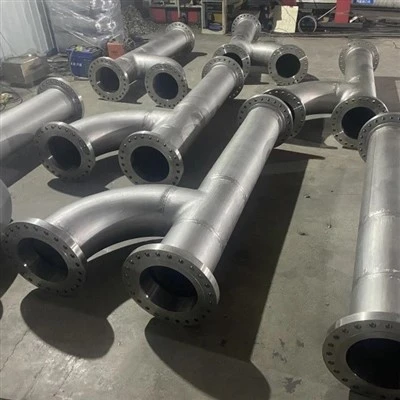
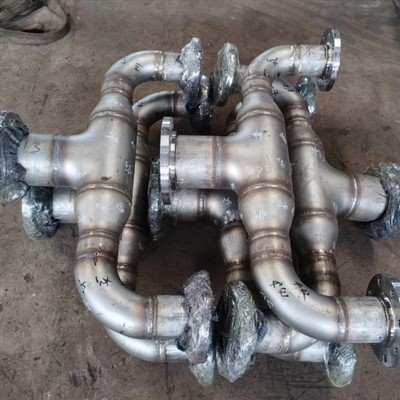
A gas turbine disc spins for tens of millions of cycles at temperatures that would soften ordinary steel. The part is only as good as the alloy and, just as important, the forging, heat treatment and inspection behind it.

This guide covers the nickel superalloy grades used for turbine forgings - Inconel 718, Waspaloy, Rene 41, X-750, 706, 625 and Hastelloy X - and the quality requirements (ASTM and AMS grades, forging reduction, grain flow, NDT and traceability) that separate an aerospace forging from a look-alike bar.
Why are forgings chosen over castings or plate for turbine rotating parts?
A forged turbine disc or shaft is chosen because forging aligns the grain flow with the stress path and lets 100% volumetric inspection prove the part is internally sound - two things casting cannot deliver at the same cost and risk for a fatigue-critical component.
A turbine disc is a rotating mass that sees low-cycle fatigue from each start-stop, high-cycle fatigue from blade passing, and steady centrifugal load. Casting can reproduce a complex shape near net, but its coarse, equiaxed grain and possible shrinkage porosity are weak points for fatigue and for ultrasonic inspectability. Open-die and closed-die forging break up the cast dendritic structure, refine the grain, and - through controlled deformation - steer the grain flow around the rim and bore where the stress is highest. That worked grain structure is also what makes the subsequent ultrasonic test meaningful: a clean forging gives a clean, readable UT trace.
Plate or bar cut to shape loses on both counts: the grain runs straight through the section instead of following the contour, and the material is not worked the way a forging is. For static, lower-stressed hardware such as casings and ducts, plate and sheet remain common - see our notes on Hastelloy X and Inconel 625 in the hot section.
Which nickel superalloys are used for gas turbine forgings?
The turbine forging family splits into precipitation-hardened disc/shaft alloys (Inconel 718, Waspaloy, Rene 41, X-750, 706, Incoloy 901) and solid-solution case/combustor alloys (Inconel 625, Hastelloy X) - each matched to a temperature band and a part.
Rotating parts that need high strength at temperature use gamma-prime (gamma') or gamma-double-prime (gamma'') precipitation-hardened nickel alloys. Structural and hot-section parts that need formability, oxidation resistance and moderate strength use solid-solution alloys. The table groups the common forging grades by the job they do.
Nickel superalloy forging grades used in gas turbines
|
Alloy (UNS) |
Strengthening |
Typical turbine forging parts |
Continuous service ceiling |
|
Inconel 718 (N07718) |
gamma'' + gamma' |
Discs, shafts, blades, seals, rings |
about 650 C (1200 F) |
|
Waspaloy (N07001) |
gamma' |
Compressor and rotor discs, shafts, spacers, rings |
650 C rotating / 870 C static |
|
Rene 41 (N07041) |
gamma' |
Hot-section sheet and forgings, afterburner hardware |
about 760-815 C (1400-1500 F) |
|
Inconel X-750 (N07750) |
gamma' |
Blades, bolts, springs, formed parts |
about 704 C (1300 F) |
|
Inconel 706 (N09706) |
gamma'' + gamma' |
Large discs and shafts |
about 650 C (1200 F) |
|
Incoloy 901 (N09901) |
gamma' |
Discs and shafts |
about 650 C (1200 F) |
|
Inconel 625 (N06625) |
solid solution |
Cases, rings, seals, ducts |
about 650 C (1200 F) |
|
Hastelloy X (N06002) |
solid solution |
Combustor liners, transition ducts, rings |
about 870 C (1600 F) oxidation-limited |
What makes Inconel 718 the workhorse turbine-disc alloy?
Inconel 718 earns its place because the gamma-double-prime precipitate gives very high strength yet forms slowly, so the alloy welds without strain-age cracking and ages uniformly through thick sections - exactly what a large disc or shaft needs.
718 is a Ni-Cr-Fe-Nb-Mo superalloy, UNS N07718 (W.Nr 2.4668), with roughly 50-55% nickel, 17-21% chromium, iron as balance, 4.75-5.50% niobium plus tantalum, 2.80-3.30% molybdenum, 0.65-1.15% titanium and 0.20-0.80% aluminium; carbon is capped at 0.08%. Its strength comes chiefly from the body-centred-tetragonal gamma-double-prime phase Ni3Nb, with a smaller gamma' (Ni3(Al,Ti)) contribution. Density is 8.19 g/cm3.
In the solution-treated and aged condition 718 reaches a minimum tensile strength of 1276 MPa (185 ksi) and 0.2% yield of 1034 MPa (150 ksi) with at least 12% elongation (AMS 5662), and it holds useful strength from cryogenic temperatures up to about 650 C (1200 F) continuous, with short-term capability toward 700 C (1290 F). Above roughly 700 C the gamma-double-prime coarsens and converts to the incoherent delta phase and the alloy loses its advantage.
Inconel 718 forging data (UNS N07718, to AMS 5662 / ASTM B637)
|
Property |
Value |
|
Nickel |
50.00 - 55.00 % |
|
Chromium |
17.00 - 21.00 % |
|
Niobium + tantalum |
4.75 - 5.50 % |
|
Molybdenum |
2.80 - 3.30 % |
|
Titanium / Aluminium |
0.65-1.15 % / 0.20-0.80 % |
|
Iron |
balance (about 16-20 %) |
|
Density |
8.19 g/cm3 (0.296 lb/in3) |
|
Min tensile (STA) |
1276 MPa (185 ksi) |
|
Min 0.2% yield (STA) |
1034 MPa (150 ksi) |
|
Min elongation (STA) |
12 % |
|
Heat treatment |
anneal 925-1010 C; double age 720 C 8h F.C. to 620 C, total 18h |
|
Specifications |
ASTM B637, B670; AMS 5662, 5663, 5664 |
Because gamma-double-prime precipitation is slow, 718 can be welded in the solution-treated condition and aged afterwards without the strain-age cracking that affects gamma-prime alloys such as Waspaloy and Rene 41. That weldability, plus uniform through-section response, is why 718 is specified from wellhead hardware to rocket turbopumps and, of course, turbine discs and shafts. See our Inconel 718 material properties page and Inconel 718 in aerospace for more.
When is Waspaloy the better choice than 718 for discs and shafts?
Choose Waspaloy (UNS N07001) when the part runs above roughly 620-650 C and needs creep-rupture life that 718 cannot deliver; choose 718 when you need the highest room-temperature strength and easy weldability below about 650 C.
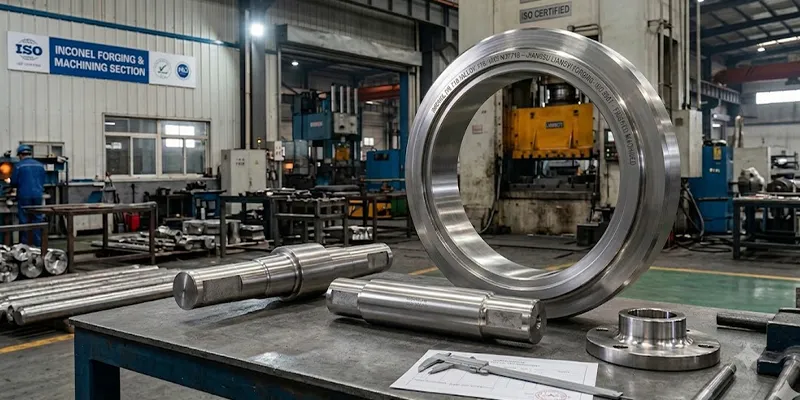
Waspaloy is a nickel-chromium-cobalt, gamma-prime-strengthened superalloy: about 58% nickel, 18-21% chromium, 12-15% cobalt, 3.5-5.0% molybdenum, 2.75-3.25% titanium and 1.20-1.60% aluminium, with iron capped at 2%. Cobalt and molybdenum give solid-solution strength; titanium and aluminium precipitate the gamma-prime Ni3(Al,Ti) that carries high-temperature strength. Gamma-prime is far more stable than the gamma-double-prime that strengthens 718, so Waspaloy keeps useful strength to about 650 C (1200 F) in rotating parts and to about 870 C (1600 F) in lower-stress static parts, and its creep-rupture strength beats 718 above roughly 620-650 C.
The trade is twofold. Waspaloy's aged minimum tensile is about 1441 MPa (209 ksi) with 0.2% yield about 1076 MPa (156 ksi) - lower than 718 at room temperature - and its gamma-prime makes it prone to strain-age cracking, so welding is harder. A typical three-stage heat treatment is solution at about 1080 C (1975 F) for 4 h, air cool; stabilise at about 845 C (1550 F) for 4 h, air cool; then age at about 760 C (1400 F) for 16 h, air cool (verify the exact cycle against the governing AMS release). Specifications are ASTM B637 and the AMS 5704 / 5706 / 5708 series.
Inconel 718 vs Waspaloy for turbine forgings
|
Attribute |
Inconel 718 (N07718) |
Waspaloy (N07001) |
|
Main strengthener |
gamma-double-prime Ni3Nb |
gamma-prime Ni3(Al,Ti) |
|
Cobalt |
1.0 % max |
12-15 % |
|
Min tensile (aged) |
1276 MPa (185 ksi) |
about 1441 MPa (209 ksi) |
|
Min 0.2% yield (aged) |
1034 MPa (150 ksi) |
about 1076 MPa (156 ksi) |
|
Rotating service limit |
about 650 C (1200 F) |
about 650 C (1200 F) |
|
Static / peak limit |
about 700 C short term |
870 C (1600 F) |
|
Creep above 620-650 C |
lower |
higher |
|
Weldability |
good (slow gamma'') |
harder (strain-age cracking) |
|
Typical parts |
discs, shafts, blades, rings |
rotor discs, shafts, seals, rings |
How do solid-solution alloys serve the hot section?
Inconel 625 and Hastelloy X are not age-hardened, so they trade peak strength for formability and oxidation/corrosion resistance - which is exactly what casings, rings, seals and combustor hardware need.
Solid-solution strengthening comes from dissolved molybdenum, niobium and chromium rather than a precipitated phase, so these alloys stay ductile and weldable and can be formed into large or thin shapes. Inconel 625 (UNS N06625: Ni balance, 20-23% Cr, 8-10% Mo, 3.15-4.15% Nb) is the standard choice for cases, rings, seals and ducts up to about 650 C, and its chloride pitting resistance is a bonus in marine and offshore turbines.
Hastelloy X (UNS N06002: Ni balance, 20.5-23% Cr, 17-20% Fe, 8-10% Mo, 0.2-1.0% W) carries the combustor: liners, transition ducts and afterburner hardware where oxidation resistance to about 870 C (1600 F) matters more than strength. Forging stock and forgings of both are covered by ASTM B564; see our Inconel 625 B564 forgings and Hastelloy X pages.
Beyond nickel: where the turbine needs oxidation resistance above about 900 C, cobalt-based alloys such as UNS R30188 (cobalt-nickel-chromium-tungsten with lanthanum) extend service toward 980 C (1800 F) for combustor and transition liners. These are supplied on request rather than as a standard stock grade.
What temperature limits apply to each alloy in turbine service?
The 'service temperature' of a turbine forging is not one number - it is the lower of the alloy's strength limit at the stress and the component's oxidation limit, and it differs by tens to hundreds of degrees between rotating and static parts.
Use the table as a planning guide, not a design value. The governing limit for a stressed rotating part is creep-rupture strength at the duty stress; for a lightly loaded combustor liner it is oxidation. Always confirm the allowable stress against the current ASME or OEM data sheet for the exact condition.
Continuous vs short-term temperature limits for turbine forging alloys
|
Alloy |
Continuous (stressed) |
Short-term / oxidation limit |
What limits it |
|
Inconel 718 |
about 650 C (1200 F) |
about 700 C (1290 F) |
gamma'' coarsening |
|
Waspaloy |
650 C (1200 F) rotating |
870 C (1600 F) static |
gamma' stability / oxidation |
|
Rene 41 |
about 760-815 C (1400-1500 F) |
higher for sheet |
gamma' stability |
|
Inconel X-750 |
about 704 C (1300 F) |
about 760 C (1400 F) |
gamma' stability |
|
Inconel 706 |
about 650 C (1200 F) |
about 700 C |
gamma'' coarsening |
|
Incoloy 901 |
about 650 C (1200 F) |
about 700 C |
gamma' stability |
|
Inconel 625 |
about 650 C (1200 F) |
about 700 C |
solid-solution strength |
|
Hastelloy X |
about 650 C (1200 F) stressed |
870 C (1600 F) oxidation |
oxidation |
|
UNS R30188 (Co) |
about 870 C (1600 F) |
980 C (1800 F) |
oxidation |
How does the strengthening precipitate differ between 718 and gamma-prime alloys?
718 is strengthened by gamma-double-prime (Ni3Nb), which forms slowly and gives good weldability; Waspaloy, Rene 41 and X-750 are strengthened by gamma-prime (Ni3(Al,Ti)), which is more temperature-stable but makes welding and repair harder.
Gamma-double-prime is an ordered body-centred-tetragonal phase. Because it nucleates and grows slowly, a 718 forging can be welded in the soft solution-treated condition and then aged to full strength without the intergranular cracking that gamma-prime alloys suffer during post-weld aging (strain-age cracking). Gamma-prime, by contrast, is coherent and extremely stable at temperature, which is why gamma-prime alloys outlast 718 in creep and rupture above about 620-650 C - but their welding windows are narrow and repairs need careful thermal control. The precipitate type, not the nickel content, is what decides both the temperature ceiling and the fabrication route.
What forging process turns a billet into a turbine disc?
Turbine discs are made by open-die or closed-die forging (often isothermal forging of 718) from a remelted billet, with the forging temperature chosen below the delta solvus for fine grain or above it for coarse grain - a deliberate choice, not an accident.

The starting point is a VIM+ESR (or triple-melt VIM+ESR+VAR) billet whose chemistry and cleanliness are documented to the heat. The billet is heated and worked - open-die for rings, blocks and preforms; closed-die (and increasingly isothermal) forging for near-net discs that minimise machining stock. For 718 the forging window is roughly 950-1150 C (1750-2100 F); turbine discs are commonly forged near 1000-1025 C.
A key control is sub-solvus versus super-solvus forging. Forging below the delta (Ni3Nb) solvus gives a fine, recrystallised grain structure with high strength, ductility and low-cycle-fatigue life - the choice for most 718 discs. Forging above the solvus gives a coarse grain structure that trades some strength for better creep/rupture life and slower dwell-fatigue crack growth, used where long-term creep governs. The grain size the process sets is later verified against ASTM E112 and is part of the forging's acceptance record.
Buy-to-fly ratio is the quiet cost driver. A precision-isothermal 718 disc can have a buy-to-fly ratio near 1.3:1 (little scrap), while a large open-die preform may start at 4:1 or more of billet that is machined away. The raw superalloy you pay for but never fly is a large part of the part's price - which is why near-net forging and HIP of premium material are worth pursuing.
What reduction ratio and grain-flow requirements do turbine forgings need?
A minimum forging reduction ratio of about 4:1 is typical, rising to 6:1-8:1 for rotating parts, and the grain flow must follow the part contour - both are verified, not assumed.
Reduction ratio is the ratio of starting cross-section to finished cross-section. It must be high enough to close casting porosity and break up the dendritic structure of the ingot; a common minimum is 4:1, and aerospace rotating parts are frequently specified at 6:1 to 8:1. But reduction alone is not enough: the direction of working must put the grain flow along the stress path. A disc rim loaded in hoop tension should show circumferential grain flow; a shaft in torsion and bending should show axial flow. A macroetch (see below) is the proof.
- Minimum reduction: about 4:1 typical; 6:1-8:1 for rotating discs and shafts.
- Grain flow: must follow the contour of the part, not run straight through it.
- Dendritic structure: fully broken up, with no centreline segregation or banding.
- Grain size: controlled and verified to the governing ASTM E112 requirement.
- Multi-directional forging: used for complex shapes to align flow in more than one direction.
What heat treatments are specified for precipitation-hardened turbine forgings?
Precipitation-hardened turbine forgings are supplied solution treated (and, for disc alloys, double-aged to the AMS/B637 cycle); the exact temperatures and holds are written into the purchase specification and recorded on the heat-treat chart.
718 is typically delivered solution treated at 925-1010 C (1700-1850 F), air cooled or faster, then double-aged: 720 C (1325 F) for 8 h, furnace cooled to 620 C (1150 F) and held for a total of 18 h, then air cooled. Waspaloy uses a solution-stabilise-age sequence as described above. The heat-treatment furnace cycle is charted and retained as part of the quality record, and special processes such as heat treating are expected to carry NADCAP accreditation for flight-critical parts. Over-aging or an out-of-window solution can move grain size and precipitate distribution enough to fail the mechanical tests, so the cycle is not negotiable.
Which ASTM and AMS specifications govern these forgings?
ASTM B637 governs precipitation-hardening nickel alloy bars, forgings and forging stock (718, X-750, 706, Waspaloy and similar); ASTM B564 governs the broader nickel-alloy forging family (625, 600, 825, X-750, 718, C-276 and others). The AMS releases name the exact heat-treat and test detail.
Specifying the ASTM grade alone is not enough - the AMS or OEM release decides the temper, the heat-treat cycle and the acceptance tests. The most-used releases for turbine forgings are listed below; our Inconel 718 ASTM B637 and Inconel 718 B564 flanges pages carry the grade-level detail.
Key specifications for gas-turbine alloy forgings
|
Alloy |
Product form spec |
Common AMS releases |
What it governs |
|
Inconel 718 |
ASTM B637, B670 |
AMS 5662 / 5663 / 5664 |
bars, forgings, heat treat |
|
Waspaloy |
ASTM B637 |
AMS 5704 / 5706 / 5708 |
bar, forging stock, forgings |
|
Rene 41 |
ASTM B637 |
AMS 5712 / 5713 |
bar, forgings |
|
Inconel X-750 |
ASTM B637, B564 |
AMS 5667 / 5668 / 5669 |
bars, forgings, strip |
|
Inconel 706 |
ASTM B637 |
AMS 5700 / 5701 |
bars, forgings |
|
Inconel 625 |
ASTM B564, B443 |
AMS 5666 / 5599 |
forgings, sheet |
|
Hastelloy X |
ASTM B564, B435 |
AMS 5754 / 5536 |
bar, forgings, sheet |
|
Incoloy 901 |
ASTM B637 |
AMS 5660 / 5661 |
bars, forgings |
What non-destructive testing is mandatory for turbine forgings?
A flight- or power-critical turbine forging gets 100% volumetric ultrasonic testing, surface penetrant or magnetic-particle testing, and a macroetch to prove grain flow - each to a named acceptance class.
No single test sees everything: a clean surface does not prove internal soundness, and a clean UT does not prove machining stock or surface condition. The three layers are complementary. The table maps each test to its usual standard for superalloy forgings.
Non-destructive testing stack for turbine forgings
|
Test |
Detects |
Common standard |
Note |
|
Ultrasonic (UT) |
internal cracks, inclusions, porosity, centreline |
AMS 2154 Class AA; ASTM A388 / ASTM E2375 |
100% volumetric; premium aerospace to Class AA |
|
Penetrant (PT / FPI) |
surface-breaking defects on non-magnetic superalloys |
ASTM E165 |
preferred for austenitic superalloys |
|
Magnetic particle (MT) |
surface / near-surface cracks on ferromagnetic parts |
ASTM E1444 |
use where the part is ferromagnetic |
|
Macroetch |
grain flow, segregation, banding, flakes |
ASTM E381 / ASTM E340 |
proves flow follows the contour |
|
Eddy current |
surface and near-surface on bar |
ASTM E309 |
rotating bar stock |
|
Positive material ID (PMI) |
grade confirmation |
ASTM E1473 / XRF |
verifies chemistry |
A passing surface test does not establish internal soundness, and a passing UT does not establish machining stock. The cheapest quote is often the one that leaves out the inspection that would catch the defect the price already hides - so name the acceptance class, not just 'UT tested'.
How is grain flow verified and why does it matter for fatigue?
Grain flow is verified by a macroetch of a representative section, and it matters because fatigue cracks follow the path of least resistance - a contour-following grain flow steers cracks away from the high-stress surface.
A macroetch (ASTM E381 for forgings, ASTM E340 generally) dissolves a prepared cross-section to reveal the deformed grain pattern. The report shows whether the flow lines wrap the disc rim, run axially along a shaft, or cut straight across a critical feature. Where flow is interrupted or runs transverse to the stress, that location becomes the fatigue-initiation candidate. For this reason the forging drawing - not just the chemistry - defines the required flow direction, and the macroetch is the evidence that the forging meets it.
What melt practice is required for aerospace-quality superalloy forgings?
Aerospace-quality turbine forgings start from vacuum induction melting plus electroslag remelting (VIM+ESR), and rotating parts are usually triple-melted (VIM+ESR+VAR); the melt route is traceable from the finished part back to the heat.
Remelting is what gives superalloy forgings their cleanliness and freedom from centreline segregation and stringer inclusions that would nucleate fatigue cracks. Vacuum induction melting controls chemistry and dissolved gases; electroslag remelting refines the ingot structure; vacuum arc remelting (the VAR step in triple melting) tightens compositional uniformity along the ingot. The heat number travels with the billet, the forging and every test coupon, so a suspect result can be traced to the exact melt. Our nickel alloy overview covers the grade families this melt practice serves.
What defects can appear in superalloy forgings and how are they prevented?
The defects that matter in turbine forgings are laps and folds, strain-rate microcracks, segregation and banding, hydrogen flakes (white spots) and inclusions - each is preventable by reduction ratio, temperature control and inspection.
Superalloys are unforgiving: they keep their strength at forging temperature, have a narrow working window and are strain-rate sensitive, so wrong temperature or ramping causes microcracking. Ingots can carry centreline segregation and, in large sections, hydrogen flakes - internal microcracks that may survive machining and cause sudden failure. The prevention stack is well established.
Common turbine-forging defects and their controls
|
Defect |
Cause |
Prevention / detection |
|
Laps / cold shuts |
folded metal that fails to weld |
smooth die flow, correct billet volume |
|
Microcracks |
wrong forging temp or strain rate |
controlled ramping; UT + macroetch |
|
Segregation / banding |
ingot solidification, low reduction |
homogenise; >=4:1 reduction; ASTM E381 |
|
Flakes (white spots) |
hydrogen in large sections |
low-H melt, dehydrogenation anneal, UT |
|
Inclusions |
cleanliness of melt |
VIM+ESR / triple melt; PMI + UT |
|
Centreline porosity |
insufficient working |
adequate reduction ratio; 100% UT |
What mechanical property tests prove a forging meets specification?
Acceptance is proved by tensile and hardness tests at minimum, plus stress-rupture or creep and impact where the duty demands, all taken from a specified coupon location and orientation.

The material test report records tensile properties per ASTM E8, hardness per ASTM E18, and - for high-temperature duty - stress-rupture or creep data per ASTM E139 and often Charpy impact per ASTM E23. Critically, the coupon is taken in the orientation and from the location the specification names (often a prolongation of the forging), so the numbers represent the part, not a convenient offcut. Grain size is reported to ASTM E112 and chemistry to the heat per ASTM E1473. A forging that passes chemistry but fails the oriented tensile is rejected - the test is the proof, not the certificate alone.
- Tensile: ASTM E8 (ultimate, yield, elongation).
- Hardness: ASTM E18 (often used for heat-treat verification).
- Stress rupture / creep: ASTM E139 (high-temperature duty).
- Impact: ASTM E23 (low-temperature or defect-tolerance cases).
- Grain size: ASTM E112 (coupon-specific).
- Chemistry: ASTM E1473 / spectro, to the heat.
How is traceability and documentation handled for turbine forgings?
An aerospace turbine forging is proven by its paperwork as much as its metal - an EN 10204 3.1 material test report with heat-number traceability, a certificate of conformance, first-article inspection and NADCAP records.
The documentation package maps every variable that could silently ruin a part: starting-stock identity and melt route, deformation sequence, thermal control, heat-treatment charts, straightening, surface conditioning, NDT results and test evidence. NADCAP (administered by the Performance Review Institute) audits special processes such as heat treating and NDT against aerospace requirements, and the audit results are public. A buyer should expect, at minimum, an MTR, a COC and a first-article inspection report backed by heat-treat charts and NDT reports.
- Material test report (MTR) with heat-number traceability - EN 10204 3.1 (3.2 with witness).
- Certificate of conformance (COC).
- First-article inspection (FAI) for new designs.
- Heat-treatment charts showing actual furnace cycles.
- NDT reports with acceptance criteria and results.
- NADCAP accreditation for heat treating and NDT where flight-critical.
What quality documents should the buyer demand in the RFQ?
Write the grade, part, load path, melt route, reduction ratio, grain-flow direction, heat-treat condition, NDT scope and documentation into the RFQ - then verify the first article before releasing production.
A vague 'Inconel forging' invitation produces a bar that looks right and fails later. The checklist below is the same one a turbine OEM uses; it is reproduced as a step procedure so it can be copied straight into a request for quotation.
Step 1. Name the exact grade and product specification: Do not write 'Inconel'. Specify Inconel 718 to AMS 5662 or AMS 5663, or Waspaloy to AMS 5708 - the grade and the issuing specification decide every downstream test.
Step 2. State the part, its load path and the operating temperature: Disc, shaft, case, seal or combustor hardware each see different stress and temperature; the duty sets the alloy and the grain-flow direction the forging must follow.
Step 3. Specify the melt route: State VIM+ESR for general duty or VIM+ESR+VAR (triple melt) for rotating parts, and require heat-number traceability back to the original melt.
Step 4. Set the forging reduction ratio and grain-flow direction: Call out a minimum 4:1 reduction (6:1-8:1 for rotating parts) and the contour the grain flow must follow; this is what the macroetch report must prove.
Step 5. Define the heat-treatment condition: Name the delivery condition - solution treated, or solution treated and aged to the AMS/B637 cycle - and who performs and certifies it.
Step 6. Set the NDT scope and acceptance class: Require 100% ultrasonic testing to AMS 2154 Class AA (or ASTM A388 / E2375), surface PT (ASTM E165) or MT (ASTM E1444), and a macroetch per ASTM E381 / E340; name the acceptance level for each.
Step 7. Require the documentation package: Demand an EN 10204 3.1 MTR, certificate of conformance, first-article inspection report, heat-treat charts and NDT reports, with NADCAP accreditation for special processes where the part is flight-critical.
How do you choose the right alloy and specification for a given turbine part?
Pick the alloy by temperature band and load - 718 for general discs/shafts to 650 C, Waspaloy or Rene 41 where creep above 650 C governs, 625 or Hastelloy X for cases and combustor - then name the ASTM grade and the AMS release, not just the trade name.
The decision is a three-way match of temperature, stress and fabricability. Below about 650 C with high strength and weldability needs, 718 is the default. Where creep above 620-650 C governs a rotating part, move to Waspaloy, and for the hottest stressed sheet/forgings to Rene 41.
Cases, rings, seals and ducts use solid-solution 625; combustor liners use Hastelloy X. Each choice then resolves to a specification: 718 to ASTM B637 / AMS 5662, Waspaloy to ASTM B637 / AMS 5708, and so on. Our Inconel and Hastelloy family pages list the stock grades behind these selections.
Alloy-selection guide by turbine part
|
Part |
Dominant need |
First-choice alloy |
Spec family |
|
Disc / shaft to 650 C |
strength + weldability |
Inconel 718 |
ASTM B637 / AMS 5662 |
|
Disc / shaft above 650 C |
creep-rupture |
Waspaloy or Rene 41 |
ASTM B637 / AMS 5708 |
|
Blades / bolts / springs |
gamma' strength |
Inconel X-750 |
ASTM B637 / AMS 5667 |
|
Case / ring / seal |
formability + corrosion |
Inconel 625 |
ASTM B564 / AMS 5666 |
|
Combustor liner / duct |
oxidation resistance |
Hastelloy X |
ASTM B564 / AMS 5754 |
|
Large disc, best forgeability |
forgeability + strength |
Inconel 706 |
ASTM B637 / AMS 5700 |
What are the cost and lead-time drivers for superalloy turbine forgings?
The price of a turbine forging is set by the alloy premium, the buy-to-fly ratio, the melt route, the NDT scope and the tooling - not by the per-kilogram bar price.
Nickel superalloys cost many times more than carbon or stainless steel, so the mass you pay for but never fly dominates the cost. Triple melting, 100% Class AA UT, macroetch and a full documentation package add real cost but are the proof the part is qualified. Lead time stacks from billet melt, forging reheats, heat treatment and NDT, with closed-die or isothermal tooling on top - plan for weeks to months, longer for large or flight-critical parts. Buying to a tight, correct specification and a near-net route is what actually controls both cost and schedule.
For comparison with the forged-product world, our ASME B16.11 forged fittings and forged pipe fittings pages cover the smaller forged components, and our Incoloy 800H / 800HT pages cover the high-temperature wrought alloys used in the warmer, lower-stress zones of the machine.
Frequently Asked Questions
The most common are Inconel 718 discs, shafts, blades, seals and rings; Waspaloy and Rene 41 rotor discs and shafts for hotter sections; Inconel X-750 blades, bolts and springs; and solid-solution Inconel 625 cases, rings and seals plus Hastelloy X combustor liners and transition ducts. See Inconel 718 and Hastelloy X for grade detail.
What is the difference between Inconel 718 and Waspaloy for forgings?
718 is strengthened by gamma-double-prime (Ni3Nb) and gives the highest room-temperature strength and easy weldability to about 650 C; Waspaloy is gamma-prime (Ni3(Al,Ti)) strengthened and keeps creep-rupture strength above roughly 620-650 C, to 870 C for static parts, but is harder to weld. Both are covered by ASTM B637.
What temperature can an Inconel 718 turbine forging withstand?
Inconel 718 is used continuously to about 650 C (1200 F) and for short periods toward 700 C (1290 F). Above roughly 700 C the gamma-double-prime precipitate coarsens and converts to delta phase and the alloy loses its strength advantage.
What does ASTM B637 cover?
ASTM B637 is the specification for precipitation-hardening nickel alloy bars, forgings and forging stock for high-temperature service - including Inconel 718, X-750, 706 and Waspaloy. The companion AMS releases (for example AMS 5662 for 718, AMS 5708 for Waspaloy) set the exact heat-treat and test detail.
What does ASTM B564 cover?
ASTM B564 covers nickel alloy forgings more broadly - Inconel 625, 600 and X-750, Hastelloy X and C-276, Incoloy 825, Monel 400 and others - for general corrosion- and heat-resistant service. It is the usual spec for solid-solution turbine forging stock and forgings.
Why is grain flow important in a turbine disc forging?
Fatigue cracks follow the path of least resistance, so grain flow that follows the disc contour steers cracks away from the high-stress surface. A macroetch per ASTM E381 / E340 is the evidence that the flow matches the drawing, and the flow direction is specified on the forging, not assumed.
What reduction ratio is needed for a turbine forging?
A minimum forging reduction of about 4:1 is typical, and rotating parts such as discs and shafts are commonly specified at 6:1 to 8:1 to break up the cast dendritic structure and close porosity.
What is sub-solvus versus super-solvus forging?
Forging 718 below the delta (Ni3Nb) solvus gives a fine recrystallised grain with high strength and good low-cycle-fatigue life; forging above the solvus gives a coarse grain with better creep/rupture life and slower dwell-fatigue crack growth. The choice is deliberate and the resulting grain size is verified to ASTM E112.
What non-destructive testing is required for turbine forgings?
A flight- or power-critical forging gets 100% volumetric ultrasonic testing (AMS 2154 Class AA, or ASTM A388 / ASTM E2375), surface penetrant (ASTM E165) or magnetic-particle (ASTM E1444) testing, and a macroetch (ASTM E381 / E340) to prove grain flow. No single test sees everything, so the layers are complementary.
What is AMS 2154 Class AA?
AMS 2154 is the aerospace specification for ultrasonic inspection of wrought metal; Class AA is its most stringent acceptance level, used for premium rotating parts such as turbine discs and shafts where internal soundness is critical.
What melt practice is used for aerospace superalloy forgings?
Aerospace-quality forgings start from vacuum induction melting plus electroslag remelting (VIM+ESR); rotating parts are usually triple-melted (VIM+ESR+VAR). The heat number traces the finished part back to the original melt.
Why are superalloy forgings hard to forge?
They retain strength at forging temperature, have a narrow working window and are strain-rate sensitive, so wrong temperature or ramping causes microcracking. Controlled heating, ramping and reduction are what make a clean forging.
What documents should a turbine forging shipment include?
At minimum an EN 10204 3.1 material test report with heat-number traceability, a certificate of conformance, first-article inspection, heat-treat charts and NDT reports; NADCAP accreditation is expected for flight-critical special processes.
Is Inconel 718 weldable?
Yes - better than most high-strength superalloys. Its gamma-double-prime precipitate forms slowly, so 718 can be welded in the solution-treated condition and aged afterwards without the strain-age cracking that affects gamma-prime alloys such as Waspaloy and Rene 41.
Can Hastelloy X be forged for turbine parts?
Yes. Hastelloy X (UNS N06002) is forged for combustor liners, transition ducts, rings and afterburner hardware where oxidation resistance to about 870 C (1600 F) matters more than peak strength. Forgings are covered by ASTM B564; see Hastelloy X.
What is the buy-to-fly ratio and why does it matter?
Buy-to-fly is the ratio of raw billet mass to finished part mass. Near-net isothermal forging of 718 can reach about 1.3:1, while a large open-die preform may start above 4:1; the superalloy you pay for but never fly is a large part of the part's cost, so near-net routes and HIP of premium material are worth pursuing.
How long does a superalloy turbine forging take to make?
Lead time stacks from billet melt, forging reheats, heat treatment and NDT, with closed-die or isothermal tooling on top - typically weeks to months, and longer for large or flight-critical parts. A tight, correct specification and a near-net route are what control schedule.
Do turbine forgings need hot isostatic pressing (HIP)?
HIP is used on premium forgings and near-net shapes to close internal porosity and improve fatigue and inspectability, and is common for critical rotating parts; whether it is required is decided by the purchase specification and the NDT acceptance class.