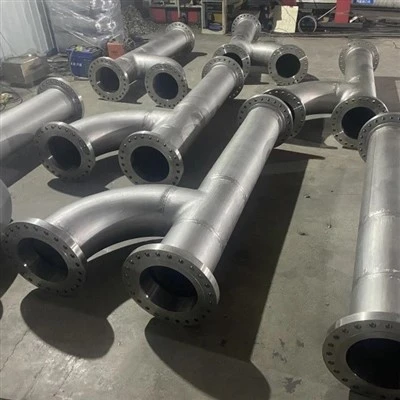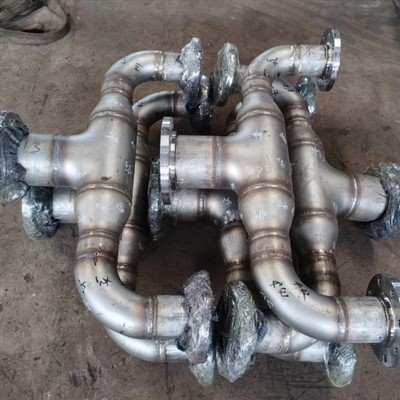
Forging squeezes hot metal into shape, and the way it is squeezed shapes the quality of the part. Nickel alloys such as Alloy 625, Monel 400, Alloy C-276, and Alloy 718 add a challenge: they stay strong at high temperature, so they resist being formed, and they have a narrow range of temperatures where they can be worked safely.
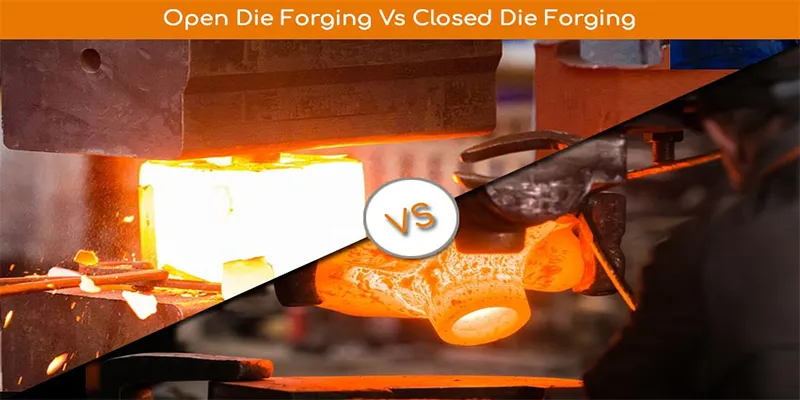
This guide compares the two main forging routes, open-die and closed-die, across process, quality, cost, and inspection, with the conclusion first in each section and the reasoning after. The figures quoted come from published producer data and specifications; always confirm values against the current specification and your supplier's procedures.
Key Takeaways
- Open-die forging shapes metal between flat or simple dies by repeated strokes, so it suits large, heavy, or low-volume parts. Closed-die forging squeezes the metal into shaped die cavities, so it suits repeatable, near-net shapes.
- Nickel alloys resist deformation at hot-working temperature and must be worked in a defined window: for example, Alloy 625 is hot-worked at 1650–2150 °F (900–1177 °C), with heavy work as close to the top of that range as possible.
- Closed-die forging gives tighter shapes, better-matched grain flow, and less machining; in one published example, a near-net closed-die forging avoided about 30% of the volume of an open-die pancake, a difference worth about 10–20% of article cost or more for expensive nickel-base alloys.
- Open-die forging gives deep, well-worked structure in large sections without dedicated tooling, but leaves more material to machine off.
- Neither route is automatically better: quality depends on temperature control, reduction, heat treatment, and inspection. Specify the required properties and tests, not just the process name.
- ASTM B564 is the principal specification for nickel alloy forgings, and its minimum properties depend on alloy, condition, and section size.
What Is the Difference Between Open-Die and Closed-Die Forging?
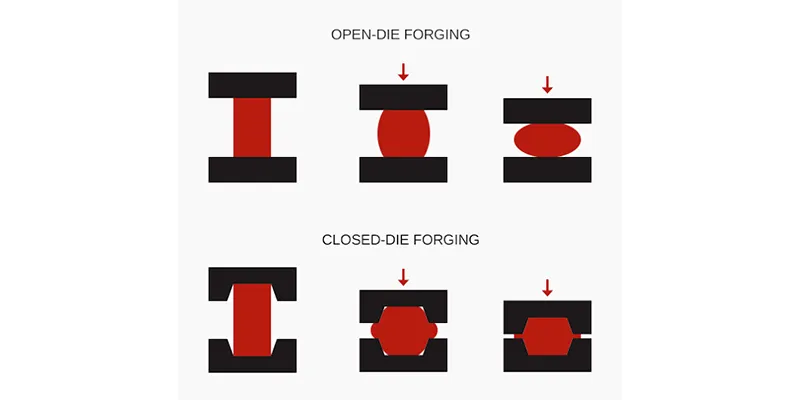
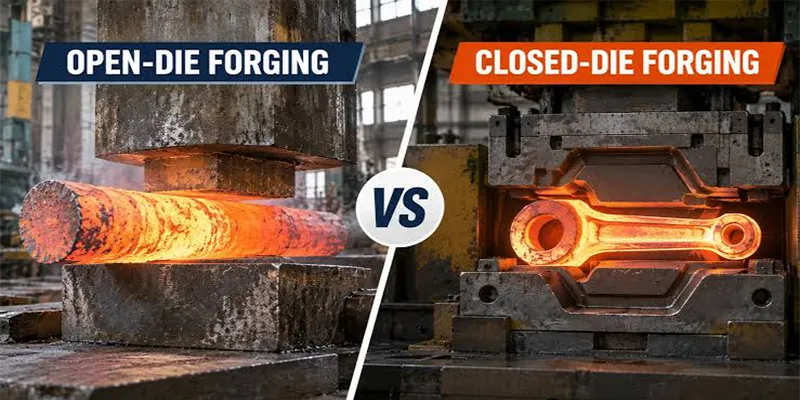
In open-die forging, the heated metal is deformed between flat or simply shaped dies that never fully enclose it; in closed-die forging, the metal is pressed into precisely shaped die cavities that give the part its form.
Open-die forging works like a blacksmith with a very large press: the workpiece is squeezed, stretched, and turned between strokes to draw it out, upset it, or form it into shafts, discs, blocks, and rings. The final shape depends on the operator's skill and a planned sequence of steps. Closed-die forging, also called impression-die forging, uses a matched pair of dies with the part shape cut into them. The metal flows to fill the cavity, with a small amount of excess squeezed out as flash that is trimmed off. A third route, ring rolling, expands a pierced disc into a seamless ring and is often grouped with open-die forging for flanges and casings.
Why Are Nickel Alloys Harder to Forge Than Steel?
Nickel alloys are harder to forge because they keep high strength at hot-working temperatures, which means more force is needed, and because they have a narrow safe temperature window where working too cold can cause cracking and working too hot can damage the metal.
Alloy 625 was designed to retain strength at high temperature, so the producer notes that it resists deformation when hot and needs adequately powerful equipment. Monel 400, by contrast, is described as softer than many steels when hot, but it can be permanently damaged if heated above 2150 °F (1175 °C).
Superalloys like Alloy 718 have an even tighter window, where reported forging temperatures sit around 950–1,050 °C, because their strengthening phases and grain size respond sharply to temperature and strain rate. At lower temperatures the flow stress rises quickly, which is why published methods set a minimum starting temperature for forging blanks.
|
Alloy |
Hot-working range |
Heavy work |
Notes from producer data |
|
Alloy 625 (N06625) |
1650–2150 °F (900–1177 °C) |
Near 2150 °F; furnace not above 2150 °F |
Lighter work can continue down to about 1700 °F (927 °C) |
|
Monel 400 (N04400) |
1200–2150 °F (650–1175 °C) |
About 1700–2150 °F |
Do not heat above 2150 °F; avoid overheating from rapid heavy forging |
|
Alloy C-276 (N10276) |
1600–2250 °F (870–1230 °C) |
Above 2000 °F (1090 °C) |
Normally annealed at 2100–2150 °F, then rapidly cooled |
|
Alloy 718 (N07718) |
About 950–1050 °C (1740–1920 °F) reported |
Controlled by strain rate and grain size goals |
Precipitation-hardening alloy; heat treatment sets final strength |
Because of these limits, nickel alloy forging depends on accurate furnace control, rapid transfer, reheating when the workpiece cools, and, for some high-strength grades, heated or isothermal dies that keep the metal and die at similar temperatures. Furnace fuel and lubricants should be low in sulfur, since sulfur can embrittle nickel alloys at high temperature.
How Do Open-Die and Closed-Die Forging Compare Across Key Dimensions?
Open-die forging offers flexibility for large and low-volume parts with little tooling, while closed-die forging offers repeatability, closer shapes, and less machining for medium-to-high volumes.
|
Dimension |
Open-die forging |
Closed-die forging |
|
Shape complexity |
Simple shapes: bars, shafts, discs, rings, blocks |
Complex, near-net shapes with features |
|
Part size and weight |
Very large and heavy parts possible |
Limited by press capacity and die size; typically small to medium |
|
Tooling |
General-purpose dies; little part-specific tooling |
Dedicated die set per part; tooling cost and lead time |
|
Dimensional accuracy |
Rough forgings with generous machining allowance |
Closer tolerances; less machining |
|
Material utilization |
Lower; more material removed |
Higher; near-net shape |
|
Grain flow |
Aligned along drawn direction; broad control by process plan |
Follows the part contour; consistent from piece to piece |
|
Internal structure |
Heavy, well-planned working can break down ingot structure in thick sections |
Strong working in the cavity; depends on preform design |
|
Repeatability |
Depends on operator and plan |
High, once the process is qualified |
|
Typical products |
Shafts, rings, valve bodies, large blocks, discs |
Valve parts, fittings, turbine components, flanges in volume |
|
Best quantity |
One-offs to small batches |
Medium to high volume |
Which Process Gives Better Grain Flow and Mechanical Properties?
Closed-die forging usually gives grain flow that follows the part's shape and more consistent properties from piece to piece, while open-die forging gives strong, well-worked structure in large sections; in both, properties are controlled by temperature, reduction, and heat treatment more than by the process name.
Grain flow is the direction in which the metal's grains are stretched during forging, similar to the grain in a piece of wood. Parts are strongest and most fatigue-resistant when the grain flow runs along the main loads, rather than being cut across by machining. Closed-die forging shapes the flow around the contour of the part, so critical features like flanges and bosses get continuous flow. Open-die forging draws and upsets the metal, which refines coarse cast structure in thick sections, but machining a complex part from a simple forging cuts across the flow.
Heat treatment resets much of the structure in corrosion-resistant alloys. ASTM B564 notes that hot working or reannealing may change properties significantly depending on working history and temperatures, and for Alloy 625 Grade 2 it requires solution annealing at a minimum of 2150 °F (1177 °C) followed by a water quench or rapid cooling. For precipitation-hardening alloys like Alloy 718, grain size is controlled through forging temperature and strain rate, with published methods reaching very fine grains (ASTM 12–14) in isothermal forging, which then coarsen to about ASTM 6–8 after a supersolvus anneal. These are aerospace-grade controls, but they show how process and heat treatment work together.
How Much Machining and Material Does Each Process Save or Waste?
Closed-die near-net-shape forging wastes less expensive nickel alloy: in one published comparison for a large turbine disk, the near-net closed-die forging avoided about 30% of the volume of the open-die pancake, a difference that can amount to 10–20% or more of the article cost.
The comparison comes from a patent describing large disk forgings from nickel-base superalloys, where a flat open-die pancake and a near-net closed-die forging were laid over the final machined part. Both need some final machining, but the pancake needs much more. Because nickel alloys cost far more per kilogram than steel, material removed as chips is a real cost, and long machining time on hard, work-hardening alloys adds to it. The saving is larger for complex parts and large volumes, and smaller for simple shapes or one-off parts.
A simple break-even formula
Break-even quantity = tooling cost / saving per part
Example with hypothetical numbers: if a closed-die tool set costs $60,000 and saves $150 per part in material and machining, the break-even is about 400 parts. Below that, open-die forging may be cheaper; above it, closed-die wins. Replace the numbers with real quotations for your part.
What Defects and Risks Should You Watch For in Each Process?
The main risks are working outside the temperature window (cracking or overheating), laps and folds, uneven grain structure, and sulfur contamination; closed-die adds die wear and underfill risks, while open-die adds coarse or uneven structure in poorly worked zones.
|
Risk |
Open-die |
Closed-die |
Control |
|
Cracking from working too cold |
Possible on long, repeated strokes |
Possible at thin sections and cold die contact |
Reheat in time; use heated dies for high-strength grades |
|
Overheating or incipient melting |
Possible in furnace or from rapid heavy work |
Possible at flash and thin ribs |
Hold furnace at limit; control strike speed |
|
Laps and folds |
From poor turning and upsetting sequence |
From die design and parting line |
Process planning, preform design, inspection |
|
Uneven or coarse grains |
Dead zones in poorly worked areas |
Local strain variation in complex shapes |
Reduction planning, grain size testing |
|
Surface contamination |
Scale, lubricants, furnace atmosphere |
Die lubricants and scale |
Low-sulfur fuel and lubricant; pickling or machining of scale |
|
Die wear and drift |
Not applicable |
Dimensional drift as dies wear |
Die maintenance; gauge checks |
What Does ASTM B564 Require for Nickel Alloy Forgings?
ASTM B564 covers forgings of many nickel alloys, including UNS N04400, N06625, N08825, N10276, and N06022, and sets minimum tensile properties that depend on alloy, heat-treat condition, and section size.
B564 applies whichever forging route is used. Minimum properties for annealed or solution-annealed forgings are shown below as examples drawn from published copies of the specification. Values differ by edition and section size; for instance, Alloy 625 annealed forgings up to 4 in. (102 mm) must meet higher minimums than those over 4 to 10 in. (254 mm), which reflects the difficulty of fully working and uniformly heat-treating thick sections. Check the current edition for exact requirements.
|
Alloy and condition |
Tensile min, ksi (MPa) |
Yield min, ksi (MPa) |
Elongation min, % |
|
Alloy 625, annealed, up to 4 in. (102 mm) |
120 (827) |
60 (414) |
30 |
|
Alloy 625, annealed, over 4 to 10 in. |
110 (758) |
50 (345) |
25 |
|
Monel 400 (N04400), annealed |
70 (483) |
25 (172) |
35 |
|
Alloy 825 (N08825), annealed |
85 (586) |
35 (241) |
30 |
|
Alloy C-276 (N10276), solution annealed |
100 (690) |
41 (283) |
40 |
Other specifications apply to specific uses: ASTM B637 covers precipitation-hardenable nickel alloy bar, forgings, and forging stock for moderate and high temperature service, and ASTM B462 and ASME B16.5 relate to forged flanges and fittings. Aerospace products use AMS specifications such as AMS 5662 and 5663 for Alloy 718.
How Do Cost and Lead Time Compare?
Open-die forging has the lower upfront cost and shorter lead time because it needs little part-specific tooling, while closed-die forging has higher tooling cost and longer lead time but lower cost per part at volume.
Closed-die dies must be designed, machined from hot-work tool steel or, for isothermal forging, nickel-base die alloys, and proven with trial forgings. That investment pays off when many identical parts are needed. Open-die forging avoids the tooling step and can start with billet or ingot, but each part needs more machining. Total cost therefore depends on quantity, size, complexity, alloy price, machining cost, and scrap risk. Request quotations that include machining allowance and testing so the comparison is on finished cost.
Which Process Should You Choose?
Choose open-die or ring-rolled forgings for large, simple, or low-volume parts, and closed-die forgings for repeatable, complex, near-net parts in medium to high volume; use hot-die or isothermal methods only for high-strength alloys that demand tight grain control.

|
Situation |
Recommended route |
Reason |
Watch for |
|
Large shaft, block, or disc; one or few pieces |
Open-die |
No tooling; handles large sections |
More machining stock |
|
Seamless ring or flange blank |
Ring rolling |
Efficient ring geometry with circumferential flow |
Section size and tolerance |
|
Medium-to-high volume valve or fitting body |
Closed-die |
Repeatable near-net shape |
Tooling payback |
|
Complex shape in costly nickel alloy |
Closed-die (near-net) |
Saves material and machining |
Die wear; flash trimming |
|
Turbine-grade disc in alloy 718 or similar |
Hot-die or isothermal closed-die |
Grain size control |
Specialist capability and cost |
|
Prototype or urgent small order |
Open-die or machined from bar |
Faster start |
Property requirements |
What Should You Specify When Ordering Nickel Alloy Forgings?
Specify the alloy and UNS number, product specification, heat-treat condition, size and machining allowance, required properties and tests, and documentation, and state any requirements for grain flow or process route, so the supplier can quote the right process.
Alloy and UNS number (for example UNS N06625) and the governing specification, such as ASTM B564.
- Condition: annealed, solution annealed, or aged, and for Alloy 625 whether Grade 1 or Grade 2 applies.
- Dimensions: finished drawing, machining allowance, and section size, since properties depend on it.
- Process: open-die, closed-die, or ring-rolled, or the performance needed, such as grain flow direction or minimum reduction.
- Testing: tensile test location and direction, hardness, grain size, ultrasonic and liquid penetrant inspection, and corrosion testing where the service demands it.
- Documentation: mill test certificates, heat-treatment records, traceability to the heat, and any third-party inspection.
Frequently Asked Questions
What is the difference between open-die and closed-die forging?
Open-die forging deforms metal between flat or simple dies that do not enclose it, suiting large or low-volume parts. Closed-die forging presses metal into shaped die cavities, giving near-net, repeatable shapes.
What temperature range is used to forge Inconel 625?
The producer's hot-working range for Alloy 625 is 1650–2150 °F (900–1177 °C), with heavy working as close to 2150 °F as possible.
Why do nickel alloys need more forging force than steel?
Many nickel alloys, especially Alloy 625, keep high strength at hot-working temperatures, so they resist deformation and need powerful presses and careful temperature control.
Which process gives better grain flow?
Closed-die forging shapes grain flow around the part contour and is repeatable, while open-die forging refines structure in large sections. Final properties depend on temperature, reduction, and heat treatment.
What standard covers nickel alloy forgings?
ASTM B564 covers forgings of many nickel alloys, including N04400, N06625, N08825, N10276, and N06022, with minimum properties by alloy, condition, and section size. ASTM B637 covers precipitation-hardenable alloys such as Alloy 718.
Is closed-die forging always cheaper?
No. It saves material and machining per part but needs dies. It is usually cheaper for medium-to-high volumes and complex shapes, and open-die is usually cheaper for large or low-volume parts.
Can forging change corrosion resistance?
Forging and the heat treatment that follows set grain size and phase distribution, so improper temperatures or cooling can reduce corrosion resistance. Specify the required condition and corrosion testing for demanding services.