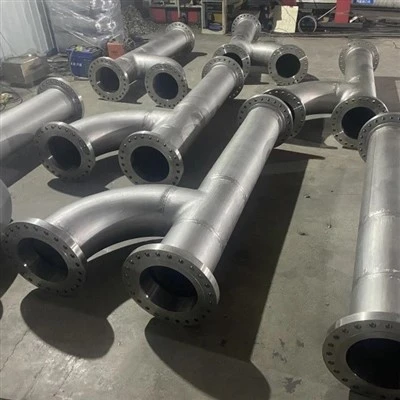
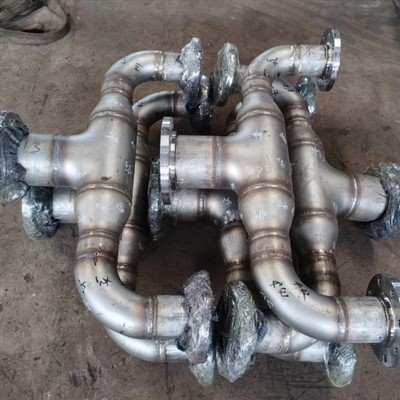
Choosing between a forged flange and a plate flange looks like a buying decision, but it is really a materials-and-code decision. A forged flange is shaped by squeezing hot steel or nickel-alloy billet under pressure in dies, so the metal's internal crystal structure follows the part's contour. A plate flange is simply cut - by plasma, laser, or oxy-fuel - from a flat rolled plate disk and then machined to size.
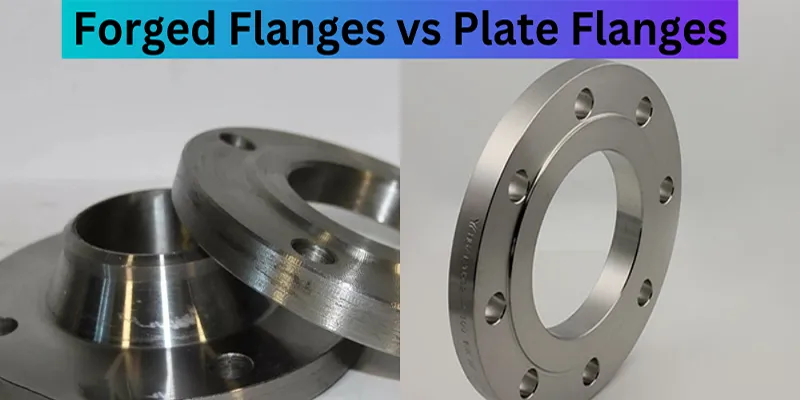
Two flanges can carry identical ASME B16.5 dimensions and look the same bolted up in a line. Internally, they are not the same part. This guide explains the difference in plain language, quantifies the strength gap, and - most importantly - spells out when the ASME code actually permits a plate flange at all.
Forged flanges have continuous, contour-following grain flow and are the code-default for pressure-retaining hubbed joints; plate flanges are cheaper but, under ASME B16.5, are limited to blind flanges and certain small reducing flanges without hubs.
What Is a Forged Flange and How Is It Made?
A forged flange is shaped by pressing and hammering hot metal in dies, rather than by cutting it from a flat slab.
To make one, a stainless or nickel-alloy billet is heated to forging temperature, then upset and pressed or hammered into a die that approximates the finished flange. The part is trimmed, machined to the B16.5/B16.47 dimension, heat-treated (solution-annealed for austenitic stainless and nickel alloys), and inspected - typically by ultrasonic, liquid-penetrant, or magnetic-particle examination - before being marked and stamped.
The compressive deformation does three useful things at once: it closes internal porosity and voids left from melting, it breaks up the coarse as-cast grain into a fine, uniform grain size, and it stretches impurities into "stringers" that follow the direction the metal was pushed. Stainless forged flanges are produced to ASTM A182 (for example F304/L, F316/L, F51 duplex); nickel-alloy forgings run to ASTM B564 (Alloy 600/600, Alloy 625, Alloy C276, Alloy 800, Alloy 400).
What Is a Plate Flange and How Is It Made?
A plate flange is a flat disk cut from rolled metal plate and faced on a lathe - there is no forging and no formed hub.
Production is straightforward: select a plate of the required grade (stainless to ASTM A240; nickel-alloy plate to the relevant B-series plate specification), cut a circular blank by plasma, oxy-fuel, or laser, drill the bolt circle, and machine the sealing face. Because no plastic deformation is involved, a plate blank cannot form a weld-neck taper or a reinforced hub; the part stays as flat as the plate it came from.
The trade-off is obvious: material scrap is low, machining is minimal, and lead time is short. The limitation is just as obvious - the finished disk carries only the properties the as-rolled plate already had, in every direction. Plate flanges therefore show up most often as blind flanges, large-diameter lap-joint backing flanges, and low-pressure utility service.
What Is "Grain Flow," and Why Does It Matter?
Grain flow is the direction in which the metal's microscopic crystals and impurity stringers are stretched; metal is strong along its grain and weak across it - the same way a wooden board is strong along its fibers.
Think of a tree. Saw across the trunk and you see concentric growth rings - that is "end grain." Saw along the trunk and the fibers run the length of the board; that board resists bending along the fibers and splits easily across them. Steel behaves the same way. When metal is worked - rolled or forged - its grains and tiny non-metallic inclusions are smeared out into long "stringers" that follow the working direction. A load carried parallel to that grain path is carried well; a load that pulls across the grain, or that exposes cut grain ends, creates a natural runway for cracks.
How Does Grain Flow Actually Differ Between the Two?
In a forged flange the grain wraps continuously around the bore, hub, and bolt circle; in a plate flange the grain runs flat and ends abruptly at every machined surface.
Forging pushes billet material outward and upward into the die, so the deformed grain follows the flange's contour - like the growth rings in a carved bowl. There is no exposed cross-grain surface at the bore or hub; the principal stresses (bolt tension, internal pressure, hub bending) run with the flow lines.
A plate flange is different. The plate was rolled flat, so all its grain lines run horizontally, parallel to the two large faces. When the shop bores the center and turns the outside diameter, it cuts that grain short and exposes "end grain" on the bore, the hub face, and the sealing face. Those exposed ends are precisely where laminations, inclusion stringers, and fatigue cracks open first.
Which Is Stronger - Forged or Plate?
On a published minimum-spec data sheet the two can look equal; in service the forging is meaningfully tougher, more fatigue-resistant, and sound through its thickness.
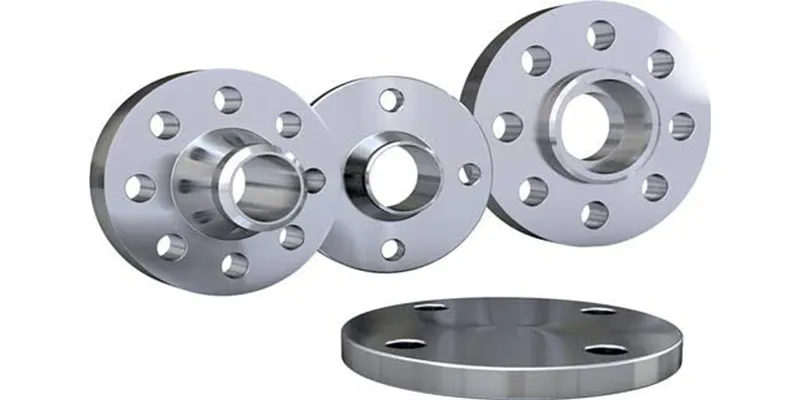
The minimum mechanicals are in fact close. ASTM A182 F316 (forged) and ASTM A240 Grade 316 (plate) both specify a minimum tensile strength of roughly 515 MPa (75 ksi) and a minimum yield of roughly 205 MPa (30 ksi). So a side-by-side spec-sheet comparison by itself does not reveal the engineering gap.
The forging advantage shows up where the minimum numbers do not capture it:
- Toughness. Hot working refines the coarse as-cast grain, raising Charpy V-notch impact toughness - the ability to absorb shock without fracture.
- Soundness. The compressive force welds shut internal voids, pipes, and porosity that can remain in plate stock; ultrasonic soundness is far more consistent.
- Working-direction strength. Forgings typically show roughly 10–15% higher strength in the working direction than the annealed plate minimum, because grain size is refined and defects are closed.
- Through-thickness. Plate is weakest through its own thickness (the "Z" direction) - exactly the direction bolt preload and gasket pressure pull. Laminations and stringers act as pre-existing cracks under that load.
- Fatigue. Thermal cycling and pressure cycling propagate cracks perpendicular to grain. Continuous forged flow lines steer cracks away; plate end grain gives them a straight path.
Does the Manufacturing Route Change Corrosion Resistance?
Yes - especially in stainless and nickel alloys - because plate flanges leave exposed end grain at the sealing face and bore where corrosion starts.
Rolling stretches sulfide and oxide inclusions into stringers that lie open at any cut face. Exposed end grain on the gasket contact face and on the bore is a classic initiation site for pitting, crevice corrosion, and chloride stress-corrosion cracking - exactly the failure modes engineers fight in 304/316 and in nickel alloys handling seawater, brines, and acidic process chemistry. A forged flange wraps its grain around those surfaces, so the sealing face carries long grain rather than end grain.
This is one reason sour-service (NACE MR0175 / ISO 15156), offshore, and subsea specifications almost universally call for forgings. In corrosive service the cost difference is not just material - it is leak risk at a spinning bolted joint.
Are Plate Flanges Even Legal Under ASME B16.5?
For nearly every flange type that actually joins to pipe, ASME B16.5 requires cast or forged material; plate is code-permissible only for blind flanges and certain small reducing flanges without hubs.
The ASME B16.5 scope is explicit. The standard covers "flanges and flanged fittings made from cast or forged materials," and separately allows "blind flanges and certain reducing flanges made from cast, forged, or plate materials." The second sentence is the entire legal universe for plate. In practical terms:
- Blind flanges: the cover that closes a line end - this is where plate is routinely and correctly used.
- Reducing flanges without hubs: those whose smaller outlet falls below the size threshold in B16.5 Table 6, so the code does not require a hub.
- Not permitted from plate: weld neck (WN), threaded (THD), socket-weld (SW), slip-on (SO), and hubbed lap-joint flanges are "flanged fittings" and must be cast or forged. A "plate slip-on" machined from disk is not B16.5-compliant as a pressure-retaining fitting, even if its dimensions match.
Nickel alloys are held to a stricter reading. ASME B16 cases (for example B16 Case 21 for UNS N06674) state that, except for blind flanges and reducing flanges without hubs, flanges shall be made only from forgings to ASTM B564. For large diameters, ASME B16.47 (NPS 26 through NPS 60; Series A aligns with MSS SP-44, Series B with API 605) likewise favors forgings for hubbed service, though large plate blind flanges are common in low-pressure, non-critical duct and water duty.
Engineering note: a fabricator may machine a plate "special," but doing so takes the part outside B16.5 and requires documented engineering approval under the applicable piping code (ASME B31.3) or pressure-vessel code (ASME BPVC Section VIII). It is not a drop-in substitute.
Which ASTM Material Specs Actually Apply?
For stainless, forged flanges run to ASTM A182 and plate to ASTM A240; for nickel alloys, forgings run to ASTM B564 and plate to the matching B-series plate spec - you cannot certify a forging out of plate.
- Stainless forgings: ASTM A182 - forged/rolled flanges, fittings, and valve parts for high-temperature service: F304/L, F316/L, F321, F347, F51/F55 duplex.
- Stainless plate: ASTM A240 - chromium and chromium-nickel stainless plate, sheet, and strip for pressure vessels: Gr 304/L, Gr 316/L.
- Nickel-alloy forgings: ASTM B564 - nickel-alloy forgings: UNS N06600 (Alloy 600), N06625 (Alloy 625), N10276 (Alloy C276), N08800 (Alloy 800), N04400 (Alloy 400).
- Nickel-alloy plate: e.g., ASTM B424 (Alloy 800 plate), B575 (Alloy C276 plate), B463 (Alloy 20 plate). The product form must match the specification. A B564-grade forging cannot be produced by cutting B575 plate and then stamped as a forging; the mill test report must show the correct form and the correct heat treatment.
How Do Cost and Lead Time Compare?
Plate flanges are cheaper and faster off the shelf; forged flanges cost more up front but are the only code-compliant option for hubbed, high-pressure, or critical service.
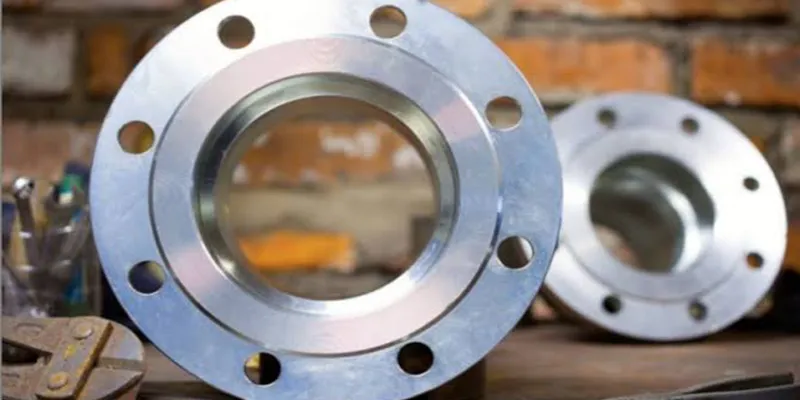
A plate blank is cut from commodity sheet with near-net shape and little machining, so unit cost is low and lead days are short - an advantage that grows in large, thin diameters. A forging requires billet, press and die time, heat treatment, and non-destructive examination, so the piece price is higher and delivery is longer, though per-unit cost falls at volume as tooling amortizes.
The total-cost view is what usually settles the argument. A plate flange that is not code-compliant, or that leaks or cracks early in cyclic or corrosive service, carries replacement, shutdown, and safety costs that dwarf the initial saving. Specifying the cheapest per-piece option is therefore only rational where the code and the duty both allow it.
So When Should You Specify Forged vs Plate?
Specify forged whenever pressure, temperature, cyclic loading, corrosive service, or a hubbed flange type is involved; reserve plate for code-permitted blind and low-pressure non-critical duty.
Choose forged when:
- the flange type is weld neck, slip-on, threaded, socket-weld, or lap-joint with a hub - B16.5 requires it anyway;
- the rating is Class 300 and above, or the service is high-temperature, cryogenic, or thermally/pressure-cycled;
- the duty is sour service (NACE MR0175), offshore, subsea, or nuclear;
- you are welding nickel-alloy process piping (B564) in chloride or acidic service;
- the gasket face must resist end-grain attack on a low-leakage critical joint.
Choose plate (within code limits) when:
- you need a blind flange for an inspection or blank end in Class 150, non-hazardous service;
- the job is large-diameter, low-pressure air, water, or duct work (for example B16.47 blind backing);
- this is temporary or utility service where a forging would be over-specified;
- any deviation from B16.5 is covered by documented engineering approval under B31.3 or BPVC Section VIII.
Side-by-Side Summary
Table 1 distills the comparison for direct specification use.
|
Dimension |
Forged Flange |
Plate Flange |
|
Raw form |
Hot-worked billet, pressed in dies |
Disk cut from rolled plate |
|
Stainless spec |
ASTM A182 (F304/L, F316/L, F51) |
ASTM A240 (Gr 304/L, 316/L) |
|
Nickel-alloy spec |
ASTM B564 forgings |
B-series plate (B424, B575, …) |
|
Grain flow |
Continuous, follows the part contour |
Flat, parallel; cut ends exposed |
|
Hubbed types (WN/SO/SW/THD/LJ) |
Yes - code-standard |
No - not B16.5-compliant |
|
ASME B16.5 use |
Full pressure-retaining range |
Blind flanges; small no-hub reducing only |
|
Toughness / fatigue |
High; refined grain, voids closed |
As-rolled; weaker through thickness |
|
End-grain corrosion risk |
Low on sealing face and bore |
Elevated at machined cut faces |
|
Relative cost |
Higher |
Lower |
|
Typical lead time |
Longer |
Shorter |
|
Best-fit service |
High pressure, cycling, sour/offshore, nickel-alloy process |
Low pressure, blind, non-critical |
Table 1 - Forged vs plate flange comparison across manufacturing, code, performance, and cost.
Frequently Asked Questions
What is the difference between a forged flange and a plate flange?
A forged flange is hot-shaped from a billet so the metal grain follows the flange's contour; a plate flange is cut from flat rolled plate. Forged flanges are tougher, more fatigue-resistant, and code-required for hubbed pressure service; plate flanges are cheaper but restricted by ASME B16.5 to blind and certain no-hub reducing flanges.
Are plate flanges ASME B16.5 compliant?
Only for blind flanges and reducing flanges without hubs below the B16.5 size threshold. All other hubbed flanges - weld neck, slip-on, threaded, socket-weld - must be made from cast or forged material.
Which is stronger, a forged or a plate flange?
For the same alloy (for example 316), the published minimum tensile and yield strengths can be equal, but the forging delivers higher impact toughness, longer fatigue life, and reliable through-thickness soundness because hot working refines the grain and closes internal voids.