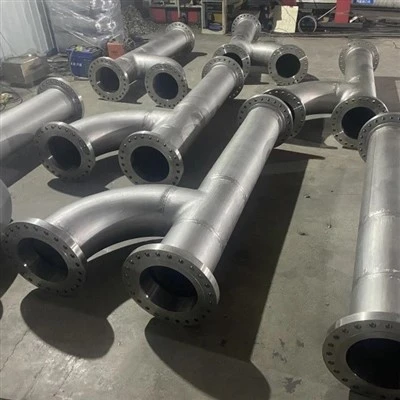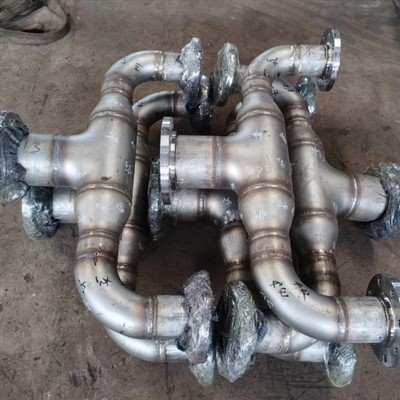
Whenever a pipe splits in two, the fitting that does the splitting decides how much pressure is lost and how evenly the flow is shared. A standard 90° tee makes the fluid turn a sharp corner. A lateral and a true wye replace that corner with a gentler angle. The two are often confused, and some catalogs use the names interchangeably, yet their geometry and behavior are different.

This guide explains the difference, shows the pressure loss and flow-split numbers using the Crane TP-410 method, and gives a practical way to choose between them. Each section states the conclusion first, then the reasoning. Values are illustrative screening calculations; final design belongs to your piping engineer.
Key Takeaways
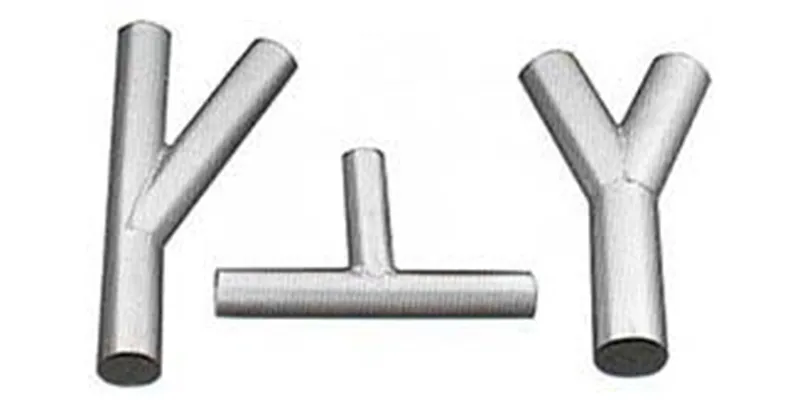
- A lateral has a straight run with one branch at about 45°. A true wye splits an inlet into two symmetric legs shaped like a letter Y. Trade usage varies, so always confirm the geometry on the drawing.
- Both reduce loss compared with a 90° tee. For equal-size pipes with half the flow going to the branch, the Crane method gives a branch loss coefficient of about 0.38 for a 45° lateral versus 1.16 for a 90° tee, roughly 67% lower.
- In an example with water at 2 m/s in NPS 4 pipe, that difference is 2.31 kPa for the tee branch versus 0.76 kPa for the lateral branch at a 50% split.
- A true wye is symmetric, so identical legs share flow equally. A lateral favors the straight run, so the split is uneven unless the downstream legs have substantial resistance.
- Merging flows also lose less through a 45° junction than through a 90° tee, and a 45° entry reduces the chance of a side stream disturbing the main flow.
- Specify the included angle, sizes, schedule, and standard (for example ASME B16.9) on the purchase order, because the words lateral, wye, and true wye are not used the same way by every supplier.
What Is the Difference Between a Lateral and a True Wye?
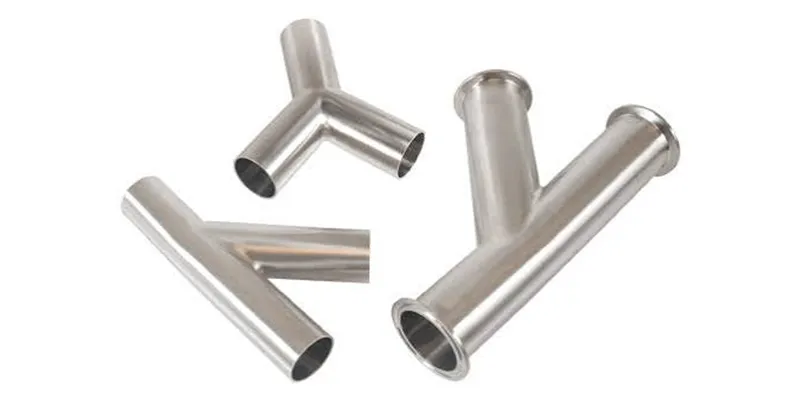
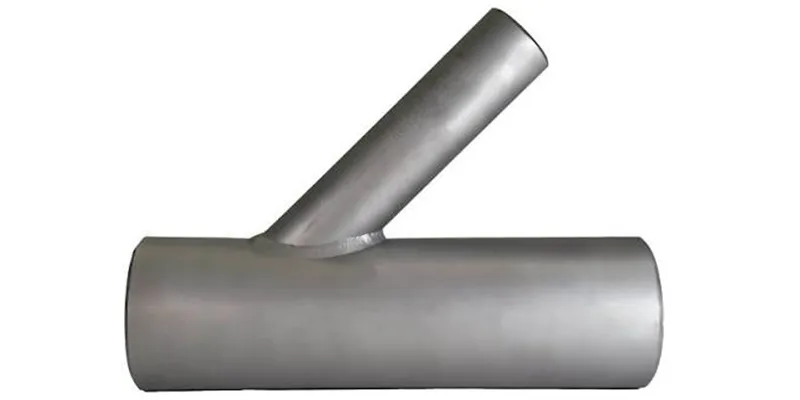
A lateral is a fitting with a straight run and a single branch joined at an angle, usually 45°; a true wye is a symmetric fitting in which one inlet divides into two legs angled equally away from the inlet axis, forming a Y.
The names come from different trades, which is why they cause confusion. A person from the plumbing trade may ask for a "wye" while a steamfitter asks for a "45° lateral," and both may mean the same fitting. In piping and fittings catalogs, a lateral is a straight through-run with one 45° branch, and a true wye divides a main inlet symmetrically into two outlets.
Sources describe the legs of a true wye in more than one way: some describe two legs each 22.5° off the inlet axis (45° between them), others describe two 45° outlets. Because of this, the angle must be stated explicitly when ordering.
|
Term |
Typical meaning |
Notes |
|
Lateral (45° lateral) |
Straight run with one branch at 45° |
Asymmetric; the run continues straight; covered in ASME B16.9 for butt-weld fittings |
|
Wye (plumbing usage) |
Often the same as a lateral |
Catalog usage varies by trade and material |
|
True wye (true Y) |
Inlet splits into two symmetric legs |
Symmetric about the inlet axis; angle per leg must be specified |
|
Lateral tee |
A lateral with an elbow on the branch so the branch ends perpendicular to the run |
Combination of lateral and 45° bend |
|
Latrolet (lateral outlet) |
A forged branch outlet fitting welded onto the run |
A branch connection, not a full fitting body |
How Do Lateral and True Wye Fittings Compare Overall?
A lateral is simpler, usually easier to source, and works well when one path is clearly the main run; a true wye gives symmetric, even distribution for two equal legs, with a more compact symmetric layout but less common availability.
|
Dimension |
Lateral (45°) |
True wye |
|
Geometry |
Straight run plus one 45° branch |
Two symmetric legs from one inlet |
|
Flow split between equal legs |
Favors the run; uneven unless legs resist strongly |
Even by symmetry |
|
Pressure loss vs 90° tee |
Substantially lower at the branch |
Lower; each leg turns through a smaller angle |
|
Merging flows |
Smooth entry from the branch; run has little disturbance |
Symmetric merging of two equal streams |
|
Layout |
Fits a main line with side connections |
Fits a symmetric header or manifold |
|
Support and orientation |
Horizontal inlet: good support from the ground |
Vertical inlet: symmetric forces on supports |
|
Availability |
Widely available in butt-weld sizes |
Often made to order or fabricated |
A practical rule from fittings suppliers is that for a horizontal inlet, a lateral supports itself well from below, while for a vertical inlet a true wye gives balanced loads. Use that as a layout hint, then check against your support design.
Which Fitting Has Lower Pressure Loss?
A 45° lateral or wye has far lower branch loss than a 90° tee: at an equal split in equal-size pipes, the Crane method gives K of about 0.38 for the 45° branch versus 1.16 for the 90° tee branch, a reduction of roughly 67%.
Pressure loss through a fitting is written as ΔP = K × ρ × V² / 2, where K is the loss coefficient, ρ is fluid density, and V is the velocity in the combined (inlet) pipe. A smaller K means less pressure lost. The table below uses the Crane Technical Paper 410 method for diverging flow with equal-size run and branch, as implemented in an open-source engineering library. The run loss coefficient in this method is the same for the tee and the lateral (it ranges from about -0.06 to 0.30 depending on the split), so the benefit shows up on the branch.
|
Branch share of flow |
90° tee branch K |
60° wye branch K |
45° lateral branch K |
Lateral vs tee |
|
25% to branch |
1.04 |
0.87 |
0.60 |
-42% |
|
50% to branch |
1.16 |
0.75 |
0.38 |
-67% |
|
75% to branch |
1.37 |
0.70 |
0.30 |
-78% |
|
100% to branch |
1.69 |
0.78 |
0.35 |
-79% |
The table shows two patterns. First, the 45° branch has a lower loss at every split. Second, a 90° tee is hardest on the flow when most of it turns the corner: at 100% to the branch, K is about 1.69 for the tee but about 0.35 for the 45° lateral.
What does that mean in pressure terms?
For water (1,000 kg/m³) at 2 m/s in the combined NPS 4 Schedule 40S pipe, the branch pressure loss is:
|
Branch share of flow |
90° tee (kPa) |
45° lateral (kPa) |
Saving (kPa) |
Reduction |
|
25% to branch |
2.08 |
1.21 |
0.87 |
-42% |
|
50% to branch |
2.31 |
0.76 |
1.55 |
-67% |
|
75% to branch |
2.73 |
0.60 |
2.13 |
-78% |
|
100% to branch |
3.38 |
0.70 |
2.68 |
-79% |
At a 50% split the tee branch loses 2.31 kPa and the lateral branch loses 0.76 kPa. A difference of about 1.55 kPa per junction looks small, but it multiplies across many junctions, and it rises with the square of velocity: doubling the velocity multiplies the loss by four. In high-velocity or high-density services, or in systems with many branches, the saving becomes significant, and for slurry or particle-laden flow a gentler angle also reduces erosion.
How Does Branch Angle Change the Loss?
Smaller turning angles give lower loss: using the Crane method at an equal split, K falls from about 1.16 at 90° to 0.75 at 60°, 0.38 at 45°, and 0.23 at 22.5°; a true wye benefits because each leg turns through only part of the full angle.
The table below varies the branch angle in the same method. It describes a single branch leaving a straight run, so for a true wye it is a guide to the trend, not an exact data set. For a symmetric Y, use the manufacturer's loss data, Idelchik's handbook of hydraulic resistance, or a CFD study.
|
Branch angle from inlet axis |
K at 50% split |
K at 100% to branch |
Note |
|
90° |
1.16 |
1.69 |
Standard tee |
|
75° |
1.16 |
1.69 |
|
|
60° |
0.75 |
0.78 |
|
|
45° |
0.38 |
0.35 |
Lateral / wye branch |
|
30° |
0.27 |
0.16 |
|
|
22.5° |
0.23 |
0.09 |
Gentle leg of a narrow Y |
The method treats angles of about 75° and above like a tee, so the benefit only appears once the branch angle drops below that range. Even so, the trend is clear: the less the flow has to turn, the less energy it loses.
How Does Flow Distribution Differ Between a Lateral and a True Wye?
A true wye splits flow evenly between two identical legs because it is symmetric, while a lateral sends a larger share through the straight run; the unevenness shrinks as the resistance of the downstream legs increases.
Flow divides itself so that the pressure drop along each path is equal. In a lateral, the run path and the branch path have different junction losses, so a perfectly symmetric downstream system still splits unevenly. The table shows the share of flow going to the branch for two identical downstream legs, each with a resistance K_leg measured in velocity heads. As a rough guide, a K_leg of 10 corresponds to about 500 pipe diameters of straight pipe at a friction factor of 0.02.
|
Downstream leg resistance K_leg |
90° tee: share to branch |
45° lateral: share to branch |
True wye (symmetric) |
|
2 |
23% |
36% |
50% |
|
5 |
38% |
46% |
50% |
|
10 |
44% |
48% |
50% |
|
20 |
47% |
49% |
50% |
|
50 |
49% |
50% |
50% |
When the downstream legs are short and low in resistance (K_leg of 2), the tee sends only 23% of the flow to the branch and the lateral sends 36%, far from an even split. When each leg has a resistance of 20 (long runs, valves, or equipment), both come within a few percentage points of 50%, but the lateral is still closer. These are screening estimates under the stated assumptions. If equal distribution matters, as it does for parallel heat exchangers, reactors, or burners, use a symmetric fitting and include balancing devices where the process requires it.
What Happens When Flows Merge Instead of Split?
For merging flows, a 45° junction also loses less than a 90° tee: at a 50/50 merge in equal-size pipes, the Crane method gives a branch K of about 0.22 for the lateral versus 0.41 for the tee.
|
Merging flows, equal pipe sizes |
90° tee |
45° lateral |
|
Branch stream loss K (50/50 merge) |
0.41 |
0.22 |
|
Run stream loss K (50/50 merge) |
0.53 |
0.40 |
Merging at a shallow angle lets the side stream join the main flow in nearly the same direction, which reduces the mixing turbulence and the chance of the side stream pushing back into the run. Collection headers, drains, and process returns benefit from this. The values are referenced to the combined outlet velocity.
What If the Branch Is Smaller Than the Run?
With a reducing branch, losses rise sharply for both fittings, but the 45° lateral stays well below the 90° tee; in the example, a half-size branch taking half the flow has K of about 1.85 for the lateral versus 5.00 for the tee.
|
Reducing branch (branch diameter = 0.5 × run) |
90° reducing tee K |
45° reducing lateral K |
|
25% of flow to a half-size branch |
2.00 |
0.54 |
|
50% of flow to a half-size branch |
5.00 |
1.85 |
These values are referenced to the velocity in the larger combined pipe, and the high numbers come from the high velocity in the small branch. Use them to compare fittings, not as a substitute for a full hydraulic calculation with the branch's own friction and fittings included.
How Do Standards, Dimensions, and Manufacturing Differ?
Butt-weld laterals are covered by ASME B16.9 and are widely made in stainless steel, for example ASTM A403 WP304 and WP316, while true wyes are often supplied as fabricated or special fittings with the dimensions agreed with the supplier.
Standards: ASME B16.9 covers factory-made wrought butt-weld fittings, including laterals; dimensions such as center-to-end lengths are specified per size. Forged socket-weld and threaded laterals fall under ASME B16.11.
Materials: stainless steel (A403 WP304/304L, WP316/316L), duplex, and nickel alloys are common for corrosive or high-temperature services.
Wall thickness: match the schedule of the connected pipe, and confirm the pressure rating of fabricated or reducing versions with the supplier.
Fabricated junctions: the crotch (the sharp intersection of branch and run) is the highest-stress location, so fabricated fittings need good weld quality, inspection, and reinforcement in line with the design code; forged and seamless fittings give more uniform stress distribution.
Size: laterals are physically long compared with tees, so allow for the extra length in the layout.
For branch reinforcement and design pressure rules, follow the governing code, such as ASME B31.3 for process piping, and consult the manufacturer for pressure ratings of non-standard fittings.
Where Are Laterals and True Wyes Typically Used?
They are used where lower loss, less erosion, or easier cleaning matters: slurry and particle-laden lines, drains and waste lines, collection headers, and process lines where a gentler branch reduces turbulence.
- Slurry and abrasive service: the gentle angle lowers impact on the fitting wall and reduces erosion compared with a 90° tee.
- Drains, vents, and waste lines: a 45° entry keeps the flow moving downstream and eases cleanout.
- Collection headers: merging side streams at an angle reduces disturbance to the main flow.
- Symmetric splits: a true wye feeds two equal legs, such as parallel equipment lines.
- Where space is tight, or the branch is short and low-flow, a standard tee may still be the better, more economical choice.
How Should You Choose Between a Lateral, a True Wye, and a Tee?
Choose a lateral when one path is the main run and loss or erosion matters, a true wye when two equal legs must share flow evenly, and a standard tee when space is limited and the added loss is acceptable.
|
Situation |
Recommended fitting |
Reason |
|
Side branch off a main run, loss or erosion matters |
45° lateral |
Branch K roughly one-third of a tee at an equal split |
|
Two equal parallel legs needing even flow |
True wye (symmetric) |
Symmetry gives an even split for identical legs |
|
Merging side stream into a main line |
45° lateral |
Smoother entry, less disturbance |
|
Slurry, abrasive, or fouling service |
Lateral or true wye |
Gentler angle reduces impact and eases cleaning |
|
Very tight space, low flow, low velocity |
Standard 90° tee |
Compact; loss is small at low velocity |
|
Large pressure budget concerns across many junctions |
Lateral or wye |
Savings add up with velocity squared |
What Should You Specify When Ordering a Lateral or True Wye?
State the fitting type and angle in plain terms, the sizes of run and branch, schedule or wall, standard, material, and end connections, and attach a drawing, so there is no ambiguity between wye, lateral, and true wye.
- Type and geometry: "45° lateral" or "true wye, X° included angle," with a sketch showing which leg is the run.
- Sizes: run size and branch size, noting if the fitting is reducing.
- Wall thickness or schedule for each end.
- Standard and material: for example ASME B16.9 and ASTM A403 WP316L, with required certificates.
- End connections: butt-weld, socket-weld, or threaded, and the corresponding standard.
- Special requirements: forged vs fabricated, inspection and NDT, cleanliness, and pressure rating for non-standard designs.
Frequently Asked Questions
What is the difference between a lateral and a true wye?
A lateral is a straight run with one branch at about 45°. A true wye splits one inlet into two symmetric legs. Trade usage varies, and some suppliers treat "wye" and "lateral" as the same fitting, so specify the geometry.
Which has lower pressure drop, a wye or a tee?
A wye or lateral. At an equal split in equal-size pipes, the Crane method gives a branch loss coefficient of about 0.38 for a 45° lateral compared with about 1.16 for a 90° tee.
Does a true wye give an even flow split?
Yes, for two identical downstream legs, because the fitting is symmetric. A lateral favors the straight run, so its split is uneven unless the downstream legs have high resistance.
What standard covers lateral fittings?
ASME B16.9 covers butt-weld laterals, and ASME B16.11 covers forged socket-weld and threaded fittings. True wyes are often supplied as special or fabricated fittings.
Is a lateral the same as a lateral tee?
Not exactly. A lateral tee is a lateral combined with a 45° elbow on the branch so the branch ends perpendicular to the run.
Are wye fittings better for slurry?
Often yes. The 45° angle reduces impact and turbulence compared with a 90° tee, which lowers erosion and eases cleanout, though material and velocity still govern erosion life.
How do I calculate pressure loss through a branch fitting?
Use ΔP = K × ρ × V² / 2, where K comes from a method such as Crane TP-410 or Idelchik, and V is the velocity in the combined pipe. K depends on the flow split, pipe sizes, and branch angle.