Introduction
A nuclear power plant is one of the most demanding material environments on Earth. Alloys used inside a reactor must simultaneously withstand extreme heat, intense radiation, high-pressure water or steam, and the relentless threat of corrosion - often for 60 years or more without replacement. Get the material wrong, and the consequences range from costly unplanned shutdowns to, in the worst case, radioactive contamination.

This guide explains which stainless steel and nickel alloy grades are used in nuclear power plants, why each was chosen, and what international standards govern their use. Whether you are an engineer specifying materials for a new build, a procurement professional sourcing bar and plate, or simply someone curious about how nuclear plants are built to last, this article gives you the facts you need.
Nuclear Materials Explain
Nuclear plant components face four simultaneous threats that no single ordinary metal can handle alone:
High temperature: Primary coolant in a pressurised water reactor (PWR) runs at approximately 315–343 °C at 155 bar. Boiling water reactors (BWRs) operate at around 285 °C at 75 bar.
High radiation: Fast neutrons and gamma rays cause atomic displacement in metals, leading to swelling, embrittlement, and changes in mechanical properties over time - a phenomenon called radiation damage or irradiation embrittlement.
Corrosion: Hot, high-purity water with dissolved hydrogen (PWRs) or oxygenated water (BWRs) creates a highly aggressive electrochemical environment, particularly dangerous for alloys susceptible to stress corrosion cracking (SCC).
Long service life: Nuclear plants are licensed for 40–60 years, with life-extension programmes pushing components to 80 years. Materials must maintain properties across this entire lifespan.
Austenitic stainless steels and nickel-based superalloys are the solution to this challenge. Their face-centred cubic (FCC) crystal structures resist radiation embrittlement, their high chromium content forms a self-healing oxide layer against corrosion, and their elevated nickel content provides exceptional toughness across the full operating temperature range.
Nickel Alloys in Nuclear Power Plants

If there is one alloy that defines modern PWR design, it is Alloy 690 (UNS N06690). With a nominal composition of 58 % nickel, 29 % chromium, and 9 % iron, Alloy 690 was developed specifically to replace the older Alloy 600, which proved susceptible to primary water stress corrosion cracking (PWSCC) after years in service - a problem that led to extremely expensive repairs at plants worldwide.
The "TT" designation stands for thermally treated, a controlled heat treatment that precipitates chromium carbides at grain boundaries. This microstructural modification virtually eliminates PWSCC susceptibility. Today, every new PWR steam generator built globally - from the AP1000 in China and the United States to the EPR in France and the United Kingdom - specifies Alloy 690TT tubing per ASME SB-163, typically in 19.05 mm OD with a 1.07 mm wall thickness. A single large steam generator contains approximately 10,000 tubes, each up to 21 metres long.
Alloy 625 brings a powerful combination of properties to nuclear service: ≥ 58 % nickel, 20–23 % chromium, and 8–10 % molybdenum. Its tensile strength in the annealed condition exceeds 830 MPa, and it retains excellent toughness after neutron irradiation. These characteristics make Alloy 625 the material of choice for reactor core internals, cladding of reactor pressure vessel nozzles, and structural components inside the reactor vessel, where both radiation exposure and corrosive coolant contact are unavoidable. It is specified to ASME SB-443 (plate) and ASME SB-446 (bar).
Alloy 718 is a precipitation-hardened nickel-chromium alloy with ultimate tensile strength exceeding 1,380 MPa in the age-hardened condition - among the highest of any corrosion-resistant alloy available. In nuclear plants, it is used for high-strength fasteners, holddown springs, and reactor internals that must maintain precise mechanical dimensions over decades. Its resistance to relaxation (the gradual loss of clamping force under sustained load at high temperature) is critical for bolted joints in reactor coolant systems. It conforms to ASME SB-637 and ASTM B637.
Alloy 600 (UNS N06600), with ≥ 72 % nickel and 14–17 % chromium, was the industry standard for PWR steam generator tubing from the 1960s through the 1980s. However, field experience revealed that in mill-annealed condition, Alloy 600 is susceptible to PWSCC in high-temperature primary water - a corrosion mechanism that propagates cracks intergranularly under tensile stress.
The industry spent an estimated USD 20 billion+ replacing Alloy 600 components over several decades. Alloy 600 remains in service at some older plants but is no longer specified for new construction. Understanding this history is essential context for appreciating why Alloy 690TT dominates modern specifications.
Stainless Steel Grades in Nuclear Service

Grade 316L (UNS S31603) and its nitrogen-enhanced variant 316LN are the workhorses of nuclear coolant system piping. The low-carbon specification (≤ 0.03 % C) prevents sensitisation during welding, preserving corrosion resistance at heat-affected zones. The addition of nitrogen in 316LN (0.10–0.16 % N) compensates for the strength reduction caused by low carbon, achieving a minimum 0.2 % proof strength of 205 MPa - an important requirement because nuclear piping must meet strict pressure boundary integrity standards under ASME Section III, NB Class 1.
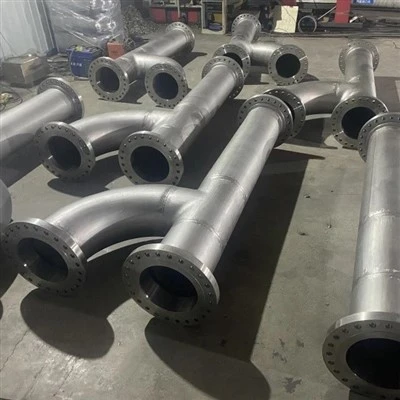
Large-diameter 316LN piping, forged to ASME SA-182 or ASME SA-376, forms the primary coolant loop in PWRs - the loop that circulates hot water between the reactor pressure vessel and the steam generators. This is safety-critical pipe: a failure here is the definition of a loss-of-coolant accident (LOCA), the initiating event in nuclear emergency planning.
Grade 304L (UNS S30403) is the standard material for nuclear containment liners, spent fuel pools, refuelling canals, and large-volume storage tanks. Its weldability is outstanding, and the low-carbon grade eliminates sensitisation risk across thousands of metres of weld seams in a large containment structure. Plate and sheet are supplied to ASME SA-240; pipe and tube to ASME SA-312.
Grades 321 (titanium-stabilised) and 347 (niobium-stabilised) are specified for components that undergo thermal cycling - repeated heating and cooling - such as heat exchangers, intermediate cooling loops, and certain piping systems. Stabilising elements chemically bind carbon, preventing chromium carbide precipitation even after extended time at temperatures in the sensitisation range (425–850 °C). Both grades conform to ASME SA-240 (plate) and SA-182 (forgings).
Zirconium Alloys - Fuel Cladding
No discussion of nuclear materials is complete without mentioning zirconium alloys. Zircaloy-4 and Zr-2.5Nb have a thermal neutron absorption cross-section of only 0.18 barns - roughly 40 times lower than stainless steel - making them essentially transparent to the neutrons needed to sustain the chain reaction. Fuel pellets are encased in zirconium alloy cladding tubes (typically 9.5 mm OD, 0.57 mm wall) that form the first barrier between the radioactive fuel and the coolant. While zirconium alloys fall outside the stainless steel and nickel alloy product range, their role explains why stainless steel is limited to structural applications outside the fuel assembly itself.
Nuclear Alloy Requirements: Quick Reference Table
The table below provides a consolidated reference for engineers and procurement teams specifying alloys for nuclear power plant applications.
|
Alloy / Grade |
Plant Zone |
Max Temp |
Key Property |
Primary Standard |
|
Alloy 690 / 690TT |
Steam generator tubing |
~343 °C |
PWSCC immune; low Ni segregation |
ASME SB-163 / RCC-M |
|
Alloy 625 (N06625) |
Core internals, cladding |
~650 °C |
High strength + radiation stability |
ASME SB-443 / SB-446 |
|
Alloy 718 (N07718) |
Fasteners, springs |
~650 °C |
Precipitation-hardened; high UTS |
ASME SB-637 / ASTM B637 |
|
316L / 316LN SS |
Reactor coolant piping |
~350 °C |
Low C; controlled N for strength |
ASME SA-376 / SA-182 |
|
304L Stainless Steel |
Containment, tanks |
~300 °C |
Austenitic, low carbon, weldable |
ASME SA-240 / SA-312 |
|
321 / 347 SS |
Heat exchangers, piping |
~400 °C |
Stabilised; resists sensitisation |
ASME SA-240 / SA-182 |
|
Alloy 600 (N06600) |
Legacy PWR nozzles |
~343 °C |
High Ni-Cr; PWSCC-susceptible* |
ASME SB-166 / SB-168 |
|
Zircaloy-4 / Zr-2.5Nb |
Fuel cladding, channels |
~350 °C |
Extremely low neutron absorption |
ASTM B811 / B353 |
Table 1: Key alloys and stainless steel grades used in nuclear power plants, with applicable standards. *Alloy 600 retained in some legacy plants; not specified for new construction. Zircaloy listed for reference only.
Nuclear Codes and Standards: What Governs Material Qualification

Nuclear materials are among the most strictly regulated in any industry. A material cannot simply meet its chemical and mechanical specification - it must be traceable, tested, documented, and qualified under a quality assurance programme. The key governing frameworks are:
ASME Boiler and Pressure Vessel Code (BPVC) Section III: The primary code for nuclear pressure vessels, piping, pumps, and valves in the United States and many international markets. Materials must appear in approved material tables (e.g., Code Case N-60 for Alloy 690).
RCC-M (French Nuclear Code): The French equivalent, mandatory for EPR reactors and widely referenced internationally. RCC-M M4105 covers Alloy 690TT tubing.
ASME NQA-1: Quality assurance requirements for nuclear facilities. Every material certificate, heat treatment record, and test report must be traceable to a unique heat number.
10 CFR 50 Appendix B (US NRC): The US Nuclear Regulatory Commission's quality assurance criteria for nuclear power plants, applying to all safety-related materials.
IAEA Safety Standards (SSR-2/1): International Atomic Energy Agency requirements for design of nuclear power plants, referenced by regulatory bodies in over 40 countries.
In practice, this means a mill test certificate (MTC) for nuclear-grade Alloy 690 tubing may run to 10 or more pages, documenting chemistry (heat analysis and product analysis), tensile properties at room and elevated temperature, hardness, corrosion tests, dimensional inspection, and non-destructive examination results - all signed off by an authorised inspector.
What to Look for When Sourcing Nuclear-Grade Alloys
Procurement teams specifying stainless steel or nickel alloys for nuclear service should verify the following before issuing a purchase order:
Nuclear qualification: Confirm the material is approved under the applicable code (ASME III, RCC-M, JSME, or KEPIC) and that the mill has the required nuclear quality programme (NQA-1 or equivalent) in place.
Heat traceability: Every piece must trace back to a unique melt heat number. Mixing heats without documentation is non-conforming in nuclear supply chains.
Third-party inspection: An authorised nuclear inspector (ANI) or approved third party must witness and certify key tests at the mill. Witness point (W) and hold point (H) requirements are defined in the purchase order.
Positive material identification (PMI): On-site XRF or OES verification that the alloy received matches the alloy ordered is mandatory for safety-classified components.
Counterfeit and fraudulent items (CFSI): Nuclear procurement must include CFSI prevention measures per NRC IN 2012-10. Only procure from approved suppliers with a documented approved supplier list (ASL).
Conclusion
Nuclear power plants demand alloys that go far beyond standard industrial grades. Alloy 690TT is the benchmark for steam generator tubing precisely because it solves the PWSCC problem that plagued Alloy 600 for decades. Alloy 625 and Alloy 718 deliver the strength and radiation resistance needed for core internals and high-stress fasteners. Austenitic stainless steels - particularly 316LN, 304L, and stabilised grades 321 and 347 - form the backbone of coolant piping, containment, and heat exchange systems.
What unifies all these materials is rigorous qualification: chemistry, mechanical testing, heat traceability, code compliance, and independent inspection. In nuclear power, the paperwork is not bureaucracy - it is engineering integrity. Choosing a qualified supplier with a proven nuclear quality programme is not a preference; it is a requirement.