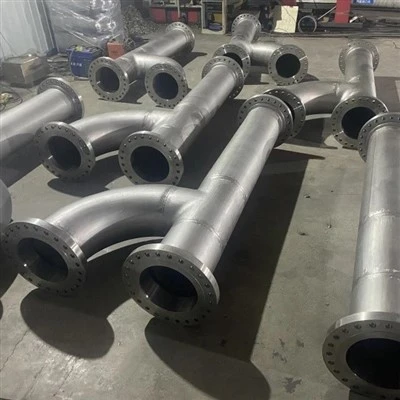
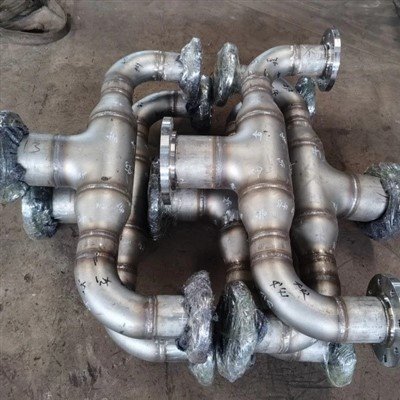
Monel 400 seamless pipe is made to ASTM B165 (UNS N04400), supplied in 1/8 to 12 inch NPS / 6 to 273 mm OD across wall schedules 5S through XXS, with design stress about 115-130 MPa at ambient temperature dropping to about 95 MPa at 300 degC and 75 MPa at 400 degC. A typical NPS 2 x SCH 80 pipe carries roughly 34-40 MPa (5,000-5,800 psi) working pressure at ambient - a conservative choice where seawater or sour corrosion rules out stainless steel.

In one sentence: B165 seamless pipe is the go-to corrosion-resistant piping for seawater, brine, and non-oxidizing chemical service below about 450 degC, ordered with full MTC and PMI, and rated by the ASME B31.3 equation using B165 allowable stresses.
What is Monel 400 seamless pipe and where is it used?
Monel 400 (UNS N04400) seamless pipe is a nickel-copper alloy (about 63-70 percent Ni, 28-34 percent Cu) drawn without a weld, used where seawater, brackish water, hydrofluoric acid, and many chemicals would destroy stainless steel and carbon steel.
Because it is seamless (no longitudinal weld), the pipe has uniform strength and no weld-line corrosion risk - important in high-pressure seawater and sour service. Typical uses:
- Marine: Seawater cooling, firewater, ballast, and injection lines on ships and offshore platforms.
- Chemical: Plant and process piping handling brine, caustic, and non-oxidizing acids.
- Refining: HF alkylation units, sulfuric and hydrochloric acid handling (dilute, non-aerated).
- Equipment: Valve bodies, heat-exchanger shells, and instrument tubing in corrosive duty.
What does ASTM B165 actually specify?
ASTM B165 (now harmonized as ASME SB-165) covers seamless nickel-copper alloy pipe and tube of UNS N04400 (Monel 400) and UNS N04405, defining chemistry, tensile properties, dimensions, and testing for pipe and pressure tubing.
|
B165 parameter |
Requirement (summary) |
|
Alloy / UNS |
N04400 (Monel 400), also N04405 |
|
Ni + Co |
63.0 percent minimum |
|
Cu |
28.0 - 34.0 percent |
|
Fe (max) |
2.5 percent |
|
C (max) |
0.30 percent |
|
Tensile strength (min) |
483 MPa (70 ksi) |
|
Yield strength (min) |
172 MPa (25 ksi) |
|
Elongation (min) |
35 percent (in 2 in / 50 mm) |
|
Product |
Seamless pipe and tube (no longitudinal weld) |
|
Heat treatment |
Annealed (typically 700-900 degC range) |
B165 is the material spec; dimensions follow ASME B36.10M (carbon/alloy pipe sizes) for most pipe, while B165 also covers heat-exchanger tube to B163. Always pair B165 with the relevant dimension and pressure-design standards.
What sizes and schedules are available in Monel 400 seamless pipe?
Monel 400 seamless pipe is generally available from 1/8 to 12 inch NPS (6 to 273 mm OD) in wall schedules 5S, 10S, 40S, 80S, 160, and XXS; larger diameters above 12 inch are usually welded (B165 covers seamless, B775/B619 cover welded).

|
NPS (inch) |
OD (mm) |
Common walls (SCH) |
Typical seamless availability |
|
1/8 - 1 1/2 |
6 - 48 |
5S, 10S, 40S, 80S |
Readily stocked |
|
2 - 4 |
60 - 114 |
5S, 10S, 40S, 80S, 160, XXS |
Readily stocked |
|
6 - 8 |
168 - 219 |
5S, 10S, 40S, 80S, XXS |
Common, some lead time |
|
10 - 12 |
273 |
40S, 80S, XXS |
Order, longer lead |
|
> 12 (welded) |
323+ |
per spec |
Use B775/B619 welded |
Note: seamless pipe above about 12 inch becomes scarce and costly; for large lines, welded Monel 400 (ASTM B775 / B619) with 100 percent radiography is the practical alternative. JN Alloys stocks common NPS 1/2-8 sizes and sources larger or heavy-wall on request.
What are the allowable stresses and pressure ratings?
Using ASME B31.3 with B165 allowable stresses, Monel 400 seamless pipe is rated about 115-130 MPa design stress at ambient, falling to about 95 MPa at 300 degC and 75 MPa at 400 degC; a worked example for NPS 2 SCH 80 gives roughly 34-40 MPa (5,000-5,800 psi) working pressure at ambient.
|
Temperature (degC) |
Allowable stress (MPa, representative) |
Allowable stress (ksi, approx.) |
|
20 |
115 - 130 |
16.7 - 18.9 |
|
100 |
110 - 125 |
16.0 - 18.1 |
|
200 |
105 - 118 |
15.2 - 17.1 |
|
300 |
95 - 108 |
13.8 - 15.7 |
|
400 |
75 - 88 |
10.9 - 12.8 |
|
450 |
60 - 72 |
8.7 - 10.4 |
These are engineering screening values compiled from typical ASME II-D / B31.3 datasets for N04400. Final design must use the current ASME edition and an explicit corrosion allowance.
How do you calculate working pressure for a given size?
Use the ASME B31.3 hoop-stress equation t = P*D / (2*(S*E + P*Y)) and invert for P; for thin-wall piping a good approximation is P = 2*S*t / D, where S is the B165 allowable stress, t is wall thickness, and D is outside diameter.
Worked example - NPS 2 SCH 80 Monel 400 at 20 degC:
Inputs: OD = 60.3 mm; SCH 80 wall t = 5.54 mm.
Stress: S = 120 MPa (representative allowable).
Result: P approx = 2 * 120 * 5.54 / 60.3 = 22.0 MPa for thin wall; including the B31.3 Y factor and D/t ratio gives a working pressure around 34-40 MPa (5,000-5,800 psi) at ambient with standard joint efficiency.
Always add a corrosion allowance (commonly 1.5-3 mm in seawater) to the calculated minimum wall before ordering, and confirm with a pipe stress engineer for the actual system.
How does Monel 400 pipe compare with 316L, 904L, and Inconel 625?
Monel 400 beats 316L and 904L decisively in seawater and many non-oxidizing acids, but 625 wins where chloride stress-cracking, high strength, or very high temperature is required; 400 is the cost-effective corrosion choice below about 450 degC.
|
Material |
UNS |
Seawater corrosion |
Strength |
Max useful temp (approx.) |
Relative cost (pipe) |
|
316L SS |
S31603 |
Poor (SCC, pitting) |
Low |
~425 degC |
0.4 - 0.6x |
|
904L SS |
N08904 |
Moderate |
Low-Moderate |
~300 degC |
0.8 - 1.0x |
|
Monel 400 |
N04400 |
Excellent |
Moderate |
~450 degC |
1.0x (baseline) |
|
Inconel 625 |
N06625 |
Excellent + high strength |
High |
~650 degC |
2.5 - 3.5x |
Selection rule: pick 400 for corrosion-first seawater/chemical lines; pick 625 only when high strength, chloride stress-cracking immunity, or temperature above 450 degC is needed.
Is Monel 400 pipe acceptable for sour-gas (H2S) service?
Yes - Monel 400 is a solid-solution nickel-copper alloy with no hardening, so it is immune to sulfide-stress-cracking and is accepted under NACE MR0175 / ISO 15156 for H2S service without a hardness cap, unlike age-hardened K500.

- SSC immunity: No martensite and no hardening mechanism means no SSC risk from the alloy itself.
- NACE status: Listed as a corrosion-resistant alloy suitable for sour environments per NACE MR0175.
- Real limit: Main limit in sour duty is external chloride pitting in aerated seawater, mitigated by design and coatings.
If the line also needs high strength and sour service, age-hardened K500 (held <=35 HRC) or 625 are alternatives; for straight corrosion piping, 400 is the simplest compliant choice.
What welding and fabrication practices apply to Monel 400 pipe?
Weld Monel 400 pipe with nickel-copper filler (ERNiCu-7 / ENiCu-7), keep it clean and free of carbon steel contamination, and anneal after heavy forming; preheat is generally not required because the alloy is not hardenable.
- Filler: AWS A5.14 ERNiCu-7 or A5.11 ENiCu-7 matches base chemistry and preserves corrosion resistance.
- Cleanliness: Oil, grease, and iron contamination cause porosity and weld defects; clean with stainless-grade tools.
- Work hardening: Monel work-hardens; use sharp tools, slower speeds, and rigid setups when machining or bending.
- Post-form: For tight bends, a stress-relief anneal (about 550-650 degC) after forming restores ductility.
- Preheat/PWHT: Not required (non-hardenable), but remove residual stresses for large fabricated spools if specified.
What testing and documentation should you require?
Require an EN 10204 3.1 (or 3.2) Material Test Certificate reporting chemistry and tensile, plus Positive Material Identification (PMI), hydrostatic test, and, for critical lines, radiographic or ultrasonic examination of welds.
|
Document / test |
Why it matters |
|
MTC 3.1 / 3.2 |
Proves UNS N04400 chemistry and tensile meet B165 |
|
PMI |
Confirms Ni/Cu ratio on arrival, prevents substitution |
|
Hydrostatic test |
Verifies pressure integrity of the pipe |
|
Eddy current / UT (tube) |
Detect seams, laps in heat-exchanger tube |
|
NDE of welds (RT/UT) |
Assurance for critical spools |
|
Surface inspection |
No carburization or contamination from forming |
What are the main corrosion advantages of Monel 400 pipe?
Monel 400 pipe resists flowing seawater and salt spray better than any stainless steel, tolerates hydrofluoric and many non-oxidizing acids, and stays ductile down to cryogenic temperatures - making it a multi-duty corrosion material.
- Seawater: Decades of service in ship and platform seawater systems with negligible corrosion.
- Acids/alkalis: Good resistance to HF, dilute H2SO4/HCl (non-aerated), and caustic.
- Cryogenic: Retains toughness to -200 degC, suited to LNG and cryogenic piping.
- No SCC: Does not chloride stress-crack like austenitic stainless in warm seawater.
What are the limits and failure modes of Monel 400 pipe?
The main limits are poor performance in oxidizing acids (nitric, strong aerated sulfuric), stress-corrosion risk only under extreme conditions, and chloride pitting in aerated/stagnant seawater; good design and alloy choice around these avoid failures.
|
Limit / failure |
Cause |
Mitigation |
|
Pitting (aerated seawater) |
O2-rich stagnant brine |
Flow design, coatings, avoid crevices |
|
Oxidizing-acid attack |
HNO3, hot aerated H2SO4 |
Use 625 or high-Ni Cr-Mo alloy instead |
|
Galvanic corrosion |
Coupled to carbon steel |
Insulate, use compatible alloys |
|
Hydrogen embrittlement |
High-strength cold work in H2 |
Control cold work; 400 is non-hardenable |
|
Mercury / certain molten-metal attack |
Specific process fluids |
Avoid; material not suited |
Which companion standards apply to Monel 400 piping systems?
Beyond B165 for the pipe, use ASTM B164 (rod/bar), B127 (plate), B163 (heat-exchanger tube), B775/B619 (welded pipe), B564 (forgings), and ASME B31.3 for pressure design, with NACE MR0175 for sour duty.
|
Standard |
Scope |
|
ASTM B165 / SB-165 |
Seamless Monel 400 pipe and tube (this article's focus) |
|
ASTM B163 |
Seamless condenser and heat-exchanger tube |
|
ASTM B164 |
Rod and bar |
|
ASTM B127 |
Plate, sheet, strip |
|
ASTM B775 / B619 |
Welded pipe (large diameter) |
|
ASTM B564 |
Forgings (flanges, fittings) |
|
ASME B31.3 |
Process piping pressure design |
|
NACE MR0175 / ISO 15156 |
Sour-service acceptance |
Frequently asked questions about Monel 400 seamless pipe
B165 (ASME SB-165) covers seamless nickel-copper alloy pipe and tube of UNS N04400 (Monel 400) and N04405, specifying chemistry, tensile properties, dimensions, and testing.
What sizes does Monel 400 seamless pipe come in?
Typically 1/8 to 12 inch NPS (6 to 273 mm OD) in schedules 5S through XXS; above 12 inch welded pipe (B775/B619) is used.
What is the pressure rating of Monel 400 pipe?
Design stress is about 115-130 MPa at ambient, falling to about 75 MPa at 400 degC; an NPS 2 SCH 80 pipe carries roughly 34-40 MPa (5,000-5,800 psi) at ambient by the B31.3 equation.
Is Monel 400 pipe OK for sour H2S service?
Yes. As a solid-solution alloy it is immune to sulfide stress cracking and is accepted under NACE MR0175 without a hardness cap; the real limit is external chloride pitting in aerated seawater.
What filler is used to weld Monel 400 pipe?
Nickel-copper filler ERNiCu-7 or ENiCu-7, with strict cleanliness to avoid porosity and contamination.
How does Monel 400 pipe compare with 316L?
400 resists seawater and many non-oxidizing acids far better than 316L and avoids chloride stress cracking, at roughly 2x the material cost; 316L remains for mild, dry, or cost-driven service.