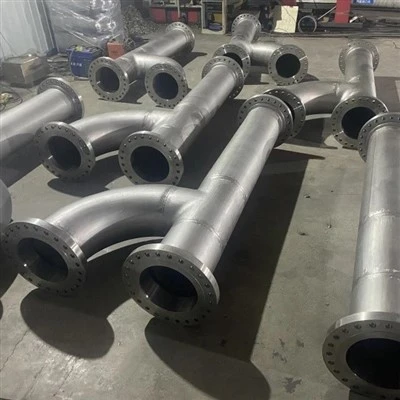
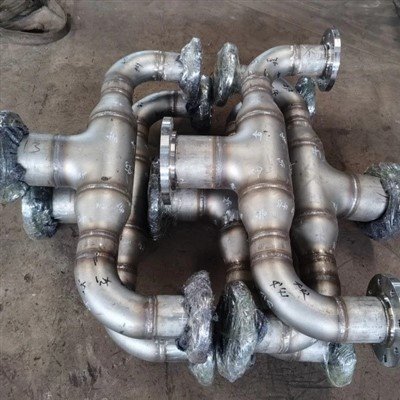
Incoloy 800H (UNS N08810) and, above about 650°C, Incoloy 800HT (UNS N08811) are the industry-standard wrought materials for steam methane reformer (SMR) outlet manifolds and transfer lines. They combine the high-temperature creep strength, carburization resistance, and weldability needed for 800-950°C H2-rich reducing gas at 15-40 bar - performance that 304H/316H stainless steels cannot match, at a fraction of the cost of cast superalloys.

In one sentence: specify 800HT (N08811) for the hottest manifold and transfer-line zones, 800H (N08810) where the metal temperature stays below about 650°C, and verify all allowable stresses against the current ASME Section II-D before finalizing wall thickness.
What are the SMR outlet manifold and transfer line, and why does material choice decide plant uptime?
The outlet manifold and transfer line are the hottest, highest-creep-risk piping in the entire hydrogen plant; choosing the wrong alloy here causes unplanned shutdowns that cost far more than any material saving.
In a steam methane reformer, natural gas (CH4) reacts with steam over a nickel catalyst inside vertical reformer tubes at 800-1000°C:
- CH4 + H2O → 3H2 + CO (endothermic, heat supplied from the furnace)
- The reacted gas - rich in hydrogen (roughly 70-75 percent), carbon monoxide (10-15 percent), CO2, steam, and residual methane - leaves the tops of the tubes, collects in a common outlet manifold (the 'header'), and flows through the transfer line to the waste-heat boiler and shift converters.
Why material selection is critical:
- Extreme heat: Metal temperatures reach 800-950°C - a range where ordinary stainless steel creeps and fails within months.
- Aggressive chemistry: The gas is reducing and H2-rich with a high carbon activity, so carburization and metal dusting attack unprotected steel.
- Pressure + creep: These components carry full process pressure (15-40 bar) while red-hot; a manifold rupture means a total plant shutdown.
- Complex geometry: A single reformer can have 100+ tubes feeding one manifold, so the header sees complex thermal stresses at every branch weld.
Why is Incoloy 800 the standard material for SMR outlet manifolds and transfer lines?
Incoloy 800 is the standard because its roughly 32 percent nickel plus 21 percent chromium balance delivers austenitic stability, creep strength, and carburization/oxidation resistance together with good fabricability - a combination no 300-series stainless steel or low-alloy steel provides at 900°C.
Four physical reasons explain the choice:

Incoloy 800H vs 800HT: which grade should you specify for reformer outlet service?
Specify 800HT (UNS N08811) for the hottest manifold and transfer-line sections (metal temperature above about 650°C); 800H (UNS N08810) is acceptable where temperatures stay lower, but most modern SMR plants standardize on 800HT for consistency and longest life.
Practical guidance: because 800HT is only marginally more expensive yet significantly more creep-resistant above 650°C, many EPCs now call out N08811 for the entire outlet manifold and transfer line to avoid grade mixing and simplify QA.
What are the typical design temperatures and pressures in SMR transfer lines?
Design metal temperatures for reformer outlet manifolds and transfer lines normally fall in the 800-950°C band at 15-40 bar; the design is creep-controlled, so wall thickness is set by allowable stress at the peak temperature, not by pressure alone.
Note: because the design is creep-limited, a 30-50°C rise in operating temperature can halve the allowable stress and force a much thicker wall or a grade upgrade. Accurate temperature mapping during FEED is essential.
How does Incoloy 800 resist carburization and metal dusting in reformer gas?
Incoloy 800 resists carburization through its high nickel content (slow carbon diffusion) and protective chromium oxide scale, and it performs well against metal dusting at the 800-950°C manifold operating range; supplemental aluminized or Cr-C overlay coatings are used only in the most severe cyclic services.

- Carburization mechanism: in reducing, H2-rich gas the carbon activity at the metal surface drives carbon inward, forming chromium carbides that deplete the matrix of chromium and embrittle the part. Two features of 800H/800HT fight this:
- High Ni: Nickel above ~30 percent lowers carbon solubility and diffusion rate, slowing internal carburization.
- High Cr: 21 percent Cr reforms a protective scale faster than carbon can penetrate.
- Metal dusting (catastrophic carburization between roughly 400 and 800°C) is less aggressive above about 800°C because the protective oxide is more stable; nevertheless, operators monitor for localized attack at cooler branch connections and use thermal-spray aluminum (PTA Al) coatings where cyclic cooling occurs.
What are the creep and stress-rupture properties of Incoloy 800H/800HT at 800-950°C?
Incoloy 800HT retains useful creep-rupture strength through 950°C; representative ASME Section II-D allowable stresses are about 40-55 MPa at 800°C, 20-30 MPa at 900°C, and 12-18 MPa at 950°C for 800HT - always confirm the latest code edition for your design.
These values are engineering approximations compiled from typical ASME II-D and NIMS creep datasets; they are intended for screening only. Final wall thickness must use the current ASME edition and the actual design life (commonly 100,000-200,000 hours).
How does Incoloy 800 compare with cast HP-modified and HK-40 for this service?
Cast HK-40 and HP-modified alloys are used for the reformer tubes themselves (centrifugal cast, higher creep strength at the very hottest spots), but the outlet manifold and transfer line are almost always wrought Incoloy 800H/800HT because only a wrought, weldable alloy can be fabricated into a multi-branch header and reliably field-welded.
Decision rule: use cast HP-modified for the catalyst tubes where maximal creep strength justifies the cost and cast form; use wrought 800HT for everything that must be welded into a manifold or transfer line.
Can stainless steels such as 304H or 316H be used for SMR transfer lines?
No. 304H and 316H lack the nickel content and creep strength for sustained 800-950°C H2-rich service; they suffer rapid carburization, sigma-phase embrittlement, and creep rupture, so they are confined to cooler downstream sections (below about 550-600°C).
A common mistake is specifying 316H for 'cost savings' on a transfer line that later runs hotter than expected. The replacement outage cost dwarfs the material saving many times over.
What welding and fabrication practices are required for Incoloy 800 manifolds?
Weld 800H/800HT with nickel-base filler (typically ERNiCr-3 / ENiCrFe-3, or ERNiCrCoMo-1 for the highest-temperature joints), control interpass temperature, avoid prolonged exposure in the 600-900°C sigma/embrittlement window, and qualify the WPS to ASME Section IX.

Key fabrication rules:
- Filler metal: AWS A5.14 ERNiCr-3 (UNS N06600) or A5.11 ENiCrFe-3 is the conventional choice; for joints expected above 950°C some specs prefer ERNiCrCoMo-1 (UNS N06617).
- Interpass temperature: Keep below about 150°C to avoid sensitization and grain-boundary precipitation.
- PWHT: 800H/800HT are normally used in the solution-annealed condition; post-weld heat treatment is generally NOT required and can reduce creep life if it lingers in the 600-900°C range. If stress relief is mandated, use a full re-solution anneal, not a low-temperature PWHT.
- Critical joints: Branch connections on the manifold are the highest-risk welds; use qualified procedures, 100 percent PT/RT on critical joints, and PMI verification of both base and filler.
- Consistent HT: Match the forging/tube heat-treatment condition across the assembly to keep creep behavior uniform.
What are the main failure modes in SMR outlet manifolds and transfer lines, and how do you prevent them?
The dominant failure modes are creep rupture, carburization embrittlement, thermal-fatigue cracking at branch welds, and fabrication defects; all are prevented by correct grade selection, verified allowable stress, controlled welding, and inspection.
Which ASTM, ASME, and industry standards apply to Incoloy 800 SMR components?
Procure to ASTM/ASME specifications for the product form (B407 pipe, B408 bar, B409 plate, B163 tube, B564 forgings, B366 fittings) and design to ASME Section VIII / B31.3 with allowable stresses from ASME Section II-D; reference API 571 and API 941 for damage mechanisms.
How do you size wall thickness and select the grade for an SMR transfer line?
Size the wall by the governing code equation using the ASME II-D allowable stress at the peak metal temperature, then confirm the chosen grade (800H vs 800HT) by whether that temperature exceeds about 650°C; add corrosion/erosion allowance and verify against creep-life target.
A practical 6-step selection workflow:
- 1. Map peak metal temperature at every manifold and transfer-line segment (FEA or measured).
- 2. If T > 650°C, use 800HT (N08811); if lower, 800H (N08810) is acceptable.
- 3. Read allowable stress at T from current ASME II-D for the chosen grade.
- 4. Compute minimum wall t = P*D / (2*(S*E + P*Y)) per ASME B31.3, add allowance.
- 5. Check 100,000-200,000 h creep-rupture adequacy, not just short-term stress.
- 6. Qualify WPS with nickel-base filler; plan 100 percent NDE on critical joints.
Case study: 800HT upgrade eliminates repeated manifold leaks at a 50,000 Nm3/h hydrogen plant
A merchant hydrogen plant that originally ran an 800H outlet manifold with frequent branch-weld leaks at 910°C shifted new construction to 800HT (N08811) with ERNiCr-3 welds and 100 percent radiographic inspection, cutting unplanned manifold downtime to near zero over a 6-year campaign.
Situation: the plant's original 800H header operated near the top of its creep window; thermal cycling at tube-to-manifold branches caused fatigue cracks every 18-24 months. Solution: upgrade specification to 800HT, tighten Al+Ti verification, re-qualify welding with controlled interpass <150°C, and apply aluminized coating on the cooler transition cones. Result: no manifold-related forced outage in the following 6 years, with inspection showing <0.2 mm uniform carburization.
Frequently Asked Questions