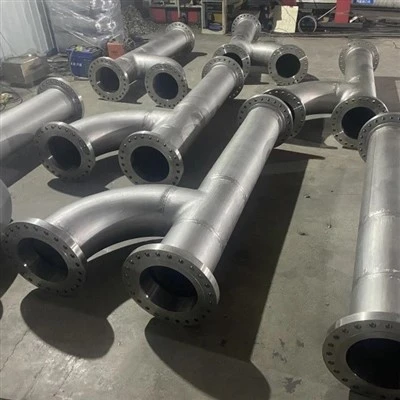
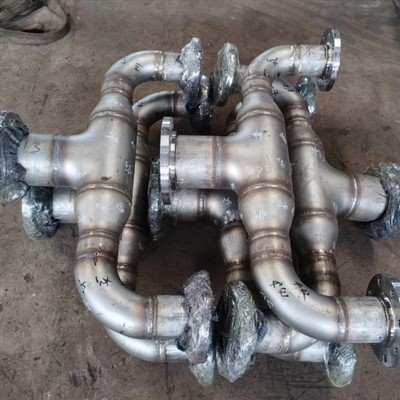
This guide examines stainless steel weld fittings from six essential perspectives: definition and composition, primary functions, common types, dimensional standardization, and advantages.
What are Stainless Steel Weld Fittings?
Stainless steel weld fittings are precision-engineered pipe connectors designed for permanent integration into pipeline systems through welding processes. Manufactured predominantly from austenitic grades and super-austenitic/double-grade alloys for specialized corrosive environments, these fittings achieve superior metallurgical bonding when joined via TIG or orbital welding techniques.
Unlike mechanical connections, welded fittings eliminate intermediary sealing components, resulting in monolithic structures that maintain pressure integrity even under extreme thermal cycling. Their standardized construction complies with ASME B16.9 and B16.25, ensuring consistent performance in critical applications like offshore oil platforms or pharmaceutical clean rooms.
Stainless Steel Weld Fitting Functions
Within complex piping networks, weld fittings serve four principal engineering functions: directional control, flow division, diameter transition, and system termination.
For example, long-radius elbows minimize pressure drop when redirecting high-velocity fluids, while eccentric reducers prevent vapor accumulation in horizontal pump suction lines. Tee fittings enable branch connections without requiring separate manifolds, whereas butt weld caps provide permanent shutdown points for future system expansion.
In cryogenic applications like LNG transfer, specially annealed 316L fittings prevent brittle fracture while maintaining leak-tight performance at -290°F. These functional characteristics make welded fittings indispensable for systems where reliability outweighs the need for disassembly.
Stainless Steel Weld Fitting Types
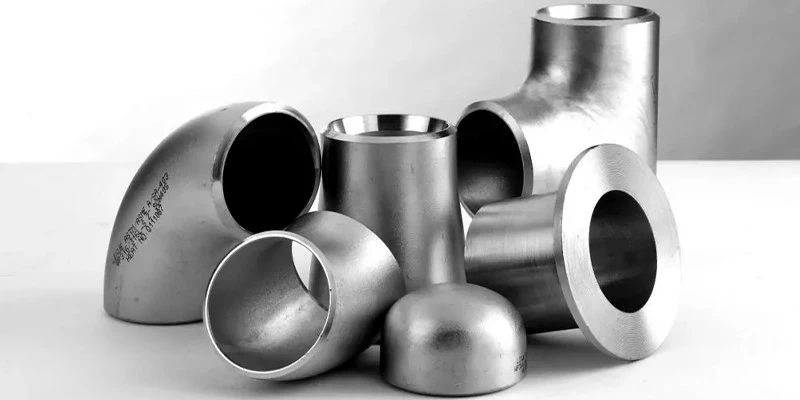
The stainless steel weld fitting product range includes seven primary classifications, each addressing specific installation requirements:
Elbows (45°/90°/180°): Manufactured in short-radius and long-radius configurations for space-constrained or low-turbulence applications respectively.
Tees (Straight/Reducing): Equal tees maintain uniform flow distribution, while reducing tees connect different pipe sizes.
Reducers (Concentric/Eccentric): Concentric reducers align pipe centers axially for vertical flows; eccentric types maintain flat-bottom flow in horizontal pipes.
Caps: Full-diameter closures for pressure testing or system decommissioning.
Stub Ends: Used with lap joint flanges to create semi-permanent connections in systems requiring periodic maintenance.
Crosses: Four-directional flow distribution in complex manifold systems.
Lap Joint Stub Ends: Facilitate flange alignment in systems requiring rotational adjustment during assembly.
Specialized variants include barred tees for pigging systems and swage nipples for instrument connections.
Stainless Steel Weld Fitting Dimensions
Dimensional compliance ensures leak-free operation and structural integrity. Key parameters include:
- Nominal Pipe Size (NPS): Standardized from ½" to 48".
- Wall Thickness: Corresponds to schedule numbers (SCH 5S, 10S, 40S, 80S, 160S), matching pipe schedules for uniform strength.
- Center-to-End/End-to-End Dimensions: Precisely controlled per ASME B16.9 tolerances (±1.5mm for NPS≤24).
- Bevel Geometry: 37.5° bevel angles with 1/16" root face for optimal weld penetration (per ASME B16.25).
For hygienic industries, electropolished fittings with Ra≤20µin surface finishes are mandatory.
Stainless Steel Weld Fitting Advantages
Compared to mechanical alternatives, welded fittings provide six uncompromising benefits:
- Structural Integrity: Continuous weld seams eliminate potential failure points at gasket interfaces.
- Pressure Endurance: Rated for ASME Class 300 to 2500 services, outperforming threaded equivalents.
- Corrosion Resistance: Homogeneous material composition prevents galvanic/crevice corrosion.
- Flow Efficiency: Smooth interior surfaces (0.8µm Ra post-electropolishing) minimize friction losses.
- Temperature Tolerance: Withstand cyclic thermal stresses that fracture brittle cast alternatives.
- Lifecycle Economy: 30+ year service life reduces maintenance/replacement costs.

Summary
Stainless steel weld fittings represent the gold standard for permanent, high-performance piping connections. With standardized geometries ensuring compatibility across global projects (ASME/EN/DIN/JIS), these components deliver unmatched durability in aggressive chemical, thermal, and pressure environments. From schedule 10S process lines to heavy-wall SCH 160 high-pressure steam systems, proper fitting selection-coupled with certified welding procedures-guarantees decades of trouble-free operation. For mission-critical installations, always specify mill-certified fittings from ISO 9001-certified manufacturers, with full traceability from raw material to finished product.