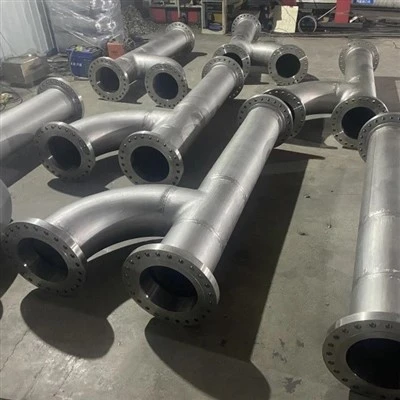
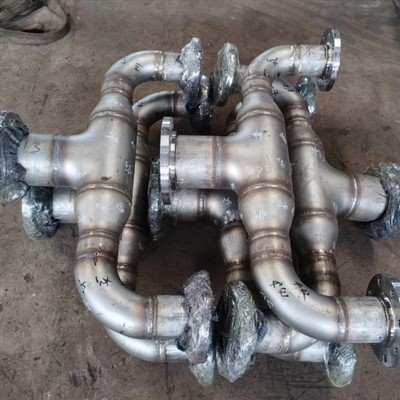
Stainless steel tubes are the standard material for vacuum lines from rough vacuum to ultra-high vacuum. This guide compares grades, surface finishes, cleaning, leak testing, outgassing and the material documentation that proves a tube is exactly the grade specified. Start with the grade selector, then read the sections on 316L stainless steel, surface finish and welding.
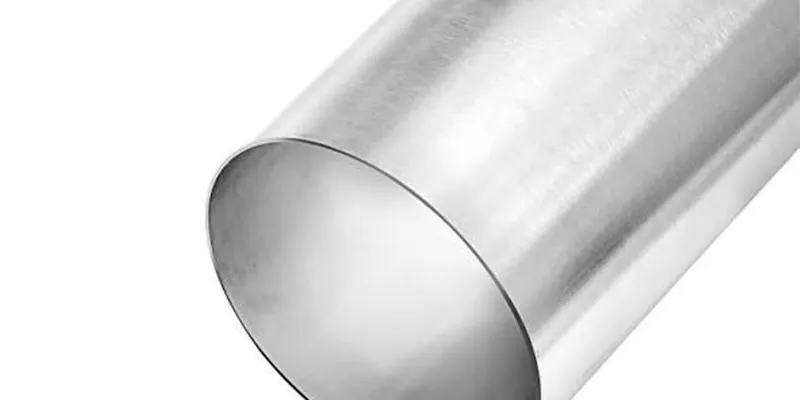
Why does leak tightness matter more in a vacuum line than in a pressurized line?
In a vacuum line every leak flows inward, so air, moisture and particles enter the system and destroy the vacuum, while on a pressurized line the fluid only escapes and the process usually keeps running.
A pressure line loses fluid to the outside; the cost is product, safety or a visible drip. A vacuum line behaves the opposite way. Because the inside is at a lower pressure than the room, any crack, pore or loose joint pulls the surrounding atmosphere in. The entering air and water vapour raise the pressure, the particles and hydrocarbons contaminate the chamber, and a process that needed a clean vacuum either fails to reach its target or produces scrap.
This is why a vacuum line is judged by how well it keeps the world out, not how well it holds fluid in. A leak that would be trivial on a water line can make a vacuum system unusable. The rest of this article shows the three things that decide that performance: the joint method, the internal cleanliness, and the material certificate that proves the tube is what you specified.
Rule of thumb: the tighter the vacuum you need, the stricter every seal must be. Rough vacuum tolerates small leaks that would be fatal at ultra-high vacuum, so specify the leak limit together with the vacuum level, never on its own.
Which stainless steel grade should you choose for vacuum tubing?
316L is the default for most vacuum lines; use 304L for non-critical duty, 316L-mod, 904L or 254 SMO for ultra-clean or more aggressive service, and a nickel alloy only when the gas or process itself is corrosive.
Stainless steel is chosen because it is strong, formable, weldable and, most importantly, it forms a stable, low-outgassing passive film. Within stainless, the grade decides corrosion resistance, weld behaviour and cost. The low-carbon variants (the "L" grades) are preferred because they resist sensitization during welding, which keeps the heat-affected zone corrosion-resistant and easy to seal.
The short guide below maps the common grades to the job they fit:
316L stainless steel - the workhorse for vacuum tubing: good corrosion resistance, low carbon, readily welded, moderate cost.
304L stainless steel - acceptable for non-critical or rough-vacuum lines where corrosion is not a factor and cost dominates.
316L-modified (316L mod) - higher nitrogen and controlled impurities for cleaner, lower-outgassing welds in high-purity service.
904L stainless steel - higher chromium, nickel and molybdenum for mildly more aggressive or higher-alloy duty.
254 SMO (super-austenitic) - very high pitting resistance and low impurity pickup for semiconductor and pharmaceutical vacuum.
Duplex 2205 - higher strength where the line is also structural or sees pressure swings.
Nickel alloys (Hastelloy C276, Inconel 625, Alloy 20) - only when the process gas itself is corrosive.
Grade selection guide for vacuum tubing
|
Grade |
Typical use in vacuum systems |
Why pick it |
|
304L |
Rough vacuum, frames, non-critical lines |
Lowest cost, easy to weld |
|
316L |
General vacuum lines, chambers, manifolds |
Balanced cost, corrosion resistance, weldability |
|
316L-mod |
High-purity, semiconductor, UHV |
Lower impurity pickup, cleaner welds |
|
904L |
Aggressive or higher-alloy duty |
More Cr/Ni/Mo than 316L |
|
254 SMO |
Ultra-clean, chloride-exposed UHV |
Very high pitting resistance |
|
Duplex 2205 |
Structural or pressure-swing lines |
High strength |
|
C276 / 625 / 20 |
Corrosive process gas |
Resist acids, halogens, chlorides |
What do BA, AP, and EP surface finishes mean for vacuum tubing?
Annealed-and-pickled (AP) has the highest outgassing, bright-annealed (BA) is cleaner, and electropolished (EP) is the cleanest; EP is required for high and ultra-high vacuum and for pharmaceutical and semiconductor duty.
Surface finish decides how much gas the tube wall can hold and later release. A rough or chemically active surface traps water, hydrocarbons and embedded iron; a smooth, passive surface releases almost none. Three finishes are used:
AP (annealed and pickled) - the standard mill finish after acid cleaning; acceptable for rough and some fine vacuum but not for UHV.
BA (bright annealed) - annealed in a controlled reducing atmosphere so the surface stays bright and smooth; lower outgassing than AP and the usual choice for clean vacuum.
EP (electropolished) - a final electrochemical polish that removes a thin surface layer, smooths micro-roughness and frees the surface of embedded iron; the choice for high and ultra-high vacuum and for pharma or semiconductor lines.
Surface finish comparison for vacuum tubing
|
Finish |
Typical outgassing |
Best vacuum range |
Typical use |
|
AP (pickled) |
Highest |
Rough vacuum |
General, non-critical |
|
BA (bright annealed) |
Medium |
Fine to high vacuum |
Clean vacuum lines |
|
EP (electropolished) |
Lowest |
High to ultra-high vacuum |
Semiconductor, pharma, UHV |
The finish also affects cleaning. An EP tube is far easier to clean to a particle and hydrocarbon spec than an AP tube, which is why high-purity facilities almost always specify EP. For background on the base alloy, see the 316L stainless steel material page.
How clean must the inside of a vacuum tube be?
The bore must be free of oil, grease, oxide scale, particles and moisture; cleanliness is proven by a wipe or particle test and a helium leak test, not by appearance.

Cleanliness is not cosmetic. Anything left inside the tube becomes a source of outgassing and a contaminant in the chamber. The tube arrives from the mill with drawing lubricant, and cutting, bending and welding add more contamination. A vacuum-quality tube is therefore cleaned, then capped or bagged, then kept sealed until installation.
- No cutting fluid, oil or grease on the bore - use clean, dry cutting methods.
- No oxide scale or discoloration from welding - control the weld root atmosphere.
- No loose particles - verified by a wipe test or a particle-count on the rinse.
- No moisture or hydrocarbon film - verified by a helium leak and sometimes a residual-gas check.
- Sealed ends - capped or bagged so the cleaned bore is not re-contaminated in storage or transit.
Because appearance is misleading, the release is based on test results, not on how the tube looks. A tube that looks bright can still carry a grease film that outgasses for hours.
What leak rate is acceptable, and how is a vacuum line tested?
Helium mass-spectrometer leak testing to a reject limit near 1x10⁻⁹ mbar.L/s is the standard for high and ultra-high vacuum; rough and low vacuum may accept 1x10⁻⁶ to 1x10⁻⁵ mbar.L/s.
The standard method is helium leak testing with a mass spectrometer. Helium is used because it is inert, small and rare in air, so a sniffer or a chamber can detect a tiny flow of it against the background. The tube or assembly is pressurized with helium (or placed in a helium atmosphere) and the detector measures how much helium enters the vacuum side.
The acceptable limit depends on the vacuum level you must hold. A rough-vacuum line can tolerate a far larger leak than an ultra-high-vacuum chamber. The table below gives typical reject limits used across the industry; always confirm the value against your process spec.
Typical helium leak-test reject limits by vacuum regime
|
Vacuum regime |
Pressure range |
Typical reject limit (mbar.L/s) |
Notes |
|
Rough vacuum |
1 to 10-3 mbar |
1x10⁻⁵ to 1x10⁻⁴ |
Forgiving; small leaks tolerated |
|
Fine / medium vacuum |
10-3 to 10-6 mbar |
1x10⁻⁶ to 1x10⁻⁷ |
Common industrial spec |
|
High vacuum |
10-6 to 10-9 mbar |
1x10⁻⁸ to 1x10⁻⁹ |
Orbital weld recommended |
|
Ultra-high vacuum |
below 10-9 mbar |
1x10⁻¹⁰ or tighter |
EP surface, baked, all-welded |
Leak testing is normally done on the finished assembly, not on loose tube, because most field leaks are at welds and joints. This is why the welding and fitting choices in the next section matter as much as the tube itself. See the fabrication comparison in the pipe spool prefabrication guide.
Do welded joints or mechanical fittings seal a vacuum line better?
Automatic orbital TIG welds with argon backing give the lowest and most repeatable leak rate and the smallest internal crevice; use VCR, ISO-KF or CF flanges only at points that must be demountable.
- A continuous weld has no gasket, no threaded path and almost no internal crevice for gas to hide in, which is exactly what a vacuum line wants. Automatic orbital TIG welding with an argon root purge produces repeatable, clean welds and is the method of choice from high vacuum upward. A poorly backed weld, by contrast, can be porous and discolored and will leak.
- Orbital TIG weld - lowest leak rate, smallest crevice, best for permanent joints.
- VCR (face-seal) fitting - metal-to-metal seal, good to high vacuum, used for instruments and demountable connections.
- ISO-KF (quick-flange) - elastomer O-ring seal, convenient but limited to rough and fine vacuum.
- CF (conflat, metal seal) - copper gasket, bakeable, used for ultra-high vacuum.
Each demountable joint is a potential leak path, so a vacuum line should be welded wherever it does not need to open, and use the right fitting only where it must. For welding procedure detail, the orbital welding guide explains root purging and discoloration control that apply to stainless as well.
How does outgassing affect vacuum performance, and how do you reduce it?
Stainless still releases adsorbed water, hydrocarbons and dissolved gas; baking the assembly and choosing 316L with an electropolished surface cut outgassing by orders of magnitude.
Even a perfectly sealed line slowly releases gas from its own walls. This outgassing is the dominant load in high and ultra-high vacuum, because once there are no real leaks, the only remaining gas comes from the materials. Water adsorbed on the surface is usually the largest contributor, followed by hydrocarbons and dissolved hydrogen.
Two actions reduce it dramatically: choose a clean, low-impurity grade and an EP surface so there is less to release, and bake the assembled system at an elevated temperature so the trapped gas leaves before the chamber is put into service. The table shows how the rate drops with grade and treatment.
Indicative outgassing rates (after 1 hour, 24 deg C)
|
Material and condition |
Outgassing rate (Torr.L/cm2.s) |
Relative |
|
304, as-received |
1x10⁻⁸ |
high |
|
316L, BA |
1x10⁻⁹ |
medium |
|
316L, EP |
1x10⁻¹⁰ |
low |
|
316L, EP and baked |
1x10-11 or lower |
very low |
Figures are indicative ranges for planning; the actual value depends on history, cleaning and bake-out. For a clean, low-impurity base alloy, see 316L-modified stainless steel.
What is the practical difference between 304 and 316L for vacuum?
316L's molybdenum improves corrosion resistance and lowers impurity pickup, so it outgasses and welds more reliably, while 304L is acceptable where corrosion is not a factor and cost dominates.
Both are austenitic stainless steels and both weld well, so either can make a vacuum line. The difference is the 2 to 3 percent molybdenum in 316L. That molybdenum raises pitting and crevice corrosion resistance and, together with tighter impurity control, gives a cleaner, more predictable weld and slightly lower outgassing. For most buyers the small price gap is worth it, and 316L has become the default.
304L vs 316L for vacuum tubing
|
Property |
304L |
316L |
Why it matters for vacuum |
|
Molybdenum |
0 |
2 to 3 percent |
316L resists corrosion better |
|
PREN (pitting index) |
about 19 |
about 25 |
Higher is better in moist gas |
|
Typical cost |
Lower |
Moderate |
304L wins on price only |
|
Weld cleanliness |
Good |
Better |
316L outgasses less |
|
Best use |
Rough, non-corrosive |
General vacuum |
316L is the default |
For the full property and application comparison, read 304 vs 316 stainless steel.
When should you use a nickel alloy instead of stainless for a vacuum line?
Only when the gas or process itself is corrosive, such as halogen, acid vapor or chloride; for pure vacuum, stainless is the right and cheaper choice.
Vacuum is not corrosive by itself, so a nickel alloy is not needed to hold a vacuum. It is needed when the gas flowing through the line would attack stainless: wet halogen, acid vapor, or chloride-laden streams. In that case the tube material is chosen for the chemistry, not the pressure.
- Hastelloy C276 - for strong reducing acids and halides in the process gas.
- Inconel 625 - for oxidizing-chloride and high-temperature gas; see 625 vs 316L.
- Alloy 20 - for sulfuric-acid-rich process streams.
- Stainless 316L - for everything that is not chemically aggressive.
For a broader view of nickel options, the nickel alloy pipe page lists the grades and their chemistry.
What does material documentation such as an MTR and EN 10204 certificate prove?
A 3.1 MTR with heat number, chemistry and mechanical results, plus positive material identification traceability, proves the tube is the specified grade, which is what supports qualification, audit and root-cause analysis.
In a vacuum system the tube grade is a safety and performance item, not a paperwork formality. The material test report (MTR) records the heat number and the actual chemistry and mechanical results for that heat, and an EN 10204 type 3.1 certificate confirms those results were made by the manufacturer's inspection, not a stockist's copy.
- Heat number - ties every tube back to the exact melt it came from.
- Chemistry - proves the grade, including the molybdenum that separates 316L from 304L.
- Mechanical results - tensile and hardness, used to confirm formability and weld prep.
- PMI (positive material identification) - an on-site check that the delivered tube matches the certificate.
- Traceability - the link from certificate to bundle to installed line for audits and failure analysis.
- For a low-impurity base alloy often used in high-purity vacuum, see 316L-modified stainless steel, and for the super-austenitic option, Alloy 31.
Which standards apply to stainless steel vacuum tubing?
ASTM A269 and A213 cover seamless tubing, A270 and ASME BPE cover sanitary high-purity tubing, ASME B31.3 covers the system, and EN 10204 covers the material certificate.
Standards relevant to vacuum tubing
|
Standard |
Scope |
Why it appears on the order |
|
ASTM A269 |
Seamless and welded austenitic tubing |
General instrumentation and vacuum tubing |
|
ASTM A213 |
Seamless ferritic and austenitic boiler/superheater tube |
Seamless thin-wall vacuum tube |
|
ASTM A270 / ASME BPE |
Sanitary and bioprocessing tubing |
Pharma and high-purity surface specs |
|
ASME B31.3 |
Process piping system code |
Design, weld and test of the line |
|
EN 10204 |
Material certificate types |
Proves grade and results (3.1) |
For dimension and schedule data referenced by these orders, the pipe dimension chart and schedule chart pages are useful companions.
What causes vacuum line failures in practice?
Five recurring causes - poor weld backing, particle contamination, a missed leak test, the wrong grade, and undocumented material - account for most field failures.
Most vacuum-line problems are not exotic. They are the same few mistakes made at fabrication or at goods-in, and each has a straightforward fix.
Common vacuum-line failure modes and fixes
|
Failure mode |
Symptom |
Fix |
|
Poor weld root (no backing) |
Leak, discolored sugared root |
Argon purge, orbital weld, inspect |
|
Internal particle contamination |
Outgassing, chamber contamination |
Clean and cap ends, wipe test |
|
Leak test skipped |
Cannot reach target vacuum |
Helium test on finished assembly |
|
Wrong grade supplied |
Corrosion or mix-up |
MTR plus PMI at goods-in |
|
No material documentation |
Cannot qualify or audit |
Require EN 10204 3.1 with heat number |
Three of the five fixes above depend on the documentation discussed in the previous section, which is why the certificate is treated as part of the product, not separate paperwork.
How do you specify stainless vacuum tubing on a purchase order?
State the grade, standard, outside diameter and wall, surface finish, cleanliness class, leak-test limit, certificate type and traceability in the purchase order.
A clear purchase order removes the ambiguity that leads to the failures above. Write the requirements as numbered line items so the supplier quotes against exactly what you need, and so goods-in can check each one.
Step 1. Grade and standard: Name the grade (for example 316L) and the tubing standard (ASTM A269 or A213). Use 316L stainless steel unless the duty is non-critical.
Step 2. Size and wall: Give the outside diameter and the wall thickness, referencing the dimension chart and schedule chart so the supplier quotes the exact size.
Step 3. Surface finish: State BA for clean vacuum or EP for high and ultra-high vacuum, with a target roughness if the application is high-purity.
Step 4. Cleanliness and cap: Require a cleaned and capped or bagged bore, and name the cleanliness class or the test (wipe test or particle count) you will accept at goods-in.
Step 5. Leak test: Specify helium leak testing on the finished assembly and the reject limit in mbar.L/s that matches your vacuum level.
Step 6. Documentation: Require an EN 10204 3.1 MTR with heat number and positive material identification (PMI) traceability back to the bundle and the installed line.
Frequently Asked Questions
What is the best stainless steel for vacuum tubing?
316L is the best general choice: it welds cleanly, resists corrosion, and has low impurity pickup that keeps outgassing low. Use 304L only for non-critical lines, and a nickel alloy only when the process gas is corrosive. For details, see the grade selection section above.
Why is 316L better than 304L for vacuum?
316L contains 2 to 3 percent molybdenum, which improves corrosion resistance and gives a cleaner, lower-outgassing weld than 304L. The small extra cost is usually worth it, so 316L has become the default for vacuum tubing.
What does BA mean on stainless tubing?
BA means bright annealed: the tube is annealed in a controlled reducing atmosphere so the surface stays bright and smooth. It outgasses less than an as-pickled (AP) surface and is the usual choice for clean vacuum lines.
What does EP mean on stainless tubing?
EP means electropolished: a final electrochemical polish removes a thin surface layer, smooths micro-roughness, and frees the surface of embedded iron. It is the cleanest finish and is required for high and ultra-high vacuum and for pharmaceutical and semiconductor duty.
What leak rate is acceptable for a vacuum line?
It depends on the vacuum level. Rough vacuum may accept about 1x10⁻⁵ to 1x10⁻⁴ mbar.L/s, fine vacuum about 1x10⁻⁶ to 1x10⁻⁷, high vacuum about 1x10⁻⁸ to 1x10⁻⁹, and ultra-high vacuum 1x10⁻¹⁰ or tighter. Specify the limit together with the vacuum level.
How is a vacuum line leak tested?
By helium mass-spectrometer leak testing. Helium is applied to one side and a detector measures how much enters the vacuum side. The test is normally done on the finished assembly because most leaks occur at welds and joints.
Are welded joints or fittings better for vacuum?
Welds are better for permanent joints: an orbital TIG weld with argon backing has no gasket, no threaded path, and the smallest internal crevice. Use VCR, ISO-KF, or CF fittings only at points that must be opened.
What is outgassing in a vacuum system?
Outgassing is gas released from the walls of the system itself, mainly adsorbed water, hydrocarbons, and dissolved hydrogen. In high and ultra-high vacuum it is the dominant gas load once real leaks are removed.
How do you reduce outgassing?
Choose a low-impurity grade such as 316L, specify an electropolished (EP) surface, and bake the assembled system so trapped gas leaves before service. Together these can cut the rate by orders of magnitude.
Do I need an electropolished tube for vacuum?
Only for high and ultra-high vacuum and for pharmaceutical or semiconductor duty. For rough and most fine-vacuum lines, a bright-annealed (BA) tube is sufficient and cheaper.
Can I use 304 instead of 316L for vacuum?
Yes for non-critical or rough-vacuum lines where corrosion is not a factor and cost dominates. For general vacuum service 316L is the safer default because of its better weld cleanliness and corrosion resistance.
What is an MTR for stainless tubing?
An MTR is a material test report that records the heat number, chemistry, and mechanical results for the exact heat the tube came from. With an EN 10204 3.1 certificate it proves the grade and supports qualification and audit.
What does EN 10204 3.1 mean?
It is a material certificate type in which the manufacturer's inspection confirms the documented chemistry and mechanical results for the specific heat. It is preferred over a stockist's 2.1 or 2.2 declaration for vacuum-grade tube.
Which ASTM standard covers vacuum tubing?
ASTM A269 covers seamless and welded austenitic tubing, ASTM A213 covers seamless thin-wall tube, A270 and ASME BPE cover sanitary high-purity tubing, and ASME B31.3 covers the piping system. EN 10204 covers the certificate.
When should I use a nickel alloy instead of stainless for vacuum?
Only when the process gas itself is corrosive, such as wet halogen, acid vapor, or chloride. For pure vacuum, stainless is the correct and cheaper material. Hastelloy C276, Inconel 625, and Alloy 20 are the usual nickel choices for corrosive gas.
What causes most vacuum line failures?
Five recurring causes: poor weld backing, internal particle contamination, a skipped leak test, the wrong grade supplied, and missing material documentation. Each is preventable with the right specification and goods-in checks.
What should I ask a supplier before buying vacuum tubing?
Ask for the heat number and EN 10204 3.1 MTR, the surface finish (BA or EP), how the bore was cleaned and capped, the leak-test method and limit, and whether positive material identification (PMI) is available at goods-in.
How do I specify vacuum tubing on a purchase order?
State the grade and standard, outside diameter and wall, surface finish, cleanliness class, helium leak-test limit, and certificate type with heat-number traceability. The step-by-step list above turns this into a numbered order.