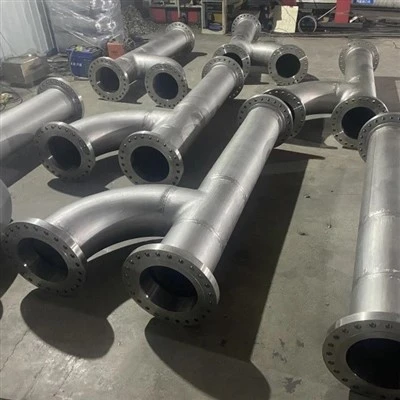
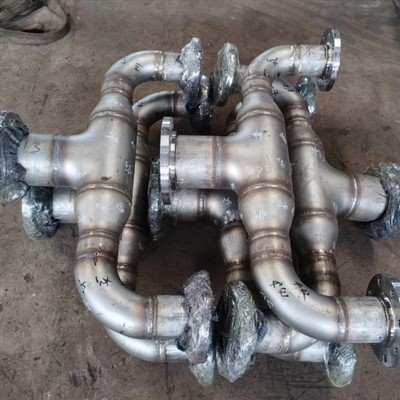
After water enters pipe insulation, inspect the entry point, the water migration path, and the places where moisture collects or evaporates. Give particular attention to low points, supports, penetrations, insulation terminations, welds, and damaged coatings. For austenitic stainless steel, thickness measurements alone cannot rule out chloride stress corrosion cracking.
What should you inspect first after water enters pipe insulation?
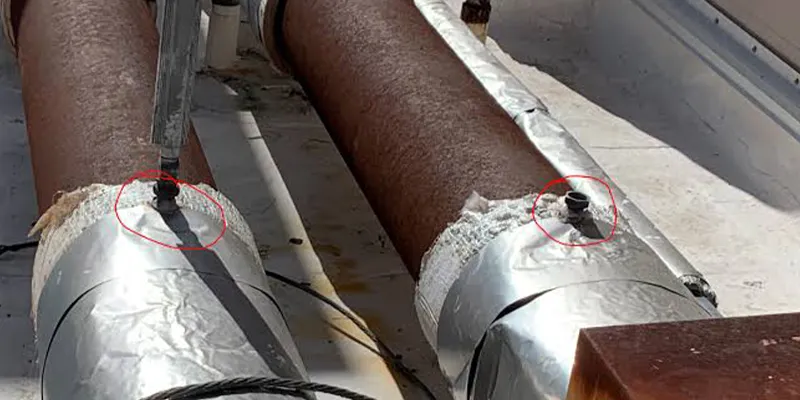
Start with the breached weather barrier, then follow the wet insulation to low points and moisture traps; also examine stressed metal within the affected area. The following sequence is a practical planning framework, not a fixed inspection rule or a substitute for a site risk assessment.
A jacket defect shows where water may enter, not necessarily where the pipe is most damaged. Water can move through insulation, collect at a support or elbow, and leave concentrated salts where it evaporates. ASTM describes insulation as a medium that can transport and concentrate corrosive ions at heated stainless steel surfaces.
|
Inspection location |
Why it matters |
What to examine after safe access |
|
Failed jacket seams, punctures and seals |
Potential entry points for rain, wash water or spills |
Extent of wet insulation; contamination; coating damage and deposits on the pipe |
|
Bottom of horizontal runs and low elbows |
Gravity can concentrate retained water |
Lower surface first, then the full circumference within the affected area |
|
Pipe shoes, support interfaces and clamps |
Discontinuities can trap water and restrict access |
Edges and concealed contact zones; obtain engineered access without compromising support |
|
Branches, instrument penetrations and insulation ends |
Weather-barrier interruptions admit water |
Seals, runback paths and adjacent pipe surfaces |
|
Welds, bends and attachment regions within the wet zone |
Residual or applied tensile stress can contribute to cracking |
Weld-adjacent surfaces and other stressed regions, not just visibly corroded areas |
|
Heat-traced sections, dead legs and temperature transitions |
Local surface temperatures can differ from the main run |
Wet/dry boundaries, deposits and locally heated areas |
Basis: this location map applies the moisture-transport, drainage, crevice and stress mechanisms described by ASTM, HSE and Inspectioneering. Actual opening locations should reflect the installed geometry and service history.
Why can insulated stainless steel crack without obvious wall loss?
Stainless steel under wet insulation can suffer localized pitting, crevice corrosion and external chloride stress corrosion cracking-not just broad surface thinning. A nearly normal thickness reading therefore does not establish that the pipe is free of cracks.
Stainless steel relies on a thin protective surface film. Chloride-bearing water can cause localized attack. When a susceptible alloy, tensile stress and a suitable chloride-containing environment act together, cracks may form. Tensile stress can remain from fabrication or arise during operation; visible rust is not a reliable measure of cracking risk.
|
Damage mechanism |
Plain-language description |
Inspection implication |
|
Pitting |
Small, deep areas of localized attack |
Inspect and measure local damage; averages can hide the deepest pit |
|
Crevice corrosion |
Localized attack where liquid is trapped in a narrow gap |
Expose relevant interfaces and deposits using a controlled procedure |
|
External chloride stress corrosion cracking |
Cracks driven by tensile stress in a chloride-containing environment |
Use a qualified crack-detection approach, not thickness checks alone |
Mechanism basis: HSE explains pitting, crevice corrosion and chloride-related stress corrosion cracking; API RP 583 specifically includes external chloride cracking under stainless steel insulation.
How should inspection differ between 304L, 316L, duplex and nickel alloy pipe?
Use the same water-path investigation for every alloy, but adjust the damage assessment to the specific grade. Higher alloy content can improve resistance; it does not justify leaving wet insulation in place or assuming immunity.
|
Material family |
Comparative behavior |
Practical inspection emphasis |
|
304 / 304L stainless steel |
Common austenitic grades susceptible to chloride-related localized attack and SCC |
Prioritize contaminated wet zones and stressed regions; consider both pits and cracks |
|
316 / 316L stainless steel |
Molybdenum improves chloride pitting resistance relative to 304; external chloride SCC remains possible |
Do not reduce examination solely because the line is 316L |
|
Duplex stainless steel, such as 2205 |
Generally greater chloride SCC resistance than conventional 300-series grades; resistance varies by grade and environment |
Verify the grade and welding history; investigate localized attack and any credible cracking mechanism |
|
Nickel alloys, such as 625 or C-276 |
Useful options for more aggressive environments; performance is alloy- and environment-specific |
Verify exact alloy identity and assess the actual contaminant and temperature exposure |
Comparison basis: Nickel Institute alloy-selection guidance and documented external cracking in insulated 316L equipment. Some nickel-base alloys can also experience external chloride cracking under suitable conditions. No universal resistance ranking applies to every chemical environment.
Which temperatures and water sources increase concern?
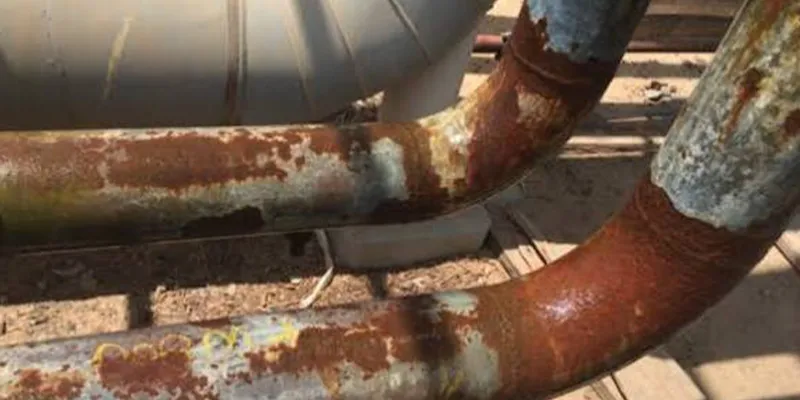
Prioritize warm, chloride-contaminated systems and equipment that repeatedly wets and dries, but do not use one temperature cutoff as proof of safety. Review metal surface temperatures during normal operation, startup, shutdown and heat tracing-not only the process design temperature.
HSE warns that even trace chlorides can cause problems in austenitic stainless steel above 60°C (140°F). This is a warning condition, not a universal lower boundary for all corrosion mechanisms or a guarantee of safety below it. Pitting and crevice corrosion require their own assessment.
Rain can carry atmospheric salts into insulation; washdown water and process spills can introduce additional contaminants. Evaporation can concentrate a small initial chloride load at the metal surface. Nickel Institute guidance describes external cracking under insulation even where low-chloride insulation was used, because environmental contamination entered later.
Should you inspect only the bottom of the pipe or the full circumference?
Use the underside as an important starting point, not as the inspection boundary. Expose the full circumference where the wetting pattern, deposits or damage mechanisms warrant it, and extend the opening along the credible water path.
Gravity favors lower surfaces, but insulation can transport water and salts away from the visible breach. Evaporation zones, penetrations and stressed regions may sit above or beside the lowest point. A small inspection window provides evidence only for its own accessible area. The required opening length and circumference should be justified by findings, not chosen as a universal number of centimeters.
As a practical escalation rule, extend exposure when adjacent insulation remains wet, deposits continue beyond the opening, coating damage persists, or crack-like indications appear. Record any areas that remain inaccessible and how that uncertainty will be resolved. This is proposed inspection planning guidance, not a quoted code requirement.
Which inspection methods find moisture, metal loss and cracks?
Choose the method for the question being asked: moisture screening locates suspect areas, thickness testing evaluates metal loss, and crack-sensitive examination addresses cracking. These functions are not interchangeable. API RP 583 covers the advantages and limitations of CUI examination methods.
|
Method or activity |
Main purpose |
Important limitation |
|
Jacket survey and moisture screening |
Locate breached barriers and suspect wet areas |
A dry-looking jacket or moisture result does not establish metal condition |
|
Insulation removal and visual examination |
Expose deposits, coating failure and visible surface damage |
Fine cracks may need additional examination; inaccessible contact zones remain unknown |
|
Ultrasonic thickness measurements or mapping |
Measure remaining wall and characterize accessible metal loss |
Routine thickness readings are not a qualified SCC detection examination |
|
Liquid penetrant examination after suitable preparation |
Reveal surface-breaking indications on accessible surfaces |
Requires clean, accessible surfaces; does not measure crack depth |
|
Qualified eddy-current examination |
Detect suitable surface or near-surface discontinuities |
Performance depends on alloy, geometry, surface condition and demonstrated procedure capability |
|
Qualified ultrasonic crack examination |
Characterize or size suitable crack-like indications |
Needs a procedure suited to stainless steel, flaw orientation, geometry and access |
Method selection is an engineering task: require the NDT provider to demonstrate coverage and sensitivity for the expected damage on the actual alloy and geometry. Eddy-current techniques vary widely; a generic claim of "inspection through insulation" should not be treated as proof that tight cracks can be excluded on austenitic stainless steel.
The table is a practical selection guide, not a promise of detection. Keep the examination scope, surface preparation, calibration, personnel qualification and acceptance criteria in the written inspection plan.
What is a practical workflow after a water-ingress event?
Make the system safe, establish the wetting extent, inspect for the credible damage mechanisms, and repair the water barrier only after the metal condition is understood. Simply replacing the visible jacket can leave the original problem hidden.

Assess immediate safety. If leakage, a crack-like indication or pressure-boundary damage is suspected, involve operations and the responsible integrity engineer. Isolation, depressurization and safe access must follow site procedures; do not disturb hot or hazardous equipment casually.
Define the exposure. Record the event, water source, possible salts or chemicals, duration if known, alloy, operating history and prior repairs. Photograph the jacket before removal.
Map the insulation system. Mark breaches, penetrations, supports, low points, heat tracing and terminations on a sketch or isometric. Identify likely water migration routes.
Open and document. Remove insulation under an approved work plan. Where analysis is needed, preserve representative wet insulation or deposits before cleaning. Observe hazardous-material and access requirements.
Examine the metal. Inspect accessible circumference and relevant weld-adjacent regions. Select thickness mapping for metal loss and a qualified crack-sensitive method where SCC is credible.
Expand and disposition. Extend the examination when findings continue beyond the opening. Refer crack-like indications and unacceptable metal loss for engineering assessment; do not hide unresolved findings.
Restore and verify. Repair or replace affected components as authorized, restore the specified protective system, install suitable dry insulation, and document weather-barrier completion and follow-up inspection.
This workflow is a proposed site-adaptable procedure. Its technical basis is the need to prevent wet insulation contact, assess localized damage and control corrosive contaminants; it is not presented as a mandatory sequence from a particular standard.
When should the inspection scope expand or the pipe be held for engineering review?
Escalate when the affected area is not bounded, when a crack-like indication is found, or when remaining wall cannot be shown to satisfy the governing assessment. A clean spot reading should not override evidence elsewhere in the wet zone.
|
Finding |
Recommended response |
|
Wet insulation or deposits continue past the opening |
Extend the inspection to establish the affected extent |
|
Crack-like surface indication |
Prompt integrity review; confirm and characterize using an appropriate procedure |
|
Deep pits or uncertain minimum wall |
Measure local damage and evaluate against the applicable design and assessment basis |
|
Unexamined support contact area |
Develop safe access or an engineered alternative; document the coverage limitation |
|
Dry metal but evidence of previous wetting |
Assess past chloride concentration and damage; dryness today is not proof of no previous attack |
|
No damage found within demonstrated coverage |
Record methods and coverage, restore the system, and assign risk-based follow-up |
These are conservative planning triggers, not universal rejection criteria. Acceptable remaining wall, crack assessment, repair and continued operation must be decided under the applicable code, owner requirements and responsible engineering authority. HSE emphasizes appropriate inspection programmes and traceable material-selection data.
How do insulation specifications compare with field contamination checks?
Insulation qualification and field inspection answer different questions. Qualification evaluates the insulation product; field inspection determines what actually happened to the installed pipe after exposure. Passing a laboratory insulation test does not prove an installed system is uncontaminated.
|
Document or check |
What it addresses |
What it does not establish |
|
ASTM C795 |
Specification for nonmetallic insulation contacting austenitic stainless steel; incorporates C692 and C871 requirements |
Fitness of an existing pipe after an ingress event |
|
ASTM C692 |
Laboratory evaluation of insulation contribution to external SCC; principally preproduction qualification |
A universal simulation of all field exposures or routine lot-compliance testing |
|
ASTM C871 |
Laboratory measurement of water-leachable chloride, fluoride, silicate and sodium in insulation |
A universal pipe-surface chloride acceptance limit or proof that cracks are absent |
|
API RP 583 |
Framework covering CUI design, maintenance, inspection and mitigation |
One fixed inspection opening size or automatic acceptance of a wet line |
Scope basis: ASTM public descriptions and API's RP 583 scope. Use the edition specified by the project and consult the complete documents for contractual requirements.
How can you reduce repeat water ingress after inspection?
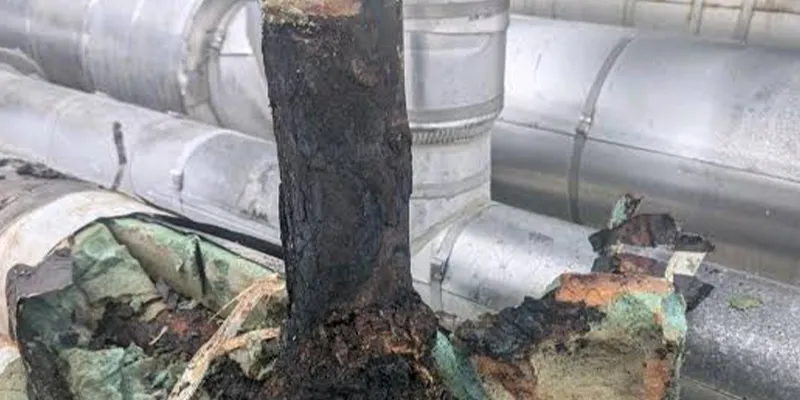
Control water entry, avoid water-retaining details, and restore an external protection system suited to the actual temperature and service. An alloy upgrade alone does not repair failed jacketing or poor drainage.
- Repair failed seams, penetrations and terminations with details compatible with the installed insulation system.
- Replace wet or contaminated insulation as directed by the approved specification; do not assume surface drying removes retained salts.
- Select any under-insulation coating for the alloy, surface preparation, operating and transient temperatures, and expected wetting.
- For cold service, restore the specified vapor-retarder continuity as well as the outer weather protection.
- Provide maintainable access and inspection records at recurrent trouble spots; avoid unengineered drilling or changes to load-bearing supports.
These are design and maintenance recommendations for project review. HSE calls for weatherproofing and protection against moisture and spills; Nickel Institute identifies minimizing wetting and suitable painting as successful countermeasures for insulated stainless steel.
What should a manufacturer provide when replacement pipe is needed?
Specify replacement pipe by verified grade, product specification, dimensions and service requirements-not by the word "stainless" alone. Ask for heat-traceable material documentation and any required examination records; evaluate an alloy upgrade against both the internal process and external exposure.
A useful purchase package identifies the required alloy and product form, wall thickness, delivery condition, joining requirements and certification. For recurring chloride exposure, a materials engineer may compare 316L with duplex or suitable nickel alloys. The right choice depends on actual chemistry, temperature, fabrication and code constraints; no supplier should promise universal CUI immunity.
What are the most common questions about wet insulation?
The key distinction is between removing moisture and proving pressure-boundary integrity. Dry insulation and sound metal are separate acceptance questions.
Is 316L immune to corrosion under insulation?
No. It has improved chloride pitting resistance relative to 304, but external chloride stress corrosion cracking has been documented on insulated 316L equipment.
Can rainwater cause problems if the insulation was specified as low chloride?
Yes. Environmental salts can enter with water and concentrate during evaporation; low-chloride insulation does not exclude later contamination.
Can normal ultrasonic thickness readings clear a line for SCC?
Not by themselves. SCC is a crack-like damage mechanism, so the examination must demonstrate suitability for cracks rather than only wall-thickness measurement.
Must every water-ingress event lead to complete insulation removal?
Not automatically. The scope should follow risk, moisture extent, geometry and findings. Limited openings must not be presented as proof of the condition of unexamined pipe.
Is there one safe chloride concentration for all insulated stainless steel?
No universal field limit is established by the sources cited here. Temperature, concentration during drying, stress, alloy and exposure conditions matter; C871 is an insulation chemical-analysis method, not a pipe fitness certificate.