|
Quick Answer
In a solvent recovery unit, the trace contaminants usually decide the Hastelloy grade, not the main solvent. Trace water can hydrolyze chlorinated solvents into hydrochloric acid. Oxidizers such as ferric ions or free chlorine favor C-22. Very low hydrochloric acid levels favor C-2000, while stronger levels favor C-276. And a solvent plus a little aqueous acid can attack Hastelloy in ways that neither liquid does alone.
A 2026 Merck study shows how big the effect can be. Hastelloy C-22 had no corrosion in pure acetonitrile or in 2 M aqueous HCl, but about 12 mpy and intergranular attack in a 9:1 mix of the two at 50 °C. Build a contaminant register first (water, HCl and halides, oxidizers, organic acids, peroxides), check it against grade data, then test the real mixture. |
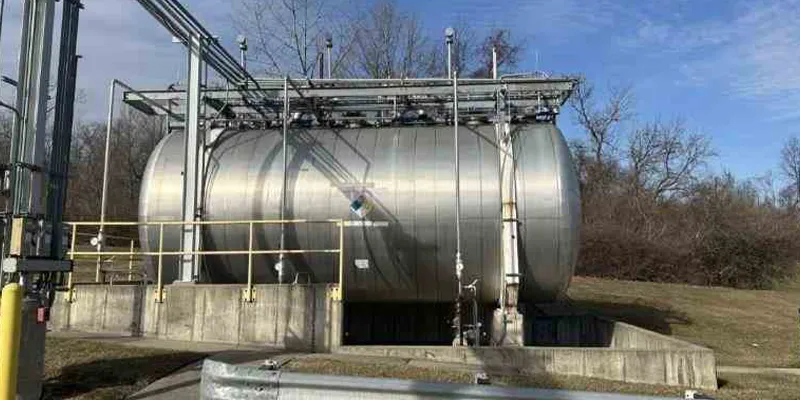
A solvent recovery unit takes used solvent, removes the dirt, and returns clean solvent for reuse. The main liquid is known: acetone, dichloromethane, acetonitrile, and so on. The trouble comes from what rides along with it. A little water, a little acid, a trace of metal ions. These contaminants are measured in parts per million, yet they often decide whether a still, condenser, or tank lasts years or months.
Why do trace contaminants matter more than the main solvent in a recovery unit?
Because distillation concentrates them. Water, acids, and oxidizers collect in the pot, in a second liquid phase, or in condensate, so the local liquid can be far more corrosive than the bulk solvent. Grade selection that ignores them is incomplete.
A recovery unit is built to separate components. Separation moves trace species into places where they build up: the reboiler, a water layer inside the column, or the first drops of condensate. The main solvent may be almost harmless to the metal, while a few hundred parts per million of the wrong contaminant, concentrated in one spot, is not.
Table 1. Trace contaminants to review in a solvent recovery unit
|
Contaminant |
Typical source |
Corrosion role |
Where it can concentrate |
|
Water |
Wet feed, steam, cleaning, humid air |
Hydrolyzes chlorinated solvents into HCl; forms an aqueous phase |
Reboiler, column mid-section, condenser |
|
Hydrochloric acid and other halides |
Hydrolysis or decomposition of chlorinated solvents; reactions upstream |
General attack, pitting, crevice attack, cracking |
Aqueous phase, condensate, crevices |
|
Oxidizers (ferric or cupric ions, free chlorine) |
Upstream corrosion products, chlorination steps |
Shift alloy ranking toward high-chromium grades |
Anywhere liquid sits, especially hot liquid |
|
Organic acids |
Process byproducts |
Low risk alone for Hastelloy; worse with halides |
Overhead and vent lines |
|
Peroxides, hydrazine |
Reagents, solvent degradation |
C-276 and C-22 can catalyze decomposition |
Any wetted metal surface |
|
Amides and amines |
Process solvents and bases |
Amide plus chlorinated solvent can release HCl; amines can suppress it |
Reboiler, hot zones |
Sources: OSTI record 6744311 (IBM solvent recovery tanks); US patent 4,980,031 (amide and chloroform recovery); Purdue P2SAC corrosion presentation; Merck P2SAC 2026 presentation; Haynes International; EETA classification.
How does trace water turn a chlorinated solvent into an acid problem?
Water hydrolyzes many chlorinated solvents and releases hydrochloric acid. The acid causes general corrosion, chloride pitting, and stress cracking, and it can collect in a separate water layer where it is much stronger than the bulk average suggests.
A study of solvent recovery tanks for methylene chloride and 1,1,1-trichloroethane at a manufacturing plant found corrosion and maintenance problems. It names hydrochloric acid as a hydrolysis product and says that the acid causes both general corrosion and chloride-induced pitting and stress corrosion cracking. The plant rebuilt the recovery tanks from a nickel-chromium-molybdenum alloy, which ran for almost a year without any sign of corrosion.
The pattern shows up in other sources. Each is a different kind of evidence, and the table says which.
Table 2. Documented cases of acid formation in solvent recovery and distillation
|
Case |
What was reported |
Evidence level |
|
Methylene chloride and trichloroethane recovery tanks |
Hydrolysis forms HCl; Ni-Cr-Mo alloy tanks ran about a year with no corrosion |
Published case note (OSTI) |
|
Wet isopropyl chloride distilled in a column with stainless packing |
Badly corroded packing; isopropyl chloride and water give isopropanol and HCl |
Industry presentation (Purdue P2SAC) |
|
Dewaxing plant with chlorinated solvents |
Chlorinated hydrocarbons are not fully stable; HCl forms from decomposition with water, causing plant corrosion |
Patent background statement |
|
Amide solvent with chloroform in stainless distillation |
The mixture promotes evolution of hydrogen chloride and corrosion; a tertiary amine was added to suppress it |
Patent (US 4,980,031) |
|
HCl and vinyl chloride column |
A second liquid phase of HCl in water causes relatively rapid corrosion of column metals |
Patent background statement (US 6,391,160) |
|
Wet dichloromethane distillation (forum question) |
Practitioners warn of hydrolysis; options discussed include 2205, 6-moly stainless, or glass-lined pots with alloy condensers |
Informal (Eng-Tips) |
Sources: OSTI 6744311; Purdue P2SAC "Corrosion" presentation; US patents 4,358,360, 4,980,031 and 6,391,160; Eng-Tips thread on dichloromethane hydrolysis. Patent statements describe the problem as the inventors saw it and are not test data.
Why can an organic solvent with trace aqueous acid be more corrosive than either alone?
Mixed organic and aqueous HCl systems can attack Hastelloy in ways that neither liquid does alone. In Merck's 2026 test, C-22 resisted pure acetonitrile and 2 M aqueous HCl, but a 9:1 mixture caused about 12 mpy and intergranular attack at 50 °C.
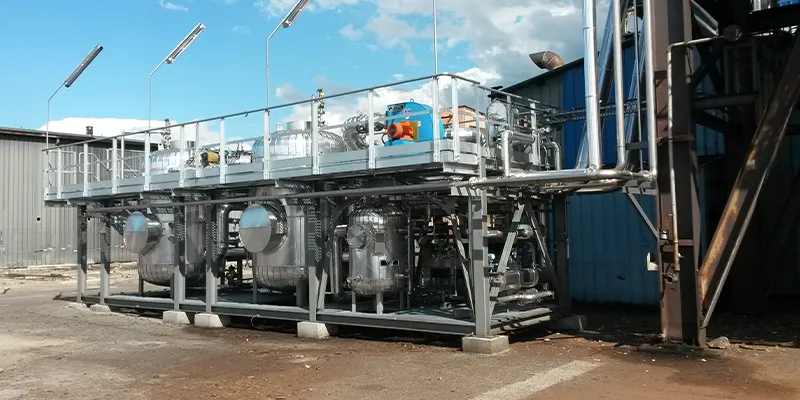
Merck scientists reported the finding after seeing corrosion in a process run at a contract manufacturer. They ran immersion tests on Hastelloy C-22 coupons (unstirred, in air, tied with polymer to simulate localized conditions) and published the work as a P2SAC conference presentation in May 2026. The surprise was that two "non-corroding" liquids became corrosive when combined in a specific ratio.
Table 3. Merck results for Hastelloy C-22 in acetonitrile (MeCN) and 2 M aqueous HCl, 50 °C, 7 days
|
Mixture (MeCN : 2 M HCl in water, by volume) |
Result |
|
Pure MeCN |
No corrosion |
|
2 M HCl in water only |
No corrosion |
|
1 : 1 |
No corrosion at 50 °C (intergranular attack at 75 °C) |
|
4.5 : 1 |
About 10.3 mpy; intergranular attack |
|
9 : 1 (about 0.9 wt% HCl) |
About 11.9 mpy; intergranular attack |
|
20 : 1 |
About 11.8 mpy; most severe visible attack |
|
49 : 1 and 99 : 1 |
About 12.9 and 13.5 mpy; intergranular attack |
Source: Chen and Margelefsky, "Intergranular corrosion on Hastelloy," Merck & Co., P2SAC, May 2026 (Purdue University). A single sampling per condition; the authors state the mechanism is still under investigation. Rates read from the presentation's chart values.
Other findings from the same study matter for grade selection:
- Temperature: no corrosion at 25 °C in the 9:1 mix; intergranular attack at 50 °C and 75 °C, with a higher rate at 50 °C than at 75 °C, possibly linked to crystal growth of a corrosion product at 75 °C.
- Time: the rate fell from 26.8 mpy at one day to 3.0 mpy at 29 days, while intergranular attack worsened. The authors concluded that the general corrosion rate does not quantify the severity.
- Other solvents: THF and acetone with 2 M HCl showed similar corrosive behavior on C-22; methanol, NMP, and triethylamine mixtures showed no corrosion.
- Other alloys: C-276 behaved similarly to C-22. 316L and 304L were attacked intergranularly (316L also cracked). A cobalt alloy (Ultimet 6B) also suffered intergranular attack. Tantalum showed no corrosion.
- What this means for grade selection. For these mixtures, moving from C-22 to C-276 did not remove the problem. The grade choice cannot be separated from the contaminant review, and no table of single-liquid data predicted this behavior.
How do C-276, C-22, and C-2000 rank across trace-contaminant conditions?
The ranking changes with the contaminant. C-2000 leads at very low HCl and in oxidizing acid, C-22 leads in wet chlorine, and C-276 leads in stronger, hotter HCl. Organic acids alone are low risk for these alloys.
Haynes describes C-22 as having much higher resistance to oxidizing media than C-276, and C-2000 as extending corrosion resistance in both oxidizing and reducing acids. The tables below show how that plays out. Lower rates are better, and all values are from reagent-grade laboratory tests.
Table 4. Haynes laboratory data relevant to trace contaminants (mm/y unless noted)
|
Condition |
C-22 |
C-276 |
C-2000 |
Lowest or best |
|
1% HCl, boiling |
0.06 |
0.33 |
0.01 |
C-2000 |
|
5% HCl, 93 °C |
3.02 |
1.25 |
1.37 |
C-276 |
|
5% HCl, boiling |
8.90 |
3.63 |
4.23 |
C-276 |
|
10% HCl, 79 °C |
1.99 |
1.18 |
1.54 |
C-276 |
|
40% HNO3, boiling (oxidizing acid) |
0.26 |
4.42 |
0.24 |
C-2000, C-22 |
|
Saturated wet chlorine, liquid, 80 °C |
No attack (1.5 mpy) |
Severe weld-metal and HAZ attack |
Not in this test |
C-22 |
|
88% formic acid, boiling |
<0.01 |
0.04 |
Not shown |
Both low |
|
99% acetic acid, boiling |
0.00 |
<0.01 |
Not shown |
Both low |
Sources: Haynes HYBRID-BC1 datasheet H-3179F (HCl rows); Haynes C-22 and C-276 alloy pages (organic acids, wet chlorine); Haynes C-276 datasheet (nitric); Haynes C-2000 datasheet. Data come from different Haynes datasheets, so treat comparisons as indicative.
Three lessons follow. First, a trace of HCl (around 1%) favors C-2000 in boiling acid, but the order flips when HCl rises toward 5% to 10%. A trace that is allowed to build up can change the best grade. Second, if oxidizers such as ferric ions or free chlorine can appear, C-22 or C-2000 is the safer starting point. Third, organic acids on their own are not the problem, but they do not protect the metal when halides are also present.
Which equipment locations concentrate trace contaminants?
The reboiler or pot, any point where a second liquid phase forms, the overhead condenser, vent lines, packing, and crevices. Each should be reviewed on its own, with its own local contaminant levels.
Table 5. Where trace contaminants collect in a recovery unit
|
Location |
Why contaminants concentrate |
Evidence |
|
Reboiler or pot |
Heavy ends and acids build up as the solvent boils off; hydrolysis is fastest where it is hottest |
Practitioners suggest hydrolysis is worst in the reboiler (informal) |
|
Column mid-section |
A second aqueous phase can form and hold HCl at high strength |
Vinyl chloride column patent (US 6,391,160) |
|
Overhead condenser |
Water and acid gas condense together at the dew point |
EETA engineering note; vent-line corrosion case below |
|
Vent lines |
Acid gases (HCl, SO2) pass through lightly wetted lines |
Purdue presentation: corroded Hastelloy vent lines from HCl and SO2 |
|
Packing and internals |
Large wetted area; wet halide solvents hydrolyze on it |
Purdue presentation: stainless packing corroded by wet isopropyl chloride |
|
Crevices (gaskets, laps, deposits) |
Restricted access lets acidity build; crevice attack starts at lower temperature than pitting |
Merck slides; Haynes G48 data (C-276 CCT 55 °C) |
How should you build a trace-contaminant register before grade selection?
List every contaminant, give it a realistic range for each campaign and for upsets, say where it can concentrate, and say how it will be measured. Then compare each line with the grade data.
- List the streams. Feed solvents, recycle streams, cleaning agents, and any reagents that can carry over.
- List the contaminants from Table 1 for each stream, including water, HCl and other halides, oxidizers, organic acids, peroxides, and amines.
- Give each a range for normal, upset, and worst-case operation, and note how often the worst case happens.
- Note where each concentrates using Table 5, and the local temperature there.
- Decide how it will be measured (for example water by Karl Fischer titration, halides by ion chromatography, metals by ICP-MS as Merck used for dissolved metals).
- Compare with data. Use Table 4 and the Haynes tables, then flag any line without data for testing.
Table 6. Example contaminant register (illustrative rows)
|
Stream |
Contaminant |
Range to record |
Where it concentrates |
Action |
|
Wet dichloromethane feed |
Water, hydrolysis HCl |
Water ppm and pH of any aqueous layer, normal and upset |
Reboiler; condenser |
Check Table 4 HCl rows; test the real stream |
|
Acetonitrile or THF with aqueous acid |
Aqueous HCl at low percent |
HCl wt% in the organic phase; water ratio |
Whole wetted path |
Run mixed-solvent immersion test (Table 3 type) |
|
Recycle from a chlorination step |
Free chlorine, ferric ions |
Ppm Cl2 and Fe3+ |
Hot zones; crevices |
Favor C-22 or C-2000; confirm by test |
|
Reagent recovery |
Peroxide or hydrazine carryover |
Ppm by assay |
Any wetted surface |
Check decomposition catalysis |
|
All streams |
Organic acids |
Wt% range |
Overhead and vents |
Low risk alone; note halide pairing |
What testing confirms a grade for the real mixture?
Immersion testing of coupons in the real or simulated mixture, with a crevice, over several time points, followed by examination of the metal structure. A weight-loss rate alone can hide intergranular attack.
Merck's own advice to engineers is direct: use the literature first; if data are unavailable, test; if the system seems suspicious, test; and some testing, even rudimentary, is better than none. Their method was simple: small coupons, polymer-tied to create a crevice, weighed before and after, and examined under a microscope.
Table 7. Tests for trace-contaminant corrosion in recovery units
|
Test |
What it shows |
Limitation |
|
Laboratory immersion (ASTM G31 style) |
Corrosion rate of base metal and welds in the real mixture and temperature |
Does not show boiling, condensing, or velocity effects |
|
Crevice coupon (polymer-tied) |
Whether attack starts at a tight gap |
Not a full crevice test; use G48 for a standard comparison |
|
Metallographic examination |
Intergranular attack, pitting, cracking |
Needs a microscope and a trained eye |
|
Multiple time points |
Whether the rate changes with time (Merck: 26.8 to 3.0 mpy) |
Needs a long test; rate can fall while damage grows |
|
Plant coupons (ASTM G4) |
Real-service rate and local attack |
Coupons may not cover transition zones or the hottest spot |
|
Solution analysis (ICP-MS) |
Dissolved metals showing what is corroding |
Shows that corrosion happened, not where |
Sources: Merck P2SAC 2026 presentation (methods and advice); ASTM G4 (iTeh previews); ASTM G31 and G48 as referenced earlier; EETA summary.
When is Hastelloy not the answer, and what else is used?
If the contaminant mix keeps the metal outside its safe range, the answer is a design or process change: dry the stream, add a suppressor, line the vessel, or use another material. Hastelloy is a strong default, not a guarantee.
Table 8. Options when trace contaminants exceed the metal's range
|
Option |
Idea |
Evidence level |
|
Dry the feed or control water |
Less water means less hydrolysis and less aqueous phase |
Logical from the hydrolysis mechanism; EETA note |
|
Add an acid suppressor |
A tertiary amine was added to suppress HCl formation in amide and chloroform distillation |
Patent (US 4,980,031) |
|
Tantalum |
No corrosion in Merck's mixed-solvent test |
Conference result; cost and mechanical limits apply |
|
Glass-lined pot with alloy condenser |
Suggested by practitioners for wet dichloromethane |
Informal forum advice |
|
Carbon steel with corrosion allowance |
Suggested for a reboiler; a pharmaceutical user questioned whether quality rules would allow it |
Informal forum advice |
Sources: US patent 4,980,031; Merck P2SAC 2026 presentation; Eng-Tips thread on dichloromethane hydrolysis (informal). Practitioner suggestions are not standards; choose with the owner's engineer.
What should a buyer specify for Hastelloy in solvent recovery?
Specify the grade with the contaminant register behind it: streams, trace ranges, temperatures, welds, test evidence, and documents. A short written basis prevents most disputes about early failure.
- Grade and form: the Hastelloy grade (UNS number) and product form, with the governing ASTM specification.
- Contaminant basis: the register from Table 6, with the worst-case ranges.
- Weld and filler: qualified procedure, filler choice, interpass temperature limit, and inspection.
- Crevices and dead legs: minimize gasket faces, laps, and stagnant pockets in wetted areas.
- Test evidence: immersion or crevice test results in the real or simulated mixture where no data exist.
- Verification: PMI of every wetted part, and a thickness baseline at the reboiler, condenser, and vents.
- Documents: EN 10204 3.1 certificate, weld records, PMI report, and test reports.
JN Alloys supplies Hastelloy among its nickel alloys and lists nickel alloy machined parts, customized processing according to drawings, and technical consultation among its services. Its testing equipment includes a spectrum analyzer, PMI testing, a universal tensile tester, a metallographic analyzer, and an impact tester. Buyers can share their contaminant register when requesting a quotation; scope for solvent recovery equipment should be confirmed for each project.
Frequently Asked Questions
Q: Why do chlorinated solvents corrode equipment in recovery units?
A: Chlorinated solvents can hydrolyze when water is present, and one product is hydrochloric acid. A study of solvent recovery tanks for methylene chloride and 1,1,1-trichloroethane notes that the acid causes general corrosion and also chloride-induced pitting and stress corrosion cracking. Trace water is therefore a corrosion variable, not only a quality variable.
Q: Can Hastelloy corrode in solvent and acid mixtures that look mild?
A: Yes. Merck scientists reported in 2026 that Hastelloy C-22 showed no corrosion in pure acetonitrile or in 2 M aqueous HCl, but about 12 mpy and intergranular attack in a 9:1 acetonitrile to 2 M HCl mixture at 50 °C. C-276 behaved similarly. This is a conference result, not a standard, but it is a strong reason to test the real mixture.
Q: Is C-22 or C-276 the better choice for solvent recovery?
A: It depends on the contaminants. Haynes data show C-22 is far more resistant to oxidizing conditions such as wet chlorine and ferric ions, while C-276 and C-2000 can be lower in some hydrochloric acid conditions. In the Merck mixed-solvent test, C-276 and C-22 were attacked in a similar way, so the grade alone did not solve the problem.
Q: Is a low general corrosion rate enough to approve a grade?
A: No. In the Merck work the rate fell from 26.8 mpy after one day to 3.0 mpy after 29 days while the intergranular attack got worse. The authors concluded that the general corrosion rate does not quantify the severity of the corrosion. Examine the metal structure as well as the weight loss.
Q: Which trace contaminants should be listed before choosing a grade?
A: List water, hydrochloric acid and other halides, oxidizers (ferric or cupric ions, free chlorine), organic acids, amines, and peroxides or hydrazine. Record the likely range of each, where it can concentrate, and how it will be measured.
Q: Do Hastelloy alloys react with peroxides or hydrazine?
A: A pharmaceutical corrosion presentation notes that C-276 and C-22 can catalyze the decomposition of hydrazine and peroxy compounds such as hydrogen peroxide and peracetic acid. If recovered streams can contain these, check compatibility as well as corrosion.
Q: Is stainless steel acceptable if the solvent is chlorinated?
A: Only with great care. Practitioners report chloride stress cracking concerns with dichloromethane in stainless steel after hydrolysis. In the Merck test, 316L and 304L were attacked intergranularly and 316L also cracked in the acetonitrile and HCl mixture. A dry, well-controlled stream may suit stainless steel; a wet or acidic one often does not.
Q: How should a trace-contaminant corrosion test be run?
A: Immerse coupons in the real or simulated mixture at the planned temperatures, with a crevice (for example a tied polymer wrap), and with a welded sample if welds are in the wetted area. Run it long enough to see change over time, then examine the coupon structure. The Merck advice is that if data are unavailable or the system seems suspicious, test it.