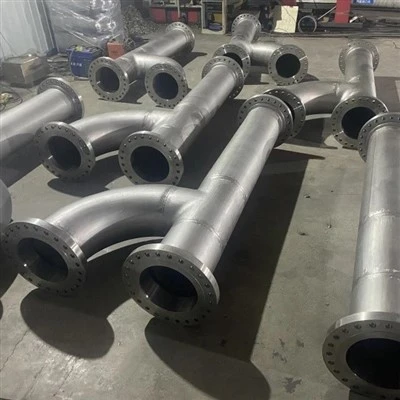
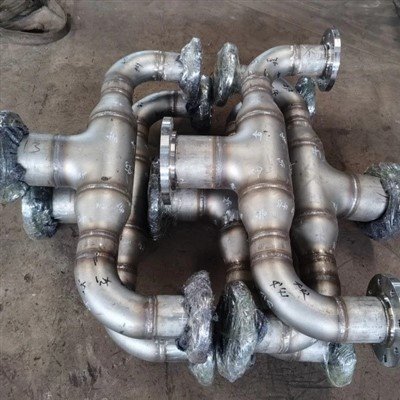
Hastelloy C22 seamless pipe (UNS N06022) is manufactured to ASTM B622, covering nickel-chromium-molybdenum-tungsten alloy pipe in nominal sizes from 1/8 inch to 12 inch (OD up to approximately 273 mm / 10.75 inch) across schedules 5S through XXS. It requires solution annealing at 1120-1175 degrees C with rapid quench and must meet minimum tensile strength of 690 MPa (100 ksi) and yield of 283 MPa (40 ksi).

Pressure rating is not a fixed flange class but is calculated per ASME B31.3 from wall thickness and allowable stress; a representative NPS 2 SCH 80 pipe carries about 39 MPa (5,660 psi) at room temperature, declining with temperature.
What Is Hastelloy C22 Seamless Pipe and How Does It Differ from C276?
Hastelloy C22 (UNS N06022) is a nickel-chromium-molybdenum-tungsten corrosion-resistant alloy with higher chromium (20-22.5 percent) than C276 (14.5-16.5 percent), giving it superior resistance to oxidizing and mixed-acid environments, while C276 retains a slight edge in strong reducing acids due to its higher molybdenum.
C22 and C276 are both members of the Hastelloy C family of nickel-molybdenum-chromium alloys, but they are optimized for different corrosive regimes. C22 was developed to bridge the gap between C276 (best in reducing acids) and C4 (best in oxidizing media). Its higher chromium content (about 21 percent vs 15.5 percent) forms a more stable passive film in oxidizing environments such as nitric acid, wet chlorine, and ferric chloride, and especially in mixed oxidizing-reducing streams. Its molybdenum (12.5-14.5 percent) is slightly lower than C276 (15-17 percent), so in strongly reducing acids (e.g., hot concentrated HCl) C276 is marginally better, but the difference is small.
For most FGD, chemical, and pulp-and-paper applications, C22 is the preferred choice because service environments are usually oxidizing or mixed rather than purely reducing. Both alloys are fully austenitic, solution-annealed, and welded with similar procedures. For seamless pipe specifically, C22 is often selected when the process stream contains chlorinated oxidants or mixed acids.
Table 1. C22 vs C276 Key Differences for Pipe Service
|
Property |
C22 (UNS N06022) |
C276 (UNS N10276) |
|
Chromium |
20.0 - 22.5 percent |
14.5 - 16.5 percent |
|
Molybdenum |
12.5 - 14.5 percent |
15.0 - 17.0 percent |
|
Tungsten |
2.5 - 3.5 percent |
3.0 - 4.5 percent |
|
Carbon (max) |
0.015 percent |
0.010 percent |
|
PREN (approx.) |
approximately 65 |
approximately 68 |
|
Best in |
Oxidizing + mixed acid |
Strong reducing acids |
|
Wet chlorine / hypochlorite |
Excellent (preferred) |
Good |
|
Hot H2SO4 (mixed) |
Excellent |
Good |
|
Concentrated HCl |
Good |
Better |
|
Relative cost |
100 percent (baseline) |
95 - 105 percent |
|
Common pipe spec |
ASTM B622 |
ASTM B622 |
Source: ASTM B574/B622; Haynes International C22 (H-2014) and C276 (H-2002) datasheets; UNS N06022 / N10276 registry.
What Does ASTM B622 Cover for C22 Seamless Pipe?
ASTM B622 is the standard specification for seamless nickel and nickel-cobalt alloy pipe and tube, covering C22 seamless pipe in the solution-annealed condition with requirements for chemistry, mechanical properties, hydrostatic or nondestructive testing, dimensions, and certification.

ASTM B622 is the primary product standard for seamless nickel-alloy pipe and tube, and C22 (UNS N06022) is listed among its covered alloys. The specification addresses: (1) chemical composition limits (heat analysis and product analysis); (2) mechanical properties (tensile and yield minimums, elongation); (3) heat treatment (solution annealing); (4) dimensional tolerances for outside diameter, wall thickness, and length; (5) nondestructive testing options including hydrostatic test, eddy current, ultrasonic, or pneumatic leak test; (6) marking and EN 10204-type certification. For pipe intended for pressure service, B622 is used together with the applicable piping code (ASME B31.3 for process, ASME B31.1 for power) which governs design, allowable stress, and welding. Note that seamless pipe falls under B622, while welded pipe of the same alloy is covered by ASTM B619 (welded pipe) and B626 (welded tube). Large-diameter C22 pipe is therefore usually welded (B619) because seamless sizing is limited.
Table 2. ASTM B622 Scope Elements for C22 Pipe
|
Requirement |
ASTM B622 Provision |
|
Alloy covered |
UNS N06022 (Hastelloy C22) and other Ni-Co alloys |
|
Product form |
Seamless pipe and tube |
|
Condition |
Solution annealed |
|
Chemistry |
Heat + product analysis per Table 1 limits |
|
Tensile test |
Required on each lot / heat |
|
Flattening test |
Required for pipe (per B622) |
|
Nondestructive test |
Hydrostatic OR eddy current / UT / pneumatic (selectable) |
|
Dimensional tolerance |
OD and wall per B622 Table |
|
Certification |
EN 10204 3.1 / 3.2 available |
|
Companion standards |
B619 welded pipe, B626 welded tube, B574 bar, B564 forging |
Source: ASTM B622-21 (Standard Specification for Seamless Nickel and Nickel-Cobalt Alloy Pipe and Tube); ASME B31.3.
What Are the Chemical Composition Limits for C22 Pipe (UNS N06022)?
ASTM B622 limits C22 chemistry to a tightly controlled range - notably chromium 20.0-22.5 percent, molybdenum 12.5-14.5 percent, tungsten 2.5-3.5 percent, and ultra-low carbon 0.015 percent maximum - which is what gives the alloy its combined oxidizing and reducing corrosion resistance.
The chemistry limits are the foundation of C22's corrosion performance. Chromium at 20-22.5 percent is the highest among the C-family alloys and is responsible for oxidizing-acid resistance. Molybdenum at 12.5-14.5 percent provides resistance to chloride pitting and reducing acids. Tungsten (2.5-3.5 percent) supplements molybdenum in pitting resistance.
The ultra-low carbon (0.015 percent max) and ultra-low silicon (0.08 percent max) prevent grain-boundary carbide and silicide precipitation during welding, so C22 is essentially immune to weld-zone sensitization without post-weld heat treatment. Cobalt is limited to 2.5 percent maximum (a nuclear-industry legacy requirement), and iron is capped at 3-6 percent to keep the nickel matrix dominant. Iron is intentionally limited to a narrow 2-6 percent band - high enough for cost but low enough to preserve corrosion resistance. These limits are verified by heat analysis and, where specified, product (check) analysis on the finished pipe.
Table 3. C22 (UNS N06022) Chemical Composition Limits (ASTM B622)
|
Element |
Composition (weight percent) |
|
Nickel (Ni) |
Balance (approximately 56 min) |
|
Chromium (Cr) |
20.0 - 22.5 |
|
Molybdenum (Mo) |
12.5 - 14.5 |
|
Tungsten (W) |
2.5 - 3.5 |
|
Iron (Fe) |
2.0 - 6.0 |
|
Cobalt (Co) |
2.5 max |
|
Manganese (Mn) |
0.50 max |
|
Silicon (Si) |
0.08 max |
|
Carbon (C) |
0.015 max |
|
Phosphorus (P) |
0.020 max |
|
Sulfur (S) |
0.010 max |
|
Vanadium (V) |
0.35 max |
Source: ASTM B622-21 Table 1 (UNS N06022); Haynes C22 datasheet H-2014.
What Are the Mechanical Property Requirements for C22 Seamless Pipe?
ASTM B622 requires C22 seamless pipe to meet a minimum tensile strength of 690 MPa (100 ksi), minimum yield strength of 283 MPa (40 ksi), and minimum elongation of 45 percent, placing it among the stronger corrosion-resistant alloys and suitable for thin-wall pressure service.

The mechanical minimums ensure the pipe can carry pressure and resist deformation. The 690 MPa tensile and 283 MPa yield are identical in magnitude to C276, because both are solid-solution-strengthened austenitic alloys with similar matrix strengthening. The 45 percent elongation requirement confirms excellent ductility, which is critical for forming, bending, and absorbing stress without cracking. Hardness is not separately specified in B622 but typically falls in the 85-95 HRB range in the solution-annealed condition.
These properties apply to the full cross-section of seamless pipe and are verified by a longitudinal tensile test. For design, the controlling value is the ASME allowable stress (see Section 6), which is derived from these tensile properties with code safety factors. Because C22 is not precipitation-hardenable, its strength cannot be increased by heat treatment; any strengthening must come from cold work (which is generally avoided for corrosion service because it can promote sensitization) or from wall thickness.
Table 4. C22 Mechanical Properties (Solution Annealed, ASTM B622)
|
Property |
Minimum Requirement |
Typical Value |
|
Tensile Strength |
690 MPa (100 ksi) |
720 - 790 MPa |
|
Yield Strength (0.2 percent) |
283 MPa (40 ksi) |
320 - 370 MPa |
|
Elongation (min) |
45 percent |
48 - 55 percent |
|
Hardness |
not specified |
85 - 95 HRB |
|
Density |
- |
8.69 g/cm3 |
|
Modulus of Elasticity |
- |
205 GPa |
Source: ASTM B622-21; ASME BPVC Section II Part D (2023); Haynes H-2014.
What Is the Size Range of C22 Seamless Pipe per ASTM B622?
C22 seamless pipe per ASTM B622 is typically supplied in nominal pipe sizes from 1/8 inch to 12 inch (outside diameter up to about 273 mm / 10.75 inch), with wall thicknesses from Schedule 5S through XXS; diameters larger than about 12 inch are normally supplied as welded pipe to ASTM B619.
Seamless pipe is produced by piercing and elongating a solid billet, which becomes impractical and uneconomical beyond certain diameters. ASTM B622 therefore covers the seamless size range that mills can reliably manufacture, generally up to NPS 12 (273 mm OD). Common stock sizes are NPS 1/2, 3/4, 1, 1.5, 2, 3, 4, 6, 8, 10, and 12.
Wall thickness follows the ANSI B36.19M (stainless) schedule system: 5S, 10S, 40S, 80S, 120, 160, and XXS. For corrosion service, thinner walls (5S, 10S) are often used because the alloy is expensive and corrosion allowance is built into the design; for mechanical strength, 40S/80S are typical.
Lengths are usually 3-6 meters (10-20 feet) for seamless, though double-random lengths up to 12 meters are available from some mills.
For projects requiring NPS 14, 16, 20, or 24 inch C22 pipe, the welded route (ASTM B619) with full radiography is the standard solution.
Table 5. Typical C22 Seamless Pipe Size Availability
|
NPS |
OD (mm) |
Common Schedules |
Common Wall (SCH 40S, mm) |
|
1/2 |
21.3 |
5S, 10S, 40S, 80S |
2.77 |
|
1 |
33.4 |
5S, 10S, 40S, 80S |
3.38 |
|
2 |
60.3 |
5S, 10S, 40S, 80S, 160, XXS |
3.91 |
|
3 |
88.9 |
5S, 10S, 40S, 80S, XXS |
5.49 |
|
4 |
114.3 |
5S, 10S, 40S, 80S, XXS |
6.02 |
|
6 |
168.3 |
5S, 10S, 40S, 80S, XXS |
7.11 |
|
8 |
219.1 |
5S, 10S, 40S, 80S |
8.18 |
|
10 |
273.1 |
5S, 10S, 40S, 80S |
9.27 |
|
12 |
323.9 |
5S, 10S, 40S (welded common) |
10.31 (often B619) |
Source: ASTM B622 / B36.19M dimensions; JN Alloy stock list 2026; mill catalog data.
What Are the Pressure Ratings of C22 Seamless Pipe?
C22 seamless pipe has no fixed 'pressure class' like a flange; its maximum allowable working pressure (MAWP) is calculated per ASME B31.3 from wall thickness and the code allowable stress, which for C22 is approximately 190 MPa at room temperature and declines to about 165 MPa at 300 degrees C and 150 MPa at 400 degrees C.

Unlike flanges (which have tabulated ASME B16.5 pressure-temperature ratings by class), pipe pressure capability is computed. The governing ASME B31.3 equation for internal pressure design thickness is: t = (P * D) / (2 * (S * E + P * Y)), where P is design pressure, D is outside diameter, S is allowable stress, E is quality factor (1.0 for seamless), and Y is the coefficient (0.4 below 480 degrees C). Rearranging to solve for the maximum pressure a given wall can carry: P = (2 * S * E * t) / (D - 2 * Y * t).
The table below shows representative MAWP values for common seamless sizes and schedules, computed with E = 1.0 and Y = 0.4 using indicative S values. These figures are for design reference; the actual allowable stress must be taken from the current ASME BPVC Section II Part D edition and the project design temperature. Note that as temperature rises, S drops, so MAWP falls - a NPS 2 SCH 80 pipe rated about 39 MPa at 20 degrees C carries about 30 MPa at 400 degrees C.
Table 6. C22 Allowable Stress (ASME BPVC II-D, indicative)
|
Temperature |
Allowable Stress S (MPa) |
|
20 degrees C |
approximately 190 |
|
100 degrees C |
approximately 185 |
|
200 degrees C |
approximately 178 |
|
300 degrees C |
approximately 165 |
|
400 degrees C |
approximately 150 |
|
500 degrees C |
approximately 135 |
Table 7. Representative MAWP of C22 Seamless Pipe (computed per ASME B31.3, E=1.0, Y=0.4)
|
Size / Schedule |
Wall t (mm) |
MAWP @20 C (MPa) |
MAWP @300 C (MPa) |
MAWP @400 C (MPa) |
|
NPS 1 SCH 80 |
3.38 |
47.0 |
40.8 |
37.1 |
|
NPS 2 SCH 80 |
3.91 |
39.1 |
33.9 |
30.9 |
|
NPS 2 SCH 160 |
7.01 |
64.5 |
56.0 |
51.0 |
|
NPS 3 SCH 80 |
5.49 |
34.1 |
29.6 |
26.9 |
|
NPS 4 SCH 80 |
6.02 |
29.0 |
25.2 |
22.9 |
|
NPS 6 SCH 40S |
7.11 |
17.5 |
15.2 |
13.8 |
|
NPS 8 SCH 40S |
8.18 |
13.4 |
11.6 |
10.6 |
Worked example: For NPS 2 SCH 80 (OD 60.3 mm, wall 3.91 mm) at 20 degrees C with S = 190 MPa: P = (2 x 190 x 1.0 x 3.91) / (60.3 - 2 x 0.4 x 3.91) = 1485.8 / 57.17 = 26.0 MPa. Note different references use slightly different S and rounding; values above are indicative and shall be verified against the controlling code edition.
How Do C22 and C276 Compare for Seamless Pipe Service?
For seamless pipe, choose C22 when the service is oxidizing, chlorinated, or mixed-acid (FGD, bleach, wet chlorine, nitric-acid environments), and choose C276 when the dominant hazard is strong reducing acid (hot concentrated HCl, certain sulfuric streams) - for most chemical and FGD piping, C22 is the more robust and equally cost-effective option.
The pipe-specific selection between C22 and C276 follows the same logic as the alloy comparison in Section 1 but is sharpened by the fact that most C22 pipe is used in oxidizing or mixed environments. In flue-gas desulfurization (FGD) systems, where the scrubber environment contains chlorides, sulfates, and oxidants (such as hypochlorite from bleaching), C22's higher chromium gives it a clear durability advantage and it has become the de facto standard for FGD absorber and ductile pipe.
In pulp and paper bleach plants (chlorine dioxide, hypochlorite), C22 similarly outperforms C276. C276 retains an edge only where hot concentrated HCl or very aggressive reducing sulfuric acid dominates. From a fabrication standpoint, both are welded identically (ERNiCrMo-10 or ERNiCrMo-22 filler), so the decision is purely corrosion-driven. Price is essentially the same (C22 within 0-10 percent of C276). A practical rule: if a process engineer is unsure whether the stream is oxidizing or mixed, specify C22 for pipe because it covers the broader envelope.
Table 8. C22 vs C276 Pipe Selection by Service
|
Service Environment |
Preferred Pipe Alloy |
Reason |
|
FGD scrubber, ductile, mist |
C22 |
Oxidizing chloride + oxidant |
|
Bleach plant (ClO2, hypo) |
C22 |
Oxidizing chlorinated environment |
|
Wet chlorine / hypochlorite |
C22 |
Excellent oxidizing resistance |
|
Mixed H2SO4-HNO3 |
C22 |
Mixed acid, high Cr helps |
|
Hot concentrated HCl |
C276 |
Higher Mo/W for reducing acid |
|
Sour gas (severe, HCl present) |
C276 |
Reducing + sour |
|
Seawater + oxidizing |
C22 or 625 |
High Cr + Mo |
|
General chemical process |
C22 (default) |
Broadest envelope |
Source: Haynes C22 and C276 application notes; FGD and pulp-paper materials guides.
What Heat Treatment and Condition Are Required for C22 Pipe?
ASTM B622 requires C22 seamless pipe to be supplied in the solution-annealed condition at 1120-1175 degrees C (2050-2150 degrees F) followed by rapid water quench; no stress-relief or post-weld heat treatment in the 600-1150 degrees C range is permitted because it would cause harmful intermetallic precipitation.

Solution annealing dissolves any carbides, silicides, or intermetallic phases formed during hot working and locks the alloy into its single-phase austenitic, corrosion-resistant state. The rapid water quench is essential: cooling slowly through the 600-1150 degrees C range would allow mu-phase and P-phase (molybdenum-rich intermetallics) to precipitate, embrittling the pipe and depleting the matrix of corrosion-resistant elements. Therefore, unlike carbon steel, C22 pipe must never be stress-relieved or post-weld heat-treated in that dangerous range.
For field welds, the only acceptable heat treatment is a full re-solution anneal; in practice, most C22 pipe is put into service after welding with no PWHT, relying on the alloy's inherent immunity to weld sensitization (ultra-low C and Si). Procurement specifications should explicitly require 'solution annealed, water quenched' and forbid any PWHT in the 600-1150 degrees C band. Mill heat-treatment records should be requested as part of the MTC.
Table 9. C22 Heat Treatment Rules
|
Operation |
Requirement |
|
Mill anneal |
1120-1175 C, rapid water quench |
|
As-supplied condition |
Solution annealed only |
|
Stress relief |
Not permitted (embrittles) |
|
PWHT (600-1150 C) |
Strictly forbidden |
|
Field weld PWHT |
None required; full re-anneal only if heated |
|
Hot forming |
Above 1040 C then re-anneal, or below 600 C |
Source: ASTM B622; Haynes H-2014 heat treatment; AWS D1.6 / ASME Section IX.
What Standards and Codes Supplement ASTM B622 for C22 Pipe?
C22 seamless pipe is used within a family of standards: ASTM B622 (seamless pipe), B619 (welded pipe), B626 (welded tube), B574 (bar), B564 (forgings), B366 (fittings), plus ASME B31.3 / B31.1 for piping design, ASME BPVC Section VIII for vessels, NACE MR0175 for sour service, and ASTM G28 for intergranular corrosion verification.
A single pipe alone does not make a system; the surrounding standards define how it is designed, joined, tested, and accepted. For a complete C22 piping system: ASTM B622 supplies the seamless pipe, while ASTM B366 butt-weld fittings (elbows, tees, reducers) and ASTM B564 forged flanges complete the line. The piping layout and pressure design follow ASME B31.3 (process) or B31.1 (power).
If the pipe enters a pressure vessel, ASME BPVC Section VIII Division 1 provides the vessel rules and references the same allowable stresses. For oil and gas sour service, NACE MR0175 / ISO 15156 Part 3 lists C22 (UNS N06022) as an acceptable corrosion-resistant alloy in the solution-annealed condition with hardness below 35 HRC. To verify that the supplied pipe is free of sensitization, ASTM G28 Method A (ferric sulfate-sulfuric acid test) is commonly specified. EN 10204 3.1 or 3.2 certification documents chemistry, mechanical properties, and heat treatment.
Table 10. Standards Referenced for C22 Pipe Systems
|
Standard |
Role |
|
ASTM B622 |
Seamless pipe specification (this article) |
|
ASTM B619 |
Welded pipe (large diameter) |
|
ASTM B626 |
Welded tube |
|
ASTM B574 |
Bar and rod |
|
ASTM B564 |
Forgings (flanges, blocks) |
|
ASTM B366 |
Butt-weld fittings |
|
ASME B31.3 / B31.1 |
Piping design and pressure |
|
ASME BPVC Section VIII |
Pressure vessel integration |
|
NACE MR0175 / ISO 15156-3 |
Sour service acceptance |
|
ASTM G28 Method A |
Intergranular corrosion test |
|
EN 10204 3.1 / 3.2 |
Material test certificate |
Source: ASTM International 2024; ASME 2023; NACE MR0175/ISO 15156-3 (2020).
How Is Hastelloy C22 Pipe Welded?
C22 seamless pipe is welded using gas-tungsten-arc welding (GTAW) with matching ERNiCrMo-22 (UNS N06022) or ERNiCrMo-10 (UNS N06059) filler, strict heat input control of 0.5-1.5 kJ/mm and interpass below 93 degrees C, and no post-weld heat treatment.

Welding C22 is straightforward because of its ultra-low carbon and silicon, which prevent weld-zone sensitization. The recommended filler is ERNiCrMo-22 (AWS A5.14, UNS N06022) for the closest composition match, or ERNiCrMo-10 (UNS N06059) which is also widely used for C-family alloys and offers good dilution tolerance. GTAW (TIG) is preferred for root passes to ensure fusion without oxidation, followed by GMAW or SMAW for fill passes where appropriate.
Heat input should be limited to 0.5-1.5 kJ/mm to avoid excessive grain growth, and interpass temperature kept below 93 degrees C. Shielding gas is 99.99 percent argon with a full argon backing purge (oxygen below 50 ppm) for the root pass to prevent oxidation of the weld root. Because C22 is immune to sensitization, post-weld heat treatment is not required; the weld remains as corrosion-resistant as the base metal. Qualification per ASME Section IX is mandatory, and the weld should be inspected per the governing code (RT/UT/PT as specified).
Table 11. C22 Pipe Welding Parameters
|
Parameter |
Recommendation |
|
Filler metal |
ERNiCrMo-22 (N06022) or ERNiCrMo-10 (N06059) |
|
Process |
GTAW root, GMAW/SMAW fill |
|
Shielding gas |
99.99 percent Ar; backing purge O2 < 50 ppm |
|
Heat input |
0.5 - 1.5 kJ/mm |
|
Interpass temperature |
Below 93 degrees C |
|
Preheat |
None required |
|
PWHT |
None required |
|
Qualification |
ASME Section IX |
|
NDT |
PT, RT/UT per code |
Source: Haynes C22 welding guide; AWS D1.6; ASME Section IX; AWS A5.14.
Case Study: FGD Scrubber Recirculation Line Conversion to C22 Pipe
A 600 MW coal-fired plant replaced failing 904L recirculation piping with C22 (UNS N06022) seamless and welded pipe in its FGD absorber, eliminating recurring chloride-induced pitting failures and extending the line service life from under 3 years to a projected 20-plus years.

The original FGD recirculation line used 904L (UNS N08904) stainless steel based on an early chloride estimate. Within 2.5 years, multiple through-wall pits appeared at weld heat-affected zones where condensed chloride concentrated during shutdowns. Metallurgical analysis showed the local chloride level during evaporative concentration exceeded 904L's critical pitting threshold (its PREN of about 35 was insufficient). A corrosion upgrade specified C22 (UNS N06022) with PREN about 65 - nearly double 904L's resistance - for the recirculation and outlet piping.
Given the range of diameters (NPS 3 through NPS 14), the specification used ASTM B622 seamless pipe for NPS 3-12 branches and ASTM B619 welded pipe with 100 percent radiography for NPS 14 mains. After 6 years of operation (2020-2026), inspection shows no pitting, no wall loss beyond measurement uncertainty, and no unscheduled downtime attributed to the C22 line. The higher material cost (roughly 3x 904L) was recovered within 4 years by avoiding two forced outages that had previously cost approximately USD 400,000 each.
Source: EPRI FGD materials handbook; JN Alloy customer case (anonymized); plant inspection records 2020-2026.
Frequently Asked Questions: C22 Seamless Pipe
Q: What is the ASTM specification for Hastelloy C22 seamless pipe?
A: Hastelloy C22 seamless pipe is covered by ASTM B622, the standard specification for seamless nickel and nickel-cobalt alloy pipe and tube. It defines chemistry (UNS N06022), mechanical properties (minimum tensile 690 MPa, yield 283 MPa, elongation 45 percent), heat treatment (solution annealed), dimensions, testing, and certification. Welded C22 pipe of larger diameter is covered separately by ASTM B619, and fittings by ASTM B366.
Q: What is the maximum size of C22 seamless pipe?
A: C22 seamless pipe per ASTM B622 is typically available from NPS 1/8 up to NPS 12 (outside diameter about 273 mm / 10.75 inch) in schedules 5S through XXS. Diameters larger than NPS 12 are normally supplied as welded pipe to ASTM B619 because seamless piercing is impractical and uneconomical above this size. Projects needing NPS 14, 16, 20, or 24 inch C22 pipe should specify welded construction with full radiography.
Q: What pressure rating does C22 seamless pipe have?
A: C22 pipe has no fixed pressure class like a flange; its maximum allowable working pressure is calculated per ASME B31.3 from wall thickness and the code allowable stress. Using indicative ASME II-D values (S about 190 MPa at 20 C, declining to about 150 MPa at 400 C), a representative NPS 2 SCH 80 C22 pipe carries about 39 MPa (5,660 psi) at room temperature and about 31 MPa at 400 C. Always verify against the current code edition and project design temperature.
Q: Is C22 better than C276 for pipe?
A: It depends on the corrosive environment. C22 has higher chromium (20-22.5 percent vs 14.5-16.5 percent) and is superior in oxidizing and mixed-acid service such as FGD scrubbers, bleach plants, and wet chlorine, which covers most chemical piping. C276 retains a slight edge only in very strong reducing acids like hot concentrated HCl. For unknown or mixed environments, C22 is the broader, equally cost-effective default for pipe.
Q: Does C22 pipe need post-weld heat treatment?
A: No. C22 is immune to weld-zone sensitization because of its ultra-low carbon (0.015 percent max) and silicon (0.08 percent max), so post-weld heat treatment is not required and is in fact forbidden in the 600-1150 C range because it would cause embrittling intermetallic precipitation. Field welds are normally put into service as-welded. The only acceptable heat treatment is a full re-solution anneal if the pipe was accidentally heated into the dangerous range.
Q: Can C22 pipe be used in sour (H2S) service?
A: Yes. C22 (UNS N06022) is listed in NACE MR0175 / ISO 15156 Part 3 as an acceptable corrosion-resistant alloy for sour service in the solution-annealed condition with hardness below 35 HRC. It is especially effective where the sour environment also contains oxidants or chlorides. For the most severe sour service with concentrated HCl, C276 may be preferred, but C22 covers the majority of H2S-CO2-chloride process streams.