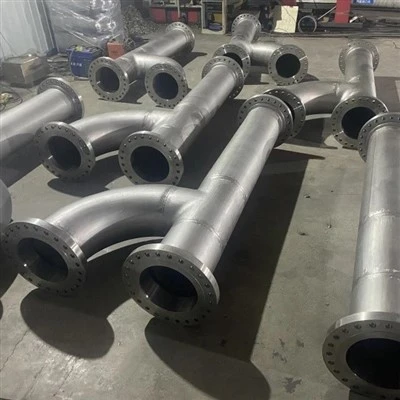
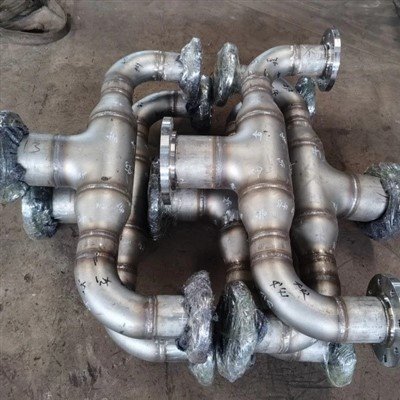
Super Duplex UNS S32750 (F53 / 1.4410) 45° short radius bends are frequently specified for their exceptional combination of mechanical strength and corrosion resistance in high-pressure, corrosive piping systems such as offshore platforms, subsea manifolds, and chemical processing plants.
These bends are manufactured and dimensioned in strict accordance with ASME B16.49-"Factory-Made, Wrought Steel, Buttwelding Induction Bends for Transportation and Distribution Systems."

Below is a detailed, professional explanation of the F53 45° short radius induction bend's standard dimensions, tolerances, and considerations.
Radius Definition for Short Radius Bends
45° short radius bend is a pipe fitting that changes the direction of a pipeline by 45 degrees with a tight bending radius. The "short radius" is specifically defined as a centerline bend radius (R) equal to 1 times the nominal pipe size (NPS), expressed as 1D.
The governing dimensional standard for factory-made wrought butt-welding fittings, including elbows, is ASME B16.9. For induction bends and pipe bends manufactured from straight pipe, the relevant standard is ASME B16.49.

According to ASME B16.49 S4.2:
Short Radius (SR) = 1 × Nominal Pipe Size (NPS).
Centerline bending radius R = 1 DN (metric) or R = 1 × NPS (imperial).
Example:
6″ Sch 80S F53 bend → R = 6″ (152.4 mm).
10″ Sch 60 F53 bend → R = 10″ (254 mm).
45° Short Radius Elbows/Bends Dimensions
The primary dimension for a 45° elbow is the center-to-end distance, often designated as dimension "F" or "A" in charts. For short-radius 45° elbows, this distance is smaller than that of a long-radius 45° elbow of the same pipe size.
The following table outlines the standard center-to-end dimensions for short radius 45° fittings, based on industry-standard data.
|
Nominal Pipe Size (NPS) |
Outside Diameter at Bevel (OD) |
Center-to-End (A/F) Dimension |
|
1 |
33.4 mm (1.32 in) |
25 mm (1.00 in) |
|
2 |
60.3 mm (2.38 in) |
51 mm (2.00 in) |
|
3 |
88.9 mm (3.50 in) |
76 mm (3.00 in) |
|
4 |
114.3 mm (4.50 in) |
102 mm (4.00 in) |
|
6 |
168.3 mm (6.62 in) |
152 mm (6.00 in) |
|
8 |
219.1 mm (8.62 in) |
203 mm (8.00 in) |
|
10 |
273.0 mm (10.75 in) |
254 mm (10.00 in) |
|
12 |
323.8 mm (12.75 in) |
305 mm (12.00 in) |
|
14 |
355.6 mm (14.00 in) |
356 mm (14.00 in) |
|
16 |
406.4 mm (16.00 in) |
406 mm (16.00 in) |
Important Tolerances: As per ASME B16.9, the center-to-end dimension tolerance for fittings up to NPS 24 is ±1.5 mm (1/16 in). Wall thickness after bending must not be less than the minimum required for the corresponding straight pipe.
Super Duplex Stainless Steel F53 Benefits

F53, also known as UNS S32750, is a super duplex stainless steel. This family of alloys is characterized by a mixed microstructure of approximately 50% austenite and 50% ferrite, which grants them:
Exceptional Corrosion Resistance: Particularly against chloride stress corrosion cracking, pitting, and crevice corrosion, surpassing standard 316L or 304 stainless steels.
High Mechanical Strength: Roughly double the yield strength of standard austenitic stainless steels, allowing for potential wall thickness reduction in some designs.
Manufacturing and Standard Compliance: ASME B16.49
While ASME B16.9 covers prefabricated elbows, ASME B16.49 governs induction-bent pipe bends, which are manufactured by bending straight pipe segments. Bends to B16.49 are common for larger diameters or specific project requirements.
For F53 material, the bending process (often induction bending) must be carefully controlled. A subsequent solution annealing and quenching heat treatment is almost always mandatory to restore the optimal 50/50 phase balance and corrosion properties after the bend is formed.
Requirements during manufacturing include:

The bent surface must be free of cracks and buckles.
Final wall thickness must meet the design specification.
Heat treatment must be performed in accordance with relevant codes.
In conclusion, the F53 45° short radius bend is a high-performance solution for tight, corrosive piping layouts.