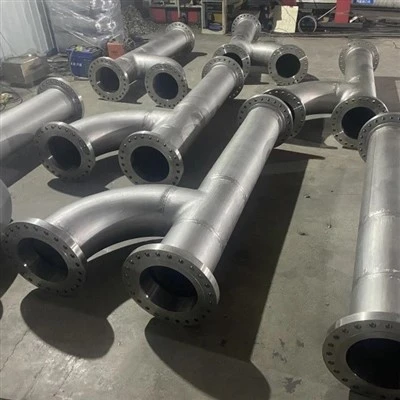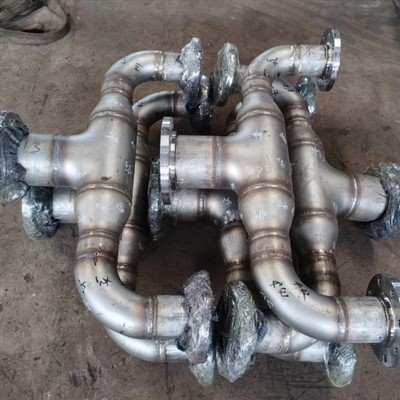
- ASTM B462 N08020 (Alloy 20) is a niobium-stabilized nickel-iron-chromium alloy developed for sulfuric-acid and phosphoric-acid service.
- Composition: 32–38% Ni, 19–21% Cr, 2–3% Mo, 3–4% Cu, Nb+Ta 8×C min to 1.0% max, Fe balance, with low C/P/S limits.
- Minimum mechanical properties: tensile 551 MPa (80 ksi), yield 241 MPa (35 ksi), elongation 30%, reduction of area 50%.
- Pressure-temperature ratings follow ASME B16.5 Group 3.1; at ambient the allowable non-shock working pressure spans 20 bar (Class 150) to 430.9 bar (Class 2500).
- Supplied in stabilized-annealed condition; field welding generally needs no post-weld heat treatment.
- Available as weld neck, slip-on, blind, socket weld, threaded, and lap joint flanges in Classes 150–2500 per ASME B16.5 / B16.47.

At a Glance: Alloy 20 Flange Specification
|
Property |
Value (ASTM B462 / ASME B16.5) |
|
UNS designation |
N08020 |
|
Material family |
Nickel–Iron–Chromium–Mo–Cu austenitic alloy |
|
Forging standard |
ASTM B462 / ASME SB462 |
|
Plate alternative |
ASTM B463 / ASME SB463 (machined plate flanges) |
|
ASME B16.5 rating group |
Group 3.1 |
|
Min. tensile strength |
551 MPa (80 ksi) |
|
Min. yield strength (0.2% offset) |
241 MPa (35 ksi) |
|
Min. elongation |
30% |
|
Condition |
Stabilized-annealed |
|
Pressure classes |
150, 300, 400, 600, 900, 1500, 2500 |
|
Max design temperature (ASME VIII-1) |
538 °C (1000 °F) |
|
Common trade names |
Carpenter 20, Alloy 20Cb-3 (sometimes loosely "Incoloy 20") |
Alloy 20 flanges are the standard connection of choice for pipelines that carry sulfuric acid, phosphoric acid, and other aggressive chemicals. They keep the entire joint-the most leak-prone part of a piping system-as corrosion-resistant as the pipe itself. This guide explains the ASTM B462 Grade N08020 specification in plain language: what the alloy is made of, its mechanical strength, and the ASME B16.5 pressure-temperature ratings you must apply when sizing a flange. The structure follows a "question heading → conclusion → explanation" format so that each fact can be read, quoted, or cited on its own.
What Is ASTM B462 Grade N08020 (Alloy 20)?
Alloy 20 (UNS N08020) is a niobium-stabilized, nickel-iron-chromium austenitic alloy covered by ASTM B462 for forged or rolled pipe flanges, fittings, and valves intended for corrosive, high-temperature service-especially dilute sulfuric acid.
ASTM B462 (and its unified international twin ASME SB462) specifies the chemistry, heat treatment, and mechanical integrity of forged/rolled N08020 products. The nominal make-up is often written as 35Ni–35Fe–20Cr–Cb (Cb = columbium, the older name for niobium). The alloy was originally developed in 1951 for sulfuric-acid handling.
Two design features make Alloy 20 practical in the field:
- Copper (3–4%) gives strong resistance to sulfuric and phosphoric acids.
- Niobium (Nb) ties up carbon, preventing chromium-carbide precipitation at grain boundaries during welding-so the flange resists intergranular corrosion and usually needs no post-weld heat treatment.
What Is the Chemical Composition of Alloy 20 (N08020) Flanges?
Per ASTM B462, Alloy 20 contains 32–38% nickel, 19–21% chromium, 2–3% molybdenum, 3–4% copper, niobium+tantalum of 8×C (minimum) up to 1.0% (maximum), iron as the balance, and tightly capped carbon, phosphorus, and sulfur.
|
Element |
Weight % (max unless a range) |
|
Carbon (C) |
≤ 0.07 |
|
Manganese (Mn) |
≤ 2.00 |
|
Phosphorus (P) |
≤ 0.045 |
|
Sulfur (S) |
≤ 0.035 |
|
Silicon (Si) |
≤ 1.00 |
|
Nickel (Ni) |
32.00 – 38.00 |
|
Chromium (Cr) |
19.00 – 21.00 |
|
Molybdenum (Mo) |
2.00 – 3.00 |
|
Copper (Cu) |
3.00 – 4.00 |
|
Niobium + Tantalum (Nb+Ta) |
8 × %C – 1.00 |
|
Iron (Fe) |
Balance (remainder) |
Why each element matters:
- Nickel (32–38%): provides the base austenitic structure and near-immunity to chloride stress-corrosion cracking-far better than 316L stainless.
- Chromium (19–21%) + Molybdenum (2–3%): build a self-healing passive film that resists pitting and crevice corrosion.
- Copper (3–4%): the signature addition that slows attack by sulfuric and phosphoric acids.
- Niobium (≥ 8×C): stabilizes the alloy so welding does not sensitize it.
- Low C/P/S: keep impurities from harming corrosion resistance and weldability.
What Are the Mechanical Properties of ASTM B462 N08020 Flanges?
At room temperature, ASTM B462 N08020 flanges must meet a minimum tensile strength of 551 MPa (80 ksi), a minimum yield strength of 241 MPa (35 ksi), at least 30% elongation, and at least 50% reduction of area. Flanges are furnished in the stabilized-annealed condition.
|
Property |
Minimum value |
|
Tensile strength |
551 MPa (80 ksi) |
|
Yield strength (0.2% offset) |
241 MPa (35 ksi) |
|
Elongation |
30% |
|
Reduction of area |
50% |
|
Condition |
Stabilized-annealed |
These are room-temperature minimums. Alloy 20 also keeps useful strength and toughness at moderately elevated temperatures, which is why ASME permits design use up to 538 °C (1000 °F) under Section VIII, Division 1. Long exposure above roughly 427 °C (800 °F) can lower allowable stress because of slow microstructural changes, so the pressure-temperature ratings below must be used for any pressurized joint.
What Are the Pressure-Temperature Ratings of Alloy 20 Flanges (ASME B16.5 Group 3.1)?
Alloy 20 flanges are assigned to ASME B16.5 Group 3.1. The maximum allowable non-shock working pressure at ambient temperature (−29 to 38 °C / −20 to 100 °F) is 20.0 bar (290 psig) for Class 150 and rises to 430.9 bar (6250 psig) for Class 2500. The allowable pressure drops steadily as temperature rises.

The two tables below are the official ASME B16.5 Group 3.1 ratings, expressed in metric (°C / bar) and imperial (°F / psig) units. Values are the maximum allowable non-shock working pressures; intermediate temperatures may be found by linear interpolation.
Table 1 - Pressure-Temperature Ratings, Metric (°C / bar gauge)
|
Temp °C |
150 |
300 |
400 |
600 |
900 |
1500 |
2500 |
|
−29 to 38 |
20.0 |
51.7 |
68.9 |
103.4 |
155.1 |
258.6 |
430.9 |
|
50 |
19.5 |
51.7 |
68.9 |
103.4 |
155.1 |
258.6 |
430.9 |
|
100 |
17.7 |
50.9 |
67.8 |
101.7 |
152.6 |
254.4 |
423.9 |
|
150 |
15.8 |
48.9 |
65.3 |
97.9 |
146.8 |
244.7 |
407.8 |
|
200 |
13.8 |
47.2 |
62.9 |
94.3 |
141.5 |
235.8 |
392.9 |
|
250 |
12.1 |
45.5 |
60.7 |
91.0 |
136.5 |
227.5 |
379.2 |
|
300 |
10.2 |
42.9 |
57.0 |
85.7 |
128.6 |
214.4 |
357.1 |
|
325 |
9.3 |
41.4 |
55.0 |
82.6 |
124.0 |
206.6 |
344.3 |
|
350 |
8.4 |
40.3 |
53.6 |
80.4 |
120.7 |
201.1 |
335.3 |
|
375 |
7.4 |
38.9 |
51.6 |
77.6 |
116.5 |
194.1 |
323.2 |
|
400 |
6.5 |
36.5 |
48.9 |
73.3 |
109.8 |
183.1 |
304.9 |
|
425 |
5.5 |
35.2 |
46.5 |
70.0 |
105.1 |
175.1 |
291.6 |
Table 2 - Pressure-Temperature Ratings, Imperial (°F / psig)
|
Temp °F |
150 |
300 |
400 |
600 |
900 |
1500 |
2500 |
|
−20 to 100 |
290 |
750 |
1000 |
1500 |
2250 |
3750 |
6250 |
|
200 |
260 |
740 |
990 |
1485 |
2225 |
3710 |
6180 |
|
300 |
230 |
710 |
945 |
1420 |
2130 |
3550 |
5920 |
|
400 |
200 |
680 |
910 |
1365 |
2045 |
3410 |
5680 |
|
500 |
170 |
655 |
875 |
1310 |
1965 |
3275 |
5460 |
|
600 |
140 |
605 |
805 |
1210 |
1815 |
3025 |
5040 |
|
650 |
125 |
590 |
785 |
1175 |
1765 |
2940 |
4905 |
|
700 |
110 |
570 |
755 |
1135 |
1705 |
2840 |
4730 |
|
750 |
95 |
530 |
710 |
1065 |
1595 |
2660 |
4430 |
|
800 |
80 |
510 |
675 |
1015 |
1525 |
2540 |
4230 |
How to read these tables: pick the row for your operating temperature and the column for your flange class. The intersection is the highest safe working pressure (non-shock) for that combination. Example: a Class 300 Alloy 20 flange at 200 °C may carry about 47.2 bar (690 psig); at 400 °C the limit falls to 36.5 bar (530 psig). Ratings apply to flanges, flanged fittings, and flanged valves of the stated class. For service below −29 °C (−20 °F), consult the current ASME B16.5 edition for material-specific limits.
Which Flange Types and Standards Apply to ASTM B462 N08020?
Alloy 20 flanges are produced in every common type-weld neck, slip-on, blind, socket weld, threaded, lap joint, and more-across Classes 150 to 2500, dimensioned to ASME B16.5 (NPS ½–24) and ASME B16.47 Series A/B for large diameters, with a plate-based option under ASTM B463.
|
Aspect |
Detail |
|
Flange types |
Weld Neck (WN), Slip-On (SO), Blind (BL), Socket Weld (SW), Threaded (TH), Lap Joint (LJ), Long Weld Neck, Reducing, Orifice |
|
Pressure classes |
150, 300, 400, 600, 900, 1500, 2500 (plus PN ratings in metric projects) |
|
Dimensional standards |
ASME B16.5 (NPS ½–24); ASME B16.47 Series A & B (NPS 26–60) |
|
Forging material spec |
ASTM B462 / ASME SB462 (UNS N08020) |
|
Plate material spec |
ASTM B463 / ASME SB463 (when machined from plate) |
|
Face types |
Raised Face (RF), Flat Face (FF), Ring Type Joint (RTJ), Tongue & Groove, Male & Female |
|
Typical size range |
½ in (DN15) to 48 in (DN1200) |
Tip for specifiers: weld neck flanges give the best strength and fatigue life under pressure and thermal cycling; slip-on flanges cost less but are weaker at the same rating. Choose the type that matches the joint's mechanical duty, not just the pressure class.
How Does Alloy 20 Compare with 316L, Alloy 825, and Hastelloy C276?
Alloy 20 is the cost-effective specialist for sulfuric and phosphoric acid and for chloride stress-cracking resistance. It outperforms 316L in acid service, is a step below Alloy 825 for oxidizing acids and high temperature, and is well below Hastelloy C276 for the most aggressive mixed-acid duty-but at a fraction of C276's cost.

|
Alloy (UNS) |
Ni % |
Cr % |
Key extras |
Best for |
Relative cost |
|
316L (S31603) |
~12 |
~17 |
Mo ~2.5 |
General mild corrosion; weak in H₂SO₄ & chlorides |
Low |
|
Alloy 20 (N08020) |
32–38 |
19–21 |
Mo ~2.5, Cu 3–4, Nb |
Sulfuric/phosphoric acid; chloride SCC |
Moderate |
|
Alloy 825 (N08825) |
~42 |
~21.5 |
Mo ~3, Cu ~2.2, Ti |
Oxidizing acids + higher temperature |
Higher |
|
Hastelloy C276 (N10276) |
~57 |
~16 |
Mo ~16, W ~4 |
Harshest mixed oxidizing/reducing acids |
Highest |
Practical rule of thumb: if the fluid is mostly sulfuric or phosphoric acid and chloride stress cracking is a risk, Alloy 20 is usually the right economic answer. If the environment is strongly oxidizing (e.g., nitric acid rich) or very hot, step up to Alloy 825. Reserve Hastelloy C276 for the少数 cases where nothing else survives.
What Are the Typical Applications of Alloy 20 Flanges?
Alloy 20 flanges are used wherever piping must survive strong acids and chlorides: sulfuric-acid plants, phosphoric-acid and fertilizer lines, chemical reactors, heat exchangers, pharmaceutical and food-acid systems, pollution-control scrubbers, and select sour-service lines.
- Sulfuric acid concentration, dilution, storage, and transfer systems
- Phosphoric acid and fertilizer production
- Chemical reactors, agitators, and heat-exchanger channels
- Pharmaceutical and food-acid processing where cleanliness meets corrosion
- Pollution control: scrubbers, stack-gas cleaning, wastewater treatment
- Petrochemical and refinery lines carrying acidic or chloride-bearing streams
- Limited sour (H₂S) service per NACE MR0175 / ISO 15156, subject to hardness and H₂S limits
Frequently Asked Questions
Q: Is Alloy 20 the same as stainless steel?
No. Alloy 20 is a nickel-based alloy with about 35% nickel, whereas common stainless steels such as 316L contain only about 12% nickel. The higher nickel content plus copper and molybdenum give Alloy 20 far better resistance to sulfuric and phosphoric acids and to chloride stress-corrosion cracking.
Q: Do Alloy 20 flanges need post-weld heat treatment?
Generally no. Niobium stabilization prevents sensitization during welding, so field welds keep their corrosion resistance without a post-weld anneal for most services. Always confirm against the specific service conditions and the applicable code.
Q: What pressure can a Class 300 Alloy 20 flange hold?
At ambient temperature (−29 to 38 °C) up to 51.7 bar (750 psig) non-shock. The rating falls with temperature-about 47.2 bar at 200 °C and 36.5 bar at 400 °C. Use the rating tables above and interpolate linearly between listed temperatures.
Q: Can Alloy 20 be used in sour (H₂S) service?
It is listed in NACE MR0175 / ISO 15156 for limited sour service, subject to hardness and H₂S partial-pressure limits. Verify against the current standard and the project's material specification before use.
Q: Alloy 20, Alloy 825, or Hastelloy C276-which do I choose?
Alloy 20 is the value choice for sulfuric/phosphoric acid and chloride SCC. Alloy 825 adds oxidizing-acid and higher-temperature capability. Hastelloy C276 covers the most aggressive mixed acids but at the highest cost. Match the alloy to the actual chemical environment, not to a generic "corrosion-resistant" label.