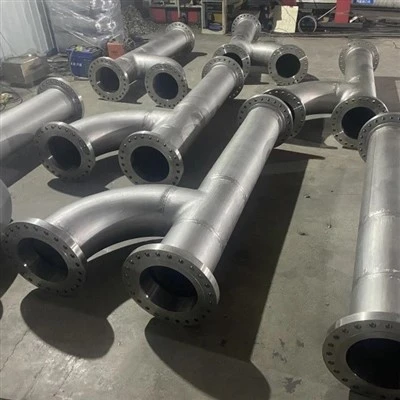
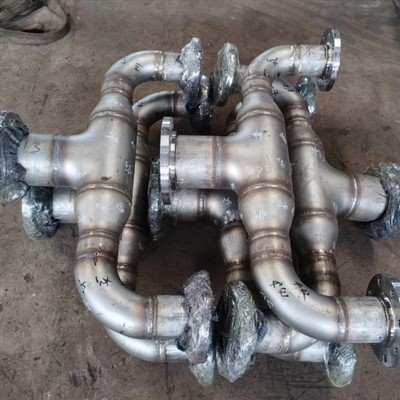
A stainless steel pipe can leave the mill straight, clean, and within tolerance, then arrive at the fabrication table with an oval, flared, or dented end. Nothing seems to have happened, yet the ends will not line up. The cause is rarely a single event. It is usually a combination of stress built into the pipe during manufacture, stress released or added when the pipe is cut, and mechanical damage during storage, lifting, and transport.
This guide explains each cause in plain language, compares cutting and handling methods, shows why thin-wall stainless pipe is especially vulnerable, and gives a practical checklist for preventing distortion. It is a companion to our article on measuring pipe ovality and resolving fit-up problems.

Short answer: Stainless steel pipe ends distort for four main reasons: residual stress locked in by forming, welding, straightening, and heat treatment; stress release and clamping forces during cutting; heat from thermal cutting methods; and mechanical damage during handling, stacking, and transport. The ends are most vulnerable because they are the first place stress is released, the thinnest-supported part of the pipe, and the part that gets bumped, strapped, and lifted. Thin-wall pipe is affected most because its ring stiffness is low. Prevent distortion by choosing cold cutting, supporting the pipe from inside and outside during cutting, protecting ends with caps, and limiting stack height and strap pressure.
This guide is general technical information. Your purchase order, applicable standards, and qualified procedures control what is acceptable.
Why Do Stainless Steel Pipe Ends Become Distorted?
Pipe ends distort because of four overlapping causes: stress built in during manufacturing, stress released or added during cutting, heat from thermal cutting, and mechanical damage during handling. The ends are where all four show up first.
|
Cause Family |
How It Distorts the End |
Typical Sign |
|
1. Built-in residual stress |
Forming, welding, sizing, straightening, and heat treatment leave uneven stress in the wall; the pipe stays round only while that stress is balanced |
Pipe is round in the middle but oval at the cut end, or springs open at the weld seam |
|
2. Cutting forces and stress release |
Cutting removes the material that was holding the stress in balance; clamps and blades add new forces |
End becomes oval or flared immediately after cutting; clamp marks or flattened areas |
|
3. Heat from cutting |
Thermal cutting heats the pipe locally, and stainless steel conducts heat poorly and expands more than carbon steel |
Wavy or warped end, heat tint, a hard edge that needs grinding back |
|
4. Handling and transport damage |
Point loads, impact, strap pressure, stacking weight, and the pipe's own weight dent or flatten ends |
Dents, local flats, bent end, flattened lower layer in a bundle |
Table 1. The four cause families behind distorted stainless steel pipe ends.
These causes add together. A thin-wall pipe with some built-in ovality, clamped hard in a vise, cut with a hot process, and stacked six layers high can arrive far from round even though each step looked minor.
How Does Manufacturing Leave Stress and Ovality Locked into the Pipe?
Every forming and finishing step can add residual stress or ovality: cold forming, welding, sizing rolls, straightening, and quenching after heat treatment. The pipe may look round, but the stress remains stored in the wall until something disturbs it.
Residual stress is stress that stays inside a metal after the forces that caused it are removed. In welded pipe, intense local heating and cooling at the weld creates strong tensile stress; one engineering reference notes that local strain from weld shrinkage can be several times the yield strain. In cold-worked pipe, uneven plastic deformation between inner and outer layers causes non-uniform stress. Austenitic stainless steel, in particular, gains strength rapidly when cold worked, so forming and machining operations lock in more stress than in many other steels.
Later steps can add distortion. A published specification for stainless tubing notes that thin-wall tubes usually develop significant ovality during final annealing, straightening, or both. Roll straightening has been shown by finite element studies on stainless tubes to leave residual cross-section ovalization, and research on large thin-walled pipes reports that if residual stress around the circumference is not uniform, ovality increases as the stress is gradually released. Quenching adds another source: large-diameter thin-wall pipe cooled non-uniformly deforms from thermal strain.
|
Manufacturing Step |
What Happens |
Effect on the Pipe |
|
Forming (rolling strip into a tube) |
Uneven cold work through the thickness |
Residual stress; springback at the seam |
|
Welding the seam |
Local heating and shrinkage; stainless steel conducts heat poorly and expands more than carbon steel |
High residual tensile stress; local distortion near the weld |
|
Sizing rolls |
Tube is brought to final diameter in roll passes; roll gap variation affects shape |
Ovality that varies along the length |
|
Straightening |
Rolls bend the pipe back and forth |
Residual ovalization and stress, more in thin wall |
|
Solution annealing and quenching |
Relieves most stress at high temperature; cooling can be non-uniform |
Dimensional change or sag if heating or cooling is uneven |
Table 2. Manufacturing steps that can lock ovality or stress into stainless steel pipe. Solution annealing is the main route for relieving residual stress in austenitic stainless steel.
Heat treatment is the standard remedy. A published review of stress relief in stainless steels notes that to produce adequate stress relief, austenitic stainless steel must be heated above 900°C, and for Types 316 and 316L the recommended anneal is between about 1,038°C and 1,120°C. Even so, the cooling and handling that follow can reintroduce distortion, which is why measurements should be taken after all manufacturing steps and again after cutting.
Why Does Cutting Change the Shape of the Pipe End?
Cutting disturbs the balance of internal stress, adds clamping and tool forces, and, with thermal methods, adds heat. The end of the pipe is the least restrained part, so it moves first.
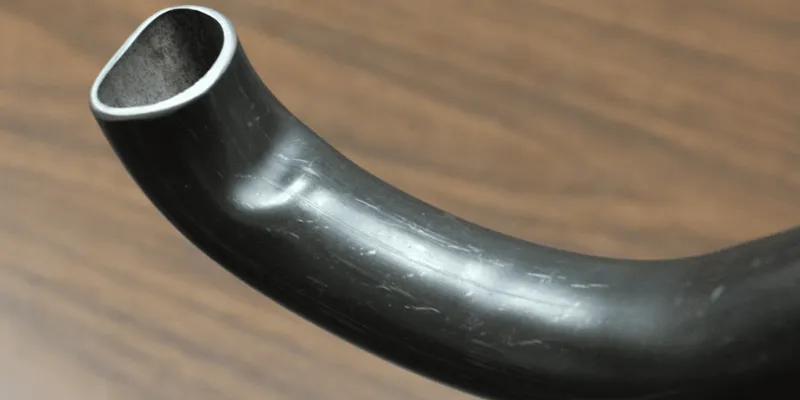
Think of a stretched rubber band tied in a loop: it holds its shape until you cut it, and then it springs open. A pipe with internal stress behaves the same way on a smaller scale. When a cut releases the material that was restraining the stress, the end can open, flare, or go oval. One mill's ovality guide states that cutting releases residual stress locally, which is one reason distortion concentrates at pipe ends. Research on welded structures confirms that cutting redistributes residual stress over a distance along the weld.
Cutting tools also add force. Vises and chain clamps squeeze thin walls. Band saw and abrasive wheels push on the pipe wall. An orbital cutting guide reports that thin-wall stainless tubing deforms under band saw pressure unless handled extremely carefully, and that abrasive wheels carry a risk of wall deformation. Heat adds a third effect: stainless steel has low thermal conductivity, so heat stays near the cut, and a higher expansion rate than carbon steel, so the localized shrinkage forces are larger.
Which Cutting Method Distorts Stainless Steel Pipe Ends the Least?
Cold cutting methods (orbital cold saw or pipe cutter, band saw with proper support, and waterjet) cause the least thermal distortion, and orbital saws are best for thin wall. Laser cutting gives the narrowest heat effect on thin wall. Plasma and abrasive cutting add heat or contamination and usually need grinding back.
|
Method |
Heat Effect |
Distortion Risk |
Stainless-Specific Notes |
|
Orbital cold saw or pipe cutter |
None (cold cutting) |
Very low; suitable for thin wall |
Best when orbital welding follows; check that the clamp does not contaminate the bore |
|
Band saw |
Minimal |
Low if pipe is supported and blade pressure is light |
Use dedicated stainless blades; thin wall can deform under pressure |
|
Abrasive cut-off wheel |
Significant heat |
Moderate to high; wall can deform |
Can embed abrasive and iron on the cut face; clean thoroughly or remove the surface |
|
Plasma |
Narrow heat-affected zone |
Moderate; worse on thin wall at slow speed |
Grind back about 2–3 mm of the heat-affected zone on walls over 4 mm before fit-up or welding; excessive heat can sensitize austenitic grades |
|
Laser |
Minimal on thin wall |
Low; tolerance around ±0.1 mm reported |
High equipment cost; typically thin-wall and precision work |
|
Oxy-fuel |
Not suitable |
Not applicable |
Stainless steel does not support the oxidation reaction needed, so oxy-fuel is ineffective |
Table 3. Cutting methods compared for stainless steel pipe. Sensitization risk applies to austenitic grades heated in roughly the 425–870°C range.
The best method depends on wall thickness, volume, and what follows. For code-quality stainless work with orbital welding downstream, cold orbital cutting is usually recommended. For heavy wall and high volume, plasma with grind-back is common. In every case, deburr, clean, and re-measure the end after cutting.
How Does Handling and Transport Distort Pipe Ends?
Ends are damaged by concentrated loads: wire ropes and hooks at the ends, forklift tines, dropped or dragged pipe, overtight straps, and heavy stacking that squeezes lower layers. Thin-wall pipe suffers most because it has little stiffness to resist the load.
|
Handling Practice |
What Goes Wrong |
Better Practice |
|
Lifting with wire rope, chain, or hooks in the bore |
Point loads dent the wall and damage bevels |
Use nylon or padded slings, wide slings, or lifting tools; never hook the pipe end |
|
Forklift tines |
Concentrated contact deforms and scratches |
Pad or protect the tines; support pipe along its length |
|
Dragging or dropping |
Impact flattens or dents ends and damages bevels |
Lift and carry; use enough people or equipment |
|
High stacking |
Lower layers are compressed; thin-wall pipe flattens |
Limit stack height for thin-wall pipe; published guidance varies from about 1.5 m for stainless pipe to 2 m for thin-wall pipe; follow supplier limits |
|
Strapping and bundling |
Tight straps or wires crush the wall, especially near ends |
Use protective pads between straps and pipe; bundle away from the ends (published packing rules place ties 300–500 mm from each end) |
|
Uneven or hard supports |
Pipe bends or flattens at contact points |
Use level, padded sleepers at proper intervals so the pipe sits on the same level |
|
No end protection |
Ends are knocked and contaminated |
Fit end caps; protect bevels and keep dirt out |
|
Mixed storage with carbon steel |
Iron contamination (not shape distortion, but a common companion problem) |
Keep stainless separate from carbon steel in storage and handling |
Table 4. Handling practices that distort or damage pipe ends, and better alternatives.
Packing rules for steel pipe treat thin-wall stainless pipe as a special case: published requirements note that stainless pipe with a wall-to-diameter ratio below 3% should be bundled in a special way or packed in containers, and that large-diameter stainless pipe should have supports at both ends to avoid deformation during transport, loading, and unloading, with protective material between the pipe and steel straps or wires.
Why Are Thin-Wall Stainless Pipes Affected More?
Thin-wall pipe has a high diameter-to-wall ratio and therefore low ring stiffness. It deforms easily, holds residual stress that shows up as ovality, and stays deformed. Stainless pipe is often thin-wall, so it is more exposed than many carbon steel pipes.
The key number is D/t, the outside diameter divided by the wall thickness. A pipe with a large D/t has a thin shell, like a beverage can compared with a thick pipe. It can be crushed by a modest local load. A mill guide lists high D/t ratio among the four main causes of ovality, along with uneven cooling after forming, sizing-roll gap variation, and stacking pressure, and notes that ovality shows up most on large-diameter, thin-wall pipe, the same pipe that gets stacked highest in the yard.
Stainless steel piping systems commonly use thin schedules such as 5S and 10S. As an illustration (nominal dimensions from memory, to be checked against ASME B36.19), 6-inch Schedule 10S pipe has an outside diameter of 168.3 mm and a wall of about 3.4 mm, giving a D/t of about 50; 12-inch Schedule 10S has a D/t of about 70. Specifications recognize this: ASTM tubing and pipe rules define thin-wall product as having a wall of 3% of the outside diameter or less and allow extra ovality for it, noting that the ordinary diameter tolerances are not enough to cover the ovality expected in thin-wall tubes.
Material properties add to the problem. Austenitic stainless steel conducts heat poorly and expands more than carbon steel, so heat from cutting or welding distorts it more. It also work-hardens quickly, so forcing a distorted end back into shape can raise hardness and cause cracking. Nickel alloys and duplex grades generally have higher yield strength, so they can spring back more after forming or straightening and resist re-rounding.
Will Cutting Back the End Remove the Distortion?
It depends on the cause. Cutting back removes local handling damage, such as dents and bent ends, but it does not remove ovality that comes from residual stress along the pipe. In thin-wall tubing, a trimmed end typically shows ovality similar to the original end.
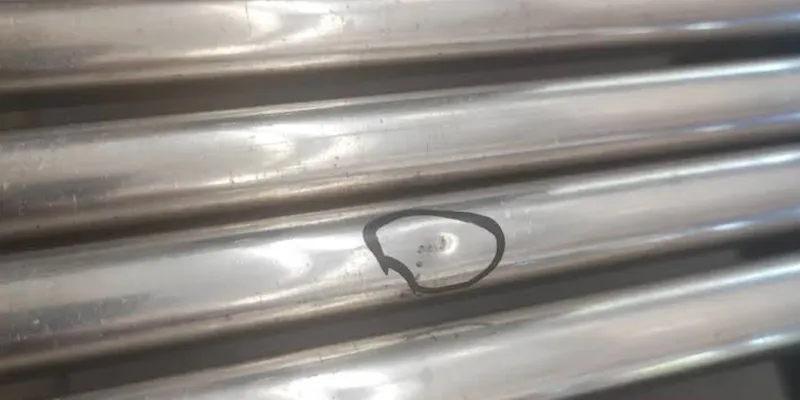
Because residual stress is fairly uniform along the length of a tube, an ovality guide for thin-wall tubing notes that trimming an end by a quarter inch or more is unlikely to improve ovality significantly, and the new end will exhibit ovality similar to the original. By contrast, a dent from a dropped pipe or a flattened end from a strap is local, so cutting back past the damaged zone does help. This is why identifying the cause matters before cutting off pipe.
|
Distortion Type |
Does Cutting Back Help? |
Reason |
|
Local dent or crushed end from handling |
Yes |
Damage is confined to the end; cut past the damaged zone and re-measure |
|
Bent or flared end from impact |
Usually yes |
Deformation is local to the impact zone |
|
Ovality from residual stress (especially thin wall) |
Usually no |
Stress runs along the length; the new end re-distorts as it is released |
|
Distortion from heat of a thermal cut |
Partly |
Grind back the heat-affected zone; an unrelieved warp may remain |
|
Ovality from clamping during cutting |
Re-cut with proper support |
The distortion came from the clamp, not the pipe |
Table 5. When trimming helps and when it does not.
How Can You Diagnose the Cause of a Distorted Pipe End?
Look at where the distortion is, how it is shaped, and whether it appeared after cutting. Local dents point to handling; oval ends that appear right after cutting point to residual stress or clamping; warped, discolored ends point to heat.
|
Symptom |
Likely Cause |
Action |
|
Oval end that was round before cutting |
Residual stress release or clamp pressure |
Measure Dmax and Dmin on both sides of the cut; re-cut with internal support or soft jaws; consider a stress-relieved lot |
|
Oval ends along the whole length, in the middle too |
Manufacturing or storage ovality (high D/t, stacking, straightening) |
Check mill records; inspect bundles; reject or return if outside the order limit |
|
Flattened bottom of the pipe |
Stacking weight or hard support |
Review stack height, supports, and strapping |
|
Dent or crease near the end |
Impact, hook, sling, or strap |
Cut back past the damage and re-measure |
|
Seam opens or flares at the weld |
Residual stress release in welded pipe |
Fit with an alignment clamp; discuss with supplier; check heat treatment |
|
Wavy bevel, blue or brown tint, hard edge |
Thermal cutting heat |
Grind back the heat-affected zone; change method or settings |
|
Burr or rolled edge |
Dull blade, abrasive wheel, or wrong feed |
Deburr; replace tooling; use a dedicated stainless blade |
Table 6. Quick diagnostic guide for distorted stainless steel pipe ends.
How Can You Prevent End Distortion During Cutting and Handling?
Prevent distortion at every stage: specify and verify roundness at purchase, support the pipe during cutting, choose a cold method for thin wall, protect and cap the ends, limit stacking and strap pressure, and re-measure after cutting.
|
Stage |
Prevention Measure |
|
Purchase order |
State a roundness limit, measurement location, and formula; for thin-wall pipe, ask for handling and packing requirements (end caps, supports, container packing) |
|
Supplier controls |
Ask for in-line diameter gauging, heat treatment records, and packing methods suited to thin wall |
|
Receiving |
Inspect ends for dents, flats, and missing caps; measure Dmax and Dmin at both ends of a sample or every pipe for critical service |
|
Storage |
Store off the ground on level padded supports; limit stack height; keep stainless separate from carbon steel; keep caps on |
|
Lifting and moving |
Use padded or nylon slings and protected forklift tines; never drag, drop, or hook the ends |
|
Before cutting |
Support the pipe along its length; use soft jaws, rubber-lined clamps, or an internal support for thin wall; mark the cut away from clamp pressure |
|
During cutting |
Prefer cold methods (orbital saw, band saw) for thin wall; keep feed and speed steady; use dedicated stainless tooling; avoid abrasive wheels where contamination or heat matters |
|
After cutting |
Deburr, clean, and re-measure the end; allow any stress release to appear before beveling; for thermal cuts, grind back the heat-affected zone |
|
Fit-up |
Clock and match ends; use alignment clamps; see our companion article for correction and rejection criteria |
Table 7. Prevention checklist across the supply chain.
Frequently Asked Questions
Why does stainless steel pipe go out of round after cutting?
Because the cut releases residual stress locked in during manufacturing, and because clamps and cutting tools add force. The end is the least restrained part of the pipe, so it moves first.
Which cutting method is best for thin-wall stainless steel pipe?
Cold cutting, especially an orbital cold saw, causes the least distortion on thin wall. Laser cutting also gives a narrow heat effect on thin wall, while abrasive wheels and slow plasma cutting carry more risk.
Does cutting off the end of a pipe fix ovality?
Only if the distortion is local damage. For ovality caused by residual stress in thin-wall pipe, the new end usually shows similar ovality.
Why does thin-wall pipe distort more easily?
It has a high diameter-to-wall ratio and low ring stiffness, so it deforms under small loads and holds residual stress as ovality. Specifications recognize this by allowing extra ovality for walls of 3% of diameter or less.
How should stainless steel pipe be stored to avoid distortion?
On level, padded supports, off the ground, with end caps, limited stack height, padded slings and forklift tines, protective pads under straps, and separate from carbon steel.
Can heat from plasma cutting damage stainless pipe?
Yes. Plasma cutting leaves a heat-affected zone that should be ground back before fit-up or welding on thicker walls, and excessive heat can sensitize austenitic stainless steel in the roughly 425–870°C range.