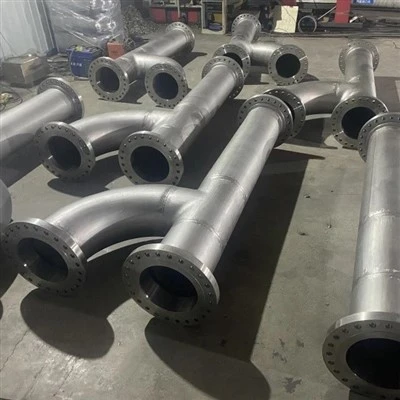
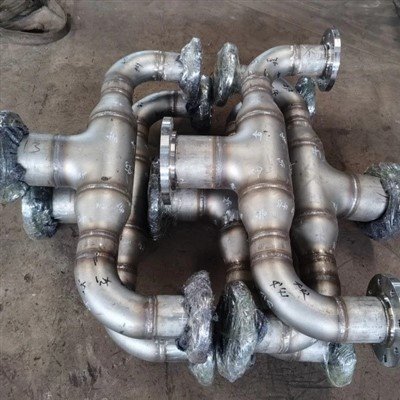
A pipe spool is a prefabricated assembly of pipes, flanges, fittings (elbows, tees, reducers), valves, and supports, manufactured under controlled workshop conditions to precise dimensional and quality specifications before shipment to construction sites. These modular units serve as standardized building blocks for complex piping networks across heavy industries. Fabricated according to isometric drawings derived from P&IDs (Piping and Instrumentation Diagrams), each spool undergoes rigorous welding (typically following ASME BPVC Section IX or API 1104 procedures), non-destructive examination (NDE) such as radiography (RT) or ultrasonic testing (UT), and surface treatment (e.g., grit blasting, coating). Materials range from carbon steel (A106 Gr.B) for general service to corrosion-resistant alloys like duplex stainless steel (UNS S32205) or nickel alloys (Inconel 625) for aggressive environments, with diameters spanning 2" to 72" and pressure ratings from ANSI 150 to 2500.

Pipe Spool Applications
Pipe spools are indispensable in sectors where piping system integrity directly impacts operational safety and efficiency. In offshore oil and gas platforms, spools integrate subsea manifolds with topside processing equipment, engineered to withstand sour service (NACE MR0175 compliance) and high-pressure hydrocarbon flows exceeding 10,000 psi. Power generation facilities utilize them in critical steam lines (ASME B31.1) operating at 1,000°F (538°C), where precise weld quality prevents catastrophic failure in turbine feed systems. Pharmaceutical and food processing plants employ electropolished 316L stainless steel spools with orbital welds and zero internal crevices to meet 3-A Sanitary Standards, ensuring sterile product transfer. Water treatment facilities leverage large-diameter spools for seawater intake systems, often incorporating cathodic protection and HDPE linings for corrosion resistance. Even nuclear installations rely on ASME Class 1 spools with full penetration welds and volumetric NDE for reactor coolant loops, where zero tolerance for defects is non-negotiable.
Pipe Spools Quantifiable Advantages
The adoption of pipe spool fabrication delivers measurable operational benefits by shifting labor-intensive tasks from constrained field environments to optimized workshop settings. Controlled fabrication reduces weld defect rates by up to 40% compared to field welding, as validated by DNV GL studies, while automated processes like submerged arc welding (SAW) enhance joint consistency. Project schedules compress by 30–50% since site activities focus solely on spool installation rather than sequential cutting, fitting, and welding-particularly crucial in shutdown maintenance where daily production losses can exceed $1M. Safety performance improves dramatically: confined space welding in trenches or elevated structures decreases by 70%, mitigating risks of gas exposure or falls. Cost efficiencies emerge through bulk material procurement, reduced NDE mobilization fees, and minimized rework; a 2023 EPRI report confirmed spool-based projects achieve 15–22% lower total installed costs. Quality assurance is systematized via traceable material certifications (EN 10204 3.1), weld mapping, and integrated NDE documentation, ensuring compliance with API 570, ASME B31.3, or PED 2014/68/EU.
Pipe Spools Manufacturing and Fabrication
Effective spool design adheres to first-principles engineering to ensure field constructability and long-term serviceability. Stress analysis using CAESAR II or AutoPIPE software validates flexibility under thermal expansion, seismic loads, and hydraulic transients, with supports strategically placed to avoid overstress at nozzle connections. Fit-up tolerances are tightly controlled-typically ±1.5mm for flange face parallelism and ±0.5° for angular alignment-using laser-guided jigs to prevent field fit-up clashes. Fabrication incorporates weld distortion mitigation techniques: sequenced welding, stiffening rings, and post-weld heat treatment (PWHT) per ASME Section VIII Div.1 for carbon steel thicknesses >32mm. For corrosive services, internal cladding (Inconel 625 overlay) or CRA liners are explosively bonded or weld-deposited during spool fabrication. Advanced workshops employ digital twin technology, where 3D laser scans verify as-built spools against design models within 2mm accuracy, preventing costly field re-engineering.
Dispelling Common Misconceptions
Contrary to perceptions of spools as merely simple pipe segments, they often incorporate sophisticated pre-commissioning elements. Instrumentation spools include pre-calibrated flow meters or temperature sensors, while insulated spools arrive with factory-applied mineral wool and aluminum jacketing. Modular skid units-essentially complex spool assemblies-integrate pumps, valves, and control systems for plug-and-play installation. Another fallacy suggests spools suit only large projects; in reality, standardized spool libraries enable rapid deployment in small-scale plant modifications. While carbon steel dominates volume, specialty spools in titanium (for chlor-alkali plants) or zirconium (acetic acid service) demonstrate the technology's adaptability to extreme corrosion challenges.
Conclusion
Pipe spools transcend mere piping components; they represent a systematic engineering methodology that enhances quality, safety, and economic efficiency in industrial construction. By transforming unpredictable field fabrication into a controlled, repeatable manufacturing process, spools enable the execution of increasingly complex projects in volatile environments-from Arctic LNG terminals to ultra-high-purity semiconductor fabs. As modularization trends accelerate, driven by labor shortages and digital twin adoption, the pipe spool's role as the fundamental building block of engineered piping systems will only expand, continually evolving through innovations in automated welding, advanced materials, and data-driven quality assurance.