Stainless steel chequered plate gets its grip from raised lugs or bars rolled into one face, and its strength from the flat base plate underneath. The common patterns (diamond, five-bar, lentil, and tear drop) all improve traction, but no pattern is best everywhere: slip resistance depends on lug height, spacing, footwear, and contamination, so it should be confirmed by test (for example the DIN 51130 R-classes).
What Is Stainless Steel Chequered Plate?
Stainless steel chequered plate (also called tread plate, floor plate, or diamond plate) is flat stainless plate with a repeating raised pattern on one face that gives walking surfaces extra grip.
Think of the pattern as the tread on a shoe. The lugs or bars bite into footwear and let liquid escape, while the flat plate beneath carries the load. Suppliers describe the product as stainless "diamond" or "tread" plate with a raised lug pattern that gives skid resistance where corrosion resistance also matters, used for walkways, platforms, mezzanines, stair treads, trench covers, ramps, and truck or trailer flooring (Metals Depot).
The long-standing U.S. reference, ASTM A793, covered stainless floor plate up to 1/2 in. (12.7 mm) thick for galley spaces, washrooms, engine rooms, machinery spaces, ladder treads, and deck treads. It required the pattern to have uniform pitch from centre to centre with raised figures, listed Types 304, 304L, 316, and 316L as base grades, and required annealing as the last heat treatment (ASTM abstract).
Important nuance: ASTM lists A793 as withdrawn in 2023. The product is still made and sold, but a modern purchase order should define the base plate (for example to ASTM A240) and describe the pattern by drawing or supplier datasheet, rather than relying on A793 alone.
What Are the Main Anti-Slip Pattern Types?
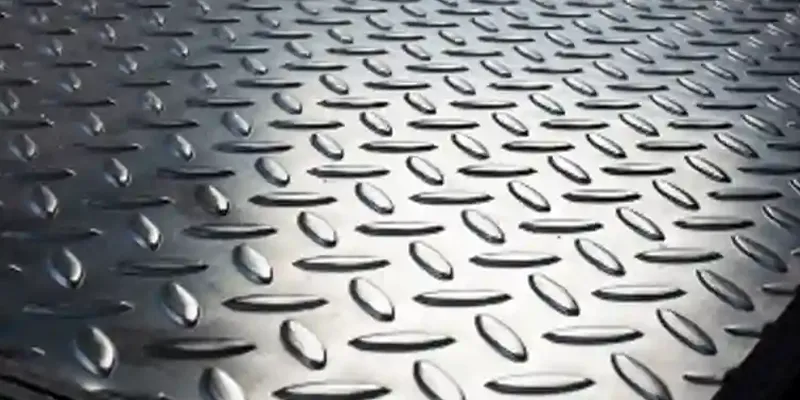
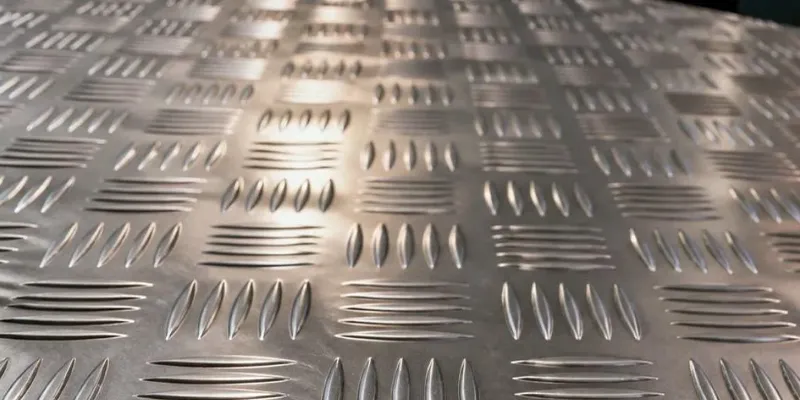
The five patterns you will meet most often are diamond, five-bar, lentil, tear drop, and round bean (dot); each has a different balance of grip direction, drainage, and cleanability.
Pattern names vary by region and mill, and there is no single global catalogue. The table summarises how suppliers and steel producers describe the common types.
|
Pattern |
What it looks like |
Strengths |
Watch-outs |
Typical use |
|
Diamond |
Raised diamond-shaped lugs at a uniform pitch, set at an angle to the plate edges |
Grip in several walking directions; the pattern most people picture as "tread plate" |
Liquid and debris can sit between lugs; slower to clean than smooth plate |
Walkways, stair treads, mezzanines |
|
Five-bar |
Raised bars in groups of five, with neighbouring groups turned to face different directions |
Described by suppliers as the most common industrial pattern; bars give strong edge contact |
Channels between bars can trap dirt in greasy service |
Industrial platforms, ramps |
|
Lentil (lens) |
Raised lens-shaped lugs |
Widely used industrial design; good all-round traction |
Lug height varies by mill, so check it |
Factory floors, equipment bases |
|
Tear drop |
Raised teardrop-shaped lugs (European "T" and American "A" versions) |
Water drains away more easily and cleaning is easier (SSAB); "A" form flanges equally well in all directions |
Lighter "T" version carries less pattern volume |
Outdoor areas, wet or freezing surfaces |
|
Round bean (dot) |
Small rounded raised dots |
Listed as a standard pattern shape in plate weight guides |
Less common; confirm availability in stainless |
Decorative and light-duty floors |
Sources: Metals Depot stainless floor plate page; ASTM A793 abstract; SSAB patterned steel page (tear patterns); Hidayath stainless chequered plate page (five-bar, diamond); China Royal Steel and MachineMFG pattern guides (lentil, round bean). Strengths and watch-outs are EETA's summary of these sources and general engineering practice.
Two details matter when comparing patterns. First, lug height drives how aggressively the surface grips; one supplier guide gives a range of 0.5–2.0 mm for carbon-steel chequered plate and another cites a minimum of 0.2 times base thickness, but we could not confirm either against standard text, so ask your supplier for the actual height. Second, pattern direction matters for forming: SSAB notes its American tear pattern flanges equally well in every plate direction, which helps when the plate will be bent into trays or treads.
Which Pattern Gives the Best Slip Resistance?
No single pattern wins in every situation; the right choice is the one that tests well with your real footwear and your real contamination (water, oil, grease, dust).
We found no published, standards-based ranking of diamond against five-bar against lentil against tear drop. Slip resistance comes from the whole system: lug height, lug spacing, edge sharpness, surface finish, the shoe sole, and what is on the floor. That is why test methods exist.
How slip resistance is measured
The most common label in Europe is the DIN 51130 ramp test. A person wearing safety footwear walks forwards and backwards on an oiled sample while the ramp is tilted. The angle at which they begin to slip sets the class, from R9 (lowest) to R13 (highest) (DGUV/IFA). DIN 51130 can be applied to profiled surfaces such as chequered plate. Barefoot wet areas use the separate DIN 51097 ramp test, and the UK and Australia also use a pendulum test (BS 7976 / AS 4586) that reports a pendulum test value.
|
Class |
Acceptance angle |
Slip resistance |
Typical workplaces (UK flooring guidance) |
|
R9 |
6° to 10° |
Low |
Areas without a high risk of slipping |
|
R10 |
>10° to 19° |
Moderate |
Commercial kitchens (dry areas) |
|
R11 |
>19° to 27° |
High |
Engineering workshops, general food processing |
|
R12 |
>27° to 35° |
Very high |
Vehicle workshops, ramps and inclines (R11–R12 minimum) |
|
R13 |
>35° |
Extreme |
Food processing with animal fats (R12–R13) |
Sources: DIN 51130 class bands as reproduced by Ritrama/Fedrigoni test certificate and Rubberco; DGUV/IFA information sheet 0086. Application examples are from a flooring supplier's guidance, not from the standard itself.
Practical rules we recommend:
- Ask for a test report on the same pattern, grade, and finish you are buying. A result on a different pattern does not transfer.
- Do not convert R-classes into pendulum values by formula. One source publishes a conversion table, while another states that no reliable direct conversion exists. Treat the two methods as separate.
- For wet, oily, or washdown areas, favour patterns that drain and clean easily (such as tear drop) and specify a high R-class.
- Be careful with polished or mirror finishes. Suppliers market them for decorative work, and a test result only applies to the surface that was tested.
How Much Load Can Stainless Chequered Plate Carry?
Within the range we calculated, a 6 mm base plate on 600 mm supports carries about 6 kPa (roughly 630 kg/m²) with deflection limited to span/200, and deflection, not strength, controls almost every case.
Load capacity depends on four things: base thickness, distance between supports (span), how the edges are supported, and the stainless grade. The pattern is not on the list (see the next section).
How we calculated it
This is a simplified, conservative check, not a design certificate. We treated a 1 mm-wide strip of plate as a simply supported beam under uniform load, ignored the pattern, and used these inputs:
- Elastic modulus 193 GPa and minimum yield strength 205 MPa (the ASTM A240 minimum for 304 and 316).
- Allowable bending stress of 0.6 × yield = 123 MPa.
- Deflection limit of the smaller of span/200 and half the plate thickness. The half-thickness cap keeps us inside the range where standard flat-plate formulas hold; Roark's plate theory assumes deflection is no more than about one-half the thickness.
The formulas are: strength-limited load w = 4σt² / 3L², and deflection-limited load w = 32·E·t³·δ / 5L⁴, where t is base thickness, L is span, σ is allowable stress, E is modulus, and δ is the deflection limit. The lower value governs.
|
Base thickness |
300 mm span |
450 mm span |
600 mm span |
900 mm span |
|
3 mm |
6.2 (D) |
1.2 (D) |
0.4 (D) |
0.1 (D) |
|
4 mm |
14.6 (D) |
3.9 (D) |
1.2 (D) |
0.2 (D) |
|
5 mm |
28.6 (D) |
8.5 (D) |
3.0 (D) |
0.6 (D) |
|
6 mm |
49.4 (D) |
14.6 (D) |
6.2 (D) |
1.2 (D) |
|
8 mm |
116.6 (S) |
34.7 (D) |
14.6 (D) |
3.9 (D) |
|
10 mm |
182.2 (S) |
67.8 (D) |
28.6 (D) |
8.5 (D) |
Allowable uniform load in kPa (kN/m²), one-way simply supported strip, grade 304/316. (D) = deflection governs, (S) = strength governs. 1 kPa ≈ 102 kg/m². EETA calculation, not a published table. Inputs: E = 193 GPa, Fy = 205 MPa (ASTM A240 minimum), allowable stress = 0.6Fy, deflection limit = min(L/200, t/2).
What the table tells us
- Span matters most. Deflection-limited capacity falls with the cube of span: going from 450 mm to 900 mm supports cuts capacity by about 8 times. Adding a support is often cheaper than adding thickness.
- Thickness helps strongly. Stiffness rises with the cube of thickness, so 6 mm is roughly 8 times stiffer than 3 mm.
- Strength rarely governs. Only thick plate on very short spans reaches the strength limit first, which is why steel floor plate design is "seldom controlled by strength considerations" (Modern Steel Construction, quoted in the ExcelCalcs notes).
Limits you must respect
- Stricter deflection limits cut the numbers. The AISC Manual's floor plate table shows a span/100 line and caps bending stress at 16 ksi for carbon floor plate, while practising engineers often use span/240 to span/360. Where a span-based limit governs, a stricter limit reduces capacity roughly in proportion.
- Concentrated loads (wheels, forklifts, dropped tools) are not covered. Check them separately.
- Edge support matters. Square panels supported on four edges behave as two-way plates and carry more than our one-way strip, so our numbers lean conservative. Poorly fixed or welded-only-at-corners plates may carry less.
- Code loads and safety factors come from the governing building or machinery code and a qualified engineer, not from this article.
Does the Raised Pattern Add Load-Bearing Strength?
No. Design with the base plate thickness and treat the pattern as a grip feature only.
Plate thickness is measured at its thinnest point, with the lugs not included (Metals Depot). Because the lugs are separate islands rather than a continuous rib, they cannot be relied on to stiffen the plate in a predictable way.
Some suppliers claim the pattern lets thinner plate carry more weight than smooth plate. We found no published test data that quantifies this for stainless chequered plate, so we treat it as unverified and do not credit it in our calculation. If you want a thinner plate, ask the supplier for a load test on the exact pattern and thickness.
How Much Does Stainless Chequered Plate Weigh?
Estimate weight as about 7.9 kg/m² for each millimetre of base thickness, plus roughly 2–4 kg/m² for the raised pattern.
SSAB adds about 2 kg/m² for its European tear pattern and about 4 kg/m² for its American tear and chequer patterns on top of the base steel weight (using carbon steel density 7.85 kg/dm³). Stainless is about 1% denser, which is negligible here, so we applied the same pattern allowances. Another guide says patterns commonly add about 5–10% to plate weight, which fits the thinner end of our range.
|
Base thickness |
Base plate only |
With light pattern (+2 kg/m²) |
With heavier pattern (+4 kg/m²) |
|
3 mm |
23.8 |
25.8 |
27.8 |
|
4 mm |
31.7 |
33.7 |
35.7 |
|
5 mm |
39.6 |
41.6 |
43.6 |
|
6 mm |
47.6 |
49.6 |
51.6 |
|
8 mm |
63.4 |
65.4 |
67.4 |
|
10 mm |
79.3 |
81.3 |
83.3 |
Should You Choose 304 or 316 Chequered Plate?
Choose 304 for general indoor and mild outdoor walkways; choose 316 wherever chlorides are present, such as marine air, de-icing salt, or washdown chemicals.
Both grades appear in the A793 grade list, and both can be supplied in low-carbon "L" versions. Type 316 adds about 2–3% molybdenum, which improves resistance to pitting and crevice corrosion in chloride environments. That is the main reason to pay more.
For load capacity the choice makes almost no difference. The ASTM A240 minimum yield and tensile strengths are the same for 304 and 316 (205 MPa and 515 MPa), and the elastic modulus is essentially the same. Because deflection controls most designs, the table above applies to both. The low-carbon L grades have lower minimum yield (170 MPa), which only matters in the few strength-governed cases, so those numbers scale by about 0.83.
For a deeper grade comparison, see our related article on 304 vs 316 in the list at the end.
How Do You Match Pattern and Thickness to the Application?
Start from the hazard (water, oil, salt, traffic), pick a pattern that tests well for it, then choose thickness and support spacing from a calculation like the one above.
|
Application |
Pattern to consider |
Starting base thickness* |
Key checks |
|
Dry indoor walkways, stair treads |
Diamond or five-bar |
3–5 mm |
Support spacing; code live load; edge fixing |
|
Wet or oily process areas |
Tear drop or five-bar |
4–6 mm |
Slip test class on the exact sample; drainage; cleanability |
|
Coastal, marine, de-icing salt |
Tear drop or lentil, grade 316 |
4–6 mm |
Chloride exposure; grade; cleaning and passivation |
|
Trench and drain covers |
Diamond or lentil |
6–10 mm |
Short spans; concentrated loads; bearing seats and fixing |
|
Truck, trailer, ramp flooring |
Diamond or five-bar |
5–8 mm |
Wheel point loads; frame spacing; wear |
Fabrication note: suppliers state that stainless diamond plate welds, cuts, forms, and machines with proper equipment (Metals Depot). After welding or grinding, clean and passivate the area so the corrosion-resistant surface is restored.
Which Standards Apply to Stainless Chequered Plate?
Use ASTM A240 (or an equivalent EN grade standard) for the base plate, describe the pattern by drawing or datasheet, and cite DIN 51130 or a pendulum method for slip performance.

|
Standard |
Status / scope |
Why it matters |
|
ASTM A793 |
Rolled stainless floor plate, ≤ 1/2 in.; withdrawn 2023 |
Historic definition of patterns, grades 304/304L/316/316L, and the magnetic permeability test; still quoted in the trade |
|
ASTM A786 |
Rolled steel (carbon) floor plates |
The carbon-steel counterpart; patterns and the "commercial grade" practice are discussed by the AISC/Modern Steel Construction notes |
|
ASTM A240 |
Chromium and chromium-nickel stainless plate, sheet, strip |
Chemistry and minimum mechanical properties for the base plate |
|
GB/T 3277 |
Chinese chequered plate standard (carbon steel) |
Often named by suppliers for pattern dimensions; confirm applicability for stainless |
|
DIN 51130 / DIN 51097 |
Ramp tests, shod (R9–R13) and barefoot |
Common slip-resistance classification on specifications |
|
BS 7976 / AS 4586 |
Wet pendulum test |
Reports a pendulum test value; used in the UK and Australia |
|
EN 10204 (type 3.1) |
Inspection documents |
Mill test certificate linking the plate to its heat and test results |
Sources: ASTM A793 and A786 catalogue entries and abstracts; ExcelCalcs/Modern Steel Construction notes; China Royal Steel product page (GB/T 3277); DGUV/IFA 0086; OSHWiki; StudioMatrx and Mactac technical guides. ASTM A240 and EN 10204 scopes are standard references; check current editions.
What Should a Purchase Order Specify?
A complete order names the grade, base thickness, pattern, finish, size, slip-test requirement, and certificate type, so nothing is left to interpretation.
Grade and standard: for example 304/304L or 316/316L to ASTM A240, with the condition (annealed) stated.
Base thickness: state that it is measured at the thinnest point, lugs excluded, and give the tolerance.
Pattern: diamond, five-bar, lentil, tear drop, or round bean, ideally with a drawing, lug height, and pitch.
Surface finish: for example non-polished, and any protective film.
Size and flatness: width, length, and flatness limits for the application.
Slip performance: the required DIN 51130 class or pendulum value, with a test report on the same pattern and finish.
Documents: EN 10204 3.1 mill certificate, and positive material identification or a magnetic permeability check if required.
Frequently Asked Questions
Q: What is the difference between chequered plate, checker plate, and diamond plate?
A: They are regional names for the same product family: plate with a raised anti-slip pattern. "Diamond plate" strictly describes one pattern, but the name is often used for all of them.
Q: Is 316 chequered plate stronger than 304?
A: No. ASTM A240 gives both the same minimum yield (205 MPa) and tensile strength (515 MPa). 316 is chosen for better chloride corrosion resistance, not for load capacity.
Q: Is stainless chequered plate slip-proof when wet or oily?
A: No surface is slip-proof. Chequered plate improves traction, but results depend on pattern, footwear, and contamination. Specify a test class such as DIN 51130 R11 or higher for wet and oily areas and ask for the test report.
Q: How thick should plate be for a walkway?
A: It depends on span and load. Using our calculation, 6 mm base plate on 600 mm supports carries about 6 kPa, while 4 mm on 450 mm supports carries about 3.9 kPa. Always check your code load and any concentrated loads with an engineer.
Q: Does the raised pattern count toward thickness?
A: No. Thickness is measured at the thinnest point with lugs excluded, and structural design should use that base thickness.
Q: Is ASTM A793 still current?
A: ASTM lists A793 as withdrawn in 2023. Many suppliers still reference it, so define the base plate to ASTM A240 and describe the pattern in your order.