Most piping decisions in a chemical plant are made on the wrong number. Procurement compares the fabrication rate, dollars per dia-inch quoted by a shop against dollars per dia-inch quoted by a field contractor, and concludes that prefabrication is 5% cheaper, or 5% more expensive, and moves on.
That comparison misses roughly half of the money. The fabrication rate is only one of nine cost buckets that make up total installed cost, and it is not the largest one.

This article builds the comparison properly. It defines total installed cost, decomposes it into its nine components, runs a transparent cost model on 10,000 dia-inches of 316L stainless process piping, and identifies the specific conditions under which prefabrication stops paying for itself. Every number is stated with its basis so you can substitute your own.
Key data points at a glance
|
Metric |
Stick-built |
Prefabricated |
Difference |
|
Direct piping cost, 10,000 dia-inches of 316L |
$2,990,000 |
$2,770,000 |
−7.4% |
|
Cost per dia-inch, direct |
$299 |
$277 |
−$22 |
|
Piping cost after fixed prefabrication setup |
$2,990,000 |
$2,920,000 |
−2.3% |
|
Total installed cost including released schedule cost |
$2,990,000 |
$2,550,000 |
−14.7% |
|
Total weld count |
1,420 |
1,620 |
+14.1% |
|
All-in welding labour per weld |
$669 |
$512 |
−23.5% |
|
Total NDE cost |
$130,000 |
$140,000 |
+7.7% |
|
Schedule, piping phase |
14 months |
11 months |
−21% |
|
Economic break-even scope |
- |
About 6,800 dia-inches |
- |
|
Bottom line |
|
Prefabrication reduces total installed cost by 8–18% on chemical plant piping above roughly 6,000 dia-inches, with a planning median near 12%. Below that threshold, fixed setup costs consume the advantage.
On stainless and nickel alloys the quality argument is stronger than the labour argument, but the material allowance on high-alloy spools can cancel most of the welding saving. |
What is the difference between prefabrication and stick-built piping?
|
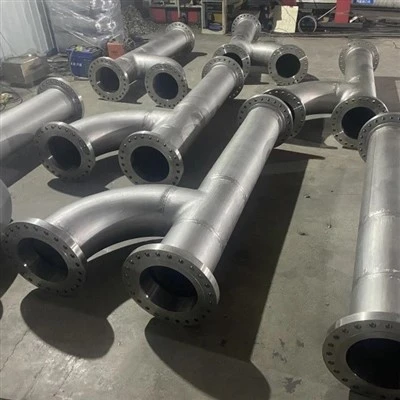
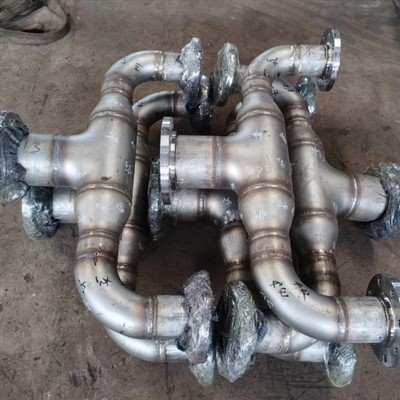
Prefabrication welds pipe into transportable sections, called spools, in a controlled workshop, then assembles those spools on site. Stick-built construction cuts, fits, and welds every joint in position. The real difference is not where the work happens. It is how much of the work is exposed to field labour rates, field weather, and field quality control. |
A useful analogy for anyone new to the industry: building a staircase. You can cut and assemble the stringers, treads, and balusters in a joinery shop where the timber sits flat on a bench, the saw is calibrated, and rain never reaches it, then carry the finished flight up and fix it in place with a handful of connections. Or you can carry raw timber to the third floor and cut every piece on a ladder. Both produce a staircase. Only one of them is priced the way you would want it to be.
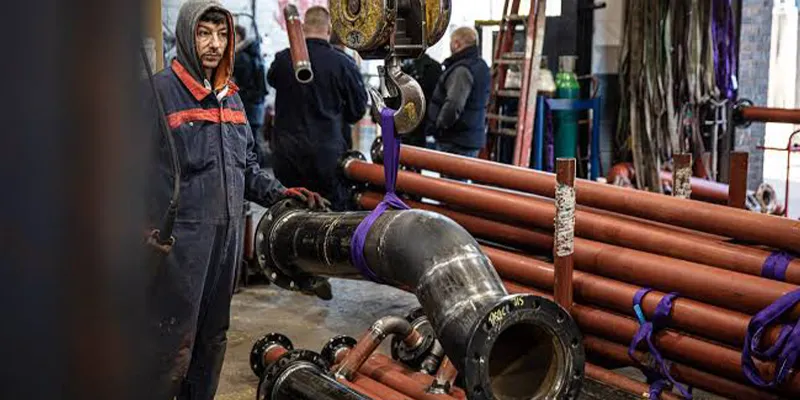
Stick-built piping is the ladder version. Every cut, bevel, fit-up, and weld happens at height, in sequence, usually after the steel is up and other trades are working nearby. Prefabrication moves 65–80% of that work into a shop by dia-inch on a greenfield chemical plant, and 30–50% on a brownfield revamp where existing dimensions cannot be fully verified.
Definitions used in this comparison
|
Term |
Plain-language meaning |
|
Spool |
A shop-welded section of pipe, flanged or plain-ended, sized to fit a truck and a crane |
|
Dia-inch (DI) |
A single number for piping quantity: nominal diameter in inches multiplied by length in metres. Ten metres of 6-inch pipe is 60 dia-inches |
|
Closure weld |
The final weld that joins two spools on site. Sometimes called a golden weld because it cannot be inspected from inside after completion |
|
Spool break |
The engineering decision about where to cut a piping run into transportable pieces |
|
Stick-built |
All fabrication performed in position at the final location |
|
Total installed cost (TIC) |
Everything required to deliver a working, tested, painted line, not just the pipe and the welding |
|
NDE |
Non-destructive examination: radiography, dye penetrant, and ultrasonic testing used to prove a weld is sound |
|
Purge |
Flooding the inside of a stainless pipe with argon during welding so oxygen cannot form oxide scale on the hot root |
Why is total installed cost the only fair basis for comparison?
|
Because the price of the pipe and the price of the weld together account for less than half of what a plant actually pays for its piping. Comparing fabrication rates compares the two smallest moving parts and ignores the seven that decide the outcome. |
Total installed cost is the sum of everything required to hand over a line that is ready to operate:
TIC = material + fabrication + installation + NDE + surface treatment + access + indirects + rework + time-related cost
Each bucket behaves differently under the two methods. Three of them fall sharply with prefabrication, three are roughly neutral, and three rise. That is why the honest answer is a percentage range rather than a single number, and why the answer changes with project size.
|
Cost bucket |
What it contains |
Effect of prefabrication |
|
Material |
Pipe, fittings, flanges, valves, supports |
Rises 3–5% because spool breaks create offcuts |
|
Fabrication |
Cutting, bevelling, fit-up, welding |
Falls 40–50% because shop rates and flat-position welding are cheaper |
|
Installation |
Setting, aligning, bolting, closure welds |
Falls 60–70% because only the joints remain |
|
NDE |
Radiography, penetrant, visual, hardness |
Rises 5–10% in total because there are more welds |
|
Surface treatment |
Pickling, passivation, coating |
Falls 30–40% because shop processes are mechanised |
|
Access |
Scaffolding, ladders, elevated platforms |
Falls 25–35% because less work happens at height |
|
Indirects |
Supervision, site facilities, QA, laydown, small tools |
Falls 35–45% because field duration shrinks |
|
Rework |
Cut-outs, re-welds, punch-list items |
Falls 40–50% because shop tolerances are tighter |
|
Time-related cost |
Owner site costs, interest during construction |
Falls with schedule, and this is often the largest single item |
The last row is the one most comparisons omit, and on a chemical plant it is frequently bigger than the other eight combined. A dollar spent two months earlier costs more than a dollar spent on time. When prefabrication shortens the field phase, it releases supervision, site facilities, crane standby, and interest during construction, and none of that appears in a fabrication quotation.
How much does prefabrication actually save on total installed cost?
|
Between 8% and 18% on a properly scoped chemical plant piping package above roughly 6,000 dia-inches, with a planning median of about 12%. Below 3,000 dia-inches prefabrication frequently costs more than it saves. |
The saving is not linear, because prefabrication carries a fixed cost that does not scale with volume: spool detailing and isometric breaking, trial assembly, expediting, transport setup, and shop mobilisation. On a mid-size package that fixed cost runs $120,000–$200,000. It is spread across the dia-inches, so small packages carry a disproportionate share of it.
|
Piping scope |
Typical TIC saving |
Why |
|
Under 3,000 dia-inches |
−2% to +3% |
Fixed setup cost exceeds the labour saving; prefabrication may cost more |
|
3,000–6,000 dia-inches |
0% to 6% |
Break-even zone; outcome depends on design maturity |
|
6,000–15,000 dia-inches |
8% to 15% |
Advantage is clear and repeatable |
|
15,000–40,000 dia-inches |
12% to 18% |
Labour saving plus measurable schedule compression |
|
Above 40,000 dia-inches |
14% to 20% |
Modularisation territory; site labour becomes the constraint, not the shop |
Two caveats matter more than the table. First, these figures assume the design is mature enough to fabricate, that isometrics are issued for construction before the shop starts cutting. If the design is still moving, prefabrication's advantage inverts quickly, because shop rework is more expensive than field rework.
Second, they assume a competitive shop market within reasonable transport distance. A shop 2,000 km away with a 12-week queue can erase a 10% labour advantage in freight and storage alone.
Where does the saving come from?
|
About 56% of the gross shop-rate advantage survives to the bottom line. Transport, the spool-break material allowance, heavier crane lifts, and the extra welds created by spooling give back the other 44%. |
This is the most important finding in the article, and it is the one that rarely appears in vendor comparisons. Prefabrication does not simply move cost from a high column to a low column. It moves most of the cost, and then adds four new costs that did not previously exist.
On the 10,000 dia-inch base case described in the next section, the gross labour and access saving is $390,000. The give-backs total $170,000. Net saving: $220,000.
|
Movement |
Amount |
Share of gross saving |
|
Welding labour and consumables |
−$120,000 |
30.8% |
|
Field indirects |
−$100,000 |
25.6% |
|
Rework and punch-list |
−$60,000 |
15.4% |
|
Scaffolding and access |
−$50,000 |
12.8% |
|
Coating and passivation |
−$60,000 |
15.4% |
|
Gross saving |
−$390,000 |
100% |
|
Transport and logistics |
+$90,000 |
−23.1% |
|
Material spool-break allowance |
+$40,000 |
−10.3% |
|
Crane and rigging |
+$30,000 |
−7.7% |
|
Additional NDE on closure welds |
+$10,000 |
−2.6% |
|
Give-backs |
+$170,000 |
−43.6% |
|
Net direct saving |
−$220,000 |
56.4% |
The pattern holds across package sizes: gross savings of roughly 39% of the welding and access cost, give-backs of roughly 44% of that gross figure. If a quotation promises a 25% saving on total installed cost, one of two things is true: either the scope is very large and highly modular, or the comparison has left out transport and material allowance.
What does a worked cost model look like for 10,000 dia-inches of 316L piping?
$299 per dia-inch stick-built against $277 prefabricated, a 7.4% direct saving that becomes 14.7% once fixed setup and released schedule cost are included. The direct saving alone is not enough to justify the coordination effort; the schedule is.
Basis of estimate
The model uses the following inputs. Substitute your own and the structure still holds.
|
Parameter |
Basis |
|
Scope |
10,000 dia-inches of 316L stainless process piping, average 4-inch nominal diameter |
|
Code and inspection |
ASME B31.3 normal fluid service, 5% random radiography |
|
Project context |
Greenfield chemical plant expansion, total project capital $45 million |
|
Estimate basis |
US Gulf Coast, 2026 US dollars, Class 4 accuracy of plus or minus 25% |
|
Exclusions |
Valves and inline instruments, procured separately in both methods |
Direct cost per dia-inch
|
Cost element |
Stick-built, $/DI |
Prefabricated, $/DI |
|
Permanent material: pipe, fittings, flanges, supports |
112 |
116 |
|
Fabrication labour: cut, bevel, fit-up, weld |
84 |
47 |
|
Welding consumables, purge gas, equipment |
11 |
7 |
|
Non-destructive examination |
13 |
10 |
|
Pickling and passivation |
8 |
4 |
|
Surface preparation and coating |
12 |
8 |
|
Transport and logistics to site |
0 |
9 |
|
Field erection: set, align, closure welds |
0 |
29 |
|
Field NDE on closure welds |
0 |
4 |
|
Field touch-up passivation |
0 |
2 |
|
Scaffolding and access |
16 |
11 |
|
Crane and rigging |
7 |
10 |
|
Field indirects allocated to piping |
24 |
14 |
|
Rework and punch-list |
12 |
6 |
|
Total |
299 |
277 |
From direct cost to total installed cost
|
Line |
Stick-built |
Prefabricated |
|
Direct piping cost |
$2,990,000 |
$2,770,000 |
|
Fixed prefabrication setup: detailing, trial assembly, expediting |
$0 |
$150,000 |
|
Piping subtotal |
$2,990,000 |
$2,920,000 |
|
Owner field indirects released by 2.5-month schedule recovery |
$0 |
−$180,000 |
|
Interest during construction on released capital |
$0 |
−$190,000 |
|
Total installed cost |
$2,990,000 |
$2,550,000 |
The direct saving is $220,000, or 7.4%. After the $150,000 fixed setup it shrinks to $70,000, or 2.3%, which is inside the estimate accuracy and would not justify the coordination burden on its own. The case for prefabrication is made by the third and fourth lines: 2.5 months of field schedule released, worth $180,000 in owner site costs and $190,000 in interest during construction. Total installed cost falls 14.7%.
Note what that means for how you present the business case. A 2.3% direct saving gets rejected in a capital committee. A 14.7% total installed cost saving, with a defensible schedule basis, gets approved. Same project, same decision, different denominator.
How does prefabrication change weld count and NDE cost?
|
Prefabrication adds 10–18% more welds but makes each weld about 24% cheaper, so total welding labour falls roughly 13% while total NDE cost rises roughly 8%. The extra welds are a real cost, not a rounding error. |
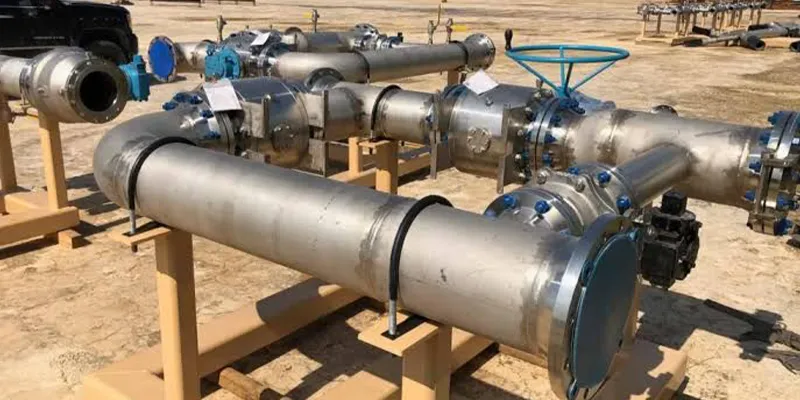
Cutting a continuous piping run into transportable spools creates new joints. A stick-built line can use full double-random pipe lengths and weld only at fittings; a spooled line must also weld at every spool boundary. On the base case that is 200 additional butt welds, 14% more work, but each one is performed flat, on a positioner, at a shop rate.
|
Metric |
Stick-built |
Prefabricated |
Change |
|
Butt welds, DN 50 and above |
1,180 |
1,360 |
+15.3% |
|
Socket and small-bore welds |
240 |
260 |
+8.3% |
|
Total welds |
1,420 |
1,620 |
+14.1% |
|
Total welding labour |
$950,000 |
$830,000 |
−12.6% |
|
All-in labour cost per weld |
$669 |
$512 |
−23.5% |
|
NDE cost per weld |
$92 |
$86 |
−6.5% |
|
Total NDE cost |
$130,000 |
$140,000 |
+7.7% |
Two conclusions follow, and they pull in opposite directions.
The first is that welding cost falls even though weld count rises, because the productivity gain from flat-position shop welding outweighs the 14% volume increase. Shop deposition rates for stainless are typically 1.8 to 2.5 times field rates for the same joint configuration, and the gap widens on small bore and on alloys that need strict heat input control.
The second is that NDE cost rises in total even though it falls per weld. More welds means more examinations, and the shop's efficiency advantage on inspection is modest, because radiography is radiography. Where prefabrication genuinely wins on NDE is schedule, not cost: field radiography requires a radiation exclusion zone that stops adjacent trades for the duration of the exposure. On a congested site that hidden cost is frequently larger than the inspection invoice.
One design rule follows directly. Closure welds should be placed where a welder can stand and a film can be shot, not at the highest point of a rack, not inside a pipe trench, and not adjacent to a live line. A spool break that optimises transport but puts the closure weld in an inaccessible location converts a $500 shop weld into a $2,000 field weld plus a scaffold.
Why do stainless steel and nickel alloy systems favour prefabrication more than carbon steel?
|
Because every quality requirement that decides whether a stainless line survives twenty years, namely purge oxygen, heat input, phase balance, iron contamination, and passivation, is easier to control in a shop than on a scaffold. On 316L, duplex, and nickel alloys the quality-driven saving often exceeds the labour saving. |
Carbon steel is forgiving. Weld it a little hot, leave a bit of scale, and it will still outlive its insulation. Austenitic stainless, duplex stainless, and nickel alloys are not forgiving. Each has a specific failure mode that a field environment makes more likely, and each failure mode is expensive to discover after the plant is running.
|
Quality requirement |
Why it matters |
Shop control |
Field reality |
|
Internal purge oxygen |
Oxygen above about 50 ppm forms oxide scale on the weld root. The scale destroys corrosion resistance locally and can shed particles into the process |
Dedicated purge dams, calibrated flow meters, oxygen analyser at the outlet, one procedure per spool |
Improvised dams, purge lines run across site, analyser shared between crews |
|
Heat input, duplex and super duplex |
Above roughly 2.5 kJ/mm, or interpass above 150 °C, sigma phase and chromium nitrides precipitate and toughness collapses |
Positioners hold flat position, calibrated parameters, interpass temperature measured at every pass |
Vertical-up welding in wind, interpass judged by hand |
|
Ferrite and phase balance |
Duplex welds need roughly 35–65% ferrite. The wrong balance means cracking or preferential corrosion |
Verification per ASTM A800 and A923 in a shop laboratory |
Destructive sampling almost never performed on site |
|
Iron contamination |
Embedded iron from carbon steel tools, scaffolding, and traffic becomes a pitting initiation site |
Segregated stainless bay, dedicated tooling, controlled laydown |
Carbon steel scaffolds, shared grinders, dust from adjacent work |
|
Passivation |
ASTM A380 and A967 restore the passive film after welding and contamination |
Immersion or controlled spray, documented and inspected |
Brush-on gel, coverage dependent on the operator |
|
Dimensional tolerance |
Misalignment above about 1 mm induces residual stress and creates root gaps that are hard to weld cleanly |
Jigs, fixtures, trial assembly of mating spools |
Come-alongs and flame straightening |
The economics of these six rows are asymmetric. A failed purge or a contaminated weld does not fail immediately. It fails at the first shutdown inspection, three years later, when the line is full of process fluid and the repair requires a shutdown. The cost of one such failure routinely exceeds the entire prefabrication premium on the package.
This is why the argument for prefabrication is stronger in alloy piping than in carbon steel, and why the argument should be made by the metallurgist rather than the estimator. The estimator can show a 7% direct saving. The metallurgist can show that the saving is not the reason to do it.
What is the material penalty on high-alloy spools?
|
A 3–5% spool-break allowance is noise on carbon steel and real money on nickel alloys. On a 6,000 dia-inch C276 package, the incremental allowance consumes about 76% of the entire welding labour saving on the same scope. |
Spooling produces offcuts. A shop cutting a 12-metre length to fit a 9-metre spool has 3 metres left, and that remnant may not match any other spool on the job. On carbon steel at $1.50 per kilogram, the remnant goes in the scrap bin and nobody notices. On C276 at $55 per kilogram, the same remnant is a $165 mistake, and a large package makes thousands of them.
|
Alloy |
UNS number |
Indicative price, USD/kg |
Cost of 1% waste per 10 tonnes |
|
Carbon steel A106 B |
K03006 |
1.2–1.8 |
$120–180 |
|
304L |
S30403 |
4–6 |
$400–600 |
|
316L |
S31603 |
6–9 |
$600–900 |
|
Duplex 2205 |
S32205 |
12–17 |
$1,200–1,700 |
|
Super duplex 2507 |
S32750 |
20–28 |
$2,000–2,800 |
|
Alloy 20 |
N08020 |
25–35 |
$2,500–3,500 |
|
Alloy 625 |
N06625 |
45–65 |
$4,500–6,500 |
|
C276 |
N10276 |
45–65 |
$4,500–6,500 |
Prices are indicative for mill quantity in 2026 and should be verified at request for quotation. The ratio between alloys is stable even when absolute prices move.
Now the arithmetic that matters. A 6,000 dia-inch C276 package carries roughly 20 tonnes of material at $55 per kilogram, or about $1.1 million.
Prefabrication typically requires an 8% spool-break and offcut allowance on nickel alloys, against about 3% for stick-built.
|
Item |
Amount |
|
Incremental allowance, 5 percentage points on $1.1 million |
$55,000 |
|
Welding labour saving on 6,000 dia-inches |
$72,000 |
|
Allowance as a share of the labour saving |
76% |
The material penalty consumes three quarters of the welding saving before transport is counted. On a C276 or Alloy 625 package, the case for prefabrication therefore has to rest on quality and schedule, not on labour, and the spool-break strategy has to be managed aggressively.
Three measures recover most of the penalty. Specify cut-to-length or mill pre-cut supply so the shop receives lengths matched to the spool schedule rather than random 6-metre stock. Require the fabricator to return offcuts above a stated minimum length and credit them at scrap-plus value. And allow the spool break to be optimised for material yield within the transport envelope, rather than fixed by the engineer before the shop sees the nest.
When does stick-built actually win?
|
Stick-built wins below about 6,000 dia-inches, in brownfield revamps where as-built dimensions cannot be trusted, on lines with schedule float, and wherever transport or shop capacity constrains the spool envelope. In those cases prefabrication adds cost and risk without adding value. |

The honest version of this comparison has to say when the answer is no. Six conditions reliably favour stick-built.
1. Scope below roughly 6,000 dia-inches. Fixed setup of $120,000–$200,000 cannot be amortised. At 3,000 dia-inches the setup alone is $40–$65 per dia-inch against a gross labour advantage of about $39 per dia-inch. Prefabrication loses.
2. Brownfield revamps with unreliable as-builts. Prefabrication requires dimensions you can trust. In a 30-year-old plant, pipe that was installed in 1994 is not where the 1994 drawing says it is. Laser scanning closes part of the gap but not all of it, and a spool that does not fit is worse than no spool at all, because it has already consumed shop labour, freight, and schedule.
3. Piping that is not on the critical path. If the schedule has float, the time-related savings collapse to near zero and only the 7% direct saving remains, which, after fixed setup, may not be positive.
4. Transport-constrained sites. Spools are limited by road width, bridge weight limits, and crane capacity at the lift point. A site at the end of a narrow access road, or a plant where the only crane position can lift 3 tonnes, forces small spools and destroys the economics.
5. Alloy shop capacity constraints. A qualified nickel alloy shop with a 14-week queue adds lead time exactly when the project needs it least. If the shop cannot start when the design freezes, prefabrication converts a labour saving into a schedule liability.
6. Abundant, low-cost local craft. In markets where qualified welders are plentiful and field rates are close to shop rates, the rate arbitrage that funds the entire model disappears.
There is also a seventh, subtler condition: high instrument density. Lines carrying many small-bore connections, sample points, and transmitters are faster to field-fit than to model, fabricate, and reconcile. Field crews working from a 3D model still adjust to what the transmitter actually needs.
How should spools be broken to minimise total installed cost?
|
Break spools for erection, not for transport. Size each spool to the largest envelope the site can lift and the road can carry, and place every closure weld where a welder can stand and a film can be shot. |
Spool breaking is where most of the value is won or lost, and it is usually done by an engineer optimising the wrong variable. The transport envelope is a constraint, not an objective. Four rules cover most of it.
Maximise spool size within the real constraint. Standard flatbed transport allows about 12 metres; many sites can take 18 metres with a low-loader. Every extra metre of spool removes a closure weld. Model the actual route, not the nominal truck.
Design for the lift, not the weld. A spool that is easy to weld but impossible to rig has simply moved the problem. Check the crane chart at the lift radius, add rigging weight, and confirm the spool can be rotated into position without hitting the steel.
Place closure welds at accessible elevations. A closure weld at 12 metres in a pipe rack costs four times a closure weld at 2 metres, and the difference never appears in the fabrication quotation.
Leave field-run segments where geometry is uncertain. Deliberately design 5–15% of the scope as field-run, particularly at equipment connections, tie-ins, and anywhere a vendor package interface exists. The cost of field-running that portion is small; the cost of a mis-sized spool is not.
What are the hidden costs of prefabrication that bids leave out?
|
Six costs are routinely omitted from prefabrication business cases: transport damage, spool-fit rework, the cost of freezing design earlier, the change-order premium after release, double handling, and shop queue risk. Together they can absorb a further 3–6% of package value. |
|
Hidden cost |
Typical magnitude |
How to control it |
|
Transport and handling damage |
1–3% of spool value |
Require cradles and soft slings; specify stainless-only transport; inspect on receipt |
|
Spool-fit rework |
0.5–2% of package value |
Laser scan before fabrication; trial-assemble critical spools; hold a field-run allowance |
|
Earlier engineering freeze |
2–4 months of pulled-forward engineering cost |
Accept it deliberately; do not freeze before vendor data is firm |
|
Change-order premium after release |
3–5 times the cost of the same change pre-freeze |
Hold a formal change window; batch changes; price rework in the contract |
|
Double handling and preservation |
1–2% of spool value |
Specify tagging, end caps, and indoor or covered storage in the contract |
|
Shop queue and storage risk |
Unquantified but material |
Contractual lead-time commitment with liquidated damages; stage deliveries to erection sequence |
The fourth row deserves emphasis because it is the true cost of prefabrication. Prefabrication buys cost certainty by giving up flexibility. Once isometrics are released for construction, the design is effectively frozen, and a change that would have cost $2,000 in the field now costs $8,000 in the shop plus freight plus schedule. Projects that change design late should not prefabricate, regardless of size.
How do you decide? A six-factor framework
|
Score six factors, namely scope size, design maturity, site access, alloy family, schedule criticality, and local craft market. Four or more favouring prefabrication justifies the full package; two or three justifies a hybrid, which typically captures about 70% of the available saving at 40% of the coordination burden. |
|
Factor |
Favours prefabrication |
Favours stick-built |
|
Scope size |
Above 6,000 dia-inches |
Below 6,000 dia-inches |
|
Design maturity |
Isometrics issuable for construction; vendor data firm |
Design still evolving; P&ID not frozen |
|
Site access |
Congested, elevated, live plant, limited laydown |
Open site, good access, unrestricted laydown |
|
Alloy family |
Stainless, duplex, nickel, quality-critical |
Carbon steel, low-pressure utility |
|
Schedule |
Piping drives mechanical completion |
Piping has float |
|
Craft market |
Scarce or expensive welders; remote site |
Abundant low-cost local craft |
The hybrid deserves more attention than it usually gets. Most chemical plant piping packages are not uniform: they contain a high-value alloy core on the critical path and a large volume of carbon steel utility lines with float.
Prefabricating only the alloy core and the critical-path lines captures most of the quality and schedule benefit while avoiding the coordination burden of spooling several thousand dia-inches of low-value utility pipe. In packages we see, that split typically delivers around 70% of the full-package saving for about 40% of the management effort.
What contract structure best captures the saving?
|
A lump sum per dia-inch, with the spool-break basis, the as-built risk allocation, and the change-order mechanism all defined before award. Time-and-materials contracts hand the productivity benefit back to the fabricator. |
Four terms decide whether the saving reaches the owner's balance sheet.
Define the spool-break basis in the contract. State the maximum spool length, maximum weight, transport envelope, and the rule for who bears the cost of a spool that does not fit. Without this, the fabricator optimises for their shop and the owner absorbs the field consequence.
Allocate as-built risk explicitly. In a revamp, state whether the fabricator or the owner carries the risk of dimensions that do not match. Ambiguity here produces the most expensive disputes in prefabrication.
Price the change mechanism before award. A rate for shop rework, a rate for re-shipment, and a defined change window. Post-award negotiation of change pricing is where prefabrication budgets fail.
Tie payment to schedule, not just to delivery. Prefabrication's value is schedule. If the contract pays on spool completion rather than on erection sequence adherence, the fabricator has no incentive to deliver in the order the site needs, and out-of-sequence spools consume laydown space and preservation budget.
Frequently asked questions
Is prefabricated piping cheaper than stick-built?
Yes, above roughly 6,000 dia-inches, typically by 8–18% of total installed cost with a median near 12%. Below that threshold the fixed cost of spool detailing, trial assembly, and transport setup exceeds the labour saving, and prefabrication can cost 2–3% more.
What percentage of a chemical plant's piping can be prefabricated?
About 65–80% by dia-inch on a greenfield plant, and 30–50% on a brownfield revamp. The remainder is field-run piping at equipment connections, tie-ins to existing lines, and anywhere as-built dimensions cannot be verified.
How much schedule does prefabrication save?
Typically 15–25% of the piping phase and 8–12% of overall mechanical completion. The saving comes from running shop fabrication in parallel with civil and structural work rather than after it.
What is a dia-inch and why is it used?
A dia-inch is nominal pipe diameter in inches multiplied by length in metres, so ten metres of 6-inch pipe equals 60 dia-inches. It is used because it captures both size and quantity in one number, allowing cost comparison across a piping package of mixed diameters.
At what project size does prefabrication break even?
At about 6,800 dia-inches, or roughly $2 million of piping scope, assuming a fixed prefabrication setup cost of $150,000 and a net direct saving of $22 per dia-inch.
Does prefabrication increase the number of welds?
Yes, by 10–18%, because cutting a continuous run into transportable spools creates closure welds at every spool boundary. Total welding cost still falls about 13% because shop welding is roughly 2.4 times more productive per weld than field welding.
Is prefabrication suitable for duplex and super duplex stainless steel?
Yes, more so than for carbon steel. Duplex requires heat input control and interpass temperature limits that are difficult to hold in field positions. Shop positioners allow flat-position welding with calibrated parameters, which protects the ferrite balance required by ASTM A800 and A923.
Who decides where spools are broken?
Ideally the fabricator, working within a transport and lift envelope set by the owner's logistics study. When the engineer fixes spool breaks before the shop sees the material nest, yield drops and the material allowance rises.
Can prefabrication be used in a brownfield revamp?
Partially, typically 30–50% of the scope. Laser scanning improves confidence in existing geometry, but tie-in points and equipment connections should generally remain field-run to avoid the cost of a spool that does not fit.
What is the biggest risk in a prefabrication strategy?
Late design change. Once isometrics are released for construction the design is effectively frozen, and a change costs three to five times what it would have cost before release.
Conclusion
The comparison resolves into four statements.
Prefabrication reduces total installed cost by 8–18% above roughly 6,000 dia-inches, and the saving is real but smaller than most quotations imply, because only about 56% of the gross labour advantage survives to the bottom line.
The direct saving alone is rarely enough to justify the coordination burden. On the worked example it is 2.3% after fixed setup, which is inside estimate accuracy. The decision is made by schedule, and schedule only has value when piping is on the critical path.
On stainless and nickel alloys the quality argument is stronger than the cost argument, because purge control, heat input, phase balance, iron contamination, and passivation are all easier to hold in a shop. But the material allowance on high-alloy spools can consume most of the welding saving, so the spool-break strategy has to be managed as aggressively as the welding.
And prefabrication is not a binary choice. Splitting the package, with the alloy core and critical-path lines prefabricated and utility and field-run scope stick-built, captures most of the benefit at a fraction of the coordination cost.
The practical next step is a two-page comparison on your own numbers: dia-inch count by line class, alloy family, schedule float, and site access constraint. Those four inputs will tell you which column you are in before anyone quotes a fabrication rate.