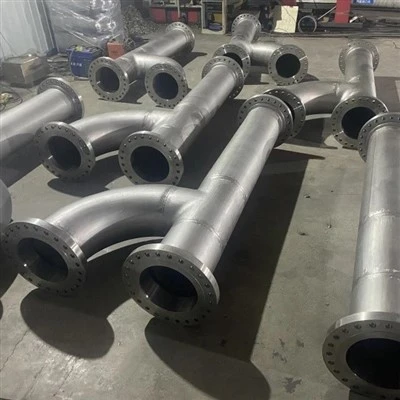
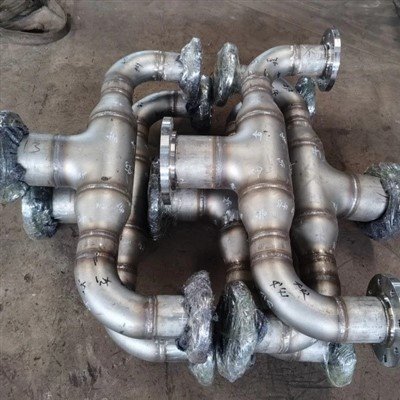
UNS N06625 and UNS N08825 are both nickel alloys, each based on nickel and enhanced with corrosion resistance through the addition of key elements such as chromium and molybdenum.
Both are listed in multiple American Society for Testing and Materials and American Society of Mechanical Engineers specifications, including ASTM B704 and ASTM B705, as suitable materials for welded pipe.

Furthermore, both alloys exhibit excellent weldability and formability, enabling them to be fabricated into pipe fittings, flanges, and other components using similar welding techniques. This makes them attractive alternatives in applications such as oil and gas, chemical equipment, and offshore engineering.
UNS N06625 and UNS N08825
UNS N06625 (Inconel 625) is a nickel-chromium-based high-temperature alloy strengthened primarily by additions of molybdenum and niobium. This alloy exhibits excellent strength and fatigue properties, as well as good machinability and weldability, from cryogenic temperatures up to 980°C.
It offers excellent corrosion resistance in a variety of corrosive media, including seawater, saline solutions, nitric acid, and phosphoric acid, and is particularly resistant to chloride-induced stress corrosion cracking. Therefore, it is widely used in demanding environments such as aerospace engine components, chemical equipment, offshore engineering, and flue gas desulfurization systems.
UNS N08825 (Incoloy 825) is an austenitic nickel alloy with additions of molybdenum and copper. This composition provides high levels of corrosion resistance in both moderately oxidizing and reducing environments. Compared to standard stainless steel, its higher nickel content, combined with the molybdenum and copper, significantly improves corrosion resistance in reducing environments.
The alloy has good ductility in the temperature range from cryogenic to over 538°C, is easy to form and weld, and is commonly used in chemical processing components, oil and gas recovery, pickling equipment, and nuclear fuel processing.
UNS N06625 vs UNS N08825: Chemical Composition
|
Composition |
UNS N06625 (Inconel 625) |
UNS N08825 (Incoloy 825 |
|
Ni |
≥58% |
38.0 - 46.0% |
|
Cr |
20.0 - 23.0% |
19.5 - 23.5% |
|
Mo |
8.0 - 10.0% |
2.5 - 3.5% |
|
Fe |
≤5.0% |
≥22.0% |
|
Nb |
3.15 - 4.15% |
- |
|
Cu |
≤0.07% |
1.5 - 3.0% |
|
Ti |
≤0.40% |
0.6 - 1.2% |
|
C |
≤0.10% |
≤0.05% |
|
Mn |
≤0.50% |
≤1.0% |
|
Si |
≤0.50% |
≤0.5% |
|
Al |
≤0.40% |
≤0.2% |
|
S |
≤0.015% |
≤0.03% |
|
P |
≤0.015% |
- |
UNS N06625 vs UNS N08825: Applications
|
Name |
UNS N06625 (Inconel 625) |
UNS N08825 (Incoloy 825) |
|
Features |
High strength, excellent creep and fracture resistance, outstanding fatigue strength, and good toughness over a wide temperature range from cryogenic to 1093°C. |
Excellent overall corrosion resistance, including good resistance to stress corrosion cracking, pitting, and crevice corrosion. |
|
Applications |
Applications include aerospace (engine components, honeycomb structures), marine engineering (high-strength piping, propulsion systems), oil and gas (oil pipes, bellows), and high-temperature chemical components. |
Applications include chemical processing (pickling equipment, heat exchangers, and nuclear fuel processing vessels), oil and gas extraction (piping systems for highly acidic environments), and seawater treatment (seawater cooling heat exchangers). |
|
Applicable Temperature |
Suitable for a wider temperature range, especially maintaining excellent strength and creep resistance in high-temperature environments (up to 1093°C). |
Typical application temperatures typically do not exceed 550°C, while maintaining good mechanical properties at room and medium-high temperatures. |
|
Products and Standards |
Commonly found in welded pipes produced according to standards such as ASTM B704/B705, it is also used in sheet, rod, and wire. |
Welded pipe is also manufactured in accordance with standards such as ASTM B704/B705 and is widely used in plate, rod, and tube applications. |
UNS N06625 vs UNS N08825: Physical Properties
|
Parameter |
UNS N06625 (Inconel 625) |
UNS N08825 (Incoloy 825) |
|
Density |
8.44 g/cm³ |
8.14 g/cm³ |
|
Melting Point Range |
1290 - 1350 °C |
1370 - 1400 °C |
|
Coefficient of Thermal Expansion |
12.3 × 10⁻⁶/°C (20-100°C) |
13.9 × 10⁻⁶/°C (20-100°C) |
|
Thermal Conductivity |
12.1 W/m·°C (100°C) |
11.1 W/m·°C (21°C) |
|
Specific Heat |
430 J/kg·°C (or 0.098 Btu/lb·°F ) |
440 J/kg·°C |
|
Elastic Modulus |
205 GPa (or 208 × 10³ MPa ) |
196 GPa |
|
Magnetic Permeability |
1.0006 |
1.005 |
UNS N06625 vs UNS N08825: Mechanical Properties
|
Parameter |
UNS N06625 |
UNS N08825 |
|
Tensile Strength |
≥ 827 MPa |
≥ 586 MPa |
|
Yield Strength |
≥ 414 MPa |
≥ 241 MPa |
|
Elongation (δ5) |
≥ 30% |
≥ 30% |
|
Hardness (HB) |
≤ 220 |
- |
UNS N06625 vs UNS N08825: Performance

Corrosion Resistance
UNS N06625 performs well in reducing media and chloride environments, particularly in seawater, hydrochloric acid solutions, and chloride-containing media. UNS N08825 is more adept at handling complex corrosive environments characterized by mixed oxidizing and reducing forces, such as mixtures of sulfuric, phosphoric, and nitric acids.
It also exhibits excellent resistance to oxidizing acids like nitric acid and alkaline solutions, and its high nickel content ensures resistance to chloride-ion stress corrosion cracking.
High-Temperature Mechanical Properties
UNS N06625 maintains stable mechanical properties and oxidation resistance at temperatures up to 980°C. UNS N08825 focuses more on corrosion resistance in the medium-temperature range, and its high-temperature mechanical properties are relatively limited. Prolonged exposure above approximately 540°C can cause microstructural changes that significantly reduce its ductility and impact toughness.
Room-Temperature Mechanical Properties
UNS N06625 exhibits very high strength and hardness at room temperature. Its typical annealed tensile strength reaches over 830 MPa, and its yield strength exceeds 410 MPa.
UNS N08825 has relatively low room-temperature strength but good toughness, with a typical annealed tensile strength of approximately 586 MPa and a yield strength of approximately 241 MPa, demonstrating improved ductility.
Processing and Welding Properties
UNS N06625 can be hot or cold worked, but it exhibits a strong tendency to work hardening during cold working, and complex forms may require intermediate annealing. It exhibits excellent weldability and can be welded using various methods, including TIG and MIG, with post-weld heat treatment generally not required.
UNS N08825 is more easily cold-formed and has a lower work hardening rate, making it suitable for operations such as deep drawing and spinning. It also exhibits excellent weldability, with commonly used welding methods including TIG and MIG, and post-weld heat treatment generally not required.
UNS N06625 vs UNS N08825: Which Is Batter?

There's no single best choice between UNS N06625 and UNS N08825; the choice depends entirely on the application.
N06625 exhibits excellent strength, oxidation resistance, and thermal fatigue resistance in high-temperature environments, while also offering strong resistance to chloride pitting corrosion. N08825, on the other hand, offers superior general corrosion resistance in moderately oxidizing and reducing environments, as well as excellent resistance to chloride stress corrosion cracking. However, its upper temperature limit is typically no higher than 538°C.
Therefore, for applications requiring high-temperature strength, thermal shock resistance, and enhanced pitting resistance, N06625 is the preferred choice. For applications requiring resistance to acid corrosion or stress corrosion cracking at moderate temperatures, N08825 is more suitable.