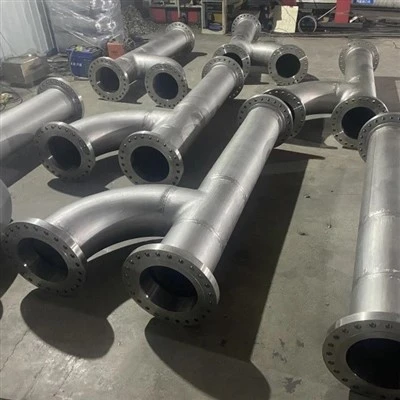
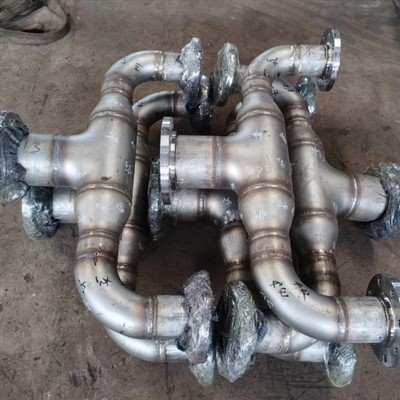
Hastelloy C22 (HASTELLOY® C-22®, UNS N06022) is a strong candidate for cleaning-in-place circuits when chloride-bearing, acidic or changing chemical conditions challenge stainless steel. Its corrosion resistance does not, however, prove that a circuit is clean, eliminate chemical residues or replace cleaning validation. Material compatibility and residue removal must be demonstrated separately.

Cleaning-in-place (CIP) circulates cleaning fluids through equipment without routine dismantling. For material selection, the important question is not simply "Does C22 resist this cleaner?" It is "Will the complete circuit tolerate the actual formulation, temperature, exposure time and carryover-and can the remaining residues be measured?"
When should a CIP circuit use Hastelloy C22 instead of 316L stainless steel?
Consider C22 when the actual cleaning or process environment requires more resistance to localized chloride attack or mixed chemical exposure than 316L can demonstrate. Do not specify it solely because it is a higher-alloy material. Haynes identifies C22 as resistant to both oxidizing and non-oxidizing chemicals, with substantially greater chloride-pitting resistance than austenitic stainless steels.
Pitting creates small, deep holes; crevice corrosion develops in narrow gaps, such as gasket interfaces. Both matter in a cleaning circuit because average wall loss alone may overlook localized damage. C22 offers a larger corrosion-resistance margin, but selection still depends on the exact service and fabrication condition.
|
Selection question |
316L stainless steel |
C22 / UNS N06022 |
C-276 |
|
Chloride-related localized corrosion |
Requires careful service-specific qualification. |
Strong candidate when chloride exposure challenges stainless steel. |
Also highly resistant; compare the actual environment. |
|
Oxidizing chemical exposure |
Do not infer compatibility from acid name alone. |
Higher chromium gives an advantage over C-276 in oxidizing media. |
Not automatically equivalent to C22 in oxidizing conditions. |
|
Predominantly reducing acid service |
May be unsuitable, especially in hydrochloric acid. |
Useful candidate, but temperature and concentration can sharply limit resistance. |
Include in comparative testing; do not assume either nickel alloy always wins. |
|
Cleaning validation |
Must demonstrate residue removal. |
Same obligation; alloy identity does not establish cleanliness. |
Same obligation; corrosion resistance is not a residue acceptance criterion. |
Comparison basis: Haynes C22 technical data and FDA equipment-cleaning guidance. This is a screening comparison, not a universal chemical-compatibility rating.
What makes C22 resistant to demanding cleaning environments?
C22 combines nickel, chromium, molybdenum and tungsten to resist several corrosion mechanisms rather than only one type of chemical exposure. Haynes lists nominal contents of about 56% nickel, 22% chromium, 13% molybdenum and 3% tungsten; these are nominal values, not purchasing acceptance limits.
Its high chromium content supports resistance to oxidizing media, while the overall alloy design provides broad acid and localized-corrosion resistance. However, the finished component matters: Haynes reports that weld-metal microstructures can produce different corrosion rates from wrought base metal. A certificate for the starting tube is therefore not proof of the assembled loop's performance.
Can Hastelloy C22 handle caustic, acid and oxidizing CIP chemicals?
C22 should be evaluated against each complete cleaning formulation; the chemical family alone is not enough to approve service. Specify concentration, temperature, contact time, contaminants and rinsing conditions before assigning a compatibility limit. Haynes explicitly recommends testing alloys under actual service conditions.

|
Chemical or formulation |
Practical selection conclusion |
Information needed before approval |
|
Sodium hydroxide / alkaline detergent |
Nickel alloys are important caustic-service candidates, but this does not establish a universal C22 operating limit. [web:2] |
NaOH strength, maximum temperature, additives, chloride contamination and stagnant exposure. |
|
Nitric acid |
Published C22 data show low corrosion in several tested conditions, not immunity at every concentration and temperature. [web:4] |
Acid strength, temperature, oxidizing additives, chloride carryover and exposure duration. |
|
Phosphoric-acid cleaner |
Use C22 phosphoric-acid data only as a starting point for the actual formulation. [web:4] |
Acid purity, concentration, temperature and halide impurities. |
|
Hydrochloric-acid cleaner |
C22 can outperform stainless steel yet still corrode too rapidly for the intended duty. [web:4] |
Actual concentration and temperature; welded and creviced surfaces; contamination limits. |
|
Hypochlorite / chlorine-bearing sanitizer |
Strong chloride and wet-chlorine performance supports evaluation, not blanket approval of bleach recipes. [web:4][web:9] |
Available chlorine, pH, temperature, dwell time, formulation and rinse performance. |
|
Peracetic-acid or peroxide blend |
Do not extrapolate a safe recipe from nitric-acid or wet-chlorine results. |
Supplier compatibility evidence for the full blend, including stabilizers, plus service-representative testing. |
The final row is an evidence limitation: the cited C22 data do not establish a universal peracetic-acid or hydrogen-peroxide CIP operating envelope. A cleaning-chemical supplier and corrosion specialist should resolve this gap before use.
How much can cleaning temperature change C22 corrosion?
Temperature can change C22 corrosion enough to reverse an apparently favorable material decision. In Haynes laboratory data, C22 in 5 wt.% hydrochloric acid shows less than 0.01 mm/year at 38°C but 0.44 mm/year at 66°C.
|
Reagent-grade test solution |
Temperature |
Reported C22 corrosion rate |
|
5 wt.% hydrochloric acid |
38°C / 100°F |
<0.01 mm/year |
|
5 wt.% hydrochloric acid |
66°C / 150°F |
0.44 mm/year |
|
10 wt.% hydrochloric acid |
38°C / 100°F |
0.01 mm/year |
|
10 wt.% hydrochloric acid |
66°C / 150°F |
0.98 mm/year |
Source: Haynes C22 selected corrosion data. These are laboratory results in reagent-grade acid, expressed as annualized corrosion rates-not measured annual losses in a CIP installation. They are neither recommended cleaning recipes nor guarantees for mixed chemicals, welds or repeated cycles.
The engineering consequence is clear: include heating overshoot, delayed draining and abnormal holds in the qualification plan. A short nominal wash does not describe every exposure the metal may experience.
Is C22 always better than C-276 for a CIP circuit?
No. C22 has documented advantages in certain oxidizing and chloride-crevice tests, but those advantages do not establish superiority in every cleaning solution. Use the chemistry that controls the actual circuit's risk to choose between them.
Haynes reports the following comparative results in acidified 6 wt.% ferric chloride using ASTM G48 procedures. Critical crevice temperature is the lowest tested temperature at which crevice attack occurs under the specified test conditions.
|
Alloy |
Reported critical crevice temperature |
|
316L |
0°C |
|
Alloy 625 |
40°C |
|
C-276 |
55°C |
|
C22 |
80°C |
These results show relative resistance in an aggressive laboratory test. They are not maximum CIP operating temperatures, safe chloride limits or evidence that C22 is immune to crevice corrosion below 80°C in every solution.
Does a corrosion-resistant alloy prevent cleaning residues?
No. Corrosion resistance addresses metal degradation; cleaning effectiveness addresses removal of unwanted material. FDA guidance requires evidence that residues are adequately removed and does not accept alloy identity as proof of cleaning performance.

A useful investigation separates three residue groups: product residues, such as active ingredients or organic deposits; cleaning-agent residues, such as detergent components; and potential equipment-derived contamination. Each group needs an appropriate analytical strategy. FDA requires product-contact equipment not to be reactive, additive or absorptive in ways that compromise product quality.
As a practical diagnostic approach, investigate a persistent deposit before increasing cleaner strength. Review where it forms, whether it dissolves in the sampling solvent, whether the location drains, and whether the deposit could be associated with surface damage. Increasing cleaning severity without identifying the cause may obscure rather than solve the problem.
Are conductivity and pH enough to prove a C22 circuit is clean?
No. A conductivity or pH endpoint alone is not proof that every relevant residue has been removed. FDA states that indirect conductivity testing can support routine monitoring after validation when its relationship to equipment cleanliness has been demonstrated.
Select methods according to the residue, rather than expecting one signal to represent all contamination. FDA accepts total organic carbon (TOC) for suitable organic residues, but notes that it does not distinguish individual compounds and that recovery studies are necessary. Rinse sampling alone is not sufficient for pharmaceutical cleaning validation; direct surface sampling should also be used where feasible.
|
Question to answer |
Candidate approach |
Important limitation |
|
Has the validated rinse endpoint been reached? |
Conductivity, with an established baseline and validated correlation. |
An acceptable signal does not independently prove all residues are absent. [web:19] |
|
Are relevant organic residues adequately removed? |
TOC or a suitable compound-specific method. |
TOC requires demonstrated suitability and does not identify individual compounds. [web:21] |
|
Are inaccessible and accessible surfaces adequately represented? |
A justified combination of rinse samples and direct surface samples. |
Rinse solvent must recover the residue; accessible surface sampling remains important. [web:21] |
|
Is there equipment-derived contamination? |
A risk-based investigation with appropriate elemental analysis. |
Set analytes and acceptance criteria for the product and process; do not use conductivity as a substitute. |
What residue limits should be specified for a C22 CIP system?
Use documented, scientifically justified limits for the particular product, cleaner and equipment-not a universal "C22 residue limit." FDA states that there is no universal standard for acceptable detergent residue and that firms must establish and justify their acceptance limits.
A validation protocol should identify the target residues, sampling locations, recovery, analytical sensitivity, acceptance limits and corrective actions. A "not detected" result means that a residue was not detected above the method's capability; it does not prove absolute absence.
This distinction also prevents misleading procurement claims: C22 is not inherently "FDA approved" equipment. FDA does not maintain a list of approved pharmaceutical manufacturing equipment; suitability is the manufacturer's responsibility.
What should engineers test before commissioning a C22 CIP circuit?
Qualify corrosion performance and cleaning performance as two connected but separate workstreams. Haynes calls for actual-service alloy testing, while FDA requires cleaning evidence that reflects equipment design, construction, use and the substances being removed.
1. Define the exposure envelope: every cleaner, sanitizer, process fluid and rinse, including maximum concentration, temperature, contact time and credible carryover.
2. Represent the finished equipment: include base material, production-representative welds, surface finish, gasket interfaces and mixed-material components.
3. Challenge realistic extremes: include delayed draining, stagnant holds, cleaning-solution reuse and the longest justified dirty-hold conditions.
4. Inspect more than average mass loss: assess localized attack and surface changes as well as general corrosion. Select acceptance criteria before testing.
5. Validate residue recovery: use representative surfaces and sampling locations, including difficult-to-clean areas; demonstrate that the selected methods can recover the residues of concern.
6. Establish change control: review changes in detergent formulation, water quality, temperature, cycle time, welding or equipment geometry before relying on the original qualification.
This checklist is a proposed engineering framework, not a universal regulatory protocol. Pharmaceutical guidance cited here should not be treated as a complete compliance program for food, beverage or other industries.
What should buyers ask JN Alloy to document for a CIP project?
Ask for a project-specific supply and inspection package tied to UNS N06022, the required product form and the finished circuit's service conditions. JN Alloy's website lists stainless steel and nickel-alloy supply, pipes, tubes, fittings, flanges and customized pipeline processing; it also describes PMI, radiographic and other inspection capabilities. Confirm the scope available for the specific order.
A practical request for quotation should identify: alloy and material certificates; applicable product standard and edition; dimensions and tolerances; required internal finish; welding and inspection requirements; traceability; cleaning and packaging requirements; and any agreed corrosion or residue-related qualification support.
Haynes lists ASTM B622 for seamless C22 pipe and tube, B619 for welded pipe, B366 for fittings and B575 for plate, sheet and strip. Select the standard appropriate to the product form and verify the governing edition; a material specification alone does not establish hygienic design or cleaning validation.
Send JN Alloy the actual cleaning formulation, operating envelope, water chemistry and required documentation when requesting C22 pipes, fittings or fabricated spools. The objective is a traceable material-and-fabrication package matched to the duty-not an unsupported promise that one alloy solves every CIP problem. Contact: Market@jnalloy.com.
Technical scope: This article is a material-selection and cleaning-validation overview, not an approved cleaning procedure. HASTELLOY® and C-22® are Haynes International trademarks. Confirm product-specific suitability with the alloy producer, cleaning-chemical supplier and responsible process/quality team.