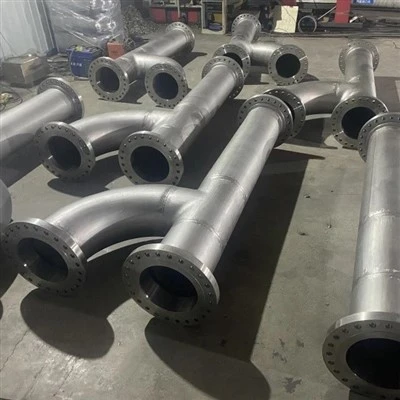
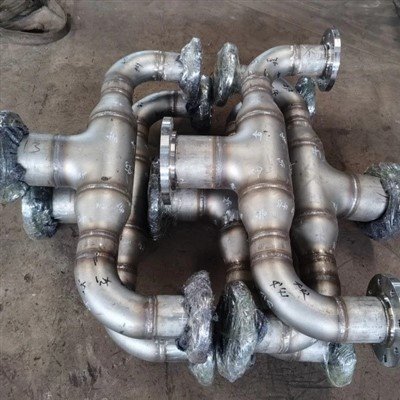
Hastelloy B2 street 90° elbows are forged pipe fittings used in corrosive environments, such as chemical processing, where their resistance to acids like hydrochloric and sulfuric is crucial. The manufacturing emphasizes precision to achieve threaded ends-one male and one female-for secure connections.

The process begins with high-quality billets, followed by controlled heating and forging to shape the elbow without defects. Subsequent steps include trimming, heat treatment, machining, and rigorous inspection to meet standards like ASTM B564.
This article outlines the step-by-step forging process.
Material Selection and Preparation
The initial step involves selecting and preparing high-quality Hastelloy B2 billets. Raw materials are sourced as cylindrical billets or ingots with a composition typically comprising 65-70% nickel, 28-30% molybdenum, and trace elements like iron and chromium, verified through spectroscopic analysis to conform to UNS N10665 standards.
Billets are cut to precise lengths using saws or shears, with dimensions calculated based on the final elbow size-typically ranging from 1/8" to 4" NPS for threaded fittings-to minimize waste and ensure sufficient material for forging.
Surface preparation includes cleaning to remove oxides or contaminants, often via abrasive blasting or pickling, as impurities can lead to forging defects like inclusions or reduced corrosion resistance.
Heating the Billet
Billets are uniformly heated in a controlled furnace to reach the optimal forging temperature, preparing the material for plastic deformation without causing thermal damage.
The heating process begins with preheating to avoid thermal shock, followed by soaking at 2250°F (1232°C) for at least 30 minutes per inch of thickness to ensure even temperature distribution, monitored using calibrated optical pyrometers.
Billets are rotated frequently to prevent uneven heating, and direct flame impingement is avoided to minimize oxidation or carburization, which could compromise the alloy's corrosion resistance.
This temperature range is selected because Hastelloy B2 exhibits good hot workability above 1800°F, allowing for sufficient ductility while staying below the solidus temperature to prevent incipient melting. Controlled atmospheres, such as neutral or slightly reducing gases, are often employed to protect the surface during heating.
Forging Operation

The heated billet is subjected to compressive forces in a die to form the rough shape of the street 90° elbow, refining the grain structure for enhanced mechanical properties.
Using closed-die forging-preferred for precision fittings like elbows-the billet is placed in a pre-heated die and hammered or pressed with forces up to several thousand tons, achieving reductions of 25-40% per pass to maintain internal heat and avoid excessive strain hardening.
Forging commences immediately upon removal from the furnace to limit temperature drop to less than 100-200°F, progressing from initial upsetting to final shaping without radical cross-sectional changes to prevent tears. The process finishes above 1800°F to ensure adequate hot work, imparting a fine, uniform grain structure that improves fatigue resistance and toughness in the final elbow.
For street elbows, the die design incorporates the 90° bend and preliminary thread forms, with multiple strokes if needed for complex geometries.
Trimming and Shaping
Excess material, known as flash, is removed from the forged blank to achieve the near-net shape of the elbow, preparing it for subsequent operations. Hot trimming shears or punches excise the flash while the part is still warm, followed by cooling in a controlled manner to room temperature, avoiding rapid quenching at this stage to prevent residual stresses.
Any surface imperfections, such as scale or minor tears, are addressed through grinding or shot blasting, ensuring dimensional accuracy within tolerances specified by ASME standards. This step is essential as it refines the geometry, facilitating precise machining later and maintaining the alloy's integrity without introducing defects.
Heat Treatment
The forged elbow undergoes solution annealing to optimize its microstructure, restoring corrosion resistance and relieving internal stresses. The component is heated to 1950°F (1066°C) in a furnace with rapid recovery capabilities, held for a duration based on thickness (typically 15-30 minutes), and then water quenched or rapidly air cooled within three minutes of removal to lock in the solution-treated state.

For Hastelloy B2, the furnace must be pre-heated to annealing temperature, and exposure to 1000-1500°F is minimized to prevent precipitation of deleterious phases that could cause intergranular cracking. Shot peening prior to annealing may be applied to high-stress areas like bends to reduce residual tensile stresses, enhancing resistance to cracking during treatment.
This process yields a hardness of approximately 220 HB and tensile strength exceeding 110 ksi, ensuring the elbow's performance in service.
Machining and Threading
The annealed blank is machined to final dimensions, including threading the ends to create the street configuration. Using CNC lathes or mills, excess material is removed to achieve precise outer diameters, bend radii, and wall thicknesses, with tolerances as tight as ±0.005 inches for critical features.
Threading involves cutting NPT or BSP threads-one male and one female-using specialized tools, ensuring leak-proof fits per ASME B1.20.1 standards. Carbide tools and coolants are employed due to Hastelloy B2's work-hardening tendency, with feeds and speeds optimized to prevent tool wear and surface galling. This step is vital for functional integrity, as improper threading could compromise joint sealing in high-pressure systems.
Inspection and Testing
Comprehensive quality checks are performed to verify the elbow's compliance with specifications and absence of defects. Visual and dimensional inspections confirm geometry and surface finish, while non-destructive tests like ultrasonic or dye penetrant detect internal flaws or cracks.
Hydrostatic pressure testing at up to 1.5 times the rated pressure ensures leak resistance, and corrosion tests may simulate service environments to validate performance. Material certification includes chemical analysis and mechanical property verification, such as tensile and hardness tests, to meet ASTM requirements. This rigorous protocol guarantees reliability, with rejection rates minimized through process controls.
Final Finishing and Packaging
The elbow receives surface treatments and is packaged to protect against damage during transit and storage. Passivation or pickling removes any scale or oxides, enhancing corrosion resistance, followed by optional coatings like oil for temporary protection.
Marking includes alloy grade, size, pressure rating, and heat number for traceability. Packaging in wooden crates or boxes prevents contamination, ensuring the product arrives ready for installation. This final step upholds quality standards throughout the supply chain.
Conclusion
These parameters, derived from established guidelines, ensure the production of defect-free Hastelloy B2 90° street elbows with superior performance characteristics.
Key Citations
https://www.adcoforgefittings.com/hastelloy-b2-pipe-fittings-astm-b366/
https://www.dineshindustries.com/hastelloy-b2-forged-fittings/
https://www.gurugautamsteels.com/hastelloy-b2-buttweld-fittings.html
https://creativepiping.com/hastelloy/b2-forged-fittings-manufacturers/
http://specialmetals.ir/images/technical_info/Total/hastelloys.pdf
https://www.hpalloy.com/Alloys/descriptions/HASTELLOYB_2.aspx
https://buntyllc.com/hastelloy-types/
https://haynesintl.com/wp-content/uploads/2024/08/Fabrication-and-Welding-Brochure.pdf
https://creativepiping.com/forged-pipe-fittings-manufacturing-process-step-by-step/
https://bullionpipe.com/how-are-forged-pipe-fittings-made/
https://www.donghuancast.com/malleable-iron/wrought-fittings-manufacturing-process.html
https://creativepiping.com/forged-pipe-fittings-manufacturing-process-step-by-step/
https://www.donghuancast.com/malleable-iron/wrought-fittings-manufacturing-process.html