|
Quick Answer
Material reviews usually check the stock acid and the final diluted stream. The quill sees something else: the mixing zone. There, strong acid turns into weak acid within a few pipe diameters, and dilution heat can push the local temperature past 100 °C. That drives the metal through the most corrosive mid-range concentrations, which neither the stock acid nor the final stream resemble.
The data show why this matters. In Haynes data for C-22 in 70% sulfuric acid, the corrosion rate rises from 0.28 mm/y at 66 °C to 14.94 mm/y at 121 °C, more than 50 times higher. Review the quill with a heat balance, the right Hastelloy grade for the acid, the weld and crevice details, and an API 570-style inspection circuit that extends past the tip. |
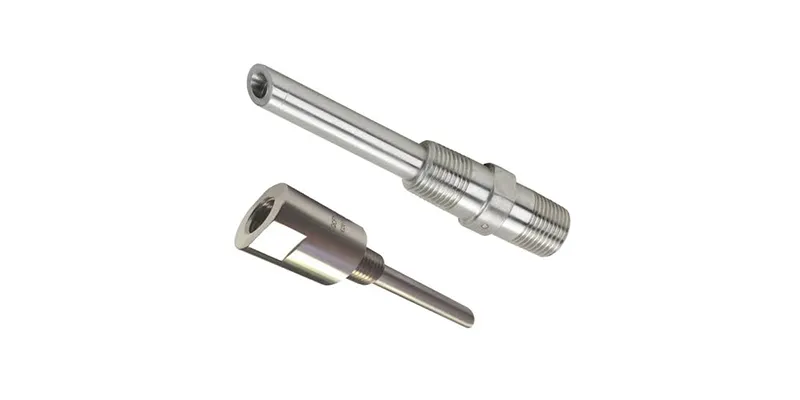
Acid injection looks simple: a small tube pushes acid into a pipe to control pH. The tube is called a quill, and it is usually made of a nickel alloy such as Hastelloy. A material review of that quill often asks two questions. Can the metal handle the stock acid? Can it handle the final, diluted liquid in the pipe? The answers are often "yes" and "yes." The quill still fails.
It fails because of the region between those two states. This article explains why the mixing zone belongs in the material review, how corrosion data change across it, and what to specify. It draws on Haynes International corrosion data, API 570 injection point guidance, engineering-practice sources, and technical data.
What is the mixing zone of an acid quill, and why is it different from the rest of the line?
The mixing zone is the short region where strong acid and the process stream meet and blend. Its concentration, temperature, and pH change fast, so it has to be judged separately from the stock acid and the final stream.
API 570 defines an injection point as a location where chemicals or process additives are introduced into a process stream, and it treats each injection point as its own inspection circuit. An industry summary of injection and mixing point practice adds that mixing zones are subject to changes in temperature, pH, phase, and the concentration of corrosive species. The related AMPP (formerly NACE) standard SP0114 focuses on proper mixing and on avoiding undiluted chemical contact with metal surfaces.
Table 1. Three zones of an acid injection line
|
Zone |
Conditions (sulfuric acid example) |
Usual material question |
What the mixing-zone review adds |
|
Stock acid |
Concentrated acid (for example 93 to 98%), usually near ambient temperature |
Is the alloy suitable for strong acid at storage temperature? |
Check the acid when it warms, not only when it is cold |
|
Mixing zone |
Gradient from strong to weak acid; local heat of dilution; turbulence; possible impingement |
Often not asked |
Evaluate the worst concentration and temperature combination along the gradient |
|
Final stream |
Dilute acid (for example 1 to 10%) at process temperature |
Is the alloy suitable for the weak acid? |
Confirm the weak acid is not the only case reviewed |
Sources: API 570 definitions and injection point circuit guidance (study-guide reproductions on Scribd); "Injection and Mixing Points – Design and Inspection Considerations" (Elsheikh, reproduction); AMPP discussion of SP0114; EETA classification.
How much heat and concentration change can the mixing zone see?
Enough to push the local metal temperature past 100 °C in the mid-range concentrations. Mixing concentrated sulfuric acid with water releases a lot of heat, and the heat is released at the point of mixing, where the quill tip sits.
Sulfuric acid is the classic case. A secondary vendor note on quill selection says that mixing concentrated sulfuric acid with water releases significant heat and that injecting 98% acid directly causes localized overheating. Published estimates give a sense of scale, but they are not a substitute for a heat and mass balance of your own case.
Table 2. Reported scale of dilution heat and its effect (informal and secondary sources)
|
Source and case |
Reported result |
Evidence level |
|
Encyclopedia summary: 98% acid added slowly to an equal volume of water |
Mixture temperature can rise to about 80 °C |
Reference summary |
|
Engineering-forum worked example from an enthalpy chart: 100 lb of 90% acid plus 50 lb of water, both at 70 °F, giving 60% acid |
About 228 °F (109 °C), assuming no heat loss |
Informal calculation |
|
Dilution-system vendor notes (SGL DIABON, reproduction) |
Heat exchanger specified to cool diluted acid from 180 °C to storage temperature |
Vendor design basis |
|
Engineering-forum field report: C-276 piping near a 98% acid injection point, dilution water at 170 °C |
About 0.1 inch (2.5 mm) of wall loss in two weeks, which converts to about 66 mm/y |
Anecdote; cause (including sulfides) not confirmed |
Sources: Wikipedia "Sulfuric acid" (dilution note); Cheresources forum "Diluting H2SO4" (worked enthalpy example); SGL DIABON H2SO4 dilution notes (Scribd); Eng-Tips thread "Diluted sulfuric acid – corrosion problem." Wall-loss conversion by EETA. These are not test data; use an enthalpy-concentration chart or process simulation for the actual case.
Why heat matters for the metal. A mixing zone is not a single temperature. Heat is released at the tip, then carried away by flow. The quill wall sees the hot spot, and the pipe wall sees it only if the acid reaches the wall. That is why the next section looks at rates against temperature, not only concentration.
How do Hastelloy corrosion rates change across the mixing gradient?
Rates are low at both ends and highest in the middle, and temperature is the biggest lever. For C-22 in 70% sulfuric acid, the rate rises from 0.28 mm/y at 66 °C to 14.94 mm/y at 121 °C.
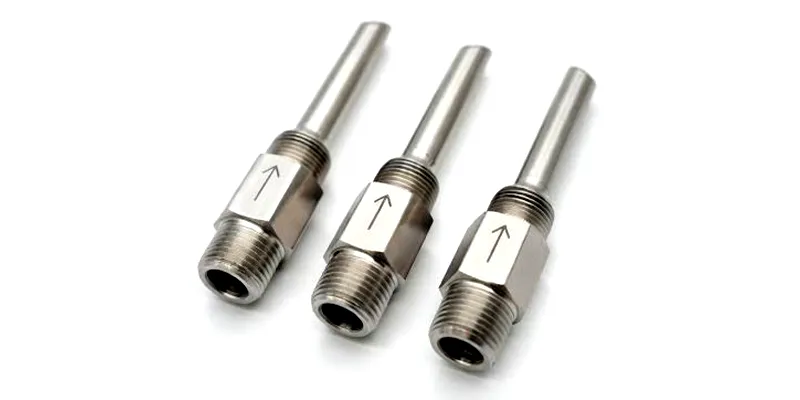
Haynes publishes corrosion rates for C-22 in sulfuric acid across concentration and temperature. Reading across a row shows what heat does. Reading down a column shows what concentration does. A mixing zone moves through both at once.
Table 3. C-22 corrosion rate in sulfuric acid across concentration and temperature (mm/y)
|
H2SO4 conc. |
66 °C |
79 °C |
93 °C |
107 °C |
121 °C |
Boiling |
|
5% |
<0.01 |
0.01 |
0.03 |
n/r |
n/r |
0.23 |
|
30% |
0.01 |
0.09 |
0.68 |
n/r |
n/r |
1.89 |
|
50% |
0.02 |
0.40 |
0.77 |
2.18 |
n/r |
9.98 |
|
70% |
0.28 |
0.56 |
0.94 |
3.07 |
14.94 |
n/r |
|
90% |
0.34 |
0.89 |
1.80 |
6.27 |
4.24 |
n/r |
|
96% |
0.10 |
n/r |
1.10 |
n/r |
n/r |
n/r |
Source: Haynes International HASTELLOY C-22 alloy page, sulfuric acid corrosion data (reagent-grade acid; "n/r" means no value reported in the Haynes table). Haynes encourages field tests before industrial use. Selected rows shown.
- Temperature effect at fixed concentration: in 70% acid the rate rises from 0.28 to 14.94 mm/y between 66 and 121 °C, a factor of about 53 (EETA calculation). In 50% acid, it rises from 0.02 to 2.18 mm/y between 66 and 107 °C.
- Concentration effect at fixed temperature: at 93 °C the rate is 0.03 mm/y in 5% acid, 0.68 in 30%, 0.94 in 70%, and 1.10 in 96%. The dilute end is gentle, and the mid and strong range is not.
- Both ends are not safe either. Even 96% acid at 93 °C shows 1.10 mm/y in this table, so "strong acid is harmless" is a rule of thumb that depends on temperature.
Haynes draws its iso-corrosion lines at 0.1 mm/y and 0.5 mm/y: rates below the first line are expected to be under 0.1 mm/y, and rates above the second line are expected to be over 0.5 mm/y. Many users treat anything above 0.5 mm/y as unsuitable for long service (an EETA screening convention). In the table above, most rows reach or exceed 0.5 mm/y at 93 °C and higher.
Which Hastelloy grade fits a mixing zone, and when is it not enough?
For sulfuric acid, C-2000 shows the lowest rates of the three grades in Haynes data. For 5% to 20% hydrochloric acid, C-276 is lowest. When the worst local condition exceeds 0.5 mm/y in any of them, the answer is a design change, not a grade change.
Table 4. C-22, C-276, and C-2000 side by side (mm/y; lower is better)
|
Acid and condition |
C-22 |
C-276 |
C-2000 |
Lowest of the three |
|
10% H2SO4, boiling |
0.29 |
0.18 |
0.09 |
C-2000 |
|
30% H2SO4, 93 °C |
0.68 |
0.42 |
0.04 |
C-2000 |
|
50% H2SO4, 93 °C |
0.77 |
0.62 |
0.16 |
C-2000 |
|
70% H2SO4, 93 °C |
0.94 |
0.50 |
0.42 |
C-2000 |
|
90% H2SO4, 93 °C |
1.80 |
0.46 |
0.37 |
C-2000 |
|
50% H2SO4, boiling |
9.98 |
3.64 |
3.35 |
C-2000 (all very high) |
|
10% HCl, 79 °C |
1.99 |
1.18 |
1.54 |
C-276 |
|
20% HCl, 66 °C |
0.90 |
0.55 |
0.69 |
C-276 |
Source: Haynes International HASTELLOY HYBRID-BC1 datasheet H-3179F (2023), "Uniform Corrosion Data," metric table. Reagent-grade acids; condensed by EETA. Values are not guaranteed limits.
The table shows two things. First, the best grade depends on the acid, so a quill for a plant that injects both sulfuric and hydrochloric acid needs a case-by-case answer. Second, even the best grade can exceed 0.5 mm/y in the hot mid-range. When that happens, practitioners usually change the design, not only the alloy.
Table 5. Design options practitioners consider when the mixing zone exceeds the alloy's range
|
Option |
Idea |
Evidence level |
|
Staged dilution before final injection |
Dilute concentrated acid in steps (for example 98 to 60 to 30 to 20 to 10%) with heat removal after each stage |
Forum and vendor practice |
|
Heat removal (cooler) after dilution |
Take out dilution heat before the liquid reaches the final injection point |
Vendor design basis (SGL DIABON) |
|
PTFE-lined tee and pipe for the mixing section |
Use a lined section from the injection point through the static mixer |
Practitioner advice; temperature limits of the lining must be checked |
|
Tantalum for the most severe mixing element |
Used for static mixers or tips where metals fail |
Mentioned by a practitioner as a costly option; not verified here |
|
Pre-diluted acid at the quill |
Feed a weaker acid so less heat is released at the tip |
Vendor note on quill selection (secondary) |
Sources: Eng-Tips thread on diluted sulfuric acid corrosion; Industrial Monitor Direct "Inline Effluent pH Neutralization: Injection Quill Selection"; SGL DIABON dilution notes. These are practitioner and vendor sources, not standards. Select an option with the owner's engineer.
How does quill geometry change the local environment?
Quill length, tip position, discharge direction, and the distance to the next bend decide whether strong acid reaches the pipe wall. Welds and crevices at the quill add their own weak points, so geometry belongs in the same review as the alloy.
The industry summary of injection point practice says that designs should allow proper mixing and dilution so that chemical does not concentrate on hot metal surfaces, and that impingement can occur when injection is too close to a change in direction. It also says that selecting materials for a mixing zone should consider local erosion, corrosion-erosion, and corrosion rates influenced by flow regime and turbulence.
Table 6. Geometry factors and what to ask
|
Factor |
Effect on the mixing zone |
Review question |
|
Tip position |
A center-stream tip keeps strong acid off the pipe wall |
Where is the tip, and what flow turndown was assumed? |
|
Discharge direction |
Cross-current discharge can push acid toward the wall; co-current can reduce wall contact |
Does the discharge send acid toward a wall or a bend? |
|
Distance to bends, valves, and mixers |
Too short a run gives impingement and uneven mixing; API 570 sets the inspection circuit to the second elbow or 25 ft |
How many pipe diameters to the first change of direction? |
|
Dipped part of the quill |
Practitioners report attack on the part of the quill that sits in the flow |
Is the wall thickness of the dipped part monitored? |
|
Weld metal at the quill joint |
Haynes: C-22 weld metal 9.3 mpy against 0.8 mpy wrought in 50% H2SO4 at 66 °C (about 12 times higher) |
Is the filler qualified for this acid and temperature? |
|
Crevices at flange, gasket, and thread |
Crevice attack starts at much lower temperatures than pitting; G48 CCT is 55 °C for C-276 and 80 °C for C-22 and C-2000 |
Are there crevices in the hot zone? |
|
Mechanical loading |
A long, thin quill in fast flow can see vibration; corrosion data do not cover fatigue |
Has a mechanical check been done? (EETA note) |
Sources: "Injection and Mixing Points – Design and Inspection Considerations" (Elsheikh, reproduction); API 570 circuit guidance; Haynes C-22 page (welds) and HYBRID-BC1 datasheet (G48 CCT); Eng-Tips thread; EETA summary. The mechanical row is EETA guidance, not from a cited standard.
How should the injection circuit be inspected and monitored?
Treat the quill and its downstream pipe as a separate inspection circuit. API 570 starts it 12 inches (or three pipe diameters) upstream and runs it to the second elbow or 25 feet past the first elbow, with more extensive inspection out to at least 10 pipe diameters.
Table 7. API 570 injection point circuit and inspection guidance
|
Element |
Guidance |
Why it matters for a Hastelloy quill |
|
Upstream limit |
12 in (300 mm) or three pipe diameters, whichever is greater |
Covers backflow and the quill's own connection |
|
Downstream limit |
Second change in flow direction, or 25 ft past the first change, whichever is less |
Captures where mixing finishes and the first impingement points |
|
Periodic inspection |
More extensive inspection from 12 in upstream to at least 10 pipe diameters downstream |
Matches where the strongest gradients sit |
|
Thickness locations |
At the injection nozzle, impingement point, fittings, straight runs, and the upstream and downstream limits |
Builds a thickness trend where corrosion starts |
|
Findings |
Accelerated or localized corrosion is treated as a separate, more closely watched circuit |
Prevents a local problem hiding in an average |
Sources: API 570 (study-guide reproductions; Scribd); Saudi Aramco SAIP-04 injection point inspection program (reproduction on Scribd: measurement points at the injection nozzle, impingement point, and 1D, 5D, and 10D downstream); AMPP discussion. Use the current edition of the code.
- Plan quill pulls. A published patent on multi-quill mixers describes detecting quill corrosion by watching injected chemical concentration downstream; a lower-than-expected concentration may indicate a corroded quill.
- Add coupons near the zone. ASTM G4 describes coupon testing in plant equipment, but notes that coupons may not cover transition zones; combine with thickness readings.
- Record the alloy and heat of every quill. A replacement quill in a look-alike alloy can change the corrosion rate sharply in some acids.
What should a mixing-zone material review package contain?
It should contain the stock acid, the final stream, a heat balance across the gradient, the worst local condition, the alloy and weld evidence for that condition, the geometry, and the inspection plan. If any of these is missing, the review is incomplete.
Table 8. Mixing-zone material review checklist
|
Item |
Question |
Evidence |
|
Stock acid |
Concentration, temperature, and impurities? |
Supplier data; storage conditions |
|
Final stream |
Concentration, pH, temperature, and contaminants such as chlorides? |
Process data |
|
Gradient and heat |
What is the worst local concentration and temperature (including low flow and upsets)? |
Enthalpy-concentration chart or process simulation |
|
Alloy data |
What rates apply at that local condition, and are they below 0.5 mm/y? |
Haynes tables (Tables 3 and 4) |
|
Weld and crevice |
Does the filler and joint design suit that condition? |
Haynes weld data; WPS and PQR |
|
Geometry |
Tip position, discharge direction, distance to bends? |
Drawing; Table 6 |
|
Alternatives |
Is staged dilution or lining needed? |
Table 5; engineering decision |
|
Inspection |
Is there a circuit, thickness points, and a quill replacement plan? |
API 570-style circuit (Table 7) |
What should a buyer specify for Hastelloy injection quills?
Specify the alloy and product form, the worst-case concentration and temperature, the filler and weld procedure, the geometry, the inspection points, and the documents. A written mixing-zone basis prevents most disputes about early quill failure.
- Alloy and form: the Hastelloy grade (UNS number) and product form, for example rod or bar for a machined quill or tube for a fabricated one, with the governing ASTM specification.
- Process basis: stock acid, final stream, and the worst local temperature and concentration from the heat balance.
- Weld and filler: the matching or overalloyed filler, a qualified procedure, interpass temperature limit, and weld inspection.
- Geometry: tip position, discharge direction, immersion length, and distance to the nearest bend on the drawing.
- Verification: PMI on every quill and flange part, and a thickness baseline at the tip and downstream points.
- Documents: EN 10204 3.1 certificate, weld records, PMI report, and the thickness baseline.
JN Alloys supplies Hastelloy among its nickel alloys and lists nickel alloy machined parts, customized processing according to drawings, and technical consultation among its services. Its testing equipment includes a spectrum analyzer, PMI testing, a universal tensile tester, a metallographic analyzer, and an impact tester. Buyers can share their drawing and mixing-zone basis when requesting a quotation; scope for injection quills should be confirmed for each project.
Frequently Asked Questions
Q: What is an acid injection quill?
A: An injection quill is a tube that introduces a chemical into the center of a flowing process stream, instead of letting it enter at the pipe wall. In acid dosing, the quill tip is where strong acid first meets the process liquid, which is why the tip and the first section of pipe downstream are called the mixing zone.
Q: Why does the quill tip often corrode first?
A: The tip sits where strong acid turns into weak acid. Practitioners report that this transition produces high local heat and that the quill tip corrodes rapidly, after which attack moves toward the source of strong acid. This is field experience from an engineering forum, not a test result, but it matches the temperature-driven corrosion data in Haynes tables.
Q: Is Hastelloy resistant to all concentrations of sulfuric acid?
A: Not at all temperatures. In Haynes data for C-22 at 93 °C, the corrosion rate is 0.04 mm/y in 10% acid, 0.77 mm/y in 50%, 0.94 mm/y in 70%, and 2.16 mm/y in 80%. At 70% acid the rate rises from 0.28 mm/y at 66 °C to 14.94 mm/y at 121 °C. Temperature, not only concentration, sets the rate.
Q: Which Hastelloy grade is best for sulfuric acid injection?
A: In Haynes side-by-side data, C-2000 has the lowest corrosion rate of C-22, C-276, and C-2000 in sulfuric acid, for example 0.16 mm/y in 50% acid at 93 °C against 0.77 for C-22 and 0.62 for C-276. In 5% to 20% hydrochloric acid, C-276 is lowest. The right grade depends on the acid and the worst local temperature.
Q: Does weld metal matter at a quill?
A: Yes. In Haynes tests of C-22 in 50% sulfuric acid at 66 °C, all-weld-metal corroded at 9.3 mpy against 0.8 mpy for wrought metal, about 12 times higher. The quill-to-flange weld sits in the mixing zone, so its metal and geometry belong in the review.
Q: How far should the inspection area extend downstream of an injection point?
A: API 570 sets the injection point circuit from 12 inches (300 mm) or three pipe diameters upstream, whichever is greater, to the second change in flow direction downstream or 25 feet past the first change in direction, whichever is less. It also calls for more extensive inspection from 12 inches upstream to at least 10 pipe diameters downstream at periodic inspections.
Q: Should concentrated acid be injected directly into the process line?
A: Practitioners often advise staged dilution, with heat removal, in a separate mixing step before final injection, because direct injection of concentrated acid concentrates heat and acid at the quill. This is engineering practice reported in forums and vendor notes. A heat and mass balance for your case should decide.
Q: Do laboratory corrosion tables apply directly to the mixing zone?
A: They are a guide. Haynes tests were run in reagent-grade acids under laboratory conditions, and Haynes encourages field tests. In a mixing zone the local temperature and concentration are changing along the flow path, and ASTM G4 notes that coupons may not cover transition zones. Combine table data with a heat balance, inspection, and monitoring.