|
QUICK ANSWER - Erosion-Corrosion Velocity Limits by Grade |
|
• There is no single "safe" velocity for stainless steel - the workable limit depends on grade, solids content, chloride level, and temperature, not pipe size alone. • As a starting reference point, standard austenitic grades (304L/316L) are typically limited to roughly 3-5 m/s (10-16 ft/s) in clean service; duplex 2205 to roughly 4-8 m/s; super duplex 2507 and 6Mo grades to roughly 8-12 m/s; and nickel alloys such as Alloy 625 tolerate the highest velocities. • Higher chromium, molybdenum, and nitrogen content (expressed as PREN) raises the erosion-corrosion threshold by stabilizing the passive film against mechanical disruption. • Sand, silt, or other entrained solids sharply lower every grade's velocity limit and require project-specific testing rather than table lookup. • The API RP 14E C-factor method (C = 300 for 13Cr stainless, C = 350 for duplex, nominally solids-free) remains the most widely referenced starting methodology, though it is now considered conservative by many operators. |
What Is Erosion-Corrosion, and Why Does Flow Velocity Control It?
Erosion-corrosion is the accelerated metal loss that occurs when flowing fluid mechanically disrupts a stainless steel's protective passive film faster than the film can reform - and flow velocity is the single variable that determines whether that disruption happens.
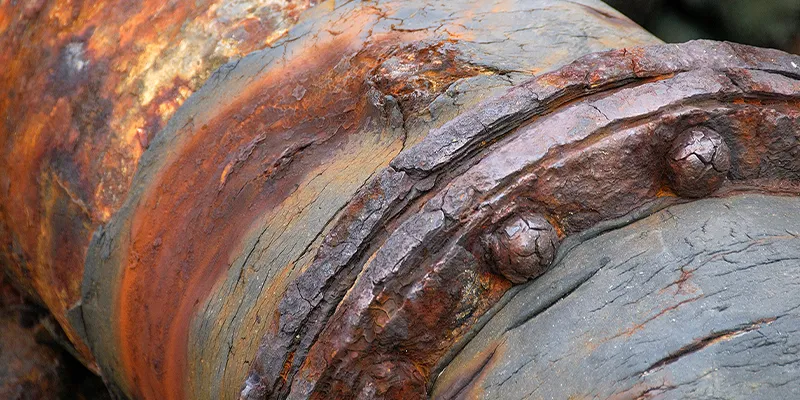
Stainless steels and nickel alloys resist corrosion because chromium (and, in higher grades, molybdenum and nickel) forms a thin, self-healing chromium-oxide passive film on the surface. Under static or low-velocity conditions, any local damage to this film repassivates almost instantly. Erosion-corrosion begins when flow velocity, turbulence, or entrained particles remove the film mechanically faster than the repassivation reaction can rebuild it. Once bare metal is repeatedly exposed, the underlying alloy corrodes at a rate far higher than it would under static immersion - often localized at elbows, tees, reducers, welds, and downstream of valves where flow separates or accelerates.
Because the mechanism is mechanical-electrochemical rather than purely chemical, erosion-corrosion cannot be prevented by material selection alone at unlimited velocity. Every grade has a threshold velocity above which the passive film cannot keep pace with mechanical removal, and that threshold - not general corrosion resistance in a coupon test - is what governs piping design in high-flow service.
What Determines Whether One Grade Outperforms Another?
Erosion-corrosion resistance tracks closely with the Pitting Resistance Equivalent Number (PREN) of the alloy - higher chromium, molybdenum, and nitrogen content produces a tougher, faster-healing passive film that tolerates higher flow velocities before damage outpaces repair.
PREN, calculated as %Cr + 3.3×%Mo + 16×%N, was developed to rank pitting resistance, but it correlates strongly with erosion-corrosion tolerance because both failure modes depend on the same passive-film stability. Grades with higher PREN values reform their protective oxide layer more quickly after mechanical disruption, which allows them to withstand higher wall shear stress and higher particle-impact energy before net metal loss becomes significant.
Microstructure also matters. Duplex and super duplex grades combine austenite and ferrite phases, which gives them higher yield strength than austenitic grades of comparable PREN - a mechanical property that helps resist the surface-hardening and micro-cutting effects of solids-laden flow, independent of the chemical passivation benefit. This is why duplex grades are frequently specified for erosive service even when a single-phase austenitic grade would offer comparable general corrosion resistance in static immersion.
Representative PREN Values by Grade Family
|
Grade |
UNS No. |
Typical PREN |
Structure |
|
304L |
S30403 |
≈18 |
Austenitic |
|
316L |
S31603 |
≈24-26 |
Austenitic |
|
317L |
S31703 |
≈30-32 |
Austenitic |
|
2205 Duplex |
S31803 / S32205 |
≈35 |
Duplex |
|
2507 Super Duplex |
S32750 |
≈42 |
Super Duplex |
|
254 SMO (6Mo) |
S31254 |
≈43 |
Super-Austenitic |
|
Alloy 625 |
N06625 |
Not PREN-ranked (Ni-based) |
Nickel Alloy |
PREN values are representative midpoints calculated from nominal chemistry per ASTM A240/A276/A182 composition ranges; verify against the specific heat's Mill Test Report (MTR) for project use.
What Are the Recommended Flow Velocity Limits for Common Piping Grades?
In clean, solids-free service, standard austenitic grades top out around 3-5 m/s, duplex 2205 extends that range to roughly 4-8 m/s, super duplex and 6Mo grades reach 8-12 m/s, and nickel alloys such as Alloy 625 are used specifically where velocities exceed what any stainless grade can tolerate.

The ranges below are engineering starting points, not fixed allowables. They synthesize the API RP 14E C-factor methodology (which assigns higher C-factors, and therefore higher permissible velocity, to more erosion-resistant materials) with erosion-corrosion research on individual grades. Every project should confirm limits against fluid composition, solids loading, temperature, and the specific piping geometry - see the sections that follow for how each variable shifts the number.
|
Grade |
Clean-Service Limit |
Sand/Solids-Laden Limit |
Governing Consideration |
|
304L / 316L |
≈3-5 m/s (10-16 ft/s) |
≈1-2 m/s |
Pitting/erosion onset at lower PREN |
|
317L |
≈5-6 m/s (16-20 ft/s) |
≈2-3 m/s |
Moderate Mo boost over 316L |
|
2205 Duplex |
≈4-8 m/s (13-26 ft/s) |
≈3-4 m/s |
Passive film + higher yield strength |
|
2507 Super Duplex |
≈8-12 m/s (26-39 ft/s) |
≈4-6 m/s |
High PREN, high hardness |
|
254 SMO (6Mo) |
≈8-12 m/s (26-39 ft/s) |
≈4-6 m/s |
High Mo/N passive film stability |
|
Alloy 625 / 825 |
Typically >12-15 m/s |
Project-specific testing required |
Ni-Cr-Mo matrix, minimal galvanic risk |
Ranges compiled from the API RP 14E erosional-velocity C-factor framework (13Cr stainless C≈300; duplex stainless C≈350, nominally solids-free), published erosion-corrosion test data on 2205 duplex in sand-laden seawater (critical velocity ≈4 m/s), and standard industry design practice. Confirm against project-specific flow-loop or field data before finalizing line sizing.
How Does the API RP 14E C-Factor Method Apply to Stainless and Duplex Grades?
API RP 14E's erosional velocity equation, Ve = C ÷ √ρm, was written for carbon steel but is commonly extended to stainless and duplex piping by substituting a higher C-factor - roughly 300 for 13Cr stainless and 350 for duplex stainless in nominally solids-free service - which raises the calculated allowable velocity in proportion to the material's greater erosion-corrosion tolerance.
In the original API RP 14E equation, Ve is the erosional velocity limit in ft/s, ρm is the gas-liquid mixture density at flowing conditions in lb/ft³, and C is an empirical constant tied to material and service severity. The API's default C = 100 for continuous carbon-steel service was developed conservatively and has been shown in later field studies to be overly cautious for many clean, non-sanded systems - some operators report acceptable performance at C-factors well above 200 once corrosion inhibition and solids content are controlled.
For stainless and duplex piping, industry practice raises the C-factor substantially above the carbon-steel baseline to reflect the higher erosion-corrosion threshold: values around 300 for 13Cr stainless and 350 for duplex stainless are commonly cited for nominally solids-free service. Because API RP 14E does not itself define stainless-specific C-factors, these figures function as design guidance drawn from operator experience and supplementary studies rather than as a mandatory code requirement - engineers should treat them as a starting point for sizing, subject to verification against the specific service.
Does Sand or Other Entrained Solids Change the Velocity Limit?
Yes - solids content is the single largest modifier of erosion-corrosion velocity limits, and published test data shows even a well-passivated grade like 2205 duplex dropping to a critical velocity near 4 m/s once sand is entrained in the flow, compared with roughly double that in clean seawater.

Erosion-corrosion research on 2205 duplex stainless steel in flowing seawater with sand particles has identified a critical velocity near 4 m/s, above which erosion-corrosion damage increases sharply as flow velocity rises and mass loss accelerates with sand content. Below that threshold, mechanical impact from particles is present but corrosion-assisted removal of the passive film dominates the damage; above it, the mechanism shifts toward erosion-dominated wear that far outpaces repassivation.
This is why API RP 14E explicitly declines to offer a fixed C-factor for solids-laden service and instead calls for project-specific testing. A velocity that is comfortably conservative in a filtered, clean process stream can be well past the erosion-corrosion threshold in an unfiltered produced-water or slurry line using the identical pipe grade and wall thickness. Any velocity table - including the one in this article - should be treated as inapplicable once solids loading exceeds a few pounds per thousand barrels without project-specific verification.
How Should Velocity Limits Be Adjusted for Specific Service Conditions?
Chloride concentration, temperature, and dissolved gas content each shift the effective velocity limit independently of solids content, so the same grade can carry a different allowable velocity in seawater injection, produced water, and geothermal brine even at identical particle loading.
Seawater and Chloride-Rich Service
Chlorides attack the passive film directly through pitting, which lowers the erosion-corrosion threshold because the film is already weakened before mechanical disruption begins. In full-strength seawater, 316L is frequently velocity-limited well below its clean-water rating specifically to manage pitting risk, and duplex or super-duplex grades are the default specification once chloride content or temperature increases.
Elevated Temperature
Passive-film repassivation kinetics slow as temperature rises in aggressive media, which narrows the margin between the velocity that causes disruption and the velocity at which the film can heal. High-temperature erosive service - geothermal brine, hot process streams - typically pushes grade selection toward higher-PREN duplex, super-austenitic, or nickel-alloy piping even at flow velocities that a lower grade would tolerate at ambient temperature.
Dissolved CO2 and H2S
In oil and gas gathering systems, dissolved CO2 forms carbonic acid that attacks any exposed base metal faster than plain water, compounding erosion-corrosion once the passive film is breached. NACE MR0175/ISO 15156 sour-service requirements layer additional metallurgical constraints - such as hardness limits and heat-treatment condition - on top of the erosion-corrosion velocity limit, and the two sets of requirements must be satisfied simultaneously rather than independently.
What Happens When a Velocity Limit Is Exceeded?
Exceeding the erosion-corrosion velocity limit produces localized, accelerating wall-thickness loss - typically at elbows, tees, and downstream of restrictions - that can progress from a coupon-scale finding to a through-wall leak far faster than uniform corrosion would predict.

Because erosion-corrosion is self-reinforcing, thinning at a high-turbulence location increases local roughness and turbulence intensity, which further accelerates film removal at that same point. This produces the characteristic horseshoe-shaped or scalloped wall-loss pattern found on elbow extrados, tee branches, and reducer outlets in failed piping - damage that a generic corrosion-allowance calculation based on uniform metal loss will not predict.
In practice, this means inspection programs for erosion-corrosion-prone lines should prioritize geometric discontinuities with ultrasonic thickness mapping rather than relying on average wall-loss trending alone.
How Should Engineers Choose the Right Grade for High-Velocity Piping?
Select the lowest-PREN grade that clears the project's actual velocity, solids, chloride, and temperature envelope with margin - not the highest-PREN grade available - since duplex, super duplex, and nickel-alloy piping carry a meaningful cost premium over standard austenitic grades.
A practical grade-selection sequence starts with 316L as the baseline for moderate velocity, low-chloride, solids-free service. Where seawater exposure, sand entrainment, or velocities above roughly 5 m/s are expected, 2205 duplex is the standard upgrade, offering a substantial jump in both PREN and yield strength at a moderate cost increase over austenitic grades. Super duplex 2507 and 6Mo super-austenitic grades such as 254 SMO are reserved for the highest-velocity or highest-chloride segments of a system - commonly short high-turbulence spools, choke and control valve trim, or injection headers - rather than specified across an entire line, which controls cost while still protecting the highest-risk points.
Nickel alloys such as Alloy 625 enter the selection when velocity, temperature, and chloride content together exceed what any stainless family can reliably tolerate, or where galvanic compatibility with existing nickel-alloy equipment is required. Because Alloy 625 and comparable nickel alloys carry the highest material cost in this comparison, they are typically applied selectively - at jet pumps, chokes, and other point-source high-velocity components - rather than for full pipe runs, with duplex or super duplex piping carrying the balance of the line.
Frequently Asked Questions
Q: What is the maximum velocity for 316L stainless steel pipe?
A: In clean, solids-free service, 316L is typically limited to roughly 3-5 m/s (10-16 ft/s). In seawater or other chloride-rich fluids, the practical limit is usually set lower to manage pitting risk rather than pure erosion, and duplex grades are often specified instead once chlorides are present.
Q: Is duplex stainless steel more erosion-corrosion resistant than 316L?
A: Yes. Duplex 2205 has a PREN roughly 35 versus roughly 24-26 for 316L, and its two-phase microstructure adds yield strength that austenitic grades lack, which together raise its erosion-corrosion velocity threshold well above 316L's in both clean and solids-laden service.
Q: Does the API RP 14E equation apply directly to stainless steel piping?
A: Not directly - API RP 14E's default C-factor of 100 was developed for carbon steel. Stainless and duplex piping use higher C-factors (roughly 300 for 13Cr stainless and 350 for duplex in nominally solids-free service) drawn from industry practice, since the recommended practice itself does not publish stainless-specific values.
Q: How much does sand content lower the velocity limit for stainless steel?
A: Substantially. Published testing on 2205 duplex in sand-laden seawater found a critical velocity near 4 m/s, roughly half the velocity tolerated in clean, solids-free conditions, and erosion-corrosion damage accelerates further as sand content increases beyond that threshold.
Q: When should a project use nickel alloy instead of super duplex stainless steel?
A: When flow velocity, temperature, and chloride content together exceed what super duplex or 6Mo grades can reliably tolerate, or where sour-service, galvanic-compatibility, or extreme-temperature requirements apply. Nickel alloys such as Alloy 625 are typically used selectively at high-velocity components rather than for entire pipe runs, given their cost premium.