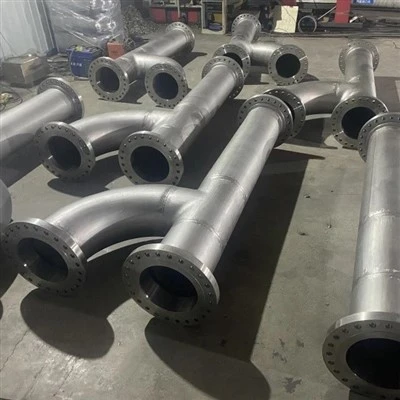
Among the standout alloys engineered to excel in these harsh environments, Duplex Stainless Steel UNS S31803, standardized as SA 182 F51, reigns supreme. This material represents an exceptional blend of strength, corrosion resistance, and cost-effectiveness, making it the preferred choice for forged fittings across numerous demanding sectors.

SA 182 F51 / UNS S31803
- SA 182 F51: This specifies the material grade within the ASTM A182 standard, which covers forged or rolled alloy and stainless steel pipe flanges, forged fittings, and valves and parts for high-temperature service. F51 designates the specific duplex stainless steel composition.
- UNS S31803: This is the Unified Numbering System identifier for the alloy, precisely defining its chemical composition. S31803 is the core identifier for this specific grade of duplex stainless steel.
Duplex refers to the unique microstructure of the steel, consisting of a near-equal balance of austenitic and ferritic phases. This dual-phase structure is the source of its superior properties.
Why S31803 Excels for Forged Fittings
Forged fittings – elbows, tees, reducers, couplings, caps, and forged flanges – are integral components subjected to significant mechanical loads and often exposed to corrosive media. S31803 duplex stainless steel provides an optimal solution due to its inherent advantages:
- Exceptional Strength: The duplex structure grants S31803 roughly twice the yield strength (min. 450 MPa / 65 ksi) and significantly higher tensile strength than standard austenitic stainless steels like 304L or 316L. This allows for thinner wall sections in fittings, reducing weight and material costs, while maintaining the pressure-bearing capability required for high-pressure systems. The high strength also provides excellent resistance to mechanical wear and galling.
- Superior Corrosion Resistance: S31803 offers outstanding resistance to a wide range of corrosive threats:
- Pitting and Crevice Corrosion: Its high Chromium, Molybdenum, and Nitrogen content results in a high Pitting Resistance Equivalent Number (PREN > 34), significantly outperforming 316L. This is crucial for fittings exposed to chlorides.
- Stress Corrosion Cracking: Duplex grades like S31803 possess far greater resistance to chloride-induced SCC than austenitic grades, a critical factor in offshore, chemical, and petrochemical applications.
- General Corrosion: Excellent resistance to acids like sulfuric, phosphoric, organic acids and caustic environments, comparable or superior to 316L in many cases.
- Erosion-Corrosion: The combination of strength and corrosion resistance makes it suitable for applications involving slurries or high-velocity fluids.
- Good Toughness and Fabricability: While not as inherently tough as some austenitics at cryogenic temperatures, S31803 offers ample toughness for the vast majority of service conditions encountered by forged fittings (typically down to around -50°C / -58°F). It can be successfully forged and machined using appropriate techniques and tooling, allowing manufacturers to produce complex fitting geometries reliably.
- Cost-Effectiveness: The combination of high strength (allowing weight reduction) and excellent corrosion resistance (reducing maintenance and replacement frequency) often makes S31803 a more economical choice over its lifecycle compared to standard austenitics or higher nickel alloys like Alloy 625, especially in aggressive environments where 316L would fail prematurely.
Forging Process for SA 182 F51 S31803 Fittings
Forging is the ideal manufacturing process for S31803 fittings due to the material's inherent characteristics:
Material Consolidation: Forging refines the grain structure of the S31803 billet, eliminating porosity and defects, resulting in superior mechanical properties and structural integrity compared to cast or machined-from-bar fittings. This is vital for high-pressure and safety-critical applications.
Directional Strength: The forging process can align the grain flow with the final shape of the fitting, enhancing its strength in critical directions where stress is highest.
Controlled Microstructure: Precise control over heating (typically within the 1100-1200°C / 2012-2192°F range) and forging parameters, followed by rapid quenching (water) is essential to achieve the desired 50/50 austenite/ferrite balance in the final S31803 product. Slow cooling or incorrect forging temperatures can lead to detrimental phases, severely impacting toughness and corrosion resistance.
Final Heat Treatment: After forging, SA 182 F51 S31803 fittings undergo a mandatory solution annealing treatment typically 1020-1100°C / 1870-2010°F followed by rapid quenching. This dissolves any precipitates formed during forging or cooling and restores the optimal duplex microstructure and corrosion resistance. Strict adherence to ASTM A182 requirements for heat treatment and subsequent testing is critical.
S31803 Forged Fitting Applications
The unique properties of SA 182 F51 S31803 forged fittings make them indispensable in environments where standard stainless steels fall short:
- Oil and Gas: Downhole equipment, manifolds, christmas trees, flow lines, seawater cooling systems, umbilicals, gas processing.
- Chemical and Petrochemical Processing: Reactors, heat exchangers, piping systems handling acids, chlorides, and other aggressive chemicals.
- Desalination and Water Treatment: High-pressure RO membranes, brine handling, seawater intake systems.
- Pulp and Paper Industry: Digesters, bleaching plants.
- Marine and Shipbuilding: Seawater piping, ballast systems, firefighting systems, hydraulic lines.
- Energy: Flue gas desulfurization systems, geothermal applications.
Conclusion
Duplex Stainless Steel SA 182 F51 UNS S31803 stands as a material engineered for resilience. Its unparalleled combination of high strength, exceptional corrosion resistance especially against pitting, crevice corrosion, and SCC in chloride environments, and good fabricability makes it the premier material specification for forged fittings facing demanding service conditions.
By choosing S31803 forged fittings manufactured to the stringent requirements of ASTM A182 F51, engineers and operators gain confidence in the longevity, reliability, and safety of their critical piping infrastructure, translating into reduced downtime, lower maintenance costs, and enhanced operational efficiency across challenging industrial landscapes. When performance under pressure and corrosion is non-negotiable, S31803 forged fittings deliver.