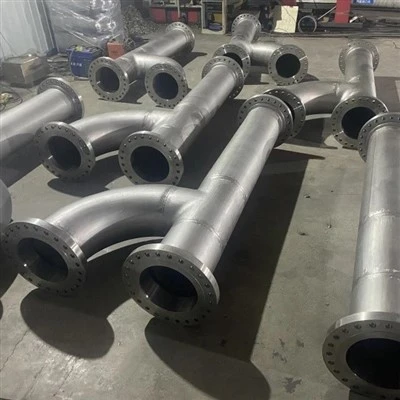
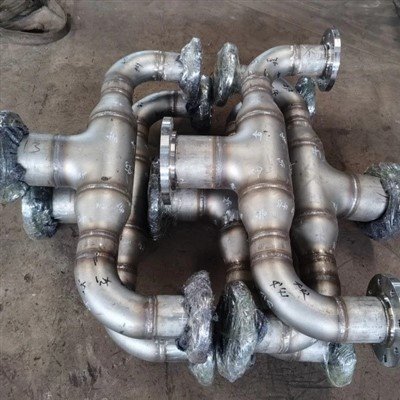
316L fails in flanged joints because the tight, stagnant gap under the gasket face creates exactly the low-oxygen, acidified, chloride-concentrated microenvironment that its passive film cannot survive - often at chloride levels and temperatures well below where 316L looks perfectly adequate everywhere else on the same system. The fix is to select flange material by Pitting Resistance Equivalent Number (PREN), not by alloy family reputation, and specify a grade with PREN above 40 for chloride-bearing service such as seawater.

Flanged joints are among the most common failure points in stainless steel piping systems, and they rarely fail from the process fluid attacking the open pipe bore. They fail at the gasket face, in the narrow gap between two mating metal surfaces. This article explains the mechanism behind that failure, why 316L in particular is a poor match for the environment a flange creates, and which alloys actually solve the problem - with the data to justify the choice, not just the reputation.
What Is Crevice Corrosion, and Why Do Flanges Create the Perfect Conditions for It?
Crevice corrosion is a self-accelerating, localized attack that starts when stagnant, oxygen-depleted liquid trapped inside a tight gap turns acidic and chloride-rich - and a flange's gasket face is essentially a manufactured crevice built into every joint.
Stainless steel resists corrosion because of a thin, self-healing chromium-oxide passive film. That film needs oxygen to maintain itself. Inside a crevice - the gap between a gasket and a flange face, under a washer, or beneath a deposit - the trapped liquid quickly uses up its dissolved oxygen and cannot exchange with the bulk fluid outside. Metal inside the crevice keeps trying to react, but without oxygen to rebuild the passive film, the surface starts corroding.
That corrosion releases metal ions, which react with water and chloride to form an acidic, chloride-concentrated solution inside the crevice - often far more acidic and far more concentrated in chloride than the process fluid ever was. This creates a feedback loop: the more the crevice corrodes, the more aggressive its internal chemistry becomes, and the faster it corrodes. A bolted, gasketed flange is close to an ideal geometry for this mechanism - a narrow, tight, stagnant gap held under constant mechanical pressure.
Why Does 316L Specifically Fail in Flanged Joints?
316L's alloying content - roughly 2 to 3% molybdenum and no significant nitrogen addition - simply isn't enough to keep its passive film stable once the crevice chemistry turns acidic and chloride-rich, and its critical crevice temperature can be at or below normal ambient conditions.

Molybdenum and nitrogen are the two alloying elements most responsible for stabilizing a stainless steel's passive film under acidic, chloride-concentrated conditions - the exact conditions a crevice produces. 316L's modest molybdenum content gives it decent resistance to general chloride attack on an open, well-oxygenated surface, which is why it performs well as a matter of everyday application.
But its critical crevice corrosion temperature (CCCT) - the temperature below which crevice attack won't initiate - can be as low as roughly -2°C (28°F) under some test conditions, meaning ordinary ambient or process temperatures offer no real margin of safety once chloride is present. Field data backs this up directly: 316L is documented to suffer crevice corrosion in seawater and in any water carrying more than roughly 1,000 mg/L chloride - a threshold many industrial waters exceed without operators realizing it.
What Is PREN, and Why Does It Predict Crevice Performance Better Than Alloy Name?
PREN (Pitting Resistance Equivalent Number) is a composition-based score - PREN = %Cr + 3.3×%Mo + 16×%N - and it correlates directly with an alloy's critical pitting and crevice temperatures, making it a far more reliable selection tool than assuming a grade is "good enough" because it's stainless.
The formula weights molybdenum and nitrogen heavily because both elements measurably raise the critical pitting temperature (CPT) and critical crevice temperature (CCT) of a stainless steel. A higher PREN means the alloy can tolerate a more acidic, more chloride-concentrated crevice environment before its passive film breaks down. This is why PREN, not product family ("stainless," "duplex," "super austenitic"), is the correct axis for flange material selection - two alloys in the same family can have meaningfully different PREN values and therefore different real-world crevice performance.
|
Alloy |
UNS Number |
Approx. PREN |
Seawater Crevice Suitability |
|
316L |
S31603 |
~24 |
Not suitable - documented crevice failures above ~1,000 mg/L chloride |
|
2205 duplex |
S31803/S32205 |
~35 |
Marginal - can still suffer crevice attack in ambient seawater |
|
904L austenitic |
N08904 |
~34 |
Marginal - documented crevice susceptibility in seawater |
|
2507 super duplex |
S32750 |
~42 |
Suitable - widely specified for seawater flanges |
|
254 SMO (6Mo) |
S31254 |
~43 |
Suitable - strong seawater crevice track record |
|
S31266 |
S31266 |
>40 |
Suitable - recommended in high-chloride flange service |
The widely cited industry threshold is a PREN above 40 for reliable crevice resistance in ambient-temperature seawater - a benchmark that has been formally adopted in offshore material specifications such as Norway's NORSOK standard. Note that 2205 duplex and even 904L, both meaningfully more alloyed than 316L, still fall short of that threshold and can still suffer crevice attack in aggressive service.
Does Switching to a Nickel Alloy Automatically Solve the Problem?
No - nickel-based alloys are not automatically superior to high-PREN stainless steels for crevice resistance, and lab comparisons have found some nickel alloys underperforming 6Mo super-austenitic stainless steel in seawater crevice conditions.
This is a common and costly misconception. Nickel content improves resistance to many corrosion mechanisms, but crevice resistance specifically still tracks chromium, molybdenum, and (for stainless grades) nitrogen content - not nickel content alone. In controlled seawater testing at elevated temperature, alloy 625 - a well-regarded nickel-chromium-molybdenum alloy - was found to have a lower effective PREN than 254 SMO stainless steel in the same study and initiated crevice corrosion faster than the stainless alternative.
Separately, weld overlays of several nickel alloys, including C-276, C-22, and 625, showed lower critical crevice temperatures than S31254 base material in similar testing; only alloy 59 outperformed it. The practical lesson: alloy family is not a substitute for checking the actual PREN and, where the application justifies it, actual test data (CPT/CCT) for the specific alloy and product form being purchased.
Does the Gasket Material Matter as Much as the Flange Material?
Yes - gasket choice can trigger galvanic corrosion or intensify crevice attack independently of the flange alloy, so gasket selection has to be engineered alongside the flange material, not treated as an afterthought.

Two separate mechanisms are at play at a gasket face. First, ordinary crevice corrosion occurs under any tight gasket, regardless of its material, because the geometry itself creates the stagnant gap. Second, galvanic corrosion can occur when the gasket material is electrochemically more noble than the flange - meaning the flange becomes the sacrificial anode and corrodes preferentially at the joint.
Documented field failures include 316L and alloy 400 gaskets causing problems, and even super-duplex flanges corroding when paired with alloy 825 or alloy 718 gaskets in seawater. In several documented cases, the practical fix was not a costlier flange material at all - it was re-machining the flange face and switching to a synthetic fiber or neoprene gasket, particularly in lower-pressure systems where a metallic gasket isn't structurally necessary.
Which Alloys Should Replace 316L in Crevice-Prone Flanged Joints?
For chloride-bearing service, specify a duplex, super-duplex, or super-austenitic grade with PREN above 40 - commonly 2507 super duplex or 254 SMO - and reserve nickel alloys for cases where their specific verified CCT, not their alloy family, justifies the added cost.
2507 super duplex (S32750): PREN ~42, roughly three times the yield strength of 316L, widely specified for offshore and seawater flanges.
254 SMO / 6Mo super-austenitic (S31254): PREN ~43, strong documented performance in seawater cooling and desalination flange service.
S31266: PREN above 40, positioned as a high-chloride flange material in current industry guidance.
Nickel alloys (625, C-276, C-22): reserve for applications where verified, alloy-specific CCT/CPT data - not general reputation - justifies their higher cost over a high-PREN stainless option.
In every case, the alloy choice should be paired with correct gasket selection and, where feasible, a flange face design that minimizes crevice depth and stagnation - material upgrades and design changes work together, not as substitutes for each other.
Are There Design Changes That Reduce Crevice Risk Without Changing the Alloy?
Yes - reducing crevice depth, improving flange face finish, and choosing gaskets that minimize stagnant gap area can meaningfully lower crevice risk, though design changes alone rarely substitute for adequate PREN in genuinely aggressive chloride service.
Minimize crevice geometry: tighter-tolerance machining and full-face gaskets reduce the volume of stagnant liquid trapped at the joint.
Improve surface finish: smoother flange faces reduce micro-crevices that can nucleate attack even under gaskets rated for the application.
Select non-conductive, chemically compatible gaskets: synthetic fiber or PTFE-based gaskets avoid the galvanic coupling risk that metallic gaskets can introduce.
Control fluid velocity and stagnation: designs that avoid dead legs and encourage flow across gasket faces reduce chloride concentration buildup.
These measures reduce risk; they do not eliminate the underlying vulnerability of a low-PREN alloy. In documented chloride-bearing and seawater service, they should be treated as a supplement to correct alloy selection, not a replacement for it.
How Should Engineers Verify Crevice Resistance Before Specifying a Flange Material?

Calculate PREN from the actual heat chemistry, then confirm against standardized crevice testing such as ASTM G48 or ASTM G150 rather than relying on nominal alloy datasheet values alone.
Pull the actual heat/cast chemistry (not the nominal specification range) and calculate PREN directly from the certified composition.
Cross-check the calculated PREN against the service chloride concentration and expected operating temperature, using the PREN > 40 seawater benchmark as a starting reference point, not an absolute rule for every environment.
For critical or high-consequence service, request or perform standardized testing - ASTM G48 (ferric chloride pitting and crevice test) or ASTM G150 (electrochemical critical pitting temperature test) - on the actual product form being purchased.
Evaluate the gasket material and flange face design together with the alloy choice, not in isolation.
Document the basis of selection (PREN calculation, test data, or both) in the material requisition so it carries forward into procurement and quality records.
Frequently Asked Questions
What PREN value is considered safe for seawater flanges?
A PREN above 40 is the widely cited benchmark for reliable crevice resistance in ambient-temperature seawater, and it has been adopted into offshore specifications such as NORSOK.
Can 2205 duplex stainless steel be used instead of 316L for crevice resistance?
It's a significant improvement over 316L, but 2205 duplex, at a PREN around 35, can still suffer crevice corrosion in ambient seawater, so it should not automatically be treated as a complete solution for aggressive chloride service.
Is alloy 625 always better than stainless steel for crevice corrosion?
Not necessarily. Test data has shown alloy 625 initiating crevice corrosion faster than 254 SMO super-austenitic stainless steel under comparable seawater conditions, so alloy family should never substitute for checking actual PREN or test data.
Why does crevice corrosion happen even in stainless steel, which is supposed to resist corrosion?
Stainless steel's corrosion resistance depends on oxygen sustaining its passive film. Inside a crevice, oxygen is depleted and the trapped solution becomes acidic and chloride-concentrated, defeating the very mechanism that makes the alloy "stainless" everywhere else on the same component.
Does changing the gasket material fix crevice corrosion on its own?
It can help, especially by avoiding galvanic coupling with a more noble gasket material, but it does not eliminate the underlying crevice mechanism. Gasket selection should complement correct alloy selection, not replace it.