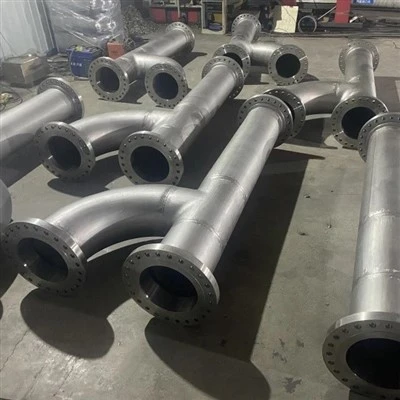
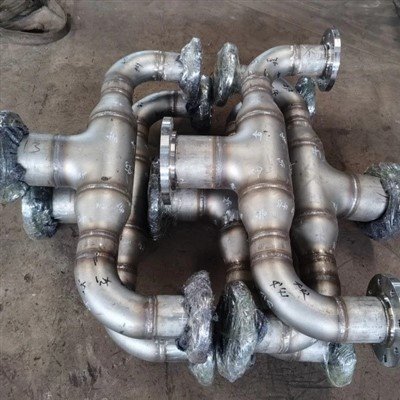
ASTM A790 UNS S32750 super duplex stainless steel pipe, also known as Duplex 2507, is a high-performance ferritic/austenitic duplex alloy.

S32750 combines the advantages of both stainless steels: a minimum yield strength of up to 55 MPa and excellent corrosion resistance. Its composition of 25% chromium, 7% nickel, and 4% molybdenum gives it a pitting equivalent value exceeding 40. This provides excellent resistance to pitting, crevice corrosion, and stress corrosion cracking, particularly in chloride-rich, high-pressure environments.
Super duplex 2507 is a suitable alternative to traditional austenitic stainless steel for harsh service applications.
ASTM A790 S32750 Specifications
ASTM A790 UNS S32750 super duplex stainless steel, designated Super Duplex 2507, follows the dimensions of standards such as ASME B36.19M or ASME B36.10M. Its diameter and wall thickness are identical to those of standard stainless steel pipe.
The ASTM A790 specification defines the material (S32750 super duplex steel), while the dimensions and wall thickness are determined by standards such as ASME. The following is a table of some dimensions based on the ASME B36.19M standard, covering common Schedules 10S, 40S, and 80S:
|
Nominal Pipe Size (NPS) |
Diameter Nominal (DN) |
Outside Diameter (mm) |
Schedule |
Nominal Wall Thickness (mm) |
|
1/2'' |
DN 15 |
21.3 |
10S |
2.11 |
|
40S |
2.77 |
|||
|
80S |
3.73 |
|||
|
--- |
--- |
--- |
--- |
--- |
|
1'' |
DN 25 |
33.4 |
10S |
2.77 |
|
40S |
3.38 |
|||
|
80S |
4.55 |
|||
|
--- |
--- |
--- |
--- |
--- |
|
2}' |
DN 50 |
60.3 |
10S |
2.77 |
|
40S |
3.91 |
|||
|
80S |
5.54 |
|||
|
--- |
--- |
--- |
--- |
--- |
|
4'' |
DN 100 |
114.3 |
10S |
3.05 |
|
40S |
6.02 |
|||
|
80S |
8.56 |
|||
|
--- |
--- |
--- |
--- |
--- |
|
6'' |
DN 150 |
168.3 |
10S |
3.40 |
|
40S |
7.11 |
|||
|
80S |
10.97 |
|||
|
--- |
--- |
--- |
--- |
--- |
|
8" |
DN 200 |
219.1 |
10S |
3.76 |
|
40S |
8.18 |
|||
|
80S |
12.70 |
ASTM A790 S32750 Key Dimension Ranges and Descriptions
Nominal Pipe Size (NPS) Range: 1/8" to 24" or larger. UNS S32750 seamless pipe is commonly found in the 1/2" NB to 12" NB range.
Wall Thickness (Schedule): Common schedules include 5S, 10S, 40S, 80S, 120, 160, XS (Extra Strong), and XXS Double Extra Strong.
Outer Diameter (OD): Within a specific NPS pipe, the outside diameter (OD) is fixed. For example, the OD of a 2" NPS pipe is always 60.3 mm (2.375 in), regardless of schedule.
Inside Diameter (ID): The inside diameter decreases as wall thickness increases.
Application: ASTM A790 S32750 super duplex steel is often used in demanding wall thickness grades (such as SCH 80 or SCH160) to cope with high pressure and high chloride environments due to its high strength and excellent corrosion resistance.
Super Duplex Pipe ASTM A790 S32750 Technical Parameters
Below is a table of chemical composition, mechanical properties, and physical properties of ASTM A790 UNS S32750 super duplex steel.
Super Duplex S32750 Chemical Composition
|
Composition |
Content, % by Weight |
|
C |
≤0.030 |
|
Mn |
≤1.20 |
|
P |
≤0.035 |
|
S |
≤0.020 |
|
Si |
≤0.80 |
|
Ni |
6.0 - 8.0 |
|
Cr |
24.0 - 26.0 |
|
Mo |
3.0 - 5.0 |
|
N |
0.24 - 0.32 |
|
Cu |
≤0.50 |
|
Fe |
Remainder |
Super Duplex S32750 Physical Properties
|
Property |
Typical Value |
Temperature |
|
Density |
7.81 g/cm3 |
- |
|
Modulus of Elasticity |
199 x 10^3 GPa |
20℃ |
|
Coefficient of Thermal Expansion |
13.5 µm/m·℃ |
20-100℃ |
|
Thermal Conductivity |
14.2 W/m·K |
20℃ |
|
Electrical Resistivity |
0.80 µΩ·m |
20℃ |
Super Duplex S32750 Mechanical Properties
|
Property |
Minimum Value |
|
Tensile Strength |
800 MPa |
|
Yield Strength |
550 MPa |
|
Elongation in 50mm |
15% |
|
Hardness |
Maximum Value |
|
Hardness, HBW |
300 HBW |
|
Hardness, HRC |
32 HRC |
ASTM A790 S32750 Super Duplex Pipe Manufacturing

1. Primary Melting and Casting
Raw Material Selection: Iron ore and alloying elements are precisely selected to ensure the final chemical composition meets the requirements of S32750.
Melting and Refining: The raw materials are melted in an electric furnace or vacuum induction furnace, and impurities are removed through refining. The alloying element content is precisely controlled to ensure the purity of the molten steel.
Casting: The molten steel is typically continuously cast into billets or slabs, which serve as the raw material for subsequent pipe making.
2. Pipe Forming Process
A. Seamless Pipe Manufacturing: Seamless pipe has no welds and is suitable for high-pressure applications.
Piercing: A solid round billet heated to a high temperature is rotated and extruded in a piercing mill to form a hollow pipe billet.
Rolling and Elongating: Hot Rolling/Extrusion: The billet passes through a mandrel mill or extruder to reduce the outer diameter and wall thickness to the desired dimensions.
Cold Drawing/Cold Rolling: For pipes requiring higher dimensional accuracy, multiple cold working steps are performed after hot rolling to further reduce the dimensions and improve the surface finish. Heat treatment is usually required before each cold working step.

B. Welded Pipe Manufacturing: Welded pipe is manufactured by welding sheet or strip steel together. It is suitable for large-diameter pipes.
Forming: S32750 flat steel sheet or strip is rolled into a cylindrical shape using rollers.
Welding: Using an automated welding process, the edges of the pipe are welded together with little or no addition of congruent weld material.
Weld Seam Treatment: The weld may require machining or heat treatment to optimize properties.
3. Final Heat Treatment
This is the most critical step in the super duplex steel manufacturing process.
Solution Annealing: The pipe is heated to a high temperature to uniformly dissolve all alloying elements in the steel.
Rapid Cooling/Water Quenching: Rapid cooling is then necessary to prevent the precipitation of harmful intermetallic phases and ensure the formation of an ideal duplex microstructure of austenite and ferrite, resulting in optimal corrosion resistance and mechanical properties.
4. Finishing and Testing
Surface treatment: Pickling is typically performed to remove surface scale, or bright annealing is performed to maintain a smooth surface finish.
Testing: A series of quality control tests are conducted in strict accordance with ASTM A790 specifications, including chemical analysis, mechanical testing, nondestructive testing to check weld or pipe integrity, hydrostatic pressure testing, and metallographic examination to ensure the correct duplex microstructure ratio.
S32750 VS S32760
UNS S32750 and UNS S32760 are both super duplex stainless steels with extremely high corrosion resistance and mechanical strength. Many of their properties are very similar, but there are differences:

1. Chemical Composition Difference
UNS S32760 intentionally contains tungsten and a higher copper content, while S32750 typically has a very low W content and an even lower Cu content.
Specifically, S32760 typically contains 0.5%-1.0% W and 0.5%-1.0% Cu, while S32750 contains no more than 0.5% Cu.
2. Corrosion Resistance Difference
The addition of tungsten and copper to S32760 provides superior corrosion resistance in certain corrosive environments, particularly those containing acids and high salinity.
While both materials have a pitting resistance equivalent of over 40, S32760 is considered safer in applications involving high salinity and certain aggressive chemicals.
3. Application and Trade Name Difference
S32750, commonly known as SAF 2507, is widely used in a variety of harsh environments worldwide, particularly in the oil and gas, desalination, and chemical industries. S32760, also known as Zeron 100, is also used in marine and highly corrosive industrial applications. However, due to its finely tuned composition, it is sometimes preferred for use in demanding environments.

4. Mechanical Properties and Specification Difference
While both materials typically have a minimum yield strength requirement of 550 MPa, some specifications may require a higher elongation for S32760, and they may correspond to different ASTM forging grades, for example, S32750 corresponds to ASTM F53, while S32760 corresponds to ASTM F55.
Overall, the high mechanical strength levels of the two materials are very similar, with the differences often arising from subtle chemical compositions and specific specification requirements.