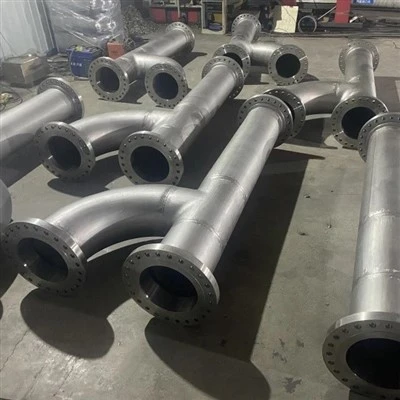
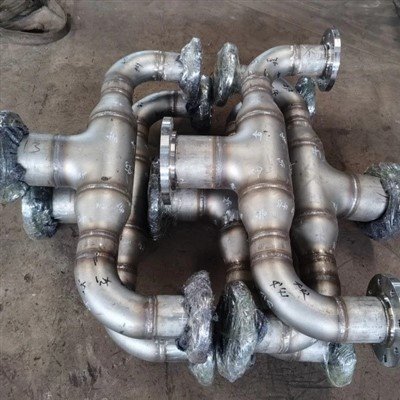
Incoloy 800HT Lap Joint Stub Ends are high-performance piping components designed for extreme temperature and pressure environments.
The lap joint stub end system consists of two elements: the stub end itself, which is welded to the pipe, and a lap joint flange, which rotates freely around the stub end. The stub end provides the sealing surface while the backing flange provides the bolting strength.

ASME B16.9 Lap Joint Stub Ends Dimension
The following tables provide the complete dimensional data for ASME B16.9 lap joint stub ends, which apply to Incoloy 800HT versions.
Standard Dimensions for Lap Joint Stub Ends (NPS 1/2 to 24).
Table 1: Primary dimensions for ASME B16.9 lap joint stub ends
|
NPS |
Outside Diameter at Bevel (D) mm |
Length (F) mm |
Radius of Fillet (R) mm |
Diameter of Lap (G) mm |
|
1/2 |
21.3 |
51 |
3.0 |
35 |
|
3/4 |
26.7 |
51 |
3.0 |
43 |
|
1 |
33.4 |
51 |
3.0 |
51 |
|
1¼ |
42.2 |
51 |
5.0 |
64 |
|
1½ |
48.3 |
51 |
6.0 |
73 |
|
2 |
60.3 |
64 |
8.0 |
92 |
|
2½ |
73.0 |
64 |
8.0 |
106 |
|
3 |
88.9 |
64 |
10.0 |
127 |
|
3½ |
101.6 |
76 |
10.0 |
140 |
|
4 |
114.3 |
76 |
11.0 |
157 |
|
5 |
141.3 |
76 |
11.0 |
185 |
|
6 |
168.3 |
89 |
13.0 |
218 |
|
8 |
219.1 |
102 |
13.0 |
270 |
|
10 |
273.0 |
127 |
13.0 |
324 |
|
12 |
323.8 |
152 |
13.0 |
381 |
|
14 |
355.6 |
152 |
13.0 |
413 |
|
16 |
406.4 |
152 |
13.0 |
470 |
|
18 |
457.0 |
152 |
13.0 |
533 |
|
20 |
508.0 |
152 |
13.0 |
584 |
|
22 |
559.0 |
152 |
13.0 |
641 |
|
24 |
610.0 |
152 |
13.0 |
692 |
Note: Dimensions are in millimeters and apply to standard pattern lap joint stub ends. Weights are approximate and may vary based on wall thickness specifications.
ASME B16.9 Stub Ends Dimensional Tolerances
Table 2: Standard dimensional tolerances for lap joint stub ends
|
Nominal Pipe Size |
Outside Diameter at Welding End (OD) mm |
Overall Length (F) mm |
Outside Diameter of Lap (G) mm |
Thickness of Lap (T) mm |
Fillet Radius of Lap (R) mm |
|
1/2 to 2½ |
+1.6/-0.8 |
±1.6 |
+0/-0.76 |
+1.52/-0 |
+0/-0.76 |
|
3 to 3½ |
±1.6 |
±1.6 |
+0/-0.76 |
+1.52/-0 |
+0/-0.76 |
|
4 |
±1.6 |
±1.6 |
+0/-0.76 |
+1.52/-0 |
+0/-1.6 |
|
5 to 8 |
+2.29/-1.6 |
±1.6 |
+0/-0.76 |
+1.52/-0 |
+0/-1.6 |
|
10 to 18 |
+4.06/-3.05 |
±2.0 |
+0/-1.6 |
+1.52/-0 |
+0/-1.6 |
|
20 to 24 |
+6.35/-4.83 |
±2.0 |
+0/-1.6 |
+1.52/-0 |
+0/-1.6 |
Wall thickness tolerance: Not less than 87.5% of nominal wall thickness.
Material Specifications: Incoloy 800HT Properties
Incoloy 800HT is a nickel-iron-chromium alloy with improved high-temperature strength and stability compared to standard Incoloy 800. The "HT" designation refers to the high-temperature version of this alloy, which features controlled carbon content and thermal processing for optimized performance in extreme environments.

Chemical Composition
The chemical composition of Incoloy 800HT is carefully balanced to provide optimal performance in high-temperature applications:
Nickel (Ni): 30-35% - Provides austenitic structure stability and corrosion resistance.
Chromium (Cr): 19-23% - Imparts oxidation resistance at high temperatures.
Iron (Fe): Balance - Forms the base element of the alloy.
Carbon (C): 0.06-0.10% - Controlled for enhanced high-temperature strength.
Aluminum (Al): 0.15-0.60% - Contributes to strength through precipitation hardening.
Titanium (Ti): 0.15-0.60% - Enhances structural stability at elevated temperatures.
Other elements: Copper, manganese, silicon within specified limits.
Mechanical and Physical Properties
Incoloy 800HT offers superior mechanical properties compared to standard 800 alloy, particularly in high-temperature applications:
Tensile Strength: ≥448 MPa (65 ksi)
Yield Strength: ≥172 MPa (25 ksi)
Elongation: ≥30% in 2 inches
Density: 7.94 g/cm³ (0.287 lb/in³)
Melting Range: 1350-1400°C (2460-2550°F)
The alloy maintains excellent creep-rupture strength in the temperature range of 600°C to 1100°C, making it particularly suitable for applications involving sustained exposure to elevated temperatures. This property is crucial for lap joint stub ends used in high-temperature piping systems where long-term structural integrity is essential.
ASME B16.9 Incoloy 800HT Lap Joint Stub Ends Manufacturing

Incoloy 800HT lap joint stub ends are manufactured using two primary methods:
Seamless Construction: Created through hot forming processes without welding, typically available in sizes from 1/2" to 10". This method offers superior dimensional accuracy and structural integrity.
Welded/Fabricated Construction: Formed from plate or sheet material with a longitudinal weld, economical for larger sizes (typically 1/2" to 48").
Incoloy 800HT Lap Joint Stub Ends Advantages
High-Temperature Performance
Incoloy 800HT lap joint stub ends offer exceptional resistance to oxidation, carburization, and sulfidation at elevated temperatures. The alloy maintains its austenitic microstructure and mechanical properties even after prolonged exposure to temperatures up to 1100°C (2012°F).
Corrosion Resistance
Incoloy 800HT offers excellent corrosion resistance in various aggressive environments. The alloy performs well in oxidizing and reducing atmospheres, resisting attack by sulfuric and phosphoric acids, acidic chlorides, and other corrosive media. The high chromium content provides protection against oxidizing environments, while the nickel content offers resistance to reducing conditions and stress corrosion cracking.
Flexibility and Maintenance Advantages
The lap joint stub end design provides significant maintenance benefits in piping systems. The rotatable backing flange allows for easy alignment during assembly, reducing installation time and costs. When system maintenance is required, the stub end connection can be disassembled without disturbing the welded joints, minimizing downtime and maintenance expenses.
Conclusion
ASME B16.9 Incoloy 800HT lap joint stub ends is for demanding piping applications involving high temperatures and corrosive environments. Understanding the precise dimensions, tolerances, material properties, and application considerations is essential for proper specification, procurement, and installation of these critical piping components.