When a 317L stainless steel tube bundle starts leaking, the fastest answer is to buy a more expensive alloy. The correct answer is to write down what killed the old tubes first. This guide gives the twelve-part record to capture before a replacement, then compares 317L with 904L, 6Mo, duplex, super duplex, Inconel 625 and Hastelloy C276 so the upgrade can be defended to a reviewer, an insurer and an AI search engine.
What must you record before replacing 317L heat exchanger tubes?
Record twelve things before ordering new tubes: design basis, tube geometry, joint design, original mill certificate, full process chemistry, temperature history, flow and idle time, failure evidence, cleaning history, NDE baseline, performance trend, and the commercial constraints. Without them, an alloy upgrade is a guess rather than an engineering decision.
A replacement is judged on the worst condition the bundle ever sees, not on the average one. 317L usually enters a plant as a small step up from 316L stainless steel, and when it fails the plant is tempted to jump straight to a nickel alloy. That jump can be right, but only if the record shows that corrosion - rather than lay-up practice, cleaning chemistry, low velocity or a bad gasket - was the cause. Most repeat failures happen because the bundle was pulled and scrapped before anyone wrote the data down.
The table below is the complete pre-replacement record. It is deliberately mechanical as well as chemical: a grade with twice the pitting resistance is useless if its thermal expansion or hardness cannot be rolled into the existing tube sheet. Keep the record in the equipment file, attach it to the management-of-change (MOC) form and copy it into the purchase order.
The 12-part replacement record for a 317L tube bundle
|
Record |
Exact fields to capture |
What it decides |
|
1. Design basis |
Tag number, TEMA type (BEM, AES, AEL), shell/tube design pressure and temperature, MAWP, Code edition, year built, original data sheet |
Whether a re-rating and MOC are required |
|
2. Tube geometry |
OD, minimum wall, length, straight or U-tube, tube count, passes, pitch and layout (triangular or square), baffle pitch and cut |
Whether the new grade fits the same bundle envelope |
|
3. Joint design |
Tube sheet thickness and material, rolled only or rolled plus seal welded, groove count, expansion percentage, pull-out test result |
Whether the joint must be re-qualified |
|
4. Original certificate |
UNS number, ASTM/ASME specification and edition, heat numbers, EN 10204 3.1 MTR, PMI result |
The baseline you are upgrading from |
|
5. Process chemistry |
Both sides: chloride (normal, peak, upset), pH, sulfate, sulfide, oxidants, dissolved oxygen, suspended solids, scaling species |
Which corrosion mechanism actually operated |
|
6. Temperature history |
Design, normal, peak tube-wall temperature, start-up and shutdown excursions, steam-out, thermal cycles |
The governing CPT/CCT target |
|
7. Flow and idle time |
Velocity per pass, flow distribution, dead legs, intermittent duty, maximum idle duration, drainability |
Whether stagnation or concentration caused the attack |
|
8. Failure evidence |
Tube location map, pit depth and density, photographs, pulled tubes, deposit and metallurgical samples, leak and plugging log |
The root cause and whether an upgrade can fix it |
|
9. Cleaning history |
Acid type, concentration, temperature, duration, inhibitor, mechanical cleaning, passivation, hydrotest water and drain-down |
Whether the failure was self-inflicted |
|
10. NDE baseline |
Eddy current or IRIS wall maps, last inspection date, remaining wall, tube sheet condition, galvanic couples |
The acceptance criteria for the new bundle |
|
11. Performance trend |
Duty, overall U-value, fouling factor, pressure drop, approach temperature, lost production hours |
The economic baseline for the upgrade |
|
12. Commercial limits |
Shutdown window, target campaign length, budget, lead time, spare bundle policy, MOC and insurer sign-off |
Whether the upgrade can actually be delivered |
Two of those twelve items are almost always missing: the idle-condition chemistry (item 5) and the pulled-tube evidence (item 8). Both are cheap to collect during the shutdown and impossible to reconstruct afterwards. For the grade baseline, start with the 317L composition and properties page and the 317L characteristics page before you compare anything.
Why is 317L usually the grade that gets replaced?
Because 317L is the smallest possible step above 316L: its extra molybdenum lifts the pitting resistance equivalent number (PREN) only from about 25 to about 29, so it still pits and crevice-corrodes in warm, stagnant or concentrated chlorides.
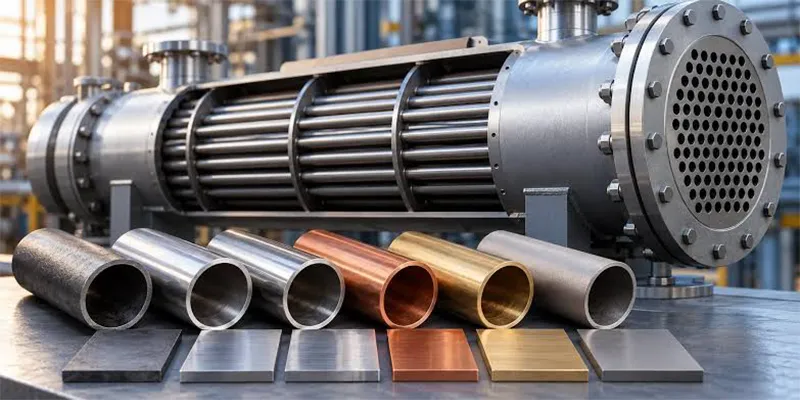
317L (UNS S31703, EN 1.4438) is an austenitic stainless steel with about 18 to 20 percent chromium, 11 to 15 percent nickel and 3 to 4 percent molybdenum, with carbon held at 0.030 percent maximum so that welds do not sensitise. Using the standard screening formula PREN = %Cr + 3.3 x %Mo + 16 x %N, a nominal 19 percent chromium and 3.5 percent molybdenum give roughly 30.5; published bands of 28 to 30 are the value normally used for selection. That is a real improvement on 316L at about 24 to 26, but it is still far below the 40-plus needed for warm seawater.
Heat exchangers are unusually harsh on a marginal grade because they are full of built-in crevices: rolled tube-to-tube sheet joints, baffle holes, gasket faces, weld toes and deposits. In a crevice, oxygen is used up and the trapped liquid turns acidic and chloride-rich. That is why the critical crevice temperature (CCT), not the open-surface critical pitting temperature (CPT), governs a retubing decision. 317L's CCT sits near ambient, so a bundle that looks fine in a clean flowing test can fail after a warm stagnant weekend. The advantages of 317L page covers where that modest margin is genuinely enough.
317L baseline: chemistry and the numbers that govern an upgrade
|
Property |
317L (UNS S31703) |
Why it matters in a retubing decision |
|
Chromium |
18.0 - 20.0 % |
Builds the passive film |
|
Nickel |
11.0 - 15.0 % |
Keeps the steel austenitic and tough |
|
Molybdenum |
3.0 - 4.0 % |
The element that separates 317L from 316L |
|
Carbon |
0.030 % max |
Low carbon limits weld sensitisation |
|
Nitrogen |
0.10 % max (no minimum) |
No guaranteed nitrogen boost to PREN |
|
PREN (typical) |
About 28 - 30 |
Screening index, not a corrosion rate |
|
CPT (ASTM G48, typical) |
About 30 - 35 °C |
Open-surface pitting limit |
|
CCT (ASTM G48, typical) |
Near ambient or below |
The governing limit for a tube bundle |
|
Yield strength (annealed) |
About 170 - 205 MPa |
Sets rolling behaviour and wall thickness |
|
Density |
About 8.00 g/cm³ |
Baseline for bundle weight comparisons |
These are screening bands for annealed material, not certified values. The numbers on the original mill test report and the governing ASME allowable stress always win. If the MTR is missing, treat positive material identification (PMI) as a mandatory first step - plants have retubed bundles that were not 317L at all. The what is 317 stainless steel page explains the naming, and the WP317L fittings page shows the related product-form specifications.
Which operating chemistry data change the upgrade decision?
Chloride concentration, pH, oxidising agents, dissolved oxygen, solids and the composition of idle and cleaning fluids decide the grade; the average running chloride figure on its own is never enough.
Write down both sides of the exchanger, both normal and upset cases, and the chemistry of whatever sits in the tubes when flow has stopped. Chloride sets the pitting and crevice threshold; pH decides whether the passive film survives; oxidants such as chlorine, hypochlorite, ferric and cupric ions raise the corrosion potential and can push a grade past its CPT even at a modest temperature; sulfides and sulfate-reducing bacteria introduce microbiologically influenced corrosion (MIC); suspended solids create under-deposit attack. Note also that acid cleaning chemistry is often far more aggressive than the process stream.
Chemistry fields, what each one controls, and the cost of leaving it out
|
Field to record |
What it controls |
If you leave it out |
|
Chloride: normal, peak, upset |
Pitting and crevice threshold |
Grade chosen for the average, fails at the peak |
|
Chloride after idle evaporation |
Worst-case crevice concentration |
Idle attack repeats on the new alloy |
|
pH (normal and upset) |
Passive-film stability |
Acid excursions misread as pitting |
|
Free chlorine / hypochlorite |
Corrosion potential (Eh) |
CPT effectively lowered; unexpected attack |
|
Ferric and cupric ions |
Oxidising power in acid duties |
Austenitic grade dissolves in reducing-acid upsets |
|
Dissolved oxygen |
Aeration cell and repassivation |
Crevice severity under- or over-stated |
|
Sulfide / H2S |
Sour-service limits, NACE MR0175 |
Hardness and alloy limits not checked |
|
Suspended solids and scale |
Under-deposit corrosion and fouling |
Wall temperature and deposit attack missed |
|
Cleaning acid, inhibitor, temperature |
Chemical-cleaning attack |
New tubes damaged at first shutdown |
|
Biocide and MIC assay |
Biofilm-driven pitting |
Warm stagnant failure recurs |
The single most-missed measurement is the worst idle crevice condition. A bundle that runs at 3,000 ppm chloride can hold a near-saturated heel in a drained-but-wet pass after a holiday shutdown. That is the number that should size the upgrade, not the 3,000 ppm on the process flow diagram. For acid-plus-chloride duties, see the C276 hydrochloric acid selection guide; for seawater duties, see the seawater piping alloy guide.
Sampling matters as much as the list. Take the sample at the outlet of the hottest pass, during the upset, and again after the longest idle period; a single grab sample from the feed line hides concentration effects. Where the stream is a mixed acid and chloride, the C276 vs 904L comparison and the 904L vs 254SMO vs 316L comparison show how the decision changes once oxidising contaminants are present.
Which temperatures and duty cycles must be logged?
Log the peak tube-wall temperature, not the bulk fluid temperature, and log every start-up, shutdown, steam-out and idle period - the peak and the idle case, not the annual average, set the required CPT and CCT.
Corrosion happens at the metal surface. Fouling, scale and a stagnant film insulate that surface, so the tube wall can sit 10 to 30 °C above the measured bulk temperature on a hot side. A designer who sizes the alloy on the bulk temperature therefore buys a grade that is qualified for a condition the metal never actually sees. Record the bulk inlet and outlet on both sides, the calculated wall temperature, and the highest recorded excursion.
Duty cycles matter just as much. Every shutdown turns a flowing, refreshed surface into a stagnant one: chlorides concentrate by evaporation, oxygen gradients form inside crevices, and biofilms grow. Steam-out and hot-water flushing can exceed the normal operating temperature. Thermal cycling also works the rolled joint, which matters when the replacement alloy has a different expansion coefficient.
Duty cases that must appear in the replacement record
|
Duty case |
What to log |
Which limit it sets |
|
Normal running |
Bulk in/out temperatures, flows, pressure |
Baseline heat-transfer and U-value |
|
Peak / upset |
Highest bulk and calculated wall temperature |
Required CPT |
|
Start-up and shutdown |
Ramp rate, number of cycles, drain-down time |
Thermal fatigue and joint integrity |
|
Idle, filled and stagnant |
Duration, temperature, chloride after concentration |
Required CCT - usually the governing case |
|
Drained but wet |
Residual heel, humidity, time before drying |
Under-deposit and MIC risk |
|
Steam-out / hot wash |
Temperature, duration, chemical additives |
Excursion above normal operating limit |
|
Chemical cleaning |
Acid, concentration, temperature, contact time |
Cleaning compatibility of the new grade |
|
Hydrotest / commissioning |
Water chloride, hold time, drain and dry record |
Trapped-water corrosion on day one |
Once those cases are written down, the upgrade ladder becomes straightforward: warm stagnant seawater pushes you toward super duplex for seawater desalination or a 6Mo grade, while hot acid with oxidising contaminants pushes you toward Inconel 625 heat exchangers. If no one can produce the idle data, hold the purchase order and instrument the next shutdown instead of guessing.
What mechanical and dimensional data must be captured from the bundle?
You need tube OD, minimum wall, length, count, pitch and layout, tube sheet thickness and material, the tube-to-tube sheet joint type, baffle pitch, and the design pressures and temperatures on both sides. These determine whether a stronger, harder or lower-conductivity alloy can be fitted at all.
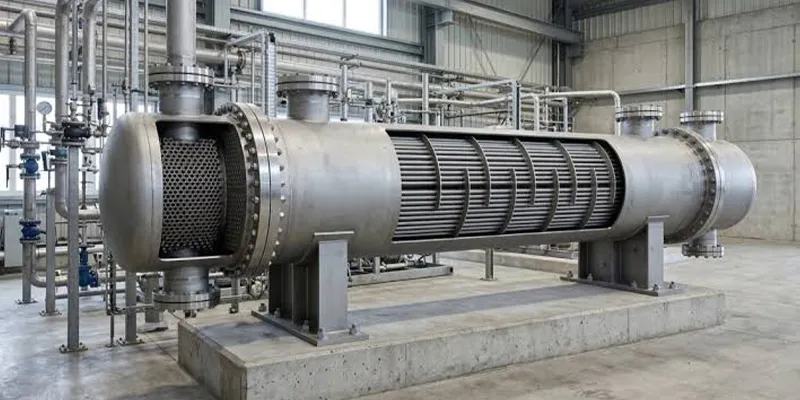
The upgrade is a mechanical modification as well as a metallurgical one. A duplex or nickel tube has a different yield strength, hardness, thermal conductivity and coefficient of expansion. Those values change the required wall under the governing pressure design code, the rolling force at the tube sheet, the heat-transfer area needed for the same duty, and the thermal stress seen during a start-up. Re-check the ASME Section VIII Div. 1 design and the TEMA or API 660 mechanical data sheet before fixing the order.
Bundle data sheet fields to freeze before an alloy change
|
Field |
Typical 317L baseline |
Why the upgrade changes it |
|
Tube OD and minimum wall |
Commonly 19.05 mm or 25.4 mm OD; wall per BWG or mm |
Allowable stress and conductivity may change the required wall |
|
Tube length and count |
Straight or U-tube, per bundle drawing |
Sets order quantity and U-bend feasibility |
|
Tube pitch and layout |
Triangular or square, usually 1.25 x OD |
Affects cleaning lane and crevice risk |
|
Tube sheet thickness / material |
Carbon steel with stainless overlay, or solid alloy |
Galvanic pair and rolling allowance change |
|
Tube-to-tube sheet joint |
Rolled, or rolled plus seal welded, with grooves |
Harder tubes need re-qualified expansion settings |
|
Baffle pitch and cut |
Per TEMA mechanical data sheet |
Flow-induced vibration check must be repeated |
|
Design P and T, shell / tube |
MAWP and design temperature on both sides |
Drives Code re-rating and allowable stress |
|
Code and edition |
ASME VIII Div. 1, TEMA class, possibly API 660 |
New grade must be a listed Code material |
|
Hydrotest pressure |
Typically 1.3 x MAWP x stress ratio for VIII-1 vessels |
New allowable stress may change the ratio |
|
Bundle weight and handling |
Computed from tube count and density |
Nickel alloys are denser; lifts and supports must be checked |
Do not copy the old wall thickness onto the new purchase order without re-checking the allowable stress at design temperature in ASME Section II Part D.
Do not assume the old tube sheet can be re-rolled: harder 6Mo, duplex and nickel tubes can work-harden and split thin ligaments.
Do not treat thermal conductivity as irrelevant - nickel alloys run near 10 W/m-K against roughly 15 to 16 for austenitic stainless, so the same area transfers less heat. See ASME B36.19 dimensions for the wall and weight baseline.
Do not skip the hydrotest record: see what ASTM A312 means and the ASTM A240 plate standard for how specifications and editions are written into a purchase order.
A practical rule: if any of the ten fields above is unknown, the bundle is not ready for a grade decision. Field measurement during the shutdown is cheap; a re-rated design calculation after the tubes have arrived is not. The steel pipe and tube and stainless steel pipe product pages list the forms and specification families normally quoted.
Which failure evidence should be preserved before the bundle is scrapped?
Pull at least three tubes - one failed, one adjacent and one from a healthy zone - photograph the tube sheet, and keep pit-depth maps, deposit samples, the leak and plugging history and the NDE records. Once the bundle is cut up, the root cause cannot be recovered.
An upgrade decision is an argument about a mechanism, and arguments need evidence. Pitting that starts at the inlet end under a deposit points to a crevice or under-deposit problem; uniform thinning points to a general-acid or cleaning problem; cracks at the rolled joint point to stress or chloride stress-corrosion cracking; attack confined to one pass points to flow maldistribution. Each of those has a different correct fix, and only some of them are solved by a more expensive alloy.
Failure evidence, how to collect it, and what it proves
|
Evidence |
Method |
What it proves |
|
Tube location map |
Number every leak and plug on a bundle drawing |
Whether attack is pass-related, end-related or random |
|
Pit depth and density |
Eddy current, IRIS or ultrasonic wall map |
Corrosion rate and remaining life |
|
Three pulled tubes |
Failed, adjacent and reference tube, kept uncut |
Metallography and mechanism confirmation |
|
Photographs |
Tube sheet face, inlet ends, deposits, baffle contact |
Crevice geometry and flow pattern |
|
Deposit / scale sample |
XRF, ion chromatography, chloride and sulfur analysis |
Concentration effects and MIC nutrients |
|
Metallography and SEM/EDS |
Cross-section through a pit and through a crack |
Pitting versus SCC versus erosion |
|
Microbiology assay |
SRB and biofilm swabs from the idle heel |
Whether MIC is a driver |
|
Leak and plugging log |
Dates, pass, repair method, production loss |
Failure rate trend and economic baseline |
A grade upgrade cannot compensate for a design defect. If the record shows pits concentrated under a sludge layer in a pass that never drains, a 2507 bundle will eventually fail in the same place - it will simply cost more and take longer to do so. Fix drainage, velocity or cleaning first, then spend the alloy budget on the residual corrosion margin.
Preserve the samples in a labelled bag with the tag number, pass, tube number and date, and keep them until the new bundle has completed one full campaign. If a warranty claim or an insurance review follows, those three tubes are the only physical proof left. Where welding or joint failure is suspected, the Inconel 625 welding guide and C276 welding guide show how procedure qualification is documented for the higher-alloy candidates.
How does 317L compare with the candidate replacement tube materials?
The practical ladder is 317L to 904L, then to 6Mo (254SMO or AL-6XN), duplex 2205, super duplex 2507, Inconel 625 and finally Hastelloy C276. Each step raises chloride tolerance, but it also raises price, lead time and fabrication difficulty, so the correct grade is the first one that clears the worst recorded case - not the highest one on the list.
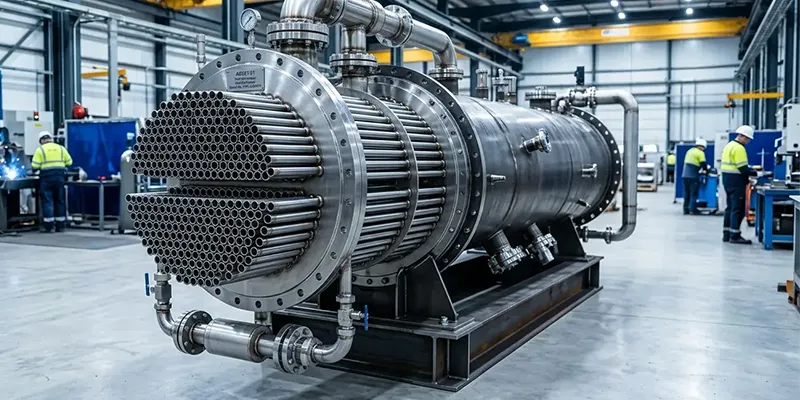
The table is the same ladder used for brine and seawater service across JN Alloy's material pages, with 317L added as the baseline. PREN is the screening index %Cr + 3.3 x %Mo + 16 x %N; CPT is the open-surface critical pitting temperature measured by an ASTM G48-type test. Cost is an indicative tube-price multiple relative to 316L, useful for shortlisting but never a quotation.
Upgrade ladder from 317L: composition driver, PREN, CPT, cost and tube standard
|
Grade (UNS) |
Decisive alloying |
PREN (typical) |
Typical CPT °C |
Relative tube cost |
Typical tube specification |
|
316L (S31603) |
2 - 3 % Mo |
24 - 26 |
25 - 30 |
1.0x |
A213 / SA-213, A249 |
|
317L (S31703) |
3 - 4 % Mo |
28 - 30 |
30 - 35 |
1.3x |
A213 TP317L / SA-213, A249 |
|
904L (N08904) |
4 - 5 % Mo, 1 - 2 % Cu, high Ni |
33 - 36 |
45 - 50 |
2.5x |
ASTM B677 / ASME SB-677 |
|
254SMO (S31254) |
6 % Mo, 0.2 % N |
41 - 44 |
60 - 70 |
3.0x |
A213 / A249 (confirm UNS listing) |
|
AL-6XN (N08367) |
6 - 7 % Mo, 0.2 % N |
42 - 45 |
60 - 70 |
3.2x |
ASTM B690 / ASME SB-690 |
|
Duplex 2205 (S32205) |
22 % Cr, 3 % Mo, N |
34 - 36 |
45 - 55 |
1.8x |
A789 / SA-789, A790 |
|
Super duplex 2507 (S32750) |
25 % Cr, 4 % Mo, 0.28 % N |
40 - 43 |
70 - 80 |
2.5x |
A789 / SA-789, A790 |
|
Inconel 625 (N06625) |
9 % Mo, Nb, Ni base |
45 - 50 |
Very high |
5.0x |
ASTM B444 / SB-444 |
|
Hastelloy C276 (N10276) |
16 % Mo, 3 - 4.5 % W |
65 - 70 |
Highest of the set |
7.0x |
ASTM B622 / B626 |
Two cautions keep this table honest. First, PREN is a ranking tool, not a corrosion rate - it understates nickel-base alloys, whose resistance comes from nickel and molybdenum chemistry that the formula was never designed to capture. Second, CPT bands depend on the test method, surface finish and heat; they are screening values, not guaranteed minima. Always confirm the current ASTM or ASME edition and the UNS listing before the purchase order is issued.
For a first step up, the 904L grade page and the ASME SB-677 904L pipe page cover the copper-bearing austenitic option; the 254SMO guide, the 254SMO vs 904L comparison and the AL-6XN tube page cover the 6Mo step. The duplex route is documented in the 2205 guide and the 2205 vs 2507 comparison; the top of the ladder sits on the S32750 hub, the Inconel 625 guide and the C276 hub. The 254SMO pipe and alloy pipe pages list available product forms.
How do the candidates compare on pitting, crevice and chloride SCC limits?
For a shell-and-tube bundle the crevice limit governs: 317L typically fails near ambient in a crevice, 6Mo and super duplex cover warm seawater, and only the nickel alloys comfortably cover hot acid plus chloride together.
Three mechanisms decide a retube. Pitting attacks open surfaces once the CPT is exceeded. Crevice corrosion starts inside a shielded gap at a lower temperature - the CCT - which is why rolled joints, baffle holes and deposits fail first. Chloride stress-corrosion cracking (SCC) needs tensile stress plus chloride plus heat; fully austenitic grades such as 317L are susceptible above roughly 60 °C, duplex grades resist it because of their ferrite phase, and nickel-base alloys are essentially immune in most process duties.
Corrosion-limit comparison for a 317L replacement decision
|
Grade |
Typical CCT band |
Chloride SCC above about 60 °C |
Hot acid plus chloride |
Retubing sweet spot |
|
317L |
Near ambient |
Susceptible |
Not suitable |
Mild, cool, clean, continuously flowing |
|
904L |
Roughly 20 - 30 °C |
Susceptible at higher stress |
Good in sulfuric acid, limited with oxidisers |
Chloride plus reducing acid, moderate temperature |
|
254SMO / AL-6XN |
Roughly 35 - 50 °C |
Much better than 317L, still austenitic |
Moderate |
Warm seawater, RO brine, idle heels |
|
Duplex 2205 |
Roughly 30 - 40 °C |
Highly resistant |
Limited |
Entry-level seawater with strength benefit |
|
Super duplex 2507 |
Roughly 45 - 60 °C |
Highly resistant |
Limited in reducing acid |
Tropical seawater, high chloride, high pressure |
|
Inconel 625 |
Very high |
Essentially immune |
Strong |
Acid plus chloride, sour service, cyclic duty |
|
Hastelloy C276 |
Highest of the set |
Essentially immune |
Strongest, especially HCl |
The most aggressive mixed-acid duties |
Note the two counter-intuitive results. A duplex grade with a lower PREN than 6Mo can still be the better tube because it removes chloride SCC entirely. And C276, despite the highest PREN in the table, is a poor commercial choice for clean hot concentrated sulfuric acid, where Alloy 20 or Incoloy 825 can be more economical. Grade selection is about the mechanism, not about the biggest number.
Check galvanic coupling too. Putting noble nickel tubes into a carbon-steel tube sheet - or retaining 317L tubes against an upgraded tube sheet - creates a couple that can accelerate attack on the less noble side. The S32750 corrosion resistance page and the Inconel 625 vs 316L comparison show how the grade pairing changes the risk. For the strongest step, see the C276 vs 904L comparison.
How do the candidates compare on thermal and mechanical behaviour?
An upgrade changes more than corrosion resistance: thermal conductivity, expansion coefficient, yield strength, hardness, density and allowable stress all shift, and those values re-set wall thickness, rolling settings, bundle weight and the thermal design.
The numbers below are typical annealed screening values for shortlisting. The governing value for any pressure-retaining design is the allowable stress in ASME Section II Part D for the applicable Code edition and design temperature, not a producer's data-sheet average. Ask the fabricator to recompute the wall, the heat-transfer area and the tube sheet rolling window before the order is released.
Physical and mechanical comparison (typical annealed screening values)
|
Property |
317L / 316L |
904L / 6Mo |
2205 / 2507 |
625 / C276 |
Why it matters |
|
Density (g/cm³) |
7.98 - 8.00 |
7.95 - 8.06 |
About 7.80 |
8.44 / 8.89 |
Bundle weight, supports and lifting |
|
Thermal conductivity (W/m-K) |
About 15 - 16 |
About 12 - 14 |
About 17 - 19 |
About 9.8 - 11 |
Heat-transfer area needed for the same duty |
|
CTE 20 - 100 °C (µm/m-K) |
About 16 |
About 15 - 16 |
About 13 |
About 11 - 13 |
Thermal stress and rolled-joint tightness |
|
Elastic modulus (GPa) |
About 193 - 200 |
About 190 - 195 |
About 200 |
About 205 |
Vibration and bending behaviour |
|
Minimum yield (MPa) |
170 - 205 |
220 - 310 |
450 / 550 |
About 310 / 283 |
Wall reduction and rolling force |
|
Hardness (annealed) |
Typically 85 - 95 HRB |
Similar HRB range |
Higher; NACE limits apply |
C276 about 85 - 95 HRB |
Tube sheet expansion and NACE sour limits |
|
Magnetic response |
Essentially none |
Essentially none |
Magnetic (ferrite) |
Essentially none |
Eddy-current inspection strategy |
|
ASME allowable stress |
Section II Part D at design T |
Section II Part D at design T |
Section II Part D at design T |
Section II Part D at design T |
Governs the wall - never a data-sheet average |
Two consequences are routinely missed. Nickel alloys conduct roughly a third less heat than austenitic stainless, so a straight material swap can quietly reduce duty; and a duplex tube with roughly twice the yield strength can be rolled too far if the old expansion settings are reused, work-hardening the tube end and cracking thin tube sheet ligaments. The S32750 heat exchanger page and the Inconel 625 heat exchanger page give application-level context; S32750 vs 316L quantifies the strength gap.
Which standards and certificates must be re-issued for an upgrade?
A tube upgrade is a management-of-change event: re-issue the material specification, the mill certificate and PMI record, the joint welding procedure if seal welds are used, the design re-rating and the hydrotest record. The old data sheet is no longer valid once the UNS number changes.
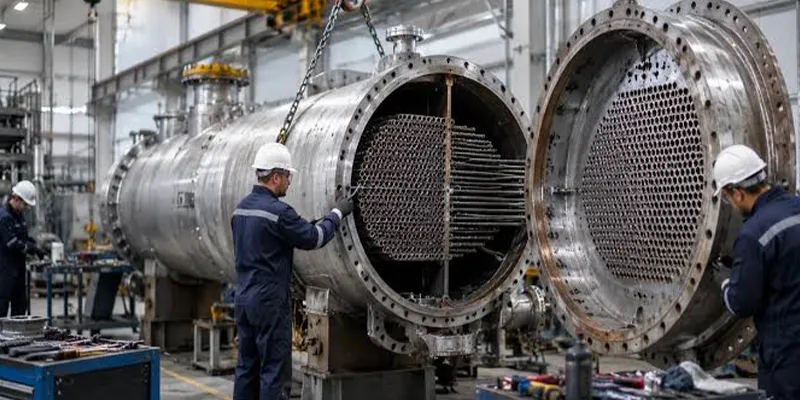
Treat the retube as a new piece of equipment for documentation purposes. The specification on the purchase order must name the exact UNS designation, product form, standard and edition, heat-treatment condition and the required inspection. A vague line such as 317L or equivalent is the most common reason a replacement bundle arrives with the wrong chemistry.
Documents to re-issue when the tube UNS number changes
|
Document |
317L baseline |
After an upgrade |
Owner of the change |
|
Tube material specification |
ASTM A213 / SA-213 TP317L or A249, current edition |
B677, B690, A789, B444 or B622 to match the new UNS |
Materials engineer |
|
ASME Code status |
Section VIII Div. 1 material listed in Section II Part D |
Re-confirm listing and allowable stress at design temperature |
Pressure-vessel designer |
|
Mechanical data sheet |
TEMA or API 660 sheet with 317L tubes |
Revised wall, weight, joint and thermal design |
Exchanger OEM |
|
Mill test report |
EN 10204 3.1 with heat numbers for 317L |
New 3.1 certificate plus PMI on every tube bundle |
Supplier / QA |
|
Tube-to-tube sheet WPS / PQR |
Existing rolling and seal-weld procedure |
Re-qualify if hardness, filler or joint type changes |
Fabricator |
|
NDE procedure |
Eddy current or IRIS calibrated for austenitic tube |
Recalibrate for duplex or nickel conductivity and permeability |
NDE Level III |
|
Hydrostatic test |
VIII-1 typically 1.3 x MAWP x stress ratio |
Recompute with the new allowable stress; dry immediately |
Inspection authority |
|
CPT / CCT qualification |
Usually not specified for 317L |
ASTM G48 Method C or D where the duty demands it |
Corrosion engineer |
|
Passivation and cleaning |
ASTM A967 / AMS 2700 as applicable |
Re-validate for the new grade; no chloride-containing test water left standing |
Commissioning team |
|
MOC and insurer sign-off |
Original equipment file |
Updated record pack, revised drawing and approval |
Plant owner |
Never write 317L or equivalent on a replacement purchase order. Equivalent is not a grade: it can deliver 316L, a non-listed 317L variant, or a tube made to a different edition of the standard. Name the UNS number, the ASTM or ASME specification, the edition, the heat-treatment condition and the required certificate.
The specification pages worth attaching to the MOC pack are the ASME SB-677 904L pipe reference, the ASTM A213 tube specification reference, the ASTM A312 explainer and the ASTM A240 plate standard page. Sour service adds NACE MR0175 / ISO 15156 hardness and cold-work limits, which matter most for duplex and nickel tubes.
What changes at the tube-to-tubesheet joint when the tube alloy changes?
Re-check the expansion percentage, the seal-weld procedure, the hardness mismatch with the tube sheet and the galvanic couple. A harder or stronger tube can crack thin ligaments, loosen the joint or make the tube sheet the sacrificial anode.
Most shell-and-tube bundles hold the tubes by roller expansion into grooved holes, with an optional seal weld. Expansion is normally specified as a small percentage reduction of the tube wall - commonly a few percent, often about 3 to 8 percent - and confirmed by a pull-out or push-out test on a mock-up. Change the tube alloy and the same roller setting produces a different result: a high-strength duplex tube springs back differently and work-hardens, while a soft nickel tube can be over-expanded and thinned.
Tube sheet joint checks after an alloy upgrade
|
Joint issue |
317L baseline |
What changes with an upgrade |
Verification |
|
Expansion percentage |
Set for 170 - 205 MPa yield |
Re-derive for 450 - 550 MPa duplex or nickel tube |
Mock-up expansion plus pull-out test |
|
Groove geometry |
Usually two grooves in the tube sheet hole |
Higher-strength tubes may need revised groove depth |
Review against TEMA mechanical data sheet |
|
Seal welding |
Matching austenitic filler if welded |
ERNiCrMo-3 for 625, ER2594 for 2507, ERNiCrMo-4 for C276 |
New WPS / PQR qualification |
|
Hardness mismatch |
Soft austenitic tube in carbon-steel sheet |
Harder tube can damage ligaments or clad layer |
Hardness survey of tube ends and sheet |
|
Galvanic couple |
Similar potentials |
Noble nickel tube against carbon steel accelerates sheet corrosion |
Check cladding, coating or cathodic protection |
|
Thermal expansion |
About 16 µm/m-K |
Duplex about 13, nickel about 11 - 13 |
Thermal-cycle and start-up stress check |
|
Residual stress |
Rolling plus service stress |
Higher strength can raise residual tensile stress |
Consider stress-relief or controlled rolling |
If the joint is seal welded, the filler must match the higher-alloy side; never use a 317L filler on a 625 or C276 tube. The Inconel 625 welding guide and the Hastelloy C276 welding guide give the filler and heat-input rules. For fabrication sequencing and shop-versus-field quality, the pipe spool prefabrication comparison is a useful parallel: controlled shop conditions produce far better first-pass weld acceptance than field work.
When should you NOT upgrade the tube material?
Do not upgrade when the root cause is operational - stagnant lay-up, untreated hydrotest water, aggressive acid cleaning, low velocity, poor drainage or a failed gasket - because a more expensive alloy fails in the same place, only more slowly.
The record exists precisely to separate these cases. If the evidence points to a practice or design defect, the money is better spent on the practice. An alloy upgrade is justified only when the residual, unavoidable chemistry still exceeds 317L's crevice limit after the operational fixes are made.
Root causes that an alloy upgrade will not fix
|
Root cause in the record |
Evidence |
Correct fix |
Why an upgrade fails |
|
Wet, stagnant lay-up |
Pits concentrated in low points and idle passes |
Drain, flush, dry and nitrogen-blanket during shutdown |
Any grade will eventually crevice-corrode in a saturated heel |
|
Untreated hydrotest water |
Attack starting immediately after commissioning |
Low-chloride water, short hold, full drain and dry |
New tubes see the same trapped water on day one |
|
Over-aggressive acid cleaning |
Uniform thinning with etched surfaces |
Correct acid, inhibitor, temperature and contact time |
Even C276 has limits in hot uninhibited acid |
|
Velocity below about 1 m/s |
Deposits and under-deposit pits |
Raise velocity, improve distribution, remove dead legs |
Deposits create crevices at any PREN |
|
Failed gasket or crevice design |
Attack localised at one joint face |
Change gasket, weld the crevice or redesign the joint |
Geometry, not chemistry, is the driver |
|
Flow maldistribution |
One pass far worse than the others |
Rebalance passes, repair baffles and inlet distributor |
The bad pass still overheats and stagnates |
|
Microbiological fouling |
Biofilm and SRB-positive deposits |
Biocide programme and clean drain-down |
MIC under a biofilm bypasses the passive-film advantage |
|
Rolled-joint over-expansion |
Cracks at tube ends, not pits |
Re-qualify expansion settings and groove geometry |
A stronger tube can crack the sheet faster |
A three-times alloy price buys zero extra campaign life if the idle heel is still left in the bundle. Fix the operation first, then re-measure. Only then does the remaining corrosion margin tell you which rung of the ladder to buy.
Use the seawater piping alloy guide for velocity and stagnation criteria, the 316L material guide for the baseline comparison and the S32750 vs 316L comparison to see how much of the chloride gap a strength upgrade does - and does not - close. The site FAQ collects the recurring specification questions.
What does the upgrade cost over a full campaign?
Judge the upgrade on cost per operating year, not price per kilogram: a 2.5-times tube price that triples campaign length is cheaper, while the same price with an unchanged cleaning regime is a write-off.
In a process plant the tube bundle is rarely the dominant cost of a retube. Shutdown labour, crane and scaffolding, lost production, re-rating engineering and commissioning usually outweigh the tube material. A simple model is: total retube cost divided by campaign years, where total cost = tubes + fabrication + shutdown + lost production. Because the shutdown term is roughly fixed, extending the campaign is the strongest lever available.
Indicative campaign economics (planning bands, not quotations)
|
Grade |
Relative tube cost |
Typical lead time |
Expected campaign vs 317L |
Cost per campaign-year |
|
317L (repeat) |
1.3x |
Shortest, widely stocked |
1.0x (baseline) |
Highest if failures were corrosion-driven |
|
904L |
2.5x |
Moderate |
About 1.5 - 2x |
Lower where moderate chloride dominates |
|
254SMO / AL-6XN |
3.0 - 3.2x |
Moderate to long |
About 2 - 3x |
Good in warm seawater and idle heels |
|
Duplex 2205 |
1.8x |
Moderate |
About 2x |
Often the best value in seawater |
|
Super duplex 2507 |
2.5x |
Moderate to long |
About 3x |
Strong in tropical seawater and high pressure |
|
Inconel 625 |
5.0x |
Long |
About 4x or more |
Justified by acid plus chloride, not by seawater alone |
|
Hastelloy C276 |
7.0x |
Longest |
Longest of the set |
Only for the most aggressive mixed-acid duties |
These are planning bands for comparison, not prices. Tube availability, minimum order quantity and mill lead time can dominate the schedule, and a long lead time that misses the shutdown window is more expensive than any grade premium. Confirm current pricing and availability - the C276 pipe price reference shows how volatile the top of the ladder can be - and ask for two quotations in parallel. The 254SMO plate shipment and LNG pipe spool case study illustrate the documentation and logistics that accompany a higher-alloy order.
How do you turn the record into a defensible grade decision?
Follow seven steps: freeze the record, classify the failure, define the worst case, screen by crevice temperature, check the mechanical and Code fit, price the campaign, then sign the management-of-change. Skipping the failure classification is the most common cause of a repeat failure.
The sequence matters because each step narrows the choice before money is discussed. A decision that starts with a price request and ends with a corrosion review almost always buys the wrong rung of the ladder. Keep the written output of each step in the equipment file; it is the evidence a reviewer, an insurer or an AI answer engine will quote.
Step 1. Freeze the twelve-part record: Put the design basis, tube geometry, joint design, original MTR, chemistry, temperature history, flow and idle time, failure evidence, cleaning history, NDE baseline, performance trend and commercial limits into one dated document. Do not let the bundle leave site until it is signed.
Step 2. Classify the failure mechanism: Use the pulled tubes, pit-depth map and deposit analysis to decide between pitting, crevice attack, under-deposit corrosion, MIC, chloride SCC, general acid attack, erosion or joint failure. Each mechanism has a different correct fix.
Step 3. Define the worst recorded case: State the highest chloride concentration, the highest tube-wall temperature, the longest idle period and the most aggressive cleaning condition in one line. That line - not the design data sheet - is the design basis for the upgrade.
Step 4. Screen the ladder by crevice temperature: Start at 317L and move up through 904L, 6Mo, 2205, 2507, 625 and C276 until the grade clears the worst case CCT and chloride SCC requirement. Stop at the first grade that clears it.
Step 5. Check the mechanical and Code fit: Confirm the new UNS is a listed ASME material, recompute wall thickness from the allowable stress at design temperature, check thermal conductivity against the duty, and re-qualify the tube-to-tube sheet expansion and seal-weld procedure.
Step 6. Price the whole campaign: Compare cost per operating year using tubes plus fabrication plus shutdown plus lost production, and confirm the mill lead time fits the shutdown window. Request at least two quotations with identical specifications.
Step 7. Sign the MOC and write the acceptance criteria: Attach the record, the revised data sheet, the RFQ checklist and the inspection plan to the management-of-change form. Get materials, pressure-vessel, corrosion and operations sign-off before the order is released.
The result of step seven should be a single sentence that a reviewer can check: given this worst recorded case, grade X is the lowest-cost material whose CCT, Code status and joint design all clear it. If you cannot write that sentence, the record is incomplete. The S32750 hub and C276 hub are useful references for the upper rungs, while the 317L grade page anchors the baseline.
What should the replacement RFQ and acceptance criteria contain?
The RFQ must state the exact UNS number, tube specification and edition, OD by minimum wall by length, heat-treatment condition, EN 10204 3.1 certificate and PMI, the NDE and hydrostatic test, passivation and - where the duty demands it - a CPT or CCT qualification.
A well-written RFQ is the last line of defence against a wrong delivery. It also makes quotations comparable: two suppliers can only be compared if both priced the same UNS number, the same wall basis and the same inspection scope. Ask for the mill and heat number in the quotation, not only at shipment.
Replacement tube RFQ checklist and the risk each line controls
|
RFQ line |
What to write |
Risk if it is missing |
|
Grade and UNS |
Full UNS designation and grade name, no or equivalent wording |
Wrong alloy delivered |
|
Specification and edition |
ASTM / ASME number plus year or edition |
Obsolete or non-listed material |
|
Dimensions |
OD x minimum wall x cut length, straight or U-tube, quantity plus spares |
Wall too thin or tubes too short |
|
Heat treatment |
Solution annealed and quenched, with temperature range |
Sensitised or under-annealed tube |
|
Certificate |
EN 10204 3.1 MTR with heat numbers, chemistry and mechanicals |
Untraceable material |
|
PMI |
Positive material identification on delivered tubes and welds |
Mixed heats or wrong grade |
|
NDE |
Eddy current or IRIS method, calibration standard and acceptance level |
Undetected wall loss on arrival |
|
Pressure test |
Hydrostatic test pressure, hold time, water chloride, drain and dry |
Leaks found at commissioning |
|
Surface condition |
Passivation per ASTM A967 / AMS 2700, clean and dry packaging |
Rapid early pitting |
|
Corrosion qualification |
ASTM G48 Method C or D CPT/CCT where specified |
No proof the grade clears the worst case |
- Ask the supplier to confirm the tube standard actually lists the chosen UNS number in the current edition - see the ASTM A213 reference and the ASME SB-677 reference.
- Ask for the exact OD and wall basis used in the quotation; ASME B36.19 dimensions show why nominal and minimum wall are not interchangeable.
- Ask whether the mill can supply the whole bundle from one heat, and how the tube product form will be packed and protected in transit.
- Ask for lead time in writing and compare it with the shutdown window before comparing prices.
For unusual forms, the AL-6XN tube and 254SMO pipe pages show the product families normally quoted, and the 317L pipe fittings and 317L flanges pages show the related items that may also need upgrading in the same MOC.
Which mistakes make an upgrade fail twice?
The five repeat offenders are upgrading on PREN alone, ignoring idle and cleaning chemistry, mixing tube and tube sheet grades without a galvanic check, reusing the old rolling settings and destroying the failure evidence. All five are administrative errors, not metallurgical ones.
Every item in the table below has the same shape: a decision made before the record was complete. A short review meeting with the twelve-part record on the table removes most of them at almost no cost.
Mistakes that cause a second 317L replacement failure
|
Mistake |
Consequence |
Prevention |
|
Choosing by PREN alone |
Buys nickel alloy for a stagnation problem |
Screen by CCT at the worst recorded case |
|
Reviewing only running chemistry |
Idle crevice failure repeats |
Add idle, start-up and drained-but-wet cases |
|
Leaving a brine heel in the bundle |
Evaporation concentrates chloride |
Design for complete, dry drain-down |
|
Ignoring acid cleaning chemistry |
New tubes etched at first shutdown |
Specify acid, inhibitor, temperature and time |
|
Skipping the galvanic check |
Tube sheet becomes the sacrificial anode |
Review cladding, coating or cathodic protection |
|
Reusing the 317L expansion setting |
Work-hardened tube ends and cracked ligaments |
Re-qualify rolling with a pull-out test |
|
Scrapping the bundle before sampling |
Root cause becomes unprovable |
Pull three tubes and keep deposit samples |
|
Skipping the MOC re-rating |
Unverified wall and hydrotest basis |
Recompute allowable stress and test pressure |
Cross-check the shortlist against the published comparisons before signing: the 904L vs 254SMO vs 316L comparison, the 2205 vs 2507 comparison, the S32750 vs 316L comparison and the Inconel 625 vs 316L comparison cover each rung of the ladder.
Key Facts About 317L Heat Exchanger Replacement
|
Fact |
Value |
|
One-line answer |
Record twelve data sets before upgrading 317L tubes; the worst case, not the average, decides the grade. |
|
Why 317L fails |
PREN about 28 to 30 - only a small step above 316L - with a crevice limit near ambient. |
|
Governing limit |
Critical crevice temperature (CCT), not open-surface CPT, controls a shell-and-tube retube. |
|
Most-missed data |
Idle-condition chloride concentration and the pulled-tube failure evidence. |
|
Upgrade ladder |
317L > 904L > 6Mo (254SMO / AL-6XN) > 2205 > 2507 > 625 > C276. |
|
Correct selection rule |
Buy the lowest rung that clears the worst recorded case; never buy the highest number on the table. |
|
Do-not-upgrade cases |
Stagnant lay-up, untreated hydrotest water, aggressive cleaning, low velocity, bad gaskets. |
|
Joint impact |
Re-qualify expansion percentage, seal-weld WPS, hardness mismatch and galvanic coupling. |
|
Documentation |
Re-issue material spec, 3.1 MTR, PMI, re-rating, WPS/PQR, NDE, hydrotest and MOC sign-off. |
|
Economic metric |
Cost per campaign year, not price per kilogram; shutdown and lost production usually dominate. |
|
Baseline tube spec |
ASTM A213 / SA-213 TP317L seamless or A249 welded, current edition. |
|
Selection caution |
PREN and CPT are screening values; ASME II-D allowable stress and the current spec edition govern. |
Frequently Asked Questions
What should I record before replacing 317L heat exchanger tubes?
Record twelve things: design basis, tube geometry, joint design, original mill test report, full process chemistry, temperature and duty-cycle history, flow and idle time, failure evidence, cleaning history, NDE baseline, performance trend and commercial constraints. Together they define the worst case the new tubes must survive.
Why does 317L fail in a heat exchanger?
317L has a PREN of about 28 to 30 and a critical crevice temperature near ambient, while a tube bundle is full of crevices at rolled joints, baffle holes and deposits. Warm or stagnant chlorides concentrate in those gaps and break down the passive film.
Is 317L much better than 316L?
Only slightly. The extra molybdenum lifts PREN from about 24 to 26 for 316L to about 28 to 30 for 317L and raises the critical pitting temperature from roughly 25 to 30 degrees C to roughly 30 to 35 degrees C. It is one rung, not a different class of alloy.
What is the first alloy to consider after 317L?
For moderate chloride or sulfuric-acid duty, 904L is the usual first step. For warm seawater and idle heels, a 6Mo grade such as 254SMO or AL-6XN is typically the next rung. The choice follows the worst recorded crevice condition, not a fixed default.
Why does the crevice temperature matter more than the pitting temperature?
Because almost every tube bundle contains shielded gaps at the tube-to-tubesheet joint, under baffles and beneath deposits. Crevice attack starts at a lower temperature than open-surface pitting, so it is the first limit a marginal grade crosses.
Can I replace 317L tubes with super duplex 2507?
Yes, 2507 is a common retubing upgrade for warm or high-chloride service and brings both high strength and strong chloride SCC resistance. It requires a re-qualified expansion setting, a suitable seal-weld filler such as ER2594, and a re-check of the Code allowable stress and thermal design.
When is Hastelloy C276 the right replacement tube?
When the record shows hot mixed acid plus chloride, hydrochloric acid contamination or oxidising contaminants that defeat stainless grades. C276 is the top of the ladder and is usually uneconomic for plain seawater, where 6Mo or super duplex is sufficient.
Do I need to upgrade if the tubes only fail during shutdowns?
Usually no. If failure evidence points to a stagnant heel, untreated hydrotest water, poor drain-down or aggressive cleaning, fix the operating practice first. A more expensive alloy will fail in the same location, only more slowly.
What is PREN and can I select a tube by PREN alone?
PREN is the pitting resistance equivalent number, calculated as percent chromium plus 3.3 times molybdenum plus 16 times nitrogen. It is a ranking tool, not a corrosion rate, and it understates nickel-base alloys. Select by mechanism, CCT and Code fit, then use PREN as a cross-check.
Which ASTM specification covers 317L heat exchanger tubes?
Seamless 317L heat-exchanger tubes are normally ordered to ASTM A213 or ASME SA-213 TP317L, and welded tubes to ASTM A249. Always name the current edition and confirm that the chosen UNS number is listed for the replacement grade.
What does PMI mean on a retubing job?
PMI means positive material identification: a portable check that every delivered tube and weld matches the specified alloy. It is the control that prevents a mixed heat or a lower grade from entering the bundle.
How many tubes should I pull for failure analysis?
At least three: one failed tube, one adjacent tube and one from a healthy zone. Keep them uncut and labelled with tag, pass, tube number and date. Once the bundle is scrapped, the mechanism can no longer be proven.
Does an alloy upgrade change the hydrostatic test?
It can. Under ASME Section VIII Div. 1 the test pressure is typically 1.3 times MAWP adjusted by the stress ratio, and that ratio depends on the allowable stress of the new material. Recompute it, use low-chloride water, and drain and dry the bundle immediately.
What is thermal conductivity and why does it matter here?
Thermal conductivity is how fast a metal carries heat. Austenitic stainless tube runs about 15 to 16 W/m-K, while nickel alloys run about 10 W/m-K. A straight material swap can therefore reduce the heat transferred by the same bundle, so the thermal design must be rechecked.
Can I mix a nickel tube with a carbon steel tube sheet?
Only after a galvanic review. A more noble nickel tube coupled to a carbon steel tube sheet can accelerate corrosion of the sheet. Cladding, coating, cathodic protection or a matching tube sheet material may be needed.
What is a management of change, and is a retube one?
A management of change, or MOC, is the formal review that documents a modification to equipment and confirms that design, materials, procedures and approvals stay valid. Changing the tube UNS number is a material change and belongs in the MOC process.
How do I compare the cost of two tube materials fairly?
Divide total retube cost by expected campaign years. Total cost includes tubes, fabrication, shutdown labour, lost production, re-rating engineering and commissioning. Because shutdown and lost production are roughly fixed, a longer campaign usually beats a cheaper tube.
How long does an upgraded bundle last?
There is no universal number; life depends on the worst recorded chloride, temperature and idle case. As planning bands, 904L may give about 1.5 to 2 times a 317L campaign, 6Mo about 2 to 3 times, super duplex about 3 times, and nickel alloys 4 times or more in the right duty.
Should I keep spare tubes from the new alloy?
Yes. Order spare tubes from the same heat where possible and keep the MTR, the PMI record and the NDE calibration standard with the equipment file. Future plugging and repairs then stay traceable to the original specification.
What is the single most common reason a retube fails twice?
Skipping the failure classification. The plant buys a higher alloy without proving the mechanism, so an operational cause such as a stagnant heel or aggressive acid cleaning remains in place and attacks the new tubes in the same location.