Stainless steel wire mesh is a precision-engineered metal fabric used across industries - from petrochemical refining to pharmaceutical filtration, from architectural facades to food processing screens. Yet selecting the right specification is far from straightforward. Three interlocking parameters - weave type, wire diameter, and opening size (aperture) - determine whether your mesh performs reliably or fails prematurely. This guide cuts through the complexity with direct conclusions backed by engineering rationale, enabling confident specification decisions.

Why Does Mesh Specification Matter?
Specifying only mesh count without wire diameter and weave type leads to performance failures - wrong filtration accuracy, insufficient strength, or premature corrosion - that cost 3–5x more in replacement than proper initial selection.
A mesh count of "100 mesh" tells you nothing definitive. Two suppliers can both deliver "100 mesh" with different wire diameters, producing openings of 0.10 mm or 0.15 mm - a 50% difference that completely changes which particles pass through. Similarly, a plain weave 100 mesh and a Dutch weave 100 mesh have fundamentally different filtration behaviors. The wrong combination of weave, wire, and aperture causes:
Filtration failures: Particles that should be captured pass through, contaminating downstream processes.
Structural failures: Thin wire in high-pressure service ruptures, causing unplanned shutdowns.
Corrosion failures: Grade 304 in chloride environments pits within months, where 316 would last years.
These failures are avoidable. Understanding the three-parameter system - weave type, wire diameter, aperture - gives you complete specification control.
What Is Stainless Steel Wire Mesh?
Stainless steel wire mesh is a woven metal fabric where warp (lengthwise) and weft (crosswise) wires interlace to form a grid with defined openings - the weave pattern, wire diameter, and spacing together control filtration precision, mechanical strength, and flow capacity.
Unlike perforated sheet or expanded metal, woven wire mesh is produced by interlacing individual wires on specialized looms. This weaving process creates precisely defined openings whose size, shape, and distribution can be controlled down to micron levels. The key advantage over other screening media:
- Precision: Openings are individually formed by wire placement, enabling consistent aperture control from 10 mm down to 5 microns.
- Strength: Woven interlocking provides inherent structural integrity - wires hold each other in position under load.
- Flexibility: Mesh can be rolled, formed into cylinders, pleated, or welded into filter elements - rigid screens cannot.
- Corrosion resistance: Austenitic stainless steels (304, 316, 316L) resist rust, chemicals, and high temperatures by design.
Which Weave Type Should You Choose?
Plain weave is the universal default for balanced performance; twill weave for heavier wire at finer mesh; Dutch weave (plain/twill/reverse) for micron-level filtration under pressure; five-heddle weave for smooth surfaces and anti-clogging in continuous processes.
Plain Weave (1-over-1-under): Each warp wire passes alternately over and under each weft wire, producing uniform square openings with equal wire diameters in both directions. It is the most economical weave, suitable for 90% of general screening and filtration applications. Typical range: 1–400 mesh, openings from 10 mm to 0.037 mm. Open area generally 30–70%.
Twill Weave (2-over-2-under): Each wire passes over two and under two successive wires, creating a diagonal pattern. This allows heavier wires at the same mesh count, yielding stronger mesh with tighter weave. Twill weave excels when you need finer filtration with adequate mechanical durability. Typical range: 20–500 mesh. Open area 25–45%.
Plain Dutch Weave: Thicker warp wires + finer, closely-spaced weft wires woven in a plain (1-over-1) pattern. The weft wires pack densely, creating triangular openings that taper from the surface inward. This produces micron-level filtration (5–100 microns) with high mechanical strength. Open area is low (15–30%), but filtration precision is exceptional.
Twill Dutch Weave: Combines twill interlacing (2-over-2) with differential wire diameters (thick warp, fine weft). Even tighter and smoother than plain Dutch, achieving filtration down to 1–5 microns. Used in hydraulic systems, chemical processing, and high-pressure gas filtration where absolute particle retention is required.
Reverse Dutch Weave: Fine warp wires + coarse weft wires - opposite of standard Dutch. This produces high mechanical strength in the weft direction and allows backwashing (flow reversal for cleaning). Ideal for pressure filter elements where flow direction reverses during cleaning cycles. Filtration range: 20–50 microns.
Five-Heddle Weave: Each warp wire passes over four and under one weft wire, creating a flat, smooth surface with large open area and minimal clogging tendency. Used in process belts, continuous filtration, and applications requiring easy cleaning. Mesh counts: 12–80. Open area: 40–60%.
|
Weave |
Pattern |
Mesh Range |
Filtration (μm) |
Open Area (%) |
Strength |
Best For |
|
Plain |
1-over-1 |
1–400 |
37–10,000 |
30–70% |
Moderate |
General screening |
|
Twill |
2-over-2 |
20–500 |
20–500 |
25–45% |
High |
Fine filtration |
|
Plain Dutch |
1-over-1, diff. dia. |
N/A* |
5–100 |
15–30% |
Very High |
Micron filtration |
|
Twill Dutch |
2-over-2, diff. dia. |
N/A* |
1–5 |
10–25% |
Very High |
Absolute filtration |
|
Reverse Dutch |
Diff. dia., reversed |
N/A* |
20–50 |
20–35% |
High (weft) |
Pressure filters |
|
Five-Heddle |
4-over-1 |
12–80 |
50–1,000 |
40–60% |
Moderate–High |
Process belts |
*Dutch weave meshes are specified by micron rating rather than mesh count, because warp and weft have different wire counts per inch.
How Does Wire Diameter Determine Mesh Performance?
Wire diameter creates a direct trade-off: thicker wire increases mechanical strength and service life but reduces open area and throughput; thinner wire maximizes open area and flow capacity but sacrifices durability - the correct choice depends on whether load-bearing or flow-through is your primary constraint.
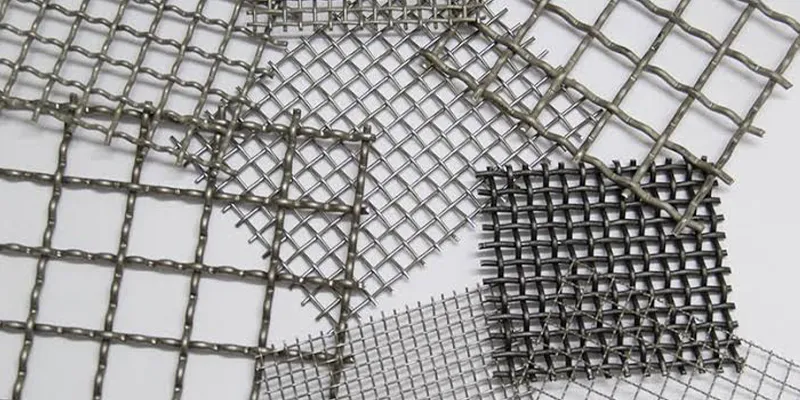
Wire diameter is the cross-sectional thickness of individual wires before weaving. It is measured in millimeters (mm) or inches, and typically ranges from 0.02 mm (ultra-fine Dutch weave) to 3.0 mm (heavy industrial screening).
The Strength–Open Area Trade-Off
For a given mesh count, wire diameter is the single variable that simultaneously controls two opposing outcomes:
Increasing wire diameter: Raises tensile strength, resists abrasive wear, extends service life under vibration or impact - but shrinks opening size and open area, reducing throughput capacity.
Decreasing wire diameter: Expands opening size and open area, increasing flow capacity and filtration speed - but weakens the mesh, making it prone to wire breakage, deformation, and shorter replacement intervals.
Practical Example: Same Mesh Count, Different Wire
Consider 30 mesh (30 openings per inch) with two wire options:
|
Parameter |
0.25 mm Wire |
0.40 mm Wire |
Difference |
|
Opening Size |
0.60 mm |
0.45 mm |
25% smaller |
|
Open Area |
54.5% |
35.4% |
19% less |
|
Wire Strength |
Moderate |
High |
2.56x cross-section |
|
Best Application |
Liquid filtration, high flow |
Abrasive screening, load-bearing |
- |
The 0.40 mm wire option has 2.56 times the cross-sectional area (strength scales roughly with area), but sacrifices 19% of open area. For abrasive mineral screening under vibration, the thicker wire is essential. For high-flow liquid filtration with non-abrasive particles, the thinner wire maximizes throughput.
Wire Diameter Selection by Application
Ultra-fine (0.02–0.10 mm): Precision filtration in electronics, pharmaceuticals, laboratories. Dutch weave only - plain/twill cannot weave wire this thin reliably.
Fine (0.10–0.25 mm): Fine particle sieving, chemical filtration, food processing. Plain/twill weave, 60–200 mesh.
Medium (0.25–0.60 mm): General industrial screening, water treatment, architectural panels. Plain/twill weave, 20–60 mesh.
Heavy (0.60–1.40 mm): Abrasive mineral screening, coal processing, security fencing. Twill or crimped weave, 4–16 mesh.
Ultra-heavy (1.40–3.00 mm): Structural reinforcement, heavy aggregate scalping, industrial guards. Welded or crimped mesh preferred.
Why Is Opening Size (Aperture) the Critical Parameter?
Opening size - not mesh count - is the parameter that directly controls which particles pass and which are retained; specifying aperture instead of mesh count eliminates the ambiguity caused by variable wire diameters.
The aperture (opening size) is the clear space between two adjacent parallel wires. It is what actually determines separation performance. Yet many specifiers use mesh count as a proxy for opening size, which is a fundamental error because:
The Aperture Formula
Aperture (mm) = 25.4 / Mesh Count − Wire Diameter (mm)
This formula reveals the dependency: opening size depends on BOTH mesh count and wire diameter. Change either value, and the aperture changes.
Examples:
100 mesh × 0.10 mm wire = 0.154 mm opening (154 microns)
100 mesh × 0.065 mm wire = 0.189 mm opening (189 microns)
The 22% aperture difference (154 vs 189 microns) completely changes which particles are captured.
Aperture vs. Mesh Count: Which to Specify?
Always specify aperture (in mm or microns) as your primary parameter, with mesh count and wire diameter as supporting specifications. Reasons:
Aperture is functional: It directly describes the separation cutoff - what passes and what is retained.
Mesh count is structural: It describes the weave density - how many wires per inch - which affects strength but not directly filtration.
Wire diameter is mechanical: It determines load-bearing capacity and service life, not filtration accuracy.
How Does Open Area Percentage Affect System Performance?
Open area percentage controls throughput capacity and pressure drop - higher open area means greater flow rate and lower pressure loss, but requires thinner wire that sacrifices mechanical durability; the optimum lies at the intersection of your flow requirement and your strength requirement.
Open Area Formula (square mesh): OA% = (Opening / (Opening + Wire Diameter))^2 × 100
This formula shows that open area is maximized when wire diameter is minimized relative to opening size. For a given mesh count, choosing thinner wire increases both opening size AND open area simultaneously. But the trade-off is wire strength.
Open Area Impact on System Performance
Flow rate: Throughput scales approximately with open area. A mesh with 50% open area passes roughly twice the volume of a 25% open area mesh at the same pressure.
Pressure drop: Lower open area = higher resistance = greater pressure loss across the mesh. In closed-loop filtration systems, excessive pressure drop increases pump energy consumption and can cause cavitation.
Blinding tendency: Lower open area meshes blind (clog) faster because particles have fewer paths through the surface. This is especially critical with sticky or fibrous materials.
Cleaning frequency: Higher open area meshes require less frequent cleaning and backwashing, reducing maintenance downtime.
Open Area Reference by Mesh Count and Wire Diameter
|
Mesh |
Wire (mm) |
Opening (mm) |
Opening (μm) |
Open Area (%) |
Weave |
Typical Use |
|
20 |
0.40 |
0.87 |
870 |
36% |
Plain |
Coarse screening |
|
40 |
0.25 |
0.385 |
385 |
36% |
Plain |
General filtration |
|
60 |
0.19 |
0.223 |
223 |
35% |
Plain |
Liquid filtration |
|
80 |
0.14 |
0.175 |
175 |
32% |
Plain |
Fine filtration |
|
100 |
0.10 |
0.154 |
154 |
30% |
Plain |
Precision sieving |
|
150 |
0.065 |
0.103 |
103 |
30% |
Twill |
Fine powder |
|
200 |
0.05 |
0.077 |
77 |
29% |
Twill |
Micro-sieving |
|
300×D |
var. |
~0.05 |
~50 |
28% |
Dutch |
Micron filtration |
|
400×D |
var. |
~0.038 |
~38 |
27% |
Dutch |
Ultra-fine filtration |
How Do Mesh Count, Wire Diameter, and Opening Size Interlock?
Mesh count, wire diameter, and opening size form a rigid three-parameter system - you can freely choose any two, but the third is then mathematically determined; understanding this constraint prevents impossible specifications that no manufacturer can produce.
The interlocking relationship is expressed through two fundamental formulas:
Formula 1: Aperture from Mesh Count and Wire Diameter
W = 25.4 / M − d
Where W = opening (mm), M = mesh count (openings per inch), d = wire diameter (mm). This formula shows: if you increase mesh count OR wire diameter, the opening shrinks. If you specify a fine opening AND a heavy wire, you need a very high mesh count - which may exceed weaving capability.
Formula 2: Open Area from Opening and Wire Diameter
OA% = (W / (W + d))^2 × 100
Where OA% = open area percentage, W = opening (mm), d = wire diameter (mm). This shows: open area improves as wire diameter decreases relative to opening. A thin wire at a large opening gives high open area; a thick wire at a small opening gives very low open area.
Practical Constraint: Minimum Wire-to-Opening Ratio
Manufacturing limits impose a minimum wire diameter relative to mesh count. If the wire is too thin for the mesh count, the weaving process cannot reliably position wires, and the mesh loses structural integrity. General guidelines:
Plain weave: Wire diameter should be ≥ 15% of the pitch (opening + wire diameter) for stable weaving.
Twill weave: Allows heavier wire - up to 30% of pitch - because the 2-over-2 pattern provides better wire stability.
Dutch weave: Uses differential diameters by design - warp wire is typically 2–5x the weft wire diameter, enabling micron-level openings with adequate structural strength.
Common Impossible Specifications
The following combinations cannot be woven because the wire is too thin for the mesh count:
|
Requested Spec |
Calculated Opening |
Why Impossible |
Correct Alternative |
|
400 mesh × 0.02 mm wire |
0.0435 mm |
Wire too thin for plain weave at this density |
Dutch weave or reduce mesh count |
|
10 mesh × 3.0 mm wire |
-0.46 mm (negative!) |
Wire thicker than pitch - no opening exists |
Reduce wire to ≤2.54 mm or reduce mesh count |
|
200 mesh × 0.15 mm wire |
0.027 mm |
Wire-to-pitch ratio too high - low open area & hard to weave |
Use 0.05 mm wire (twill) or Dutch weave |
Which Stainless Steel Grade for Your Environment?
304 is the cost-effective default for mild environments; 316/316L is mandatory for chloride exposure (marine, chemical, pharmaceutical); specialty grades (310S, 321, 904L, Duplex 2205) serve extreme temperature or corrosion conditions - upgrading grade without upgrading weave/wire does not fix structural shortcomings.

Material grade determines corrosion resistance and high-temperature capability, but does NOT change filtration performance - the same mesh count, wire diameter, and weave in 304 and 316 produce identical openings and open area. Grade selection is purely an environmental decision.
Grade Selection by Operating Environment
|
Grade |
Key Composition |
Corrosion Resistance |
Max Temp |
Best Applications |
|
304/304L |
Cr 18%, Ni 8% |
Good - air, freshwater, mild chemicals |
800°C |
Food, general filtration, indoor screening |
|
316/316L |
Cr 16–18%, Ni 10–14%, Mo 2–3% |
Excellent - seawater, acids, chlorides |
870°C |
Marine, chemical, pharma, desalination |
|
321 |
Cr 17–19%, Ni 9–12%, Ti 0.4% |
Good + intergranular stabilization |
900°C |
High-temp cyclic service, exhaust systems |
|
310S |
Cr 24–26%, Ni 19–22% |
Good - oxidation-resistant at high temp |
1100°C |
Furnace screens, kiln liners |
|
904L |
Cr 20%, Ni 25%, Mo 4.5%, Cu 1.5% |
Superior - strong acids, sulfuric |
450°C |
Sulfuric acid service, seawater cooling |
|
Duplex 2205 |
Cr 22%, Ni 5%, Mo 3%, N 0.18% |
Excellent - chloride pitting, stress corrosion |
300°C |
Desalination, offshore, H2S service |
304 vs 316: The Most Common Decision
The 304 vs 316 choice is driven by one element: molybdenum (Mo). 316 contains 2–3% Mo, which provides:
Pitting resistance: Mo significantly reduces pit initiation in chloride environments. In 5% salt spray testing, 316 lasts 30%+ longer than 304.
Crevice corrosion resistance: Mo stabilizes the passive film in oxygen-depleted crevices - critical for mesh packed into filter housings.
Cost trade-off: 316 costs 20–30% more than 304 per unit. But in chloride environments, 316's service life is 2–3x longer, making total lifecycle cost 15%+ lower.
How to Select the Right Mesh for Your Application?
Match weave type to filtration precision, wire diameter to mechanical load, aperture to particle size, and grade to environment - use the decision matrix below for rapid specification.
Specification decisions should follow this priority order: (1) What particle size must I retain or pass? → determines aperture. (2) What mechanical loads will the mesh face? → determines wire diameter and weave. (3) What environment will the mesh operate in? → determines grade.
|
Application |
Weave |
Wire (mm) |
Aperture |
Grade |
Open Area |
Priority |
|
Coarse screening (4–16 mesh) |
Plain/Twill |
0.6–1.4 |
1.0–5.0 mm |
304 |
45–65% |
Strength |
|
General filtration (20–60 mesh) |
Plain |
0.19–0.40 |
0.2–0.9 mm |
304/316 |
35–55% |
Flow |
|
Fine filtration (80–200 mesh) |
Twill |
0.05–0.14 |
20–175 μm |
316 |
25–35% |
Precision |
|
Micron filtration (5–100 μm) |
Dutch |
var. |
5–100 μm |
316L |
15–30% |
Absolute retention |
|
Chemical processing |
Dutch/Twill Dutch |
var. |
1–50 μm |
316L/904L |
10–25% |
Corrosion+retention |
|
Pharmaceutical |
Twill Dutch |
var. |
1–20 μm |
316L |
10–20% |
Hygiene+retention |
|
Food & beverage |
Plain |
0.10–0.25 |
0.15–0.6 mm |
304/316 |
30–50% |
Cleanability |
|
Architectural panels |
Plain/Five-Heddle |
0.4–1.0 |
1–10 mm |
304/316 |
40–70% |
Aesthetics+strength |
|
Marine/seawater |
Plain/Twill |
0.25–0.60 |
0.2–0.6 mm |
316L/Duplex |
30–50% |
Corrosion |
|
High-temp furnace |
Twill |
0.6–1.4 |
1–5 mm |
310S/321 |
40–60% |
Temp+strength |
|
Pressure filter element |
Reverse Dutch |
var. |
20–50 μm |
316L |
20–35% |
Pressure+backwash |
What Is the Real Filtration Accuracy of Each Weave Type?
Plain weave delivers nominal filtration (actual retention ≈ 70–85% of rated aperture); twill weave improves to ≈ 80–90%; Dutch weave achieves near-absolute retention (>95%) because tapered triangular openings capture particles smaller than the surface aperture - this is why Dutch weave is specified for critical filtration.
Filtration accuracy is not simply "the opening size equals the particle cutoff." The relationship between aperture and actual particle retention depends on weave type, particle shape, and flow dynamics:
Nominal vs. Absolute Filtration Rating
Nominal rating: Indicates the approximate particle size that the mesh will retain most of (typically 80–90%). A "100-micron nominal" mesh will capture most 100-micron particles but allow some larger ones through if they are elongated or the mesh is slightly distorted.
Absolute rating: Indicates the largest particle that will definitely not pass under any conditions. Absolute rating is always larger than the measured aperture - typically 1.2–2x the surface opening for Dutch weave, because particles can deform the mesh or pass through at oblique angles.
Why Dutch Weave Achieves Higher Retention
Dutch weave openings are triangular and taper from the surface inward. A particle that appears to fit the surface opening is progressively constrained as it moves through the mesh depth. This "depth filtration" effect captures particles that would pass through a plain weave mesh with the same surface aperture. Key differences:
Plain weave: Square openings, uniform through the mesh thickness. Particles pass if they are smaller than the opening in any orientation. Retention efficiency ≈ 70–85% at nominal rating.
Twill weave: Slightly constricted openings due to wire displacement at crossover points. Better retention ≈ 80–90% at nominal, but still allows some elongated particles.
Dutch weave: Tapered triangular openings + depth filtration effect. Retention >95% at absolute rating. Particles smaller than the surface aperture may still be captured in the tapered channel.
Typical Filtration Ranges by Weave Type
|
Weave Type |
Nominal Range (μm) |
Absolute Range (μm) |
Retention Efficiency |
|
Plain |
50–500 |
1.2–2x nominal |
70–85% |
|
Twill |
20–200 |
1.1–1.5x nominal |
80–90% |
|
Plain Dutch |
5–100 |
1.1–1.3x surface |
>90% |
|
Twill Dutch |
1–5 |
1.05–1.2x surface |
>95% |
Frequently Asked Questions
Can I Use Mesh Count Alone to Specify Filtration Precision?
No - mesh count alone is ambiguous because the same mesh count with different wire diameters produces different opening sizes; always specify aperture (in mm or microns) as the primary filtration parameter.
When Must I Choose Dutch Weave Over Plain or Twill?
Choose Dutch weave when your required filtration rating is below 50 microns, when you need absolute (>95%) particle retention, or when the mesh must withstand high differential pressure - plain and twill weaves cannot reliably deliver any of these three requirements.
Is 316 Always Better Than 304 for Wire Mesh?
No - 316 is superior only in chloride-containing environments (seawater, chemical processing, saline solutions); for general indoor, freshwater, or food-processing applications, 304 provides equivalent performance at 20–30% lower cost.
How Do I Calculate Open Area for Dutch Weave Mesh?
Dutch weave open area cannot be calculated with the simple square-mesh formula - because warp and weft have different wire counts and diameters, the effective open area depends on the triangular opening geometry and must be obtained from manufacturer data sheets or calculated using the weft opening formula specific to Dutch weave.
What Is the Difference Between Nominal and Absolute Micron Rating?
Nominal rating indicates the particle size the mesh will capture most of (typically 80–90%); absolute rating indicates the largest particle that will never pass under any conditions - absolute rating is always 1.1–2x the nominal rating, and only Dutch weave meshes can reliably claim absolute ratings.
Can Stainless Steel Wire Mesh Be Used at High Temperatures?
Yes - austenitic stainless steel wire mesh retains mechanical integrity up to 800°C (304), 870°C (316), 900°C (321), and 1100°C (310S), but oxidation resistance and creep become limiting factors above 500°C for prolonged service; for cyclic high-temperature service, specify 321 (titanium-stabilized) to prevent intergranular corrosion.