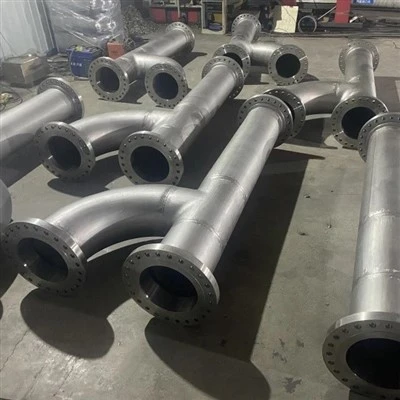
Stainless steel hollow bar is round bar stock produced with a pre-formed central bore, sold as a near-net-shape alternative to solid round bar for any component that will ultimately be machined with a hole through it. Because the center of a round bar contributes little strength for the weight it adds, hollow bar can remove a substantial fraction of that weight and machining time while sacrificing only a small fraction of stiffness - the trade-off this article quantifies.

|
Weight savings from hollow bar equal the square of the ID-to-OD ratio: a bar bored to half its outside diameter removes 25% of the weight, while a bar bored to 70% of its OD removes about 49%.
That same 25%-lighter hollow bar retains roughly 94% of solid bar's bending and torsional stiffness, because material near the center of a round section carries very little load.
Hollow bar typically costs more per pound than solid bar of the same grade, but total component cost is often lower once reduced machining time, tooling wear, and scrap are included - one supplier reports a 1.8x increase in usable part length per pound of material versus solid bar.
Hollow bar is produced to the same stainless bar standards as solid bar (ASTM A276, A479, A484) and to mechanical tubing practice (ASTM A511), in the same common grades - 304/304L, 316/316L, and 2205 duplex. |
What Is a Stainless Steel Hollow Bar, and How Is It Different From a Solid Bar or a Tube?
Hollow bar is round bar stock manufactured with a factory-formed central bore, positioned between solid round bar and seamless tube - thicker-walled than tube so it can be machined into a finished part, and lighter than solid bar because the bore replaces material that a machinist would otherwise have to drill or bore out.
Solid round bar starts as a fully filled cylinder; any component that needs a bore - a bushing, a valve body, a shaft with an internal oil gallery - requires that center material to be drilled or bored out and discarded as swarf. Hollow bar is produced by piercing or rotary-forging a billet into a tube-like section with a thicker wall than a pressure or process tube, then finishing it to a controlled OD and ID by cold drawing or turning. The result is a near-net-shape starting stock: the rough bore is already there, so the machinist only needs to finish-bore to final size rather than remove the entire core.
The distinction from seamless tube is wall thickness and purpose. Tube is designed and sized to carry or contain fluid, so machining is typically limited to the ends. Hollow bar is designed to be machined extensively - turned, bored, faced, and threaded - into a finished mechanical component, which is why it is supplied with a heavier wall and tighter concentricity between ID and OD.
How Much Weight Does Hollow Bar Actually Save Compared to Solid Round Bar?
Weight savings equal the square of the ratio between the bore diameter and the outside diameter (ID/OD)² - so a bar bored to half its OD is 25% lighter, and a bar bored to 70% of its OD is roughly 49% lighter, before any machining even begins.

Because weight is proportional to cross-sectional area, and the area removed by the bore is proportional to the bore diameter squared, the percentage weight reduction from switching to hollow bar follows a simple, exact relationship: percent weight saved equals (ID ÷ OD)² × 100. This holds for any round bar, regardless of alloy, and it is the single number to use when estimating shipping weight, handling cost, or raw-material cost differences before pricing a part.
|
ID / OD Ratio |
Weight Removed vs. Solid Bar |
Typical Use Case |
|
0.30 |
9% |
Light bore for a fastener, pin, or lubrication passage |
|
0.40 |
16% |
Small internal bore with a thick remaining wall |
|
0.50 |
25% |
Common general-purpose hollow bar wall ratio |
|
0.60 |
36% |
Bushings and sleeves needing a larger bore |
|
0.70 |
49% |
Thin-wall components prioritizing weight reduction |
Source: Calculated from cross-sectional area: percent weight saved = (ID/OD)² × 100, applicable to any round bar geometry independent of alloy density.
Applied to real dimensions, the effect is substantial. Using a representative austenitic stainless density of approximately 0.287 lb/in³ (304/316), the table below compares solid bar to hollow bar bored to half the outside diameter - a common general-purpose wall ratio - across several standard sizes.
|
Outside Diameter (in.) |
Solid Bar Weight (lb/ft) |
Hollow Bar Weight, ID = 0.5×OD (lb/ft) |
Weight Saved per Foot |
|
2.0 |
10.8 |
8.1 |
2.7 lb (25%) |
|
3.0 |
24.3 |
18.3 |
6.1 lb (25%) |
|
4.0 |
43.3 |
32.5 |
10.8 lb (25%) |
|
6.0 |
97.4 |
73.0 |
24.3 lb (25%) |
Source: Weight calculated from cross-sectional area × density (≈ 0.287 lb/in³ for 304/316 austenitic stainless) × 12 in./ft. Actual mill weight varies slightly by grade and tolerance.
At production volume, this compounds directly into freight and handling cost, since stainless bar is commonly priced and shipped by weight - a 24-foot length of 6 in. OD hollow bar at this ratio arrives roughly 580 lb lighter than the solid-bar equivalent before a single cut is made.
Does Removing the Center Material Weaken the Bar?
Only slightly - a round bar bored to half its outside diameter loses about 25% of its weight but retains roughly 94% of its bending and torsional stiffness, because material near the central axis of a round section does almost no structural work.
Bending and torsional stiffness of a round section both depend on how far the material sits from the center axis, not simply how much material is present. The governing property - the second moment of area for bending, or the polar moment of inertia for torsion - scales with the diameter raised to the fourth power, so material at the outer radius contributes far more stiffness per unit weight than material near the core.
Removing the core therefore removes a disproportionately small share of stiffness relative to the weight it represents. This is the same structural principle that makes I-beams and hollow structural sections efficient, applied to a round bar.
|
ID / OD Ratio |
Weight Removed |
Bending/Torsional Stiffness Retained |
|
0.30 |
9% |
99.2% |
|
0.40 |
16% |
97.4% |
|
0.50 |
25% |
93.8% |
|
0.60 |
36% |
87.0% |
|
0.70 |
49% |
76.0% |
Source: Calculated from beam theory: for a round section, both bending moment of inertia and polar moment of inertia scale as (1 − (ID/OD)⁴); stiffness retained = 1 − (ID/OD)⁴, expressed as a percentage.
This is why hollow bar is a standard choice for torsionally loaded components such as drive shafts and axles, not just a lightweighting shortcut: at moderate bore ratios, the stiffness penalty is small enough to be inconsequential in most designs, while the weight and material savings are not.
Is Hollow Bar More Expensive Per Pound Than Solid Bar?
Yes, on a per-pound basis - hollow bar carries a higher mill price than solid bar of the same grade because of the extra piercing or boring step in manufacturing - but the relevant comparison for a finished part is total cost per component, where hollow bar frequently wins.

Raw material price is only one line item in the cost of a finished, machined part. The other line items - machining time, tool wear, coolant and energy consumption, scrap disposal or recovery, and handling - all move in hollow bar's favor because there is less material to remove and, in many designs, no drilling or boring operation required at all. Buyers who compare hollow bar to solid bar only on a dollars-per-pound basis are comparing the wrong total.
|
Cost Factor |
Solid Bar (Bored In-House) |
Hollow Bar |
|
Raw material price per pound |
Lower |
Higher |
|
Material purchased per finished part |
Higher (full solid section) |
Lower (near-net-shape) |
|
Drilling/boring operation |
Required |
Reduced or eliminated |
|
Tool wear from core removal |
Higher |
Lower |
|
Scrap generated (swarf) |
Higher |
Lower |
|
Machining cycle time |
Longer |
Shorter |
Independent supplier data supports the direction of this trade-off: one hollow bar producer reports that, for the same total weight of purchased material, hollow bar yields approximately 1.8 times more usable finished part length than solid bar machined down to the same geometry, because so much less material is removed as waste. A separate productivity study measured a 40% gain in machining throughput using near-net-shape hollow bar in place of solid bar for parts requiring a central bore.
How Much Can Hollow Bar Reduce Machining Time and Scrap Compared to Boring Solid Bar?
Hollow bar eliminates or shortens the single most time-consuming and tool-intensive step in machining a bored component - removing the solid core - which is why suppliers report roughly 1.8 times more finished part length per pound of purchased material and up to a 40% productivity gain versus solid bar.
Drilling or boring a deep, small-diameter hole in solid bar is slow, generates heat that work-hardens stainless steel, and consumes disproportionate tool life compared with turning an outside diameter. Because hollow bar starts with the bore already roughed in, that step shrinks to a light finish-bore, or disappears entirely if the as-supplied ID already meets the print tolerance. The swarf generated is also lower-value: fine drilling chips from a deep bore are harder to reclaim cleanly than the larger turnings produced when machining an OD, so hollow bar improves scrap recovery value as well as scrap volume.
These savings scale with batch size. For a single prototype part, the price premium on hollow bar raw material may not be recovered. For a production run of hundreds or thousands of identical bored components - valve bodies, bushings, pump sleeves - the cumulative machining time and tooling savings typically outweigh the higher per-pound material cost well before the run is complete.
Which Stainless Grades Are Available as Hollow Bar, and What Standards Apply?
Hollow bar is produced in the same common stainless grades as solid bar - 304/304L, 316/316L, and 2205 duplex - under the same bar specifications (ASTM A276, A479, A484), supplemented by mechanical tubing practice (ASTM A511) that governs the tubular manufacturing process.

Because hollow bar sits between solid bar and mechanical tubing, its specification typically draws on both product families: chemical composition, mechanical properties, and general bar requirements follow ASTM A276 (stainless steel bars and shapes), A479 (bar for boilers and pressure vessels), and A484 (general requirements for stainless steel bars, billets, and forgings), while the tubular forming, wall tolerance, and straightness practice draws on ASTM A511 (seamless stainless mechanical tubing). Buyers should confirm with their supplier which combination of standards a given hollow bar order is certified against, since "hollow bar" itself is a product form rather than a single standard.
|
Grade |
UNS |
Typical Hollow Bar Application |
|
304/304L |
S30400 / S30403 |
General-purpose bushings, sleeves, low-corrosion components |
|
316/316L |
S31600 / S31603 |
Marine, chemical-process, and food/pharma components needing chloride resistance |
|
2205 Duplex |
S32205 |
High-strength shafts and fittings needing both strength and corrosion resistance |
What Applications Benefit Most From Hollow Bar Over Solid Bar?
Hollow bar delivers the largest advantage in high-volume, radially machined components with a through-bore - valve bodies, bushings, pump and cylinder sleeves, and rotating shafts - where weight, machining time, or torsional performance all matter simultaneously.
Valve, flange, and fitting bodies: nearly all require a central bore, making hollow bar a direct near-net-shape starting point.
Pump and hydraulic cylinder sleeves and bushings: benefit from both the pre-formed bore and improved bore concentricity.
Rotating shafts and drive components: torsional stiffness retention is high relative to weight removed, improving inertia and dynamic response.
Weight-sensitive structures: aerospace, robotics, and mobile equipment components where every pound of unsprung or rotating mass has a downstream cost.
Marine, food-processing, and pharmaceutical equipment: corrosion-resistant grades in hollow form reduce both weight and machining time on hygienic or washdown-rated components.
How Should You Decide Between Hollow Bar and Boring Solid Bar?
Choose hollow bar when the finished part requires a through-bore, the ID tolerance can be met by the available hollow bar sizing, and production volume is high enough to recover the material price premium through machining savings; choose solid bar and bore in-house for one-off parts, non-standard bore geometries, or bores that do not run the full part length.
A quick way to frame the decision is to check three conditions. First, does the finished component need a bore that runs most or all of the part's length - if the bore is a shallow feature rather than a through-hole, solid bar may remain simpler. Second, is a hollow bar size available with an ID close enough to the finished bore to avoid re-boring most of the wall away, since ordering an oversized hollow bar defeats the purpose.
Third, is the production quantity large enough that machining time and tooling savings, multiplied across the run, exceed the raw material price premium. When all three are true, hollow bar is almost always the lower total-cost choice; when any one is false, it is worth pricing both options before committing.
Frequently Asked Questions
Q: How much weight does hollow bar save compared to solid round bar?
A: Weight savings equal (ID/OD)² × 100%. A bar bored to half its outside diameter saves 25% of the weight; a bar bored to 70% of its OD saves about 49%.
Q: Is hollow bar as strong as solid round bar?
A: For bending and torsion, a hollow bar bored to half its OD retains about 94% of solid bar's stiffness while weighing 25% less, because material near the center of a round section contributes little structural resistance.
Q: Is stainless steel hollow bar cheaper than solid bar?
A: Not per pound - hollow bar typically costs more per pound than solid bar of the same grade. It is usually cheaper per finished component once reduced machining time, tooling wear, and scrap are factored in, particularly at production volumes.
Q: What is the difference between hollow bar and stainless steel tube?
A: Tube is manufactured and sized to carry fluid, with machining typically limited to the ends. Hollow bar has a much thicker wall relative to its diameter, intended to be extensively machined into a finished mechanical component.
Q: What stainless steel grades are available as hollow bar?
A: The most common grades are 304/304L and 316/316L austenitic stainless, with 2205 duplex available where higher strength and corrosion resistance are both required.
Q: When should I bore solid bar instead of buying hollow bar?
A: Solid bar and in-house boring make sense for one-off or low-volume parts, non-standard bore geometries, or bores that only run partway through the part, where hollow bar's near-net-shape advantage cannot be fully used.