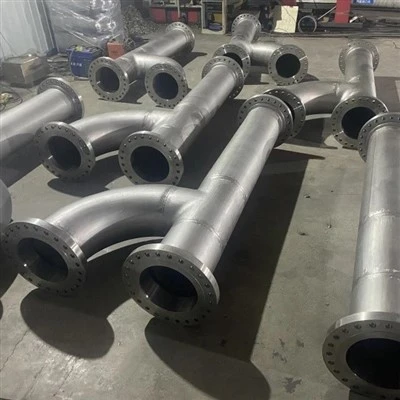
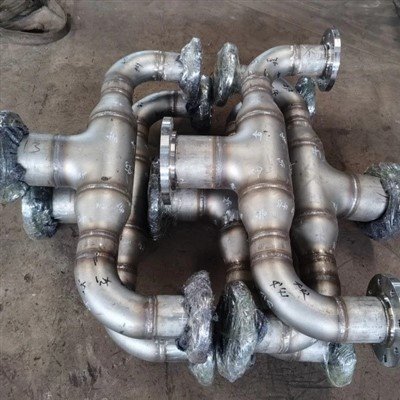
S32760 is the UNS number; ASTM A182 Grade F55 is its forging designation; other names are EN 1.4501 (X2CrNiMoCuWN25-7-4) and the trade name Zeron 100. It is a super duplex stainless steel.
F55 carries a guaranteed Pitting Resistance Equivalent Number (PREN) of 40 or higher - written into the material specification and proven heat-by-heat on the mill certificate, which is the offshore industry threshold for seawater service.
In the solution-annealed condition it must meet a minimum yield strength of 550 MPa and tensile strength of 750 MPa - roughly three times the yield of 316L - with 25% minimum elongation.
The deliberate copper (0.5-1.0%) and tungsten (0.5-1.0%) additions give F55 extra resistance to reducing acids and to crevice corrosion, the failure mode that starts under gaskets and bolted joints in seawater.
F55 is qualified for sour service under NACE MR0175 / ISO 15156-3 and for North Sea duty under NORSOK M-650 (M-630 MDS 055), making it a default choice for subsea and wellstream components.

Key Specifications at a Glance
|
Metric |
Value |
|
Grade / UNS |
ASTM A182 F55 / UNS S32760 |
|
Material family |
Super duplex stainless steel (25% Cr) |
|
European / EN |
1.4501 (X2CrNiMoCuWN25-7-4) |
|
Common trade name |
Zeron 100 |
|
Minimum yield strength |
550 MPa (80 ksi) |
|
Minimum tensile strength |
750 MPa (109 ksi) |
|
Minimum elongation |
25% |
|
Guaranteed PREN |
>= 40 (by chemistry, per heat) |
|
Critical pitting temperature (CPT) |
>= 50 deg C (ASTM G48 Method E) |
|
Service temperature range |
approx. -46 deg C to +250 deg C |
|
Sour-service qualification |
NACE MR0175 / ISO 15156-3 |
|
Hardness (general / sour cap) |
<= 310 HBW (32 HRC) / <= 28 HRC |
What Is ASTM A182 Grade F55 (S32760)?
ASTM A182 Grade F55 is the forging designation for UNS S32760, a super duplex stainless steel also known as EN 1.4501 and by the trade name Zeron 100. When an engineer specifies "F55 forged fittings," they are naming this exact material in its forged, solution-annealed form.
ASTM A182 (and its ASME equivalent SA-182) is the standard specification that covers forged or rolled alloy and stainless steel pipe flanges, forged fittings, valves and pressure-part components for high-temperature and corrosive service. Within that standard, each "grade" is a material; F55 is the grade that maps to UNS S32760. The same alloy appears in other ASTM product standards under its UNS number - for example A790 pipe, A240 plate and A479 bar - so a project can specify one consistent chemistry across every product form.
"Super duplex" means the steel has a roughly 50/50 mix of ferrite and austenite phases, with a chromium content of about 25% (versus 22% for standard duplex and 16-18% for 316L). That higher alloy content is what pushes corrosion resistance into the aggressive-seawater class. F55 is the tungsten- and copper-enhanced member of the super duplex family, which is why it is especially common in North Sea and UK-heritage offshore specifications.
What Is the Chemical Composition of S32760 F55?
F55 is a 24-26% chromium, 6-8% nickel, 3-4% molybdenum super duplex. What sets it apart from every other super duplex is the deliberate copper (0.5-1.0%) and tungsten (0.5-1.0%) additions, which are ranged alloying elements rather than residual impurities. The full ASTM A182 composition limits are below.
|
Element |
Weight % (max unless range shown) |
Role in the alloy |
|
Carbon (C) |
0.030 max |
Kept low to avoid chromium carbide precipitation |
|
Silicon (Si) |
1.00 max |
Deoxidation; limited to protect toughness |
|
Manganese (Mn) |
1.00 max |
Austenite former; capped for phase balance |
|
Phosphorus (P) |
0.030 max |
Impurity; minimized for corrosion |
|
Sulphur (S) |
0.010 max |
Tightest ceiling in the family; aids weldability |
|
Chromium (Cr) |
24.0 - 26.0 |
Primary pitting / passive-film element |
|
Nickel (Ni) |
6.0 - 8.0 |
Austenite former; stabilizes structure |
|
Molybdenum (Mo) |
3.0 - 4.0 |
Pitting and crevice resistance |
|
Nitrogen (N) |
0.20 - 0.30 |
Strengthens austenite; boosts PREN |
|
Copper (Cu) |
0.50 - 1.00 |
Resistance to reducing acids (F55-only) |
|
Tungsten (W) |
0.50 - 1.00 |
Crevice resistance; counts in PREN (F55-only) |
|
Iron (Fe) |
Balance |
Matrix element |
The practical takeaway for specifiers: the copper and tungsten are the "F55 signature." Positive Material Identification (PMI) on the shelf can read that Cu-W fingerprint to distinguish F55 from its tungsten-free twin F53 (2507). The composition also carries a built-in PREN requirement of 40 minimum, which we cover next.
What Are the Mechanical Properties of ASTM A182 F55 Forged Fittings?
In the mandatory solution-annealed condition, ASTM A182 requires F55 forged fittings to meet a minimum yield strength of 550 MPa (80 ksi), a minimum tensile strength of 750 MPa (109 ksi) and a minimum elongation of 25%. These are the values a buyer should see demonstrated on every mill certificate.
|
Property |
Minimum (solution annealed) |
Test method |
|
0.2% Yield strength (Rp0.2) |
550 MPa (80 ksi) |
ASTM E8 / E8M |
|
Ultimate tensile strength (Rm) |
750 MPa (109 ksi) |
ASTM E8 / E8M |
|
Elongation (4D gauge) |
25% |
ASTM E8 / E8M |
|
Reduction of area |
45% |
ASTM E8 / E8M |
|
Hardness (general) |
<= 310 HBW (32 HRC) |
ASTM A182 / E10 |
|
Hardness (NACE sour service) |
<= 28 HRC |
NACE MR0175 |
|
Charpy V-notch impact, RT |
>= 45 J avg, 35 J min |
ASTM E23 |
|
Charpy V-notch impact, -46 deg C |
>= 45 J avg (FLT path) |
ASTM E23 |
|
Ferrite content (parent metal) |
35 - 55% |
ASTM E562 |
|
Critical pitting temperature (CPT) |
>= 50 deg C |
ASTM G48 Method E |
Why this matters: the 550 MPa yield is about three times that of 316L (170 MPa) and roughly 20% above standard duplex 2205 (450 MPa). That extra strength lets engineers design thinner-wall piping, smaller flanges and lighter topside structures - and on an offshore platform, every kilogram saved is saved twice over in material and in the structure that supports it. F55 also trades a slightly lower tensile floor (750 MPa vs the 800 MPa of F53) for a higher ductility floor (25% vs 15%), a balance many piping engineers prefer for small-bore fittings that will be welded and bolted in the field.
What Does the PREN Value Tell Us About F55 Corrosion Resistance?
F55 carries a guaranteed PREN of 40 or higher, and - uniquely among the super duplex grades - that number is written into the material specification and proven chemistry-by-chemistry on every heat. PREN is the single most useful shorthand for ranking stainless steels against chloride pitting.
PREN is calculated as: %Cr + 3.3 x (%Mo + 0.5 x %W) + 16 x %N.

Notice that tungsten is credited at half the weight of molybdenum, which is the arithmetic recognition of what the tungsten addition contributes. For a typical F55 heat (25.5 Cr, 3.5 Mo, 0.7 W, 0.25 N) the result lands around 41-42 - comfortably above the 40 threshold the offshore industry uses to define "seawater-capable."
The guarantee is the key point. Where F53 (2507) reaches PREN 40 by its chromium-molybdenum-nitrogen recipe, F55 makes PREN 40 a certified property: the mill certificate computes and states it per heat, so a piping class that simply says "PREN >= 40 guaranteed" is naming S32760 whether or not it prints the UNS number. In G48 testing, F55 typically shows a critical pitting temperature (CPT) above 50 deg C, which is what lets it survive warm raw seawater and chlorinated firewater where lower-PREN grades would pit.
How Does F55 (S32760) Compare with F53 (S32750 / 2507)?
F55 and F53 are "super duplex twins" with nearly identical strength and PREN; the real difference is chemistry strategy. F53 (2507) reaches its PREN with chromium, molybdenum and nitrogen alone, and offers a slightly higher tensile floor (800 MPa). F55 (Zeron 100) adds copper and tungsten for extra reducing-acid and crevice resistance, and is the only one of the two whose specification guarantees PREN >= 40 on every heat.
|
Property |
F55 (S32760) |
F53 (S32750 / 2507) |
|
UNS / EN |
S32760 / 1.4501 |
S32750 / 1.4410 |
|
Key additions |
Cu + W |
None beyond Cr-Mo-N |
|
Yield strength, min |
550 MPa (80 ksi) |
550 MPa (80 ksi) |
|
Tensile strength, min |
750 MPa (109 ksi) |
800 MPa (116 ksi) |
|
Elongation, min |
25% |
15% |
|
Guaranteed PREN |
>= 40 (by chemistry) |
>= 40 (typical) |
|
CPT (G48) |
>= 50 deg C |
~55-70 deg C |
|
Reducing-acid resistance |
Better (Cu) |
Good |
|
Crevice resistance |
Better (W) |
Good |
Practical selection: the two grades overlap almost completely in service, so the choice is usually made by the specification itself - North Sea and UK-heritage documents tend to name S32760, while Scandinavian and US documents lean toward 2507. Where the seawater is acidified (e.g., produced water, acidified injection) or the duty sees mineral-acid excursions, F55's copper earns its margin. Where maximum tensile floor and broadest global stock matter, F53 counters. Either way, they are interchangeable on strength.
How Does F55 Compare with Duplex 2205 (F51/F60) and 316L?
F55 delivers roughly 20% more yield than duplex 2205 and about three times the yield of 316L, with a PREN roughly 15 points higher than 316L. That combination is what moves a component from "mild-corrosion duty" into "aggressive warm-seawater and sour duty."
|
Grade |
UNS |
Type |
PREN (approx.) |
Yield MPa |
Tensile MPa |
Elong. % |
|
316L |
S31603 |
Austenitic |
24-26 |
170 |
485 |
40 |
|
2205 (F51/F60) |
S31803/S32205 |
Standard duplex |
34-38 |
450 |
620-655 |
25 |
|
F53 (2507) |
S32750 |
Super duplex |
41-43 |
550 |
800 |
15 |
|
F55 (Zeron 100) |
S32760 |
Super duplex +Cu/W |
>= 40 (guar.) |
550 |
750 |
25 |
The rule of thumb: 316L covers mild chlorides; 2205 (PREN ~34) carries brackish water, produced water and general process chloride duty economically but falls short in hot open seawater and crevice-prone geometry; F55 clears the 40-PREN bar and takes proper seawater systems - lift and injection lines, cooling circuits, firewater ring mains and splash-zone hydraulics. Step up to a nickel alloy only when temperature or acid severity exceeds F55's envelope.
Why Does F55 Contain Copper and Tungsten?
Copper and tungsten are deliberate alloying additions that close two specific weaknesses of chloride-focused super duplex steels: copper improves resistance to reducing (non-oxidizing) acids, and tungsten strengthens the passive film in tight crevices. Neither element is a residual - both are specified ranges in ASTM A182.

Copper (0.5-1.0%): plain chromium-molybdenum-nitrogen super duplexes are excellent against oxidizing chlorides but suffer in reducing acids such as dilute sulphuric and hydrochloric acid. Copper broadens F55 into acidic chloride streams - acid-leach slurries in hydrometallurgy, acidified seawater and certain oilfield chemicals - where tungsten-free grades would corrode.
Tungsten (0.5-1.0%): the classic seawater failure is crevice corrosion, which starts under gaskets, washers, bolt holes and deposits where oxygen cannot refresh the passive film. Tungsten is credited with raising the critical crevice temperature above that of tungsten-free super duplex, and it is formally recognized in the extended PREN formula at half molybdenum's weight. Together, copper and tungsten are why seawater pump, valve and flange specifications so often name S32760.
What Heat Treatment Does ASTM A182 F55 Require?
F55 forgings are supplied solution-annealed at 1100-1140 deg C (2010-2085 deg F) with a hold time proportional to section thickness (minimum 30 minutes per 25 mm), followed by a rapid water quench to room temperature. This treatment fixes the correct ferrite-austenite balance and dissolves any harmful intermetallic phases.
The water quench is not optional. The rich super-duplex chemistry has a "precipitation nose" between roughly 600 and 1000 deg C where sigma phase, chi phase and chromium nitride (Cr2N) form quickly; these brittle intermetallics destroy both corrosion resistance and toughness. Quenching skips that nose. Because the structure is so sensitive, F55 must never be field-heat-treated, flame-cut or casually welded, and offshore specifications routinely verify the result with ASTM A923 (Method C) testing to confirm the material is sigma-phase free.
What Temperature Range Can F55 Forged Fittings Withstand?
F55 is qualified for roughly -46 deg C to +250 deg C in common offshore specification practice. The upper limit is metallurgical, not arbitrary: the same high chromium and molybdenum that buy corrosion resistance also accelerate embrittling phases if the material is held too hot.
Above about 250-300 deg C, two mechanisms threaten the alloy. "475 deg C embrittlement" stiffens and brittles the ferrite phase, while sigma-phase precipitation occurs around 600-900 deg C. Both form quickly in super duplex, so long-term service stays below about 250 deg C and any heating is strictly controlled. The lower limit reflects ferrite toughness; impact testing at -46 deg C is standard for offshore specifications, and F55 comfortably meets the required 45 J average. Inside that window, F55 pairs near-nickel-alloy corrosion performance with roughly twice the strength of austenitic stainless.
What Corrosion Resistance Does S32760 Provide?
F55 resists pitting, crevice corrosion, chloride stress-corrosion cracking and mildly reducing acids in warm seawater and sour conditions - precisely the environments where 316L and even 2205 fail. Its resistance is best understood mechanism by mechanism.
Pitting: guaranteed PREN >= 40 and CPT >= 50 deg C (G48) mean F55 resists the initiation of pitting in warm, chlorinated seawater far better than 316L (PREN ~25) or 2205 (PREN ~34).
Crevice corrosion: the tungsten addition raises the critical crevice temperature, protecting the geometry under gaskets, flanges and bolted joints where oxygen starvation would otherwise trigger attack.
Chloride stress-corrosion cracking (SCC): the duplex structure resists chloride SCC to roughly 130 deg C and above, far beyond the ~60 deg C ceiling of austenitic 316L - a key reason F55 is chosen for hot seawater and process chloride duty.
Reducing acids: copper gives F55 an edge in dilute sulphuric and hydrochloric acid and in acidified seawater, extending its envelope beyond straight chloride service into hydrometallurgical and chemical-process streams.
Sour (H2S) service: with hardness and heat-treatment controls, F55 is accepted under NACE MR0175 / ISO 15156 for H2S-containing environments (see below).
Which Standards and Specifications Cover F55?
F55 is supported by a complete family of ASTM/ASME product standards plus the leading sour-service and offshore qualification schemes, so a single material can be specified consistently across pipe, plate, bar and forgings - and proven compliant for the most demanding projects.

|
Scope |
Standard(s) |
|
Forged flanges, fittings, valves |
ASTM A182 / ASME SA-182 Grade F55 |
|
Seamless pipe |
ASTM A790 / ASME SA-790 (UNS S32760) |
|
Welded pipe |
ASTM A928 (UNS S32760) |
|
Butt-weld fittings |
ASTM A815 (UNS S32760) |
|
Plate & sheet |
ASTM A240 / ASME SA-240 (UNS S32760) |
|
Bar & rod |
ASTM A479 / A276 (UNS S32760) |
|
Forgings (general) |
ASTM A473 (UNS S32760) |
|
European material |
EN 10088-3, material 1.4501 |
|
Sour service |
NACE MR0175 / ISO 15156-3 |
|
North Sea / offshore |
NORSOK M-650 with M-630 MDS 055 |
|
Corrosion & phase testing |
ASTM G48 (CPT), ASTM A923 (sigma phase) |
|
Pressure equipment (EU) |
PED 2014/68/EU; ASME approval for PV |
What Forged Fitting Types Are Available in F55?
F55 is produced as the full range of ASME B16.11 forged fittings and mates directly with ASME B16.5 / B16.47 flanges and A790 / A815 pipe, so a complete super-duplex piping system can be built from one chemistry.
|
Product |
Typical forms |
Dimensional standard |
|
Forged fittings |
Elbows (45/90 deg), tees, reducers, caps, couplings, unions, outlet fittings |
ASME B16.11 |
|
Flanges |
Weld neck, slip-on, blind, socket-weld, threaded, lap-joint; RTJ/RF/FF facings |
ASME B16.5 / B16.47; EN 1092-1 |
|
Valve parts |
Bodies, bonnets, trim for sour/offshore valves |
API 6A / 6D as applicable |
|
Pipe (system) |
Seamless (A790) and welded (A928); butt-weld fittings (A815) |
ASME B36.10 / B36.19 |
Sizes commonly run from 1/2" NB through 56" NB for flanges, in pressure classes from 150# to 2500# (PN 2.5 to PN 400), with bores machined to the stated pipe schedule so the joint runs flush. Where a project requires it, fittings can be supplied with pickling/passivation, shot peening, ferrite count, G48 and PMI testing, and third-party (SGS/TUV/DNV/Lloyd's) inspection.
Where Is S32760 F55 Used in Industry?
F55 is specified wherever warm seawater, sour gas or acidic chloride slurries meet high pressure - the exact intersection of corrosion severity and mechanical load. The dominant applications break down by sector as follows.
Offshore oil & gas: subsea manifolds and templates, Xmas trees, wellheads, tubing hangers, risers and flowlines; the tungsten addition earns its keep in deep-water crevices while NACE MR0175 qualification covers sour wellstreams.
Seawater & firewater systems: seawater lift and injection lines, cooling and utility circuits, and chlorinated firewater ring mains - the classic crevice and warm-chloride duty where F55's guaranteed PREN 40 is decisive.
Desalination: high-pressure pump casings and piping, brine concentrators and evaporator components exposed to hot, concentrated chloride.
Chemical processing: hot chloride brines, ferric chloride, and process streams with acid contamination where 2205 would be marginal.
Hydrometallurgy (HPAL): high-pressure acid-leach circuits for gold, copper and uranium, where copper-loaded slurry attacks plain super duplex - F55's own copper addition is the defense.
Marine & shipbuilding: seawater injection pumps, ballast and bilge systems, and splash-zone hydraulics on vessels and platforms.
Pulp & paper and FGD: bleaching stages and flue-gas-desulfurization components exposed to acidic chloride environments.
Is F55 Qualified for Sour Service (H2S)?
Yes. F55 is accepted for sour service under NACE MR0175 / ISO 15156-3 when the specified hardness and heat-treatment controls are met, which makes it suitable for H2S-containing wellstreams, downhole components and sour gas processing.
Sour service means the environment contains hydrogen sulphide (H2S), which can cause sulfide stress cracking in hard or improperly treated steels.
For F55, compliance hinges on three controls: (1) the material is in the correct solution-annealed condition; (2) hardness is capped - NACE MR0175 limits F55 sour-service lots to 28 HRC (about 269 HBW); and (3) the chemistry and testing are documented on the mill certificate. Because F55 already meets the PREN >= 40 and strength requirements that sour offshore duties demand, it is a default selection for subsea and wellhead components in H2S service.
How Do You Specify and Source F55 Forged Fittings?
Specify F55 by its UNS number S32760 (or "ASTM A182 Grade F55"), state the applicable ASME dimensional standard and pressure class, request an EN 10204 3.1 (or 3.2 for witness) mill certificate, and call out any corrosion or ferrite testing the project requires. A precise specification prevents grade substitution and gives you a verifiable paper trail.
Material: "ASTM A182 Grade F55 (UNS S32760), solution annealed, intermetallic-free per ASTM A923."
Product & standard: e.g., "Forged tee per ASME B16.11, 3000#" or "Weld-neck flange per ASME B16.5, Class 600, RF."
Certificate: EN 10204 3.1 minimum; 3.2 where a third-party witness is required (SGS/TUV/DNV/Lloyd's).
Verification: PMI to confirm the Cu-W fingerprint, ferrite count (35-55%), G48 CPT at the specified temperature, and -46 deg C impact where offshore duty applies.
Traceability: heat number, dimensions, marking and export packing recorded against the purchase order.
What Are the Welding and Fabrication Considerations?
F55 welds like any super duplex but demands disciplined thermal control - over-alloyed filler, a capped interpass temperature and no post-weld heat treatment - because careless heating precipitates the brittle phases that destroy corrosion resistance.
Filler metal: use over-alloyed super duplex consumables such as ER2594 / E2594, or an S32760-matching wire where the project requires tungsten-bearing weld metal.
Heat input: moderate, with interpass temperature capped around 100-150 deg C to stay clear of the sigma-phase nose.
No PWHT: post-weld heat treatment is not used in normal practice; it would only encourage intermetallic precipitation.
Verification: offshore procedures back the weld with ferrite measurement, ASTM A923 screening and often G48 corrosion testing on production welds.
Fabrication: avoid flame cutting and field heating; machine or use controlled thermal cutting followed by restoration of the annealed condition at the cut edge.
What Are the Limitations and Cautions of F55?
F55 is not a free lunch. Its strengths come with a capped temperature window, a higher price than 2205, less welding forgiveness, and an absolute prohibition on field heat treatment - all of which a specifier should weigh before selecting it.
Temperature ceiling: long-term service is limited to about 250 deg C because of 475 deg C embrittlement and sigma-phase formation above that range.
Cost: F55 carries a premium over 2205 (and far over 316L) from its nickel, molybdenum, copper and tungsten content; justify it with the duty, not by habit.
Weld discipline: the narrow thermal window demands qualified procedures and supervision; it is less forgiving than 2205 in the field.
No field heat treatment: never flame-cut, stress-relieve or casually heat F55; any thermal exposure must be followed by a full solution anneal and quench.
Galvanic & erosion: like all stainless steels, F55 is not immune to galvanic coupling with more noble metals or to erosion-corrosion at very high velocities - design accordingly.
How Do You Choose Between F55 and Alternative Materials?
Choose F55 when the duty is warm or hot seawater, sour gas, or acidic chloride streams at high pressure; step down to duplex 2205 (F51/F60) where 316L-class resistance already suffices and cost dominates, or step up to a nickel alloy when temperature or acid severity exceeds F55's envelope.
|
If your duty is... |
Best choice |
Reason |
|
Mild chlorides, ambient seawater |
316L |
Cost-effective; PREN ~25 is enough |
|
Brackish water, process chlorides |
2205 (F51/F60) |
PREN ~34; economical workhorse |
|
Warm/hot seawater, firewater, crevices |
F55 or F53 |
Guaranteed PREN >= 40; crevice/SCC resistance |
|
Acidified seawater, acid-leach slurries |
F55 (S32760) |
Copper + tungsten edge over F53 |
|
Sour (H2S) subsea / wellstream |
F55 or F53 |
NACE MR0175 qualified |
|
Very high temp or strong acids |
Nickel alloy (e.g., 625, C276) |
Beyond F55 temperature/acid envelope |
Frequently Asked Questions
Q: What does "F55" stand for in ASTM A182?
A: In ASTM A182, "Grade F55" is simply the letter-number grade assigned to the super duplex stainless steel UNS S32760. The "F" prefix denotes a forged/forging-grade alloy; the number identifies the specific chemistry. So "F55" and "S32760" are the same material in two naming systems.
Q: Is S32760 the same as Zeron 100?
A: Yes. S32760 is the generic UNS (Unified Numbering System) designation; Zeron 100 is the original trade name under which UNS S32760 was developed (UK origin, proven in North Sea service). ASTM A182 F55 is the forging grade. All three refer to the same super duplex chemistry.
Q: What is the difference between S32760 and S32750?
A: S32760 (F55) and S32750 (F53 / 2507) are both super duplex grades with the same ~550 MPa yield and guaranteed PREN >= 40. The difference is chemistry: S32760 adds copper and tungsten for reducing-acid and crevice resistance and guarantees PREN by heat; S32750 reaches PREN with Cr-Mo-N alone and offers a slightly higher tensile floor (800 MPa vs 750 MPa).
Q: What PREN does F55 have?
A: F55 has a guaranteed PREN of 40 or higher, computed as %Cr + 3.3 x (%Mo + 0.5 x %W) + 16 x %N and stated per heat on the mill certificate. Typical values run about 41-42, which is the offshore threshold for seawater service.
Q: Can F55 be used in seawater?
A: Yes - that is its primary application. With guaranteed PREN >= 40 and CPT >= 50 deg C (ASTM G48), F55 resists pitting and crevice corrosion in warm, chlorinated and raw seawater, including firewater systems and seawater injection, where 316L and even 2205 would be marginal.
Q: What is the minimum yield strength of F55?
A: The minimum 0.2% yield strength of ASTM A182 F55 in the solution-annealed condition is 550 MPa (80 ksi). That is about three times the yield of 316L and roughly 20% above standard duplex 2205.
Q: Is F55 stronger than 316L?
A: Substantially. F55's minimum yield (550 MPa) is about 3.2 times that of 316L (170 MPa), and its tensile (750 MPa) is about 1.5 times 316L's (485 MPa), while also delivering far superior chloride corrosion resistance.
Q: What temperature can F55 withstand?
A: F55 is qualified for roughly -46 deg C to +250 deg C. The lower limit reflects ferrite toughness (impact-tested at -46 deg C); the upper limit is metallurgical - above about 250-300 deg C the alloy risks 475 deg C embrittlement and sigma-phase formation.
Q: Is F55 suitable for sour service / H2S?
A: Yes, when controls are met. F55 is accepted under NACE MR0175 / ISO 15156-3 for sour service provided it is correctly solution-annealed and its hardness is capped at 28 HRC for sour-service lots. This qualifies it for H2S-containing subsea and wellstream components.
Q: What filler metal is used to weld F55?
A: Welds use over-alloyed super duplex consumables such as ER2594 / E2594, or an S32760-matching wire where the project requires tungsten-bearing weld metal. Interpass temperature is capped around 100-150 deg C and no post-weld heat treatment is used.
Q: What is the hardness limit for F55 in sour service?
A: NACE MR0175 caps F55 sour-service lots at 28 HRC (approximately 269 HBW). The general ASTM A182 hardness maximum is 310 HBW (32 HRC); the tighter 28 HRC limit applies specifically to H2S/sour duty.
Q: What standards cover F55 forged fittings?
A: Forged fittings and flanges are covered by ASTM A182 / ASME SA-182 Grade F55. Companion standards include A790 (seamless pipe), A815 (butt-weld fittings), A928 (welded pipe), A240 (plate), A479 (bar), plus NACE MR0175, NORSOK M-650 and EN 10088-3.
Q: What pipe does F55 mate with?
A: F55 forged fittings and flanges mate with ASTM A790 seamless pipe in UNS S32760, A928 welded pipe on larger diameters, and A815 butt-weld fittings in the same chemistry - giving a complete, matched-composition super duplex piping system.
Q: Does F55 need post-weld heat treatment?
A: No. Post-weld heat treatment is not used in normal practice for F55; it would encourage sigma-phase precipitation. The correct approach is a qualified welding procedure with controlled heat input, capped interpass temperature, and verification by ferrite count and ASTM A923.
Q: What forged fitting types come in F55?
A: The full ASME B16.11 range: 45/90 deg elbows, tees, reducers, caps, couplings, unions and outlet fittings, plus ASME B16.5/B16.47 flanges (weld neck, slip-on, blind, socket-weld, threaded) in classes from 150# to 2500#.
Q: Why is F55 more expensive than 2205?
A: F55 contains more nickel, molybdenum, copper and tungsten than 2205, and its tighter chemistry plus guaranteed-PREN certification add cost. It is justified where warm seawater, crevice-prone geometry, sour gas or acidic chloride streams demand performance beyond 2205.
Q: What is the density of S32760?
A: S32760 (F55) has a density of about 7.81-7.85 g/cm3 (roughly 0.283 lb/in3), with a Young's modulus near 199 GPa (29 x 10^6 psi). These values are useful for weight and stress calculations in piping design.
Q: How do I read an F55 mill certificate?
A: An EN 10204 3.1/3.2 certificate reports the heat number, the verified chemical composition (including Cu and W), mechanical results (yield, tensile, elongation, hardness, impact), ferrite content (35-55%), the computed PREN (>= 40), and any G48/A923 corrosion results - confirming the material meets ASTM A182 F55.