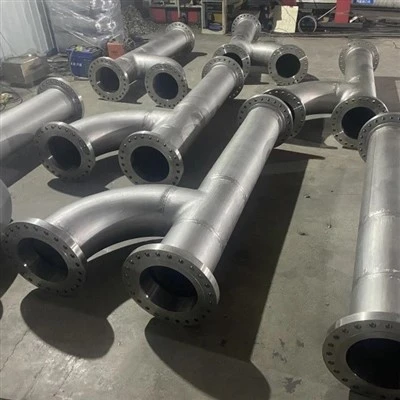
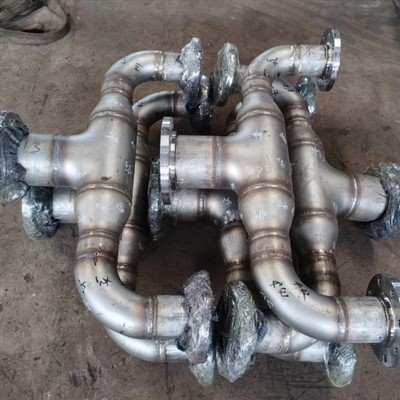
S31803 flanges are produced to ASTM A182 as Grade F51 - a forged duplex stainless steel (UNS S31803, the original "2205" chemistry) with about twice the strength of 316L and good chloride resistance. Their pressure-temperature ratings follow ASME B16.5 material group rules: at ambient temperature a Class 150 F51 flange is rated about 275 psi, Class 300 about 720 psi, and Class 600 about 1,440 psi, with values derated as temperature rises.

In one sentence: an S31803 / F51 flange is a high-strength, corrosion-resistant forged duplex flange whose dimensions come from ASME B16.5 and whose allowable working pressure comes from the ASME B16.5 pressure-temperature rating tables for the duplex material group.
Key Takeaways
- S31803 = UNS S31803; the equivalent forged-flange grade in ASTM A182 is F51. The newer, tighter version is UNS S32205 / A182 F60.
- ASTM A182 covers forged or rolled alloy-steel pipe flanges, forged fittings, and valves/parts; F51 is the duplex entry in that standard.
- Typical F51 properties: yield >= 450 MPa (65 ksi), tensile >= 620 MPa (90 ksi), hardness <= 290 HB, ferrite 35-65%.
- Dimensions follow ASME B16.5 (NPS 1/2-24) and ASME B16.47 (NPS 26-60); pressure-temperature ratings follow ASME B16.5.
- Ratings (representative): Class 150 ~275 psi, Class 300 ~720 psi, Class 600 ~1,440 psi at ambient, derated upward with temperature.
- F51 flanges need solution annealing (~1040 deg C) + rapid quench and matching duplex welding (ER2209) to keep strength and corrosion resistance.
What Is S31803 and ASTM A182 Grade F51?
S31803 is the UNS number for the original Duplex 2205 stainless steel; when that chemistry is supplied as a forged flange, fitting, or valve part it is designated ASTM A182 Grade F51. F60 is the newer, tighter version (UNS S32205).
Duplex stainless steel has a roughly 50/50 mix of austenite and ferrite. S31803 was the first widely used "2205" grade; S32205 tightened the nitrogen and molybdenum ranges for more consistent corrosion resistance. In flange form, both are covered by ASTM A182 - F51 for S31803 and F60 for S32205. Most mills today supply F60 (S32205), but "F51 / S31803" remains the common procurement label.
|
Designation |
Meaning |
|
UNS S31803 |
Original Duplex 2205 chemistry |
|
UNS S32205 |
Improved Duplex 2205 (tighter N, Mo) |
|
ASTM A182 F51 |
Forged flange/fitting grade for S31803 |
|
ASTM A182 F60 |
Forged flange/fitting grade for S32205 |
What Does ASTM A182 Cover?
ASTM A182 is the standard specification for forged or rolled alloy-steel pipe flanges, forged fittings, and valves and parts for high-temperature service; Grade F51 is the duplex stainless entry, and it defines chemistry, mechanical properties, heat treatment, dimensions (by reference to ASME B16.5 etc.), marking, and testing.
A182 does not set flange face dimensions itself - those come from ASME B16.5 (and B16.47 for large sizes). A182 sets the material: what the forging is made of and how strong it must be. For F51, it references the duplex chemistry and the 450 MPa / 620 MPa minimum yield / tensile.
F51 Chemical Composition Requirements (ASTM A182)
F51 (S31803) must meet, per heat analysis, about 21-23% chromium, 4.5-6.5% nickel, 2.5-3.5% molybdenum, and 0.08-0.20% nitrogen, with carbon capped at 0.030% - the molybdenum and nitrogen are what give duplex its strength and chloride resistance.
|
Element |
F51 (S31803) requirement, % |
|
Carbon (C) |
<= 0.030 |
|
Manganese (Mn) |
<= 2.00 |
|
Phosphorus (P) |
<= 0.030 |
|
Sulfur (S) |
<= 0.020 |
|
Silicon (Si) |
<= 1.00 |
|
Chromium (Cr) |
21.0 - 23.0 |
|
Nickel (Ni) |
4.5 - 6.5 |
|
Molybdenum (Mo) |
2.5 - 3.5 |
|
Nitrogen (N) |
0.08 - 0.20 |
Note: F60 (S32205) tightens Mo to 3.0-3.5% and N to 0.14-0.20%, raising the minimum PREN. Always verify the actual MTR against the ordered grade.
F51 Mechanical Properties (ASTM A182)
Minimum mechanical properties for F51 forgings: tensile strength 620 MPa (90 ksi), yield strength 450 MPa (65 ksi), elongation 25%, and hardness not exceeding 290 HB - roughly double the yield of 316L.
|
Property |
F51 (S31803) minimum |
|
Tensile strength |
>= 620 MPa (90 ksi) |
|
Yield strength (0.2% offset) |
>= 450 MPa (65 ksi) |
|
Elongation in 2 in / 50 mm |
>= 25% |
|
Reduction of area |
>= 45% |
|
Hardness |
<= 290 HB |
|
Ferrite content |
35 - 65% |
Heat Treatment and Ferrite Balance
F51 flanges are supplied solution-annealed at a minimum of about 1040 deg C (1900 deg F) followed by rapid quench; this dissolves harmful phases and locks in the 35-65% ferrite / austenite balance that gives duplex its properties.
Solution annealing is mandatory - it prevents sigma phase and 475 deg C embrittlement and restores corrosion resistance after forging. The ferrite content must stay in the 35-65% window; too much ferrite lowers toughness and weldability, too little lowers strength and SCC resistance. Verify with a ferrite scope and PMI at incoming inspection.
Flange Dimensions (ASME B16.5)
S31803 / F51 flanges are dimensioned exactly like any ASME B16.5 flange - the material grade does not change the geometry, only the pressure-temperature rating class and the alloy. Common face types are RF, FF, and RTJ in Classes 150, 300, 600, 900, 1500, and 2500.
Because dimensions follow ASME B16.5, an F51 flange is a direct dimensional substitute for a carbon-steel or 316 flange of the same NPS, class, and face type - you only change the material and its allowable pressure. (See the WN flange dimension tables in our companion guide for NPS 1/2-24.)
|
Size range |
Governing dimension standard |
|
NPS 1/2 - 24 |
ASME B16.5 |
|
NPS 26 - 60 |
ASME B16.47 (Series A/B) |
|
Face types |
RF, FF, RTJ, (LWN, reducing) |
|
Pressure classes |
150, 300, 600, 900, 1500, 2500 |
Pressure-Temperature Ratings (ASME B16.5)
The allowable working pressure of an F51 flange is read from the ASME B16.5 pressure-temperature rating table for the duplex material group; representative values are about 275 psi (Class 150), 720 psi (Class 300), and 1,440 psi (Class 600) at ambient temperature, decreasing as temperature rises.
These ratings apply to the flange only and assume a sound design (correct gasket, bolting, and assembly). Values below are representative of the ASME B16.5 duplex material group and should be confirmed against the current ASME B16.5 edition and the manufacturer data for the specific class and temperature.
|
Temperature |
Class 150 |
Class 300 |
Class 600 |
|
-29 to 38 deg C (ambient) |
~275 psi |
~720 psi |
~1,440 psi |
|
93 deg C (200 deg F) |
~250 psi |
~655 psi |
~1,310 psi |
|
149 deg C (300 deg F) |
~230 psi |
~605 psi |
~1,210 psi |
|
204 deg C (400 deg F) |
~215 psi |
~560 psi |
~1,120 psi |
|
260 deg C (500 deg F) |
~200 psi |
~525 psi |
~1,050 psi |
|
315 deg C (600 deg F) |
~185 psi |
~485 psi |
~970 psi |
Practical ceiling: duplex flanges are normally limited to about 300 deg C (570 deg F) continuous service to avoid sigma-phase formation; above that, consider a high-temperature austenitic or nickel alloy. Below about -40 deg C, verify impact-tested material for the service.
F51 vs F60 vs 316L Flanges
For flanges: F51/F60 (duplex) gives about 2x the yield of 316L and better chloride resistance at a modest cost premium; F60 is preferred over F51 when maximum corrosion margin is needed; 316L remains the choice where formability and lowest cost dominate over strength.
|
Feature |
316L flange |
F51 (S31803) |
F60 (S32205) |
|
Yield strength |
~170-310 MPa |
>= 450 MPa |
>= 450 MPa |
|
PREN |
24-26 |
32-35 |
34-38 |
|
Chloride SCC |
Lower limit |
Good |
Better |
|
Relative cost |
1.0x |
~1.6x |
~1.7x |
|
Best use |
General corrosion |
Balanced duty |
Aggressive chlorides |
Welding and Fabrication of F51 Flanges
Weld F51 flanges with matching duplex filler (ER2209 for 2205 family), control heat input to 0.5-2.5 kJ/mm, keep interpass below 150 deg C, and pickling/passivate after welding to preserve the corrosion margin.
- Filler: ER2209 (matching duplex) keeps PREN and phase balance.
- Heat input: 0.5-2.5 kJ/mm; too hot forms sigma, too cold leaves excess ferrite.
- Interpass: below 150 deg C; avoid reheating the same zone repeatedly.
- Post-weld: pickling + passivation restores the passive film; grinding alone is insufficient.
- Never stress-relieve in the 600-900 deg C band; only full solution anneal + quench if required.
Frequently Asked Questions
Q: Is S31803 the same as F51?
A: S31803 is the UNS alloy number; F51 is the ASTM A182 forged-product grade for that same chemistry. In flange procurement, "S31803 flange" and "A182 F51 flange" mean the same duplex 2205 material.
Q: What is the difference between F51 and F60?
A: Both are Duplex 2205 forged grades. F51 = UNS S31803 (original chemistry); F60 = UNS S32205 (tighter nitrogen and molybdenum for higher PREN and better corrosion resistance). F60 is generally preferred for new procurement.
Q: What pressure can a Class 300 F51 flange hold?
A: At ambient temperature, a Class 300 duplex flange is rated about 720 psi working pressure per ASME B16.5; the rating decreases as temperature rises (about 605 psi at 149 deg C, 485 psi at 315 deg C). Confirm against the current code.
Q: Can F51 flanges be used in seawater?
A: Yes for cool, flowing seawater below about 30-35 deg C in creviced zones and below about 60 deg C for stress-corrosion limits; for warm or high-chloride seawater, step up to Super Duplex 2507 (F53/F55).
Q: What is the maximum service temperature for F51 flanges?
A: Normally about 300 deg C (570 deg F) continuous to avoid sigma-phase embrittlement. The ASME B16.5 rating tables extend higher, but the material limit should govern duplex service.
Q: Do F51 flanges need stress relieving?
A: No. Never stress-relieve in the 600-900 deg C band (it causes sigma). Only a full solution anneal (>= 1040 deg C) plus rapid quench is appropriate if thermal treatment is needed.