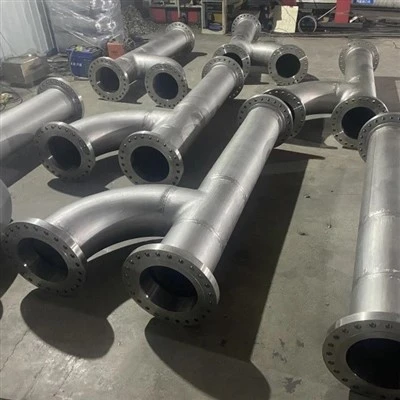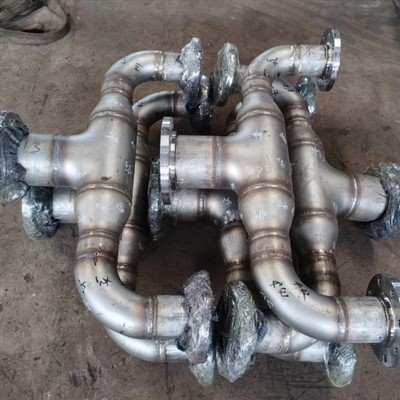
Inconel 625 pipe is not a single product. The same UNS N06625 chemistry is supplied under ASTM B444 in two heat-treatment conditions, Grade 1 and Grade 2, and the two differ in minimum strength, service-temperature ceiling, hydrostatic test basis and creep behaviour. A purchase order that says only "Inconel 625 pipe, ASTM B444" leaves the choice of condition to the mill.
This guide explains what each grade actually is, why the room-temperature strength of the two grades appears to run backwards, how the choice changes wall thickness and welding, and what wording on the purchase order prevents a substitution that passes every tensile test but fails in service.
Table 1. Key facts about Inconel 625 Grade 1 and Grade 2 pipe
|
Item |
What you should know |
|
Alloy |
UNS N06625 / W.Nr. 2.4856, a nickel-chromium-molybdenum alloy stabilised with niobium; Ni 58.0% min, Cr 20.0–23.0%, Mo 8.0–10.0% |
|
Product form |
Cold-worked seamless pipe and tube. Welded pipe is ASTM B705, not ASTM B444 |
|
Grade 1 |
Annealed at 871 °C (1,600 °F) min; normally used up to 593 °C (1,100 °F) |
|
Grade 2 |
Solution annealed at 1,093 °C (2,000 °F) min; for service above 593 °C where creep governs |
|
Room-temperature strength |
Grade 1: 827 MPa tensile and 414 MPa yield min. Grade 2: 690 and 276 MPa min. Both 30% elongation min |
|
Hydrostatic test basis |
Allowable fibre stress 207 MPa for Grade 1 against 172 MPa for Grade 2 |
|
Design consequence |
A lower allowable stress means a thicker wall at the same pressure, so weight and cost rise |
|
Sour service |
UNS N06625 is listed with a 35 HRC maximum hardness; condition and hardness must still be verified |
|
What the order must state |
Standard, UNS number, grade, heat-treatment temperature, test basis and certificate type |
|
Typical failure mode |
Accepting a certificate that says only "ASTM B444", then learning the condition after installation |
Source: ASTM B444, clause 1.1.1, Table 1 and clause 9.1; alloy composition from ASTM B444, Table 2.
What Do Grade 1 and Grade 2 Mean in ASTM B444?
Grade 1 and Grade 2 are two heat-treatment conditions of one alloy, not two different alloys and not two interchangeable strength levels. Both are UNS N06625 with the same chemistry; the difference is the final anneal and everything that follows from it.
ASTM B444 covers cold-worked seamless pipe and tube. Clause 1.1.1 states that UNS N06625 products are furnished in two grades of different heat-treated conditions. Grade 1 is annealed and is normally employed at service temperatures up to 1,100 °F (593 °C). Grade 2 is solution annealed and is normally employed above that temperature, where resistance to creep and rupture is required.
The standard then fixes the treatment behind each name. Grade 1 is annealed at a minimum of 1,600 °F (871 °C). Grade 2 is solution annealed at a minimum of 2,000 °F (1,093 °C), with or without a subsequent stabilisation anneal at a minimum of 1,800 °F (982 °C) to increase resistance to sensitisation. Same alloy, same chemistry table, two different thermal histories.
That is why the grade is a purchasing decision and not a detail. A mill that is not told which grade to make can supply either, and either will be correct to "ASTM B444". The grade word is the only part of the order that controls the furnace.
What Are the Mechanical Property Differences Between the Two Grades?
Grade 1 is the stronger grade at room temperature; Grade 2 is deliberately softer at room temperature so that it can be more stable at high temperature. Both grades must reach 30% elongation, so neither condition is brittle.
Table 2. Room-temperature requirements and hydrostatic test basis in ASTM B444
|
Condition |
Tensile strength, min |
Yield strength, min |
Elongation, min |
Hydrostatic fibre stress |
|
Grade 1 (annealed at 871 °C min) |
827 MPa (120 ksi) |
414 MPa (60 ksi) |
30% in 2 in. |
207 MPa (30 ksi) |
|
Grade 2 (solution annealed at 1,093 °C min) |
690 MPa (100 ksi) |
276 MPa (40 ksi) |
30% in 2 in. |
172 MPa (25 ksi) |
Source: ASTM B444, Table 1 (mechanical properties, yield strength at 0.2% offset) and clause 9.1 (allowable fibre stress for the hydrostatic test).
Read the table in the direction it is written, because it looks inverted at first glance: the grade with the higher strength is the grade for the lower temperature. At or below 593 °C, extra room-temperature strength is useful because it lets a designer use a thinner wall. Above that temperature the limiting failure mode changes from yielding to creep, and a different microstructure is worth more than a higher yield number.
The hydrostatic test figure is part of the grade, not a separate choice. Every length is tested, and the allowable fibre stress used to set the test pressure is 207 MPa for Grade 1 and 172 MPa for Grade 2, with the option of testing at 1.5 times these values where the purchaser and manufacturer agree.
Why Is Grade 2 Weaker at Room Temperature but Better in Creep?
Because the two treatments leave different amounts of strengthening precipitate in the metal and different grain sizes. The hotter treatment dissolves more of the niobium-rich particles that block deformation at room temperature and lets the grains grow; coarser grains deform more slowly at high temperature, which is exactly what creep resistance means.
In simple terms, Alloy 625 gets its strength from three mechanisms working together. Molybdenum, chromium and niobium dissolved in the nickel matrix make the lattice harder to deform. Fine niobium-rich carbides and carbonitrides act like grit that pins the crystal structure in place. Grain boundaries, the surfaces between individual crystals, are obstacles that dislocations must cross.
Annealing at 871 °C does not erase those particles, so the fine-grained Grade 1 keeps a high yield strength. Holding at 1,093 °C dissolves a large part of them back into solid solution and allows the grains to coarsen. The result is a cleaner, coarser structure with fewer internal barriers. That lowers the room-temperature yield number, but it also slows the diffusion and boundary sliding that cause creep once the metal is hot. In practical units, 593 °C is about half of the alloy's absolute melting temperature, and around that point creep rather than yield usually governs a wall thickness.
ASTM B444 adds a warning worth repeating: hot working or reannealing can change properties significantly, depending on working history and temperature. A pipe that is hot-formed or re-annealed after it leaves the mill is no longer described by its original certificate until it is re-tested.
Which Grade Should You Specify for Your Operating Temperature?
Specify Grade 1 below roughly 593 °C, and Grade 2 above it or whenever the design is limited by creep or stress rupture. Treat 593 °C as a boundary to check, not a rule to apply blindly.
Table 3. Grade selection by duty
|
Situation |
Specify |
Why |
|
Design metal temperature at or below 593 °C, pressure governs |
Grade 1 |
The higher allowable stress gives the thinnest compliant wall |
|
Above 593 °C, or long hold times and thermal cycling at high temperature |
Grade 2 |
The coarser, cleaner structure resists creep and rupture |
|
Wet H₂S service with a project sour-service specification |
Either, subject to a verified 35 HRC maximum |
The grade alone is not the acceptance criterion; hardness and environment are |
|
Pipe to be hot-formed or re-annealed after the mill |
Re-certify the condition |
Heat treatment rewrites the properties the grade describes |
Source: service-temperature basis from ASTM B444 clause 1.1.1; hardness limit from NACE MR0175 / ISO 15156-3.
Two situations deserve more thought than the table allows. The first is a system that spans the boundary, for example a reactor loop that runs at 560 °C on one leg and 640 °C on another. Standardising on Grade 2 throughout removes the risk of a wrong grade being installed in the hot leg, at the cost of thicker walls and heavier pipe everywhere. The second is cyclic service just below the boundary: if the metal is repeatedly heated and cooled, thermal fatigue and creep interact, and the supplier's elevated-temperature data should be checked before Grade 1 is accepted.
Where the design code or the client specification already names a grade, that instruction wins. This article explains the engineering behind the choice; it does not override a project standard.
Does the Grade Change Corrosion Resistance?
Chemically, no. Both grades are the same alloy with the same chromium, molybdenum and niobium content, so the passive film and the resistance to chlorides, reducing acids and oxidising acids are essentially the same. What changes is the microstructure around a weld and the hardness that sour-service standards limit.
The corrosion behaviour comes from the composition, and the composition is identical in both grades: chromium 20.0–23.0%, molybdenum 8.0–10.0%, niobium plus tantalum 3.15–4.15%, nickel 58.0% minimum, carbon 0.10% maximum. Chromium builds the thin oxide film that separates the metal from the fluid. Molybdenum improves resistance to chlorides and to localised attack such as pitting and crevice corrosion. Niobium and molybdenum together carry much of the resistance to reducing acids.
The grade does influence two secondary effects. First, sensitisation: when the alloy is held in a certain temperature band, chromium carbides can precipitate along grain boundaries and leave adjacent zones short of chromium. ASTM B444 allows the optional stabilisation anneal at 982 °C minimum specifically to raise resistance to sensitisation, which is worth writing into the order when the pipe will be welded and then exposed to an aggressive aqueous environment. Second, hardness: sour-service standards limit hardness because hard microstructures are more susceptible to sulfide stress cracking, and hardness is a property of the delivered condition, not of the alloy name.
How Does the Supplied Condition Affect Welding and Fabrication?
Both grades weld with the matching ERNiCrMo-3 filler and, in most services, need no post-weld heat treatment. The condition still matters because the mill's 1,093 °C treatment cannot be repeated on a field weld, so the weld and its heat-affected zone will not be Grade 2 metal even if the pipe was.
Filler metal selection is straightforward. ERNiCrMo-3, classified in AWS A5.14 and ASME SFA-5.14, matches the N06625 base metal and is the normal choice for both grades; the alloy is solid-solution strengthened rather than age hardened, so it keeps its strength and corrosion resistance in the as-welded condition. Post-weld heat treatment is generally unnecessary for corrosion service, and a full solution anneal at 1,093 °C followed by rapid cooling is impractical for a pipe spool: furnaces of that size are rare, and quenching a fabricated spool distorts it.
The consequence is that a Grade 2 pipe becomes a mixed structure once it is welded. The base metal keeps its coarse grain, the weld and heat-affected zone do not. If the design depends on Grade 2 creep strength, the weakest point in the joint deserves its own qualification: a procedure qualified at the service temperature, and in some cases elevated-temperature testing of the weld. Where creep is not the governing case, this point is informative rather than critical.
Forming follows the same logic. Grade 1, with its finer grain, is the more formable condition for cold bending and flaring. Grade 2 is softer in yield but coarser. Neither is fragile, because both conditions keep the 30% elongation minimum, but a bend that is made hot will change the microstructure locally and should be reviewed against the original grade rather than assumed to be unchanged.
What Does the Grade Change in Pressure Design and Hydrostatic Testing?
Both the allowable stress used to calculate wall thickness and the pressure used for the works test change with the grade. The grade printed on the certificate decides which line of the design code a designer is entitled to use.
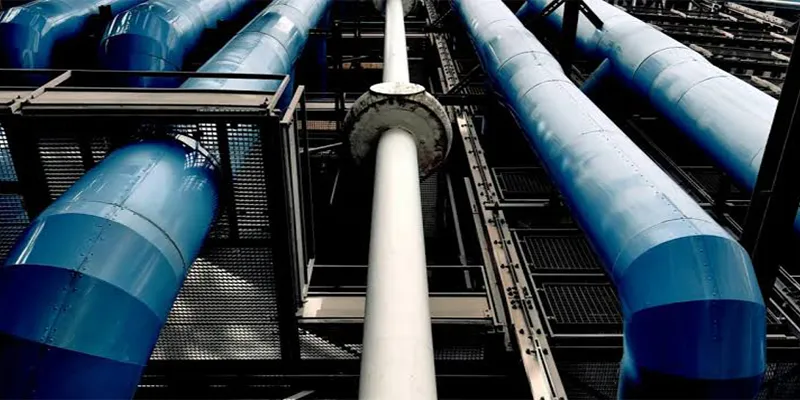
ASME BPVC Section II, Part D lists N06625 Grade 1 and N06625 Grade 2 as separate material lines, and ASME B31.3 Table A-1 points designers back to those lines for process piping. At ambient temperature the code rules take the lower of two-thirds of yield strength and one-third of tensile strength, which places Grade 1 near 276 MPa (about 40 ksi) and Grade 2 near 184 MPa (about 27 ksi) before any temperature-dependent reduction. The two grades therefore are not interchangeable in the wall-thickness formula: the same pressure, diameter and joint factor produce a wall about 1.5 times as thick in Grade 2, and about 50% more metal weight per metre.
That is the point most easily missed on a price comparison. Grade 2 metal is sometimes quoted lower per kilogram because it is the softer condition, but a Grade 2 line needs more kilograms. The honest comparison is installed cost per metre of pipe that satisfies the same design pressure, not cost per tonne of metal.
At temperature the gap widens, because the allowable stress falls with temperature and the two grades fall at different rates. A design that is comfortable in Grade 1 at 400 °C can be outside the creep-limited region at 650 °C, where Grade 1 has no business being specified at all. The hydrostatic test is the visible counterpart of the same logic: 207 MPa fibre stress for Grade 1, 172 MPa for Grade 2, unless the purchaser agrees to test at 1.5 times those values.
Is Either Grade Acceptable for Sour Service Under NACE MR0175 / ISO 15156?
UNS N06625 is a listed material for sour service, but the listing is tied to a maximum hardness of 35 HRC and to defined environmental limits. "Either grade" is therefore acceptable only if the delivered hardness and the actual environment both pass.
NACE MR0175 / ISO 15156-3 is the standard that oil and gas projects use to decide whether a material may be exposed to wet H₂S. For nickel-based corrosion-resistant alloys it works by listing qualified material groups together with limits such as maximum hardness, and by referring the user to environmental limits for temperature, partial pressure of H₂S, chloride content and pH. UNS N06625 appears with a 35 HRC maximum hardness, and annealed or solution-annealed product normally sits comfortably below that ceiling.
None of this makes the grade irrelevant. The hardness must be measured and reported, the heat-treatment condition must be stated, and the project's environmental limits must be checked against the actual temperature, H₂S partial pressure and chloride level. A certificate that proves the alloy but not the condition is an incomplete sour-service dossier.
Why Can a Grade 1 Pipe Pass a Grade 2 Order Without Being Grade 2?
Because Grade 1's minimum tensile and yield strengths are higher than Grade 2's, a Grade 1 pipe automatically satisfies a Grade 2 acceptance test. A tensile test therefore cannot prove which grade was supplied; only heat-treatment records and microstructural evidence can.
This is the single most important argument for specifying the condition. Compare the two rows of Table 2 again. Grade 1 must reach 827 MPa tensile and 414 MPa yield. Grade 2 must reach 690 MPa and 276 MPa. Every Grade 1 pipe clears the Grade 2 bar without effort. If the purchase order says "Grade 2" and the acceptance criterion is "meets the tensile requirements of ASTM B444 Grade 2", a Grade 1 pipe will be accepted, and the paperwork will look perfect.
The failure appears years later, and only in the right conditions: a line that runs above 593 °C, holds temperature for long periods, or sees thermal cycling. Creep damage is slow, dimensional and often invisible from the outside; the pipe swells and eventually ruptures, and the certificate in the file shows a compliant material that was never the right condition.
The reverse substitution is caught. A Grade 2 pipe cannot meet the Grade 1 tensile minimum, so a mill cannot quietly supply Grade 2 against a Grade 1 order. That asymmetry is why the mistake happens in one direction only, and why the paperwork, not the test, is the control point.
How Should the Purchase Order and MTR Be Written?
Name the standard, the UNS number, the grade, the heat-treatment temperature, the test basis and the certificate type, in that order. Anything less leaves the choice of condition to the supplier.
Table 4. Purchase order clauses that fix the supplied condition
|
Order item |
Wording to use |
Why it matters |
|
Standard and alloy |
ASTM B444 / ASME SB-444, UNS N06625, seamless, cold-worked |
Excludes welded B705 product offered as "B444" |
|
Grade |
"Grade 1" or "Grade 2", stated explicitly |
The only word that controls the heat treatment |
|
Heat treatment |
Grade 2: solution annealed at 1,093 °C minimum, rapid cool; stabilisation anneal at 982 °C minimum if required |
Makes the certificate auditable, not just plausible |
|
Test basis |
Hydrostatic test at 172 MPa (Grade 2) or 207 MPa (Grade 1) fibre stress; NDE alternative if agreed |
The works test pressure follows the grade |
|
Finish and dimensions |
Pickled or ground outside diameter; state inside-diameter condition; NPS and schedule per ASME B36.19M |
Surface state affects corrosion and inspection access |
|
Certification |
EN 10204 3.1 with heat number, heat-treatment record, hardness result and dimensional records |
Type 3.2 only where the project requires third-party validation |
|
Marking |
Grade and heat number marked on each length |
Prevents mixing of conditions in the store |
Source: requirements compiled from ASTM B444 clauses 1.1.1, 6, 8, 9.1 and Appendix X2; ASME B36.19M for pipe dimensions.
A workable order line reads: "Seamless pipe, ASTM B444 / ASME SB-444, UNS N06625, Grade 2, solution annealed at 1,093 °C minimum and rapid cooled, hydrostatically tested at 172 MPa fibre stress, pickled, EN 10204 3.1 certificate with heat-treatment record and hardness, grade and heat number marked on each length." Nothing in that sentence is optional, and nothing in it can be satisfied by a Grade 1 pipe.
The mill test report then has to echo the same words. Chemistry alone does not prove a grade; the report needs the grade designation, the heat-treatment temperature and cooling method, the mechanical results against that grade, and hardness. Where the duty is sensitive to creep, add elevated-temperature data or a grain-size check; where the duty is sour, add the hardness traverse. These are inexpensive to ask for at enquiry stage and impossible to obtain once the pipe is in the rack.
Which Grade Is Standard Supply, and What Does Availability Look Like?
Grade 1 is the volume product and the condition most mills hold in stock; Grade 2 is made to order, usually with a longer lead time and a price premium that grows with diameter and wall thickness.
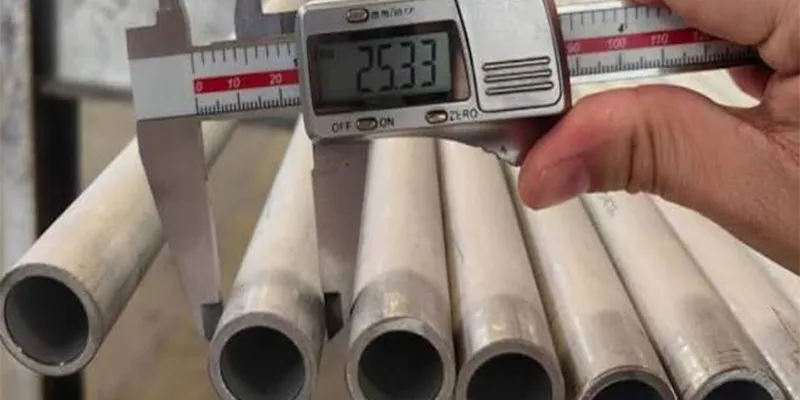
The reason is simply where the applications sit. Most chemical processing, marine and general oil and gas duties run below 593 °C, so Grade 1 covers them with the thinner wall. A distributor such as JN Alloy, which manufactures and supplies Inconel 625 seamless pipe to ASTM B444, lists a seamless range from about 4 mm to 219 mm outside diameter with 0.5 mm to 20 mm wall, in schedules from SCH5 and SCH10 through SCH40, STD, SCH80 and SCH160. That range covers the sizes most projects need, and the common schedules are the ones held or rolled to order.
Large-diameter, heavy-wall seamless pipe is the constrained part of the market, because cold pilgering nickel alloy at those sizes needs specialised tooling and tonnage, and only a limited number of mills can do it. Where the size or the schedule goes beyond the economic seamless range, projects usually move to ASTM B705 welded pipe and accept a weld seam, a weld procedure and additional testing as part of the design. That is a different product with different rules, and it should be a deliberate decision rather than a substitute offered on a quotation.
What Are the Most Common Specification Mistakes?
The recurring mistakes are buying "625 pipe" without a grade, comparing prices per kilogram instead of per installed metre, and accepting a tensile result as proof of heat treatment.
Table 5. Specification mistakes and their consequences
|
Mistake |
What actually happens |
Correct action |
|
Omitting the grade |
The mill ships its default, usually Grade 1, and the hot leg is built from the wrong condition |
State the grade on every line item |
|
Comparing price per kilogram |
The softer Grade 2 looks cheaper per tonne but needs a thicker wall |
Compare cost per metre at equal design pressure |
|
Accepting "meets Grade 2 tensile" |
A Grade 1 pipe passes and the substitution is invisible |
Require the heat-treatment record and hardness |
|
Treating B444 and B705 as interchangeable |
Welded pipe arrives against a seamless specification |
Name the product form and the standard together |
|
Re-annealing after hot forming |
The delivered properties no longer match the certificate |
Re-certify the condition after any thermal rework |
|
Quoting typical values as minimums |
930 MPa appears in the quotation, 690 MPa appears in the certificate |
Use the specification minimums for design |
|
Using Grade 1 above 593 °C |
The wall is designed on yield while the metal fails by creep |
Check the temperature-dependent allowable stress |
|
Accepting "625" for sour service |
No hardness evidence, no condition statement |
Add the 35 HRC check to the certificate pack |
Source: consequences derived from ASTM B444 Table 1 and clause 1.1.1, and from NACE MR0175 / ISO 15156-3 hardness limits.
Frequently Asked Questions
Q1. What is the difference between Inconel 625 Grade 1 and Grade 2 pipe?
Both are UNS N06625. Grade 1 is annealed at 871 °C minimum and has higher room-temperature strength; Grade 2 is solution annealed at 1,093 °C minimum and is intended for service above 593 °C where creep governs.
Q2. Which grade is stronger?
Grade 1, at room temperature: 827 MPa tensile and 414 MPa yield minimum, against 690 MPa and 276 MPa for Grade 2. At high temperature the comparison reverses, because creep strength is the controlling property.
Q3. Why does the stronger grade have the lower temperature limit?
Strength at room temperature comes partly from fine niobium-rich particles and fine grains. The 1,093 °C solution anneal dissolves many of those particles and coarsens the grain, which lowers the room-temperature yield but slows high-temperature creep.
Q4. At exactly 593 °C, which grade should I use?
The standard says Grade 1 is normally used up to 593 °C and Grade 2 above it. At the boundary, let the design code, the supplier's elevated-temperature data and the amount of thermal cycling decide.
Q5. Can Grade 2 pipe be welded without post-weld heat treatment?
Yes. Inconel 625 is solid-solution strengthened and keeps its properties in the as-welded condition, so post-weld heat treatment is generally unnecessary; use ERNiCrMo-3 filler to AWS A5.14.
Q6. Does Grade 2 resist corrosion better than Grade 1?
No. The chemistry is identical, so the corrosion resistance is essentially the same. The differences that matter are sensitisation behaviour after welding and the hardness relevant to sour service.
Q7. Can a supplier deliver Grade 1 pipe against a Grade 2 order?
In practice yes, because Grade 1 exceeds Grade 2's minimum tensile and yield values and passes the test. The control is documentary: the certificate must state the grade and the solution-annealing temperature.
Q8. Is Grade 2 required for sour gas service?
Not by grade name. What matters is that UNS N06625 is listed with a 35 HRC maximum hardness and that the environmental limits are met, so hardness evidence and the condition statement are what an auditor looks for.
Q9. Does the grade change the hydrostatic test pressure?
Yes. ASTM B444 sets the allowable fibre stress at 207 MPa for Grade 1 and 172 MPa for Grade 2, with an optional 1.5 times test by agreement.
Q10. Which grade is easier to bend and form?
Grade 1, because its finer grain is the more formable structure. Both conditions retain a 30% minimum elongation, so neither is brittle, but hot forming changes the local microstructure.
Q11. Is Grade 2 more expensive overall?
The metal is sometimes cheaper per kilogram, but the lower allowable stress requires a thicker wall, so the installed cost per metre is usually higher than Grade 1 below 593 °C.
Q12. What should the certificate include?
The standard and grade, heat number, heat-treatment temperature and cooling method, tensile and yield results against the specified grade, hardness, dimensions, and the hydrostatic or NDE result.