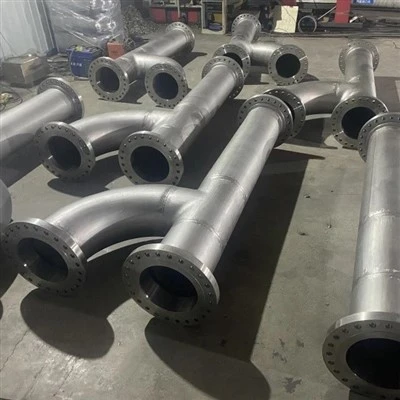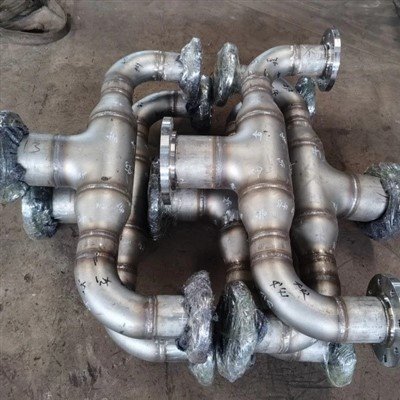
A furnace radiant tube is the metal pipe that carries combustion gas inside an industrial furnace. It does not touch the product being heated; instead it radiates heat through its wall into the furnace chamber while its outer surface is blasted by hot combustion products and its inner surface by flame gas. In a typical heat-treat or calciner furnace that wall runs at or near 1100°C, and the tube is switched on and off every cycle - so it heats, cools, heats again, thousands of times over its life.

Two alloys compete for this job: Inconel 601 (UNS N06601), a nickel-chromium-iron alloy with a deliberate aluminium addition, and 310S stainless steel (UNS S31008), a high-chromium, high-nickel austenitic stainless. They look similar on a composition table and both "resist oxidation," but at 1100°C under real furnace cycling they behave like different materials - because the oxide film each one grows decides whether the tube survives or spalls itself to failure.
The bottom line: at 1100°C in cycling furnace service, Inconel 601 outlasts 310S stainless by roughly 3 to 5 times. The reason is the oxide scale, not the base strength: 601 grows a duplex alumina + chromia film that clings through heat-up and cool-down, while 310S grows only a chromia film that becomes volatile above ~1000°C and flakes off each cycle, exposing fresh metal. For continuous, lightly loaded duty below about 1050°C, 310S is the economical choice; once you approach 1100°C, cycle the furnace, or load the tube, 601 is the rational specification.
What Makes the Two Alloys Different at 1100°C?
The single most important compositional difference is aluminium: Inconel 601 contains 1.0-1.7% Al, and 310S contains essentially none. That small aluminium addition is what lets 601 form an alumina (Al2O3) inner layer. Everything else - nickel level, chromium level, iron balance - shapes strength and cost, but aluminium is the variable that changes the oxidation mechanism. 310S instead relies on its 24-26% chromium to build a chromia (Cr2O3) scale and nothing more.
|
Element |
Inconel 601 (N06601) |
310S Stainless (S31008) |
Why It Matters at 1100°C |
|
Nickel (Ni) |
58-63% (base) |
19-22% |
Austenite stability, Cr2O3 adherence |
|
Chromium (Cr) |
21-25% |
24-26% |
Chromia scale former (both) |
|
Aluminium (Al) |
1.0-1.7% |
~0% |
Alumina inner layer - only in 601 |
|
Iron (Fe) |
Balance (~14%) |
Balance (~50%) |
Cost / matrix |
|
Carbon (C) |
≤ 0.10% |
≤ 0.08% |
Carbide control |
|
Silicon (Si) |
≤ 0.50% |
≤ 1.50% |
Minor oxidation aid |
|
Density |
8.11 g/cm³ |
7.90 g/cm³ |
601 slightly heavier |
[Source] ASTM B167/B168 (Inconel 601) and ASTM A213/A240 (310S); Special Metals / alloy supplier datasheets.
Why Chromium Alone Is Not Enough Above 1000°C
Chromia (Cr2O3) is an excellent protective scale up to about 1000-1050°C. Above that, chromia starts to volatilize as CrO3 gas in oxidizing combustion atmospheres, and the scale can no longer self-repair fast enough. On a furnace tube that cools and reheats, the chromia also contracts at a different rate than the steel beneath it, so it cracks and spalls off - a process called "breakaway" oxidation. 310S has no backup scale, so once chromia spalls, the tube oxidizes rapidly. 601 avoids this because its aluminium forms a second, tougher scale underneath.
Think of it like paint on a metal roof. 310S is a single coat of paint that blisters and peels every winter; 601 is a primer-plus-topcoat system where the primer (alumina) stays glued to the metal even after the topcoat cracks. The primer is what makes the difference over years of cycling.
Oxidation Resistance at 1100°C
Under cyclic oxidation testing at 1100°C (repeated 1-hour heat/cool cycles, the closest laboratory proxy for radiant-tube duty), Inconel 601 shows mass gain on the order of 1.5-3.0 mg/cm² after 1000 hours, while 310S shows a mass change roughly an order of magnitude higher and, critically, suffers measurable scale spalling. Expressed as service life, multiple vendor and industry sources report 601 lasting about 3-5 times longer than 310S at this temperature. The mass-gain number alone understates the gap because 310S loses scale (mass) by spalling while 601 retains it.
|
Metric (1100°C cyclic oxidation) |
Inconel 601 (N06601) |
310S Stainless (S31008) |
Interpretation |
|
Mass gain (1000 h, 1 h cycles) |
~1.5-3.0 mg/cm² |
~10-25 mg/cm² (range, spalling) |
601 ~ order of magnitude lower |
|
Scale spalling |
Negligible |
Significant |
601 scale rides the cycles |
|
Relative service life |
~3-5x of 310S |
Baseline |
Consistent vendor reports |
|
Continuous oxidation ceiling |
~1200°C |
~1035-1050°C |
601 rated ~150°C higher |
|
Cyclic oxidation ceiling |
~1150°C |
~1000°C (spalls) |
601 survives cycling |
[Source] Cyclic oxidation data compiled from alloy supplier technical literature (e.g., MWAlloys, Special Metals, Huaxiao, Hangbo); ranges reflect different test methods and should be confirmed against the specific grade and atmosphere.
The Mechanism in Plain Terms
At 1100°C, chromium in both alloys oxidizes first to form a chromia layer. In Inconel 601, aluminium (which bonds to oxygen even more strongly than chromium) then diffuses outward and forms a thin, dense alumina layer just under the chromia. Alumina grows orders of magnitude slower than chromia and matches the metal's expansion better, so when the tube cools the scale stays attached and self-heals on reheating. In 310S there is no aluminium reservoir, so once the chromia is damaged the tube is bare - and the next hot cycle oxidizes fresh metal. Repeat that 10,000 times and 310S has lost far more wall thickness.
The three failure steps that shorten 310S radiant-tube life at 1100°C:
- Chromia volatilizes as CrO3 above ~1000°C, thinning the protective layer.
- Tube cools → chromia and steel shrink differently → scale cracks and spalls.
- Fresh metal is exposed → next hot cycle oxidizes it → wall thins → tube fails or plugs.
- Inconel 601 interrupts this loop at step 2: the alumina primer holds, so spalling does not expose bare metal.
Strength and Creep - A Radiant Tube Must Also Carry Load
A radiant tube is not just exposed to heat - it hangs under its own weight and contains pressurized gas, so creep (slow, permanent sagging under load at temperature) decides its life too. At 1000°C, Inconel 601 retains a creep-rupture strength roughly an order of magnitude higher than 310S; 310S loses most of its load-bearing capability above 1000°C. This is why 601 tubes can be thinner-walled yet outlast thicker 310S tubes, and why 310S tubes in hot zones often sag, distort, or burst.
|
Property (annealed) |
Inconel 601 (N06601) |
310S Stainless (S31008) |
Note |
|
Tensile, room temp (min) |
550 MPa (80 ksi) |
515 MPa (75 ksi) |
Similar cold |
|
Yield 0.2%, room temp (min) |
205 MPa (30 ksi) |
205 MPa (30 ksi) |
Similar cold |
|
Tensile at 1000°C (typ) |
~120-160 MPa |
~80 MPa |
601 stronger hot |
|
Creep-rupture 1000°C / 1000 h |
~25 MPa |
~few MPa |
601 ~ order of magnitude higher |
|
Min creep 0.0001%/h @1093°C |
~3 MPa |
Very low |
601 holds load hot |
|
Max structural temp |
~1038°C (rated) |
~900-1000°C (practical) |
601 rated higher |
[Source] ASTM B167/B168 and A213/A240 minimums; high-temperature strength from alloy supplier datasheets (NeoNickel, Womic, Special Metals). Creep values are typical and application-specific.
The Sigma-Phase Trap in 310S
310S has a secondary weakness: prolonged exposure in the 650-900°C range can precipitate sigma phase, a brittle intermetallic that embrittles the steel and can trigger cracking. In radiant tubes the tube ends and supports often sit in exactly this temperature band, so 310S tubes can fail by embrittlement even where the hot zone looks intact. Inconel 601, being nickel-based, does not form sigma phase and keeps its ductility through long service.
Carburization, Nitriding, and Other Furnace Atmospheres

Real furnace atmospheres are rarely pure air. Heat-treat furnaces inject natural gas (carburizing), ammonia (nitriding), or combustion products with sulfur. Inconel 601 resists carburization and nitriding better than 310S because its high nickel content slows carbon diffusion and its aluminium/chromium scale blocks carbon entry; 310S carbide precipitation ("green rot" in alternating carburizing-oxidizing cycles) embrittles it. Both alloys have limited resistance to strongly sulfidizing (low-oxygen) gas - for that, a higher-chromium or Hastelloy grade is needed.
|
Atmosphere |
Inconel 601 |
310S Stainless |
Winner |
|
Air / combustion (oxidizing) |
Excellent to ~1200°C |
Good to ~1050°C |
601 |
|
Thermal cycling (air) |
Excellent, no spall |
Poor, spalls |
601 |
|
Carburizing (C-rich) |
Good (better than Fe-base) |
Moderate, embrittles |
601 |
|
Nitriding (<650°C) |
Good |
Limited |
601 |
|
Sulfidizing (low O2) |
Limited |
Limited |
Use C276/Alloy 600 |
|
Continuous, low-temp (<1000°C) |
Over-spec |
Economical |
310S |
[Source] Carburization penetration depth comparisons (e.g., MWAlloys): 601 ~0.1-0.3 mm vs 310S ~0.5-1.5 mm after 1000 h at 900-1050°C. Sulfidizing behavior per alloy supplier guidance.
Frequently Asked Questions
Q: Is Inconel 601 better than 310S for furnace radiant tubes at 1100°C?
A: Yes, for tubes that cycle thermally. Inconel 601 (UNS N06601) forms a duplex Al2O3/Cr2O3 scale that stays adherent through heating and cooling, while 310S (UNS S31008) forms only chromia, which spalls under cyclic conditions at 1100°C. The result is roughly 3-5x longer service life for 601 at this temperature, plus higher creep strength. 310S remains the economical choice for continuous, non-cycling duty below about 1050°C.
Q: What is the key difference in the oxide scale between Inconel 601 and 310S?
A: Inconel 601 contains 1.0-1.7% aluminium, which forms a dense, slow-growing inner alumina (Al2O3) layer beneath the outer chromia. Alumina has a far lower oxygen-diffusion rate than chromia and bonds more tenaciously to the metal, so the scale self-heals and resists spalling. 310S has no aluminium; it relies solely on chromia, which becomes volatile above ~1000°C and flakes off when the tube cools and reheats, exposing fresh metal to oxidation.
Q: At what temperature does 310S stainless start to fail by oxidation in furnace service?
A: 310S has a continuous oxidation-service ceiling of about 1035-1050°C. At 1100°C it is already at or beyond that limit: the chromia scale becomes unstable and spalls during thermal cycling, so wall thinning and tube failure accelerate. Inconel 601, by contrast, is rated for continuous oxidation service up to about 1200°C and survives cyclic duty to roughly 1150°C.
Q: Does Inconel 601 also have better creep strength than 310S at 1100°C?
A: Yes. Radiant tubes carry their own weight and internal gas pressure at temperature, so creep strength matters. At 1000°C, Inconel 601 offers a creep-rupture capability roughly an order of magnitude higher than 310S; 310S loses most of its load-bearing strength above 1000°C. This is why 601 tubes can be thinner-walled and still outlast 310S tubes.
Q: When is 310S stainless still the right choice for a radiant tube?
A: When the furnace runs continuously (minimal on/off cycling) at or below about 1050°C, the tube is lightly loaded, and first cost dominates the decision. In that regime 310S is the honest, economical recommendation. The step up to Inconel 601 is justified once temperature approaches 1100°C, cycling is severe, load is significant, or carburizing/nitriding atmospheres are present.
Q: What standards cover Inconel 601 and 310S tube and plate?
A: Inconel 601 is specified to ASTM B167 (seamless pipe/tube), B163 (seamless tube), B168 (plate/sheet/strip), B166 (bar/rod) and B564 (forgings); 310S stainless to ASTM A213 (seamless tube), A312 (pipe), A240 (plate/sheet/strip) and A276 (bar). Require the UNS designation (N06601 vs S31008) and an EN 10204 3.1 material test report with heat number and NDE records.
Conclusion
For furnace radiant tubes at 1100°C, the alloy choice is decided by the oxide film, not the sticker price. Inconel 601 wins because its aluminium-bearing duplex scale survives the thermal cycling that destroys 310S's chromia film - delivering roughly 3-5x longer life plus far higher creep strength in the hot zone. 310S is not a bad alloy; it is the right, economical choice for continuous duty below about 1050°C. Specify by duty: 601 where it is hot, cycling, and loaded; 310S where it is steady and cool. Match the alloy to the mechanism, and the tube - not the shutdown - sets the schedule.
Rule 1 Radiant tube at/above 1100°C and cycling → Inconel 601 (UNS N06601). Alumina scale rides the cycles.
Rule 2 Continuous duty at/below ~1050°C, light load → 310S (UNS S31008). Economical and adequate.
Rule 3 Significant load/pressure at temperature → 601; creep strength at 1000°C ~ order of magnitude higher.
Rule 4 Carburizing/nitriding or sigma-band (650-900°C) exposure → 601; 310S embrittles there.
Rule 5 Buy on lifecycle cost, not kg price: 601's longer life usually wins in hot cycling zones.
Rule 6 Specify UNS + EN 10204 3.1 MTC; confirm ASTM B167/B163 (601) vs A213/A312 (310S) and NDE records.
Rule 7 Mixed furnace? Run 310S in cool zones, 601 at the burners - capture reliability without over-spending.
Market@jnalloy.com | www.jnalloys.com | +86 19339900211
Jinie Technology (Jiangsu) Co., Ltd. | Wuxi, Jiangsu, China
ISO 9001 Certified | Stainless Steel & Nickel Alloy Manufacturer & Supplier