When a heat exchanger or condenser must survive sulfuric acid, seawater, or sour gas for decades, two decisions decide everything: the tube alloy, and the specification it is purchased against. For nickel-alloy duty, one combination has become an industry benchmark - Alloy 825 (UNS N08825, DIN 2.4858, Incoloy® 825) supplied as seamless tube to ASTM B163, the standard specification for seamless nickel and nickel alloy condenser and heat-exchanger tubes.
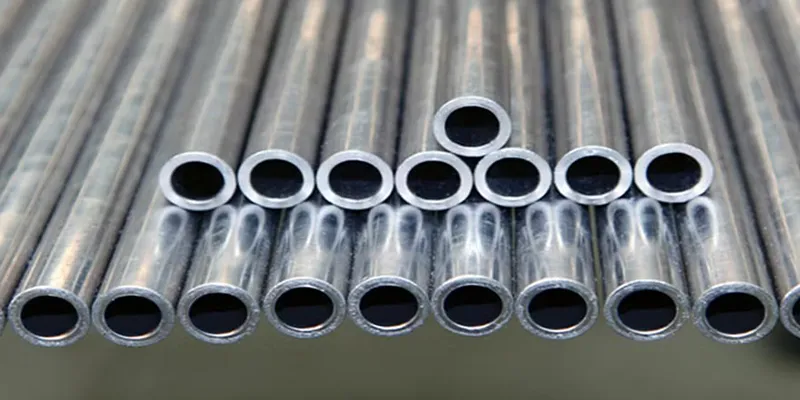
This article answers the questions engineers, buyers, and maintenance teams ask most: what the alloy is, what ASTM B163 actually requires, how the tubes are made and tested, how 825 compares with alternatives such as 316L and Alloy 625, and how to specify the tube correctly for your project. Every section begins with a direct conclusion, so the key facts can be extracted and cited quickly
What Is Incoloy 825 (Alloy 825, UNS N08825)?
Incoloy 825 - officially Alloy 825, UNS N08825, DIN 2.4858 - is a solid-solution-strengthened nickel-iron-chromium alloy with molybdenum, copper, and titanium, and it is one of the most widely specified nickel alloys for heat exchangers and condensers handling aggressive chemicals.
"Incoloy" is a registered trademark of Special Metals Corporation; the generic metallurgical designation is Alloy 825, or UNS N08825. The Incoloy family covers nickel-iron-chromium alloys, and 825 is its most popular member for aqueous corrosion service.
The nominal composition is roughly 40% nickel, 21% chromium, and 22% iron, plus about 2.8% molybdenum, 2.3% copper, and 1% titanium [3]. The high nickel content keeps the structure fully austenitic and gives outstanding resistance to chloride stress-corrosion cracking; the titanium addition stabilizes the alloy against sensitization and intergranular corrosion after welding.
In simple terms, Alloy 825 behaves like a "super stainless steel": far more corrosion-resistant than 316L in acids and chlorides, yet still ductile, weldable, and easy to fabricate - exactly the combination an exchanger tube needs.
What Is ASTM B163, and Why Does It Govern Alloy 825 Heat-Exchanger Tubes?
ASTM B163 (adopted as ASME SB-163) is the standard specification for seamless nickel and nickel alloy condenser and heat-exchanger tubes; it is the document that defines how Alloy 825 tube must be made, what properties it must prove, and how it must be tested for exchanger service.
Scope. B163 covers seamless tubes of nickel and nickel alloys for condenser and heat-exchanger service, supplied as outside-diameter-and-average-wall or outside-diameter-and-minimum-wall tube. The sizes covered are 3 in (76.2 mm) and under in outside diameter, with minimum wall thicknesses of 0.148 in (3.76 mm) and under, or average wall thicknesses of 0.165 in (4.19 mm) and under.
What the standard controls. B163 fixes the chemical composition limits for each permitted grade (including UNS N08825), the required mechanical properties, the heat-treatment condition, dimensional tolerances, workmanship and finish, and a defined set of tests - chemical analysis, tension, hardness, flattening, flaring, and pressure testing or equivalent nondestructive examination.
Why it matters commercially. Ordering "Incoloy 825 tube" without a standard leaves chemistry, mechanicals, and testing unenforceable. Specifying ASTM B163 / ASME SB-163 makes every one of those requirements verifiable and traceable, and it is the basis of the mill test certificate that buyers rely on [9]. B163 sits alongside companion specs such as B161 (nickel seamless pipe and tube), B165 (alloy 400), and B829 (general requirements); welded exchanger tubes are governed by B704/B676, not by B163.
What Chemical Composition Does ASTM B163 Require for Alloy 825 Seamless Tube?
ASTM B163 requires Alloy 825 tube to meet UNS N08825 composition limits: nickel 38.0–46.0%, chromium 19.5–23.5%, molybdenum 2.5–3.5%, copper 1.5–3.0%, titanium 0.6–1.2%, iron balance (minimum 22%), with carbon ≤ 0.05%, manganese ≤ 1.0%, silicon ≤ 0.5%, sulfur ≤ 0.03%, and aluminum ≤ 0.2%.
Table 1 - Chemical composition of Alloy 825 (UNS N08825), weight %
|
Element |
Min (%) |
Max (%) |
What it does in the alloy |
|
Nickel (Ni) |
38.0 |
46.0 |
Austenite stability; resistance to chloride stress-corrosion cracking |
|
Chromium (Cr) |
19.5 |
23.5 |
Resistance to oxidizing acids and general corrosion |
|
Iron (Fe) |
22.0 (min) |
Balance |
Structural base; cost control |
|
Molybdenum (Mo) |
2.5 |
3.5 |
Pitting and crevice resistance; resistance to reducing acids |
|
Copper (Cu) |
1.5 |
3.0 |
Passivation in sulfuric acid; seawater resistance |
|
Titanium (Ti) |
0.6 |
1.2 |
Stabilization against sensitization and intergranular attack |
|
Carbon (C) |
- |
0.05 |
Kept low for weldability |
|
Manganese (Mn) |
- |
1.0 |
Deoxidation |
|
Silicon (Si) |
- |
0.5 |
Deoxidation |
|
Sulfur (S) |
- |
0.03 |
Impurity control |
|
Aluminum (Al) |
- |
0.2 |
Deoxidation |
In plain language: nickel fights stress-corrosion cracking in chlorides; chromium fights oxidizing acids; molybdenum fights pitting and helps in reducing acids; copper helps the alloy passivate in sulfuric acid; and titanium "lock up" carbon so the tube does not become sensitized and corrode along grain boundaries after welding. This five-element balance is why 825 outperforms ordinary stainless steel in mixed acid-plus-chloride service.
What Mechanical Properties Does ASTM B163 Require for Alloy 825 Seamless Tube?

In the annealed condition in which B163 Alloy 825 exchanger tube is normally supplied, the required minimum properties are: tensile strength 85 ksi (586 MPa), 0.2% offset yield strength 35 ksi (241 MPa), and elongation 30% in 2 in (50 mm) or 4D, with hardness verified by Rockwell or an equivalent method.
Table 2 - ASTM B163 mechanical requirements for annealed Alloy 825 tube
|
Property |
Required minimum |
|
Tensile strength |
85 ksi (586 MPa) |
|
Yield strength (0.2% offset) |
35 ksi (241 MPa) |
|
Elongation (2 in / 50 mm or 4D) |
30% |
|
Hardness |
Verified (Rockwell or equivalent) |
B163 fixes the temper (condition) for each grade; Alloy 825 is furnished annealed, which optimizes corrosion resistance and fabricability, and the tube material must conform to these minimum values when tested per lot [1][2]. The 30% elongation requirement is not cosmetic: exchanger tubes are mechanically expanded into tube sheets and often flared, so ductility is a functional requirement, while the 85/35 ksi combination provides enough strength for thin-wall, high-pressure duties.
How Is Incoloy 825 Seamless Tube Manufactured to ASTM B163?
B163 Alloy 825 seamless tube starts from a solid billet, is hot worked by extrusion or rotary piercing, then cold worked by pilgering or drawing to final dimensions, solution annealed and water quenched, straightened, and finished - it has no longitudinal weld seam because none is made.
Seamless versus welded. Welded exchanger tube (B704/B676) is formed from strip and seam-welded; seamless tube is formed from a pierced or extruded hollow. Removing the weld seam removes the most common tube failure location in cyclic thermal service, gives a uniform wall, and preserves full pressure integrity.
Typical processing route: rotary piercing or extrusion of a forged billet → cold pilgering and drawing in multiple passes with intermediate anneals → final solution anneal (approximately 940–1010 °C / 1725–1850 °F for 825) followed by water quenching → straightening → internal and external surface cleaning and inspection [9]. The final anneal restores the stabilized, fully austenitic microstructure and optimum corrosion resistance.
For exchanger service, surface condition matters as much as chemistry: a clean internal bore (pickled or bright-finished) avoids contaminating process fluids and improves corrosion performance. This is standard mill practice for condenser-grade tube.
What Testing and Inspection Does ASTM B163 Require?
ASTM B163 mandates chemical analysis, tensile testing, hardness checks, flattening and flaring tests, and a pressure test (hydrostatic or air-under-water) or equivalent nondestructive examination; responsible manufacturers additionally perform positive material identification (PMI) and issue EN 10204 3.1/3.2 mill certificates.
Test by test, what each requirement catches:
- Chemical analysis - verifies the UNS N08825 composition limits on every heat (lot).
- Tension test - verifies tensile strength, yield strength, and elongation minimums per lot.
- Hardness - Rockwell or equivalent, confirming the annealed condition.
- Flattening test - proves the tube can be flattened without cracking; a workability check.
- Flaring test - where tubes will be flared or expanded, proves end ductility.
- Pressure test - hydrostatic (or air-under-water) on each tube, unless an NDE method is substituted; eddy-current or ultrasonic testing gives 100% volumetric coverage without water.
Supplier best practice for exchanger duty - 100% PMI on finished tube, dimensional and length verification, and an EN 10204 3.1 certificate (3.2 with third-party witness). Buyers should write these into the purchase order rather than assume them.
Why Choose Incoloy 825 over 316L, Alloy 20, or Alloy 625 for Heat Exchangers and Condensers?
Alloy 825 offers the best cost-performance balance for exchangers that must handle mixed acids, chlorides, seawater, or sour gas: 316L fails in these duties, Alloy 20 covers a narrower chemistry window, and Alloy 625 is stronger and costlier than exchanger service usually requires.

Table 3 - Alloy comparison for heat-exchanger and condenser service
|
Property / duty |
316L stainless |
Alloy 20 (N08020) |
Alloy 825 (N08825) |
Alloy 625 (N06625) |
|
Relative cost |
Lowest |
Moderate |
Moderate |
Highest |
|
Chloride stress-corrosion cracking |
Poor (fails in boiling MgCl₂ within hours) |
Fair |
Excellent |
Excellent |
|
Sulfuric acid resistance |
Poor to fair |
Good |
Excellent |
Very good |
|
Pitting / crevice resistance |
Low |
Moderate |
High |
Very high |
|
Seawater service |
Limited |
Moderate |
Good to excellent |
Excellent |
|
Weldability / fabricability |
Excellent |
Good |
Excellent |
Good |
|
Best fit for exchanger duty |
- |
Narrow acid range |
Broad acid + chloride + sour service |
Over-specified for most duties |
316L is inexpensive and fine in benign water, but it fails quickly under chloride stress-corrosion cracking and in sulfuric acid above moderate concentrations - the two most common exchanger failures. Alloy 20 was developed for sulfuric acid and performs well there, but its overall range is narrower than 825 and it is less established in seawater and sour service. Alloy 625 delivers outstanding performance but costs roughly twice as much as 825, and its higher strength is not needed for tube-sheet expansion.
Engineering rule of thumb: if the duty is "aggressive but not extreme," 825 is usually the technically sufficient and economically smart choice - and in many designs it is a direct drop-in upgrade from 316L.
Where Are Incoloy 825 Seamless Tubes Used in Heat-Exchanger and Condenser Service?
Alloy 825 seamless tubes are used wherever an exchanger or condenser must resist acids, chlorides, seawater, or sour process streams: sulfuric and phosphoric acid coolers, seawater-cooled exchangers, refinery and sour-gas intercoolers and condensers, flue-gas desulfurization, chemical processing, and nuclear fuel reprocessing equipment.
Chemical processing - sulfuric acid service (resisting up to roughly 60% acid at ambient temperature and wide ranges at elevated temperature), phosphoric acid, nitric acid, and organic acids: acid coolers, condensers, and evaporators.
Oil and gas - sour-gas and oil-well coolers and condensers, amine units, and produced-water heat exchangers; the nickel-molybdenum-copper balance resists H₂S/CO₂/chloride combinations.
Marine and offshore - seawater-cooled exchangers and desalination evaporators and condensers, where molybdenum plus copper give good seawater performance with stress-corrosion resistance.
Pollution control - flue-gas desulfurization scrubbers, flue-gas reheat exchangers, and quench systems.
Nuclear - dissolvers and process equipment in fuel reprocessing that handle sulfuric and nitric mixtures.
How Should You Specify and Qualify Incoloy 825 Seamless Tube for Your Project?
Specify "ASTM B163 (ASME SB-163), UNS N08825, annealed" with the outside diameter, wall thickness and wall basis (minimum or average), length, tolerances, and test requirements stated in writing, and require an EN 10204 3.1/3.2 mill certificate plus PMI at receipt.
- Standard and grade - write "ASTM B163 / ASME SB-163, UNS N08825, annealed"; never order "just Incoloy 825".
- Dimensions - exact outside diameter and wall, and state whether the wall is minimum-wall or average-wall basis; they carry different tolerances and mass.
- Length and end condition - specified length, square-cut ends, straightness and tolerance class.
- Testing - hydrostatic versus eddy-current/ultrasonic option, flattening and flaring, and 100% PMI.
- Documentation - EN 10204 3.1 certificate (3.2 with third-party witness) and full traceability to heat and lot numbers.
- Receiving inspection - match the certificate heat number to tube markings, run PMI on samples, verify dimensions and surface condition (no scratches, pits, or weld repair).
- Pitfalls to avoid - "equivalent" substitutions without approval, minimum-wall versus average-wall confusion, accepting tube without a traceable certificate, and non-annealed stock that fails flaring or flattening.