|
Duplex and super duplex stainless steels (UNS S32205, S32750, S32760) resist chloride pitting and stress corrosion cracking far better than austenitic grades, but they are susceptible to hydrogen-induced stress cracking (HISC) when subsea components are electrically bonded to a cathodic protection (CP) system. HISC is not prevented by grade selection alone. It is controlled by limiting sustained tensile stress below the thresholds set out in DNV-RP-F112, by specifying a fine, uniform ferrite-austenite microstructure (austenite spacing below roughly 30 micrometers), and by maintaining coating integrity so that CP current does not reach bare metal at design-governing stress locations. |

Hydrogen-Induced Cracking in Duplex Stainless Steel: Subsea Service Considerations
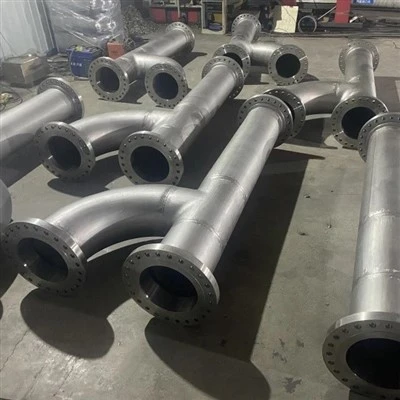
Duplex and super duplex stainless steels are the workhorse materials for subsea manifolds, tie-in spools, connectors, and pipe spools because they combine high strength with excellent resistance to chloride pitting and crevice corrosion. That same subsea environment, however, introduces a failure mode that does not affect ordinary austenitic grades in the same way: hydrogen-induced stress cracking, or HISC. This article explains why HISC occurs, which duplex grades and component geometries are most exposed, what design standards apply, and how procurement teams can specify material that resists it in service.
What Is Hydrogen-Induced Stress Cracking in Duplex Stainless Steel?
HISC is a delayed, brittle cracking mechanism in which atomic hydrogen generated by cathodic protection diffuses into the ferrite phase of duplex stainless steel, embrittling it under sustained tensile stress until a crack initiates and propagates without warning.
Duplex stainless steel has a two-phase, roughly 50/50 microstructure of body-centered cubic (BCC) ferrite and face-centered cubic (FCC) austenite. When a component is polarized to a cathodic potential, the hydrogen evolution reaction at the metal surface produces atomic hydrogen. Because BCC ferrite has much higher hydrogen diffusivity and lower hydrogen solubility than FCC austenite, hydrogen concentrates in the ferrite phase and reduces its ductility.
Once local stress at a notch, weld toe, or geometric discontinuity exceeds a critical threshold, a crack initiates in the embrittled ferrite and propagates rapidly, typically arresting where it meets an austenite grain boundary before jumping to the next ferrite path. The result is a brittle-looking fracture surface in a material that is normally ductile - a signature investigators use to distinguish HISC from fatigue or mechanical overload.
Why Are Duplex Grades Uniquely Vulnerable Compared to Austenitic Stainless Steel?
The same dual-phase microstructure that gives duplex stainless steel its strength and pitting resistance advantage over austenitic grades such as 316L is also the source of its HISC susceptibility.

Single-phase austenitic stainless steels like 316L have high hydrogen solubility and low hydrogen diffusivity, so hydrogen tends to stay dissolved and dispersed rather than concentrating at susceptible locations. Duplex grades were adopted subsea specifically because their higher yield strength allows thinner-walled, lighter components than austenitic alternatives, and because their higher chromium and molybdenum content, quantified by the
Pitting Resistance Equivalent Number (PREN), resists localized corrosion without requiring cathodic protection on its own. In practice, though, subsea duplex components are electrically bonded to carbon steel structures - manifolds, jumpers, and structural steel - that do require CP. That bonding polarizes the duplex component along with the carbon steel, introducing the hydrogen source that its ferrite phase is vulnerable to.
Does Cathodic Protection Cause HISC, and Can It Simply Be Removed?
Cathodic protection is the primary hydrogen source for subsea HISC, but removing it is not a workable fix because duplex components remain electrically bonded to CP-protected carbon steel and would otherwise corrode.
HISC can occur at any potential more negative than the reversible potential of the hydrogen evolution reaction, which is approximately -0.73 V versus a saturated calomel electrode (SCE) at seawater pH. Typical subsea CP systems for duplex stainless steel target protection potentials around -0.60 V (Ag/AgCl), but galvanic coupling to sacrificial anodes or impressed-current systems designed for carbon steel commonly drives the actual potential more negative, in some documented cases toward -1.0 V SCE or beyond.
The more negative the potential, the higher the hydrogen charging rate. Because duplex components cannot be electrically isolated from the CP-protected structures they connect to without introducing a different corrosion risk, HISC avoidance is treated as a design and material-selection problem, not a CP-system problem.
Standard Duplex vs. Super Duplex: Which Grade Offers Better HISC Resistance?
Higher alloy content does not automatically translate into higher HISC resistance. Super duplex grades carry a higher design stress by virtue of their higher yield strength, which can offset the metallurgical benefit of their microstructure and requires equally rigorous stress control.
The table below compares the two duplex families most commonly specified for subsea service. PREN values use the standard formula %Cr + 3.3 x %Mo + 16 x %N.
|
Grade |
UNS / EN |
Typical PREN |
Min. Yield Strength |
Typical Subsea Use |
HISC Design Consideration |
|
Standard Duplex 2205 |
S31803 / S32205 |
~35 |
≈450 MPa (65 ksi) |
Pipe, fittings, moderate-depth flowlines |
Lower design stress in absolute terms; still requires DNV-RP-F112 stress verification |
|
Super Duplex 2507 |
S32750 |
≥40 |
≈550 MPa (80 ksi) |
HTHP flowlines, manifolds, tie-in spools |
Higher yield strength raises the absolute allowable design stress; microstructure control is critical |
|
Super Duplex Zeron 100 / S32760 |
S32760 |
≥40 |
≈550 MPa (80 ksi) |
Subsea connectors, forgings, valve bodies |
Documented HISC failures in swaged and forged components; forging route and austenite spacing are decisive |
Table 1. Comparative HISC-relevant properties of standard duplex and super duplex stainless steel grades commonly supplied for subsea service.
Sources: ASTM A182/A240/A479 chemistry and mechanical property requirements; Alleima SAF 2507 technical data; NORSOK M-650 qualification literature.
What Design Standards Govern HISC Avoidance in Subsea Duplex Components?
DNV-RP-F112 is the internationally recognized design standard for HISC avoidance in subsea duplex stainless steel, and it is applied alongside NORSOK M-001, NORSOK M-650, and NACE MR0175/ISO 15156 depending on the operator and field.

|
Standard |
Scope |
|
DNV-RP-F112 |
Design of duplex stainless steel components against HISC under cathodic protection; defines stress and strain acceptance criteria, load categories, and testing methods |
|
NORSOK M-001 |
Material selection for the Norwegian continental shelf, including duplex stainless steel use limits and CP interface requirements |
|
NORSOK M-650 |
Qualification of manufacturers and manufacturing methods for special materials, including duplex and super duplex forgings and castings |
|
NACE MR0175 / ISO 15156 |
Material qualification for H2S-containing (sour) service; addresses hydrogen-related cracking mechanisms broadly, including HISC-adjacent sulfide stress cracking |
|
ASTM G48 |
Standard test methods for pitting and crevice corrosion resistance, used to verify PREN performance of duplex heats |
Table 2. Standards commonly invoked together for subsea duplex stainless steel HISC design and material qualification.
What Stress Thresholds Prevent HISC in Duplex Stainless Steel?
There is no single universal stress limit; DNV-RP-F112 sets allowable design stress as a function of component category, load type, and verified microstructure, and independent laboratory data shows the achievable margin depends heavily on how well the manufacturing route controls austenite spacing.
DNV-RP-F112 divides subsea duplex components into load categories and assigns stress and strain design criteria for each, rather than a single flat percentage of yield strength. As a general illustration of the sensitivity involved, published third-party testing has reported that cold-pilgered and solution-annealed duplex tube with a fine austenite spacing of 5 to 15 micrometers can tolerate sustained stress up to roughly 130 percent of yield strength without HISC in controlled test conditions, while coarser microstructures with wider austenite spacing show markedly lower thresholds.
Constant-load testing in boiling magnesium chloride per ASTM G36 has shown stress corrosion cracking thresholds around 50 percent of proof strength for both parent metal and welded joints of super duplex grade 2507. These figures illustrate why DNV-RP-F112 treats stress limits as design-basis calculations tied to verified material condition rather than a fixed industry number, and why component-specific engineering analysis, not a rule of thumb, is required for every subsea application.
How Does Microstructure Control HISC Resistance?
Fine, uniform austenite spacing and a balanced ferrite fraction, typically 35 to 55 percent ferrite, are the primary microstructural levers for HISC resistance, and both are controlled through forging or pipe-forming route, solution annealing, and cooling rate.

Because HISC cracks propagate through the ferrite phase and arrest at ferrite-austenite boundaries, a microstructure with closely and evenly spaced austenite islands limits how far a crack can travel before it is arrested, raising the effective threshold stress. DNV-RP-F112 recommends austenite spacing below approximately 30 micrometers. Coarse-grained forgings, especially thick-section components solidified or forged without adequate reduction, tend to produce wider austenite spacing and correspondingly lower HISC resistance.
This is why manufacturing route matters as much as chemistry: hot isostatic pressing (HIP) and advanced forging processes that promote fine, homogeneous grain structure have been shown to improve both low-temperature toughness and HISC resistance compared to conventional forging of the same nominal grade.
Does External Coating Eliminate HISC Risk?
No. Coating reduces the area exposed to CP current but does not eliminate HISC risk, because coating damage, holidays, and field joints are assumed to occur over the service life and design must account for eventual bare-metal exposure.
Fusion-bonded epoxy and other coating systems are standard practice on subsea duplex components, and they meaningfully reduce the hydrogen charging rate compared to bare metal exposed directly to CP. However, coating is treated as a mitigation, not a design substitute for stress control.
DNV-RP-F112 and NORSOK guidance both assume that coating integrity will degrade at some locations over field life - through installation damage, abrasion, or disbondment - and require that the underlying stress and material qualification still satisfy HISC acceptance criteria as if CP exposure were direct. Relying on coating alone, without verifying stress and microstructure, has been identified as a contributing factor in several documented subsea failures.
When Should Nickel Alloys Replace Duplex Stainless Steel for HISC-Critical Subsea Service?
Single-phase austenitic nickel alloys such as Inconel 625 (UNS N06625) are largely immune to CP-driven HISC because they lack the ferrite phase that makes duplex steel susceptible, making them the preferred upgrade for the highest-consequence connectors, sour-service components, and locations where stress cannot be reliably kept below duplex HISC thresholds.
|
Consideration |
Duplex / Super Duplex Stainless Steel |
Nickel Alloy 625 (N06625) |
|
Microstructure |
Two-phase ferrite-austenite; ferrite phase is hydrogen-susceptible |
Single-phase austenitic (FCC); high hydrogen solubility, low diffusivity |
|
HISC susceptibility under CP |
Documented failure mechanism; requires stress and microstructure control per DNV-RP-F112 |
Not susceptible to CP-driven HISC in the same mode |
|
Relative cost |
Lower material cost per unit strength |
Significantly higher material cost |
|
Typical subsea role |
Pipe, spools, manifolds, general structural and pressure components |
High-consequence connectors, sour service, extreme HISC or corrosion risk locations |
Table 3. Selection considerations for duplex stainless steel versus nickel alloy 625 in HISC-critical subsea applications.
For a full property comparison, see EETA's Inconel 625 material guide, which covers chemical composition, corrosion resistance, and offshore application data for this grade in more depth.
What Do Documented Subsea HISC Failures Teach Us?
Every well-documented subsea HISC failure traces back to the same three conditions occurring together: a susceptible microstructure, hydrogen charging from cathodic protection, and applied or residual stress at or above the material's threshold - which is why design standards now address all three factors jointly rather than any one in isolation.

The first widely reported HISC failure was the Foinaven subsea hub connector in the North Sea in 1996, followed by tie-in spool fractures on the Scott and Britannia fields. These incidents, occurring on assets polarized to potentials around -1.0 V SCE, prompted the joint industry projects between TWI, DNV, and Sintef that produced the technical basis for DNV-RP-F112. More recent root-cause investigations of failed super duplex (UNS S32760) swaged subsea connectors have continued to point to the same combination: brittle fracture surfaces, calcareous deposits consistent with CP exposure, and stress concentration at a swaged, thicker-to-thinner section transition. NORSOK's own failure history has recorded roughly eight documented duplex structure failures attributed to HISC, most involving tie-in components and spools where high ferrite content, coating damage, or localized stress concentration were present.
How Should Procurement Teams Mitigate HISC Risk When Sourcing Duplex Components?
HISC risk is best controlled at the sourcing stage by specifying microstructure and manufacturing route requirements in the purchase specification, not just chemistry and mechanical properties, and by requiring documented compliance with DNV-RP-F112 and NORSOK M-650.
Practical specification points for subsea duplex procurement include:
Reference DNV-RP-F112 explicitly in the purchase order and require the supplier's stress and strain design basis documentation for the component category.
Specify a maximum austenite spacing (commonly 30 micrometers or tighter) and a ferrite content range, and require metallographic evidence in the material test report.
Require NORSOK M-650 manufacturer and manufacturing-method qualification for forged or cast duplex components destined for subsea service.
Confirm the forging or pipe-forming route (for example, hot isostatic pressing or an advanced forging process) where low-temperature toughness and fine grain structure are both required.
Verify coating specification and inspection requirements, while confirming the underlying material still meets HISC stress criteria on a bare-metal basis.
Request positive material identification (PMI) and full EN 10204 3.1 or 3.2 documentation traceable to heat and forging lot.
Frequently Asked Questions
Q: Is duplex stainless steel unsuitable for subsea use because of HISC risk?
A: No. Duplex and super duplex stainless steels remain widely and successfully used subsea; hundreds of thousands of kilometers of duplex pipe have been installed with cathodic protection since the 1970s. HISC is a manageable design constraint, not a reason to avoid the material family.
Q: Does welding increase HISC susceptibility?
A: Yes, welds and their heat-affected zones are common HISC initiation sites because welding can locally coarsen the microstructure, introduce residual stress, and create geometric stress concentrations at the weld toe. Welded joints are evaluated separately from parent metal in HISC design assessments.
Q: Can HISC be detected before a component fails in service?
A: HISC is a delayed, often rapid brittle failure with limited visible warning, which is why the industry approach emphasizes preventing the conditions for cracking through design and material control rather than relying on in-service inspection to catch it early.
Q: Is HISC the same phenomenon as hydrogen embrittlement in carbon or low-alloy steel?
A: They share the same root cause, atomic hydrogen embrittling a susceptible microstructure, but HISC in duplex stainless steel specifically concerns hydrogen partitioning into the ferrite phase of a two-phase microstructure under cathodic protection, whereas carbon and low-alloy steel hydrogen embrittlement involves a single-phase matrix and different threshold mechanics.