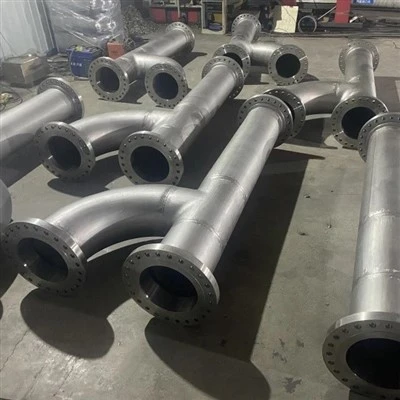
What is F51 Duplex Stainless Steel?
F51, most commonly known as UNS S31803 or 2205, is a duplex stainless steel. As a "duplex" alloy, its microstructure consists of a balanced, roughly 50/50 mix of ferrite and austenite phases.

Initially standardized as UNS S31803, the alloy has evolved. Manufacturers often produce it at the upper end of the elemental ranges for enhanced performance, leading to the introduction of a tighter specification known as UNS S32205 (F60 in forging standards). S32205 is the modern, preferred specification for guaranteed high corrosion resistance.
F51 Material Equivalent
F51/2205 is recognized under numerous standard systems worldwide. The table below outlines its key equivalent grades.
|
Standard System |
Equivalent Designation(s) |
|
UNS (Unified Numbering System) |
S31803, S32205 |
|
EN (European Standard) |
1.4462 |
|
EN Chemical Name |
X2CrNiMoN22-5-3 |
|
Common/Trade Names |
2205, SAF 2205 |
|
Chinese Standard |
00Cr22Ni5Mo3N |
|
Forged Product Standard (ASTM A182) |
F51, F60 |
ASTM A240 / A276 F51 Chemical Composition
|
Element |
Weight % (S31803) |
|
Carbon (C) |
0.030 max |
|
Chromium (Cr) |
21.0 – 23.0 |
|
Nickel (Ni) |
4.5 – 6.5 |
|
Molybdenum (Mo) |
2.5 – 3.5 |
|
Nitrogen (N) |
0.08 – 0.20 |
|
Manganese (Mn) |
2.00 max |
|
Silicon (Si) |
1.00 max |
|
Phosphorus (P) |
0.030 max |
|
Sulfur (S) |
0.020 max |
|
Iron (Fe) |
Balance |
Minimum Mechanical Properties
|
Property |
Value (S31803 / S32205) |
|
Tensile Strength |
≥ 620 MPa (90 ksi) |
|
Yield Strength (0.2%) |
≥ 450 MPa (65 ksi) |
|
Elongation in 50 mm |
≥ 25 % |
|
Hardness (Brinell) |
≤ 290 HBW (typically 230–260) |
|
Impact Toughness (Charpy V, -46 °C) |
≥ 100 J average (common requirement) |
F51 Material Advantages

Excellent Corrosion Resistance
Twice the pitting and crevice corrosion resistance of 316L in chloride environments.
Outstanding resistance to stress corrosion cracking (SCC) in sour (H₂S) and chloride-bearing media.
High Mechanical Strength
Approximately double the proof strength of austenitic grades → allows significant wall-thickness reduction and weight savings.
Cost Effectiveness
Lower nickel and molybdenum content than super duplex S32750/S32760 and 6Mo austenitics, yet delivers superior performance in most seawater and process applications.
Good Weldability and Fabricability
Can be welded with matching 2209 filler (ER2209 / E2209-17) or over-alloyed 2594 filler for optimum properties.
Solution annealing at 1020–1100°C followed by rapid water quenching restores phase balance.
Wide Temperature Range
Suitable from -50°C up to approximately 280°C without risk of 475°C embrittlement or sigma-phase formation in properly heat-treated material.
Available F51 Product Forms from Stock

We maintain extensive inventory of F51/S32205 seamless and welded butt-weld fittings to ASME B16.9, MSS SP-43, and EN 10253:
Long & Short Pattern Stub Ends (Type A/B)
Elbows 45°/90°/180° LR & SR
Equal & Reducing Tees
Concentric / Eccentric Reducers
Caps and Crosses
Sizes: ½″ – 48″ (Sch 10S, 40S, 80S, 160, XXS)
All items are supplied with EN 10204 3.1 or 3.2 certificates, positive material identification (PMI), and full traceability.
Conclusion
F51 (UNS S31803/S32205, 1.4462, 2205) remains the workhorse duplex grade for corrosive environments where 316L is insufficient and super duplex is over-specified.
For technical datasheets, welding guidelines, or immediate quotations on F51 duplex butt-weld fittings and flanges, please contact our sales team.