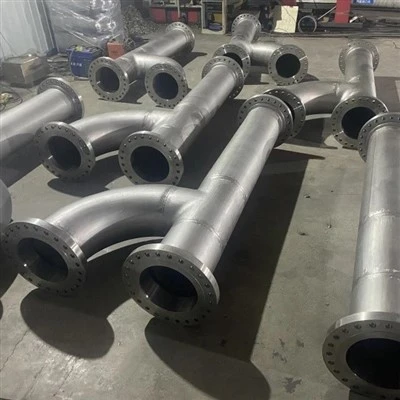
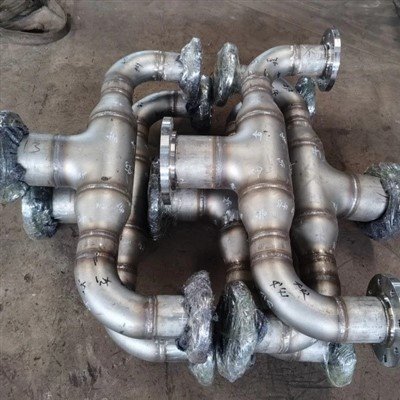
ASTM B366 is the standard for wrought nickel and nickel-alloy butt-welding fittings, including the highly corrosion-resistant Alloy 20 (UNS N08020).
These BW fittings serve as critical connectors in piping systems requiring exceptional resistance to aggressive media, such as sulfuric acid, chlorides, and phosphoric acid.

Alloy 20, also known as "Carpenter 20," is a nickel alloy originally developed for sulfuric acid environments in pulp and paper mills. Alloy 20 BW fittings under ASTM B366 include elbows, tees, reducers, caps, and crosses, designed to form permanent, leak-free connections in high-pressure and corrosive service conditions.
ASTM B366 Standard Specification
ASTM B366 Scope and Purpose
ASTM B366, titled "Standard Specification for Factory-Made Wrought Nickel and Nickel Alloy Fittings," establishes the requirements for wrought welding fittings used in pressure piping systems. The standard covers fittings factory-made from nickel and nickel alloys, including both butt-welding and socket-welding types.
The scope specifically includes common fitting types such as 45° and 90° elbows, 180° bends, caps, tees, reducers, lap-joint stub ends, and other types as covered by ASME B16.9, ASME B16.11, MSS SP-43, MSS SP-95, and MSS SP-97. It's important to note that the standard does not apply to cast welding fittings, which are covered under different specifications.

The purpose of this standard is to ensure that fittings manufactured under its provisions consistently meet minimum requirements for material quality, dimensional accuracy, pressure ratings, and examination standards.
Classification and Material Grades
Within the ASTM B366 specification, materials are designated with a prefix based on the applicable dimensional and rating standards. For nickel alloys, including Alloy 20, the primary designations are:
WP (Wrought Product) Grades: These fittings are manufactured to the requirements of ASME B16.9 and B16.11. For Alloy 20, the specific grade designation is WP20CB for pressure applications.
CR (Corrosion Resistant) Grades: These include the designation CR20CB for corrosion-resistant applications.
For WP grades, the standard further classifies fittings based on their method of manufacture and level of nondestructive examination:
Class S: Seamless construction.
Class W: Welded construction.
Class WU: Welded construction with additional ultrasonic examination requirements.
Alloy 20 Properties and Advantages
Alloy 20 combines the benefits of austenitic stainless steels with enhanced corrosion resistance:

Corrosion Resistance: The alloy resists pitting, crevice corrosion, and stress corrosion cracking in chloride-rich environments. Its copper content provides superior resistance to sulfuric acid, while molybdenum and chromium defend against oxidizing and reducing agents.
Mechanical Strength: Typical mechanical properties include a tensile strength of ≥551 MPa, yield strength of ≥241 MPa, and elongation of ≥30%. These properties allow Alloy 20 fittings to withstand high pressures and temperatures up to 400°C.
Stabilization with Niobium: The addition of niobium minimizes carbide precipitation during welding, ensuring resistance to intergranular corrosion in the as-welded condition. This eliminates the need for post-weld heat treatment in many applications.
The alloy's PRE exceeding 40 positions it between standard stainless steels and higher-cost nickel alloys like Hastelloy, offering a solution to highly corrosive environments.
Alloy 20 BW Fittings Types
Under ASTM B366, manufacturers produce a comprehensive range of Alloy 20 butt-welded fittings to accommodate various piping system layouts and requirements. The most common types include:
Elbows: Used for changing flow direction; available in 45°, 90°, and 180° angles with both long radius (LR) and short radius (SR) configurations.
Tees: For branching purposes; available as equal tees and reducing tees.
Reducers: For connecting pipes of different diameters; available as concentric reducers and eccentric reducers.
Caps: Used to terminate pipe ends.
Stub Ends: Used with lap joint flanges for systems requiring frequent disassembly; available in long and short patterns.
Crosses: For four-way branch connections.
These fittings are manufactured in size ranges from ½" NB (Nominal Bore) to 48" NB, with various wall thickness schedules including SCH 10S, 40S, 80S, 160S, and XXS.
BW Fittings Manufacturing Processes

The manufacturing of ASTM B366 Alloy 20 fittings involves several processes:
Material Selection: Raw materials must conform to relevant ASTM standards such as ASTM B464/B468 for pipe, ASTM B463 for plate/sheet, and ASTM B472/B473 for bar/forgings.
Forming Operations: Fittings may be manufactured using seamless or welded construction methods. Forming operations can include hot or cold pressing, bending, forging, or a combination of these methods.
Heat Treatment: All fittings must undergo solution annealing at 1700-1850°F (927-1010°C) followed by rapid cooling to optimize the corrosion resistance and mechanical properties.
Testing and Examination: The standard requires various tests including hydrostatic testing, chemical analysis, and mechanical property testing. Optional supplementary requirements may include additional nondestructive examination methods such as radiography or ultrasonic testing.
Surface Condition: Final surface finishes may include pickled, polished, or sand-blasted conditions, depending on application requirements.
ASTM B366 Alloy 20 BW Fittings: Types and Applications
ASTM B366 covers a wide range of fitting types required for welded pipe systems to meet various flow direction changes, branching, diameter reduction, and sealing needs. The main fitting types are as follows:

Elbows: Used to change the direction of pipes; common types include 45-degree, 90-degree, and 180-degree elbows, available in long and short radius series.
Tees: Used to branch fluids; available in equal-diameter and reducing tees.
Reducers: Used to connect pipes of different diameters; available in concentric and eccentric reducers.
Pipe Caps: Used to seal the ends of pipes.
Other Fittings: Such as flanged short sections, often used in conjunction with slip-on flanges.
These Alloy 20 welded pipe fittings are widely used in several critical industries due to their excellent corrosion resistance.
In the chemical processing industry, it is used in reactors, acid storage tanks, and piping systems for transporting corrosive media;
In the petrochemical and offshore platforms, it is used to handle media containing hydrogen sulfide and chlorides;
In the pharmaceutical and food industries, it is used for process piping.
FAQs
Q1: How does Alloy 20 compare to 316L in chloride environments?
Alloy 20 significantly outperforms 316L due to its higher Mo, Cu, and Ni content, providing superior resistance to pitting and SCC. While 316L is suitable for mild environments, Alloy 20 is preferred for concentrated acids and chlorides.
Q2: What are the welding considerations for ASTM B366 Alloy 20 fittings?
Welding should use matching filler metals (e.g., ER320LR) and low heat input to avoid hot cracking. Niobium stabilization allows welding without post-weld annealing, but stress-relieving may be needed for thick sections.
Q3: How to avoid counterfeit or non-compliant fittings?
Always request mill test certificates validating chemical composition and mechanical properties. Third-party inspection adds assurance.
Q4: What are the limitations of Alloy 20?
Alloy 20 is not recommended for hydrochloric acid or oxidizing chlorides. In temperatures above 400°C, prolonged exposure may cause embrittlement.